Connect with us

astronomy

Habitable Zone Planets: How Scientists Search for Liquid Water Beyond Earth

Habitable zone planets: Scientists use the habitable zone to find planets that could host liquid water and life. Learn how planetary atmospheres and geology determine true habitability beyond Earth.

Published

on

 Habitable Zone Planets: How Scientists Search for Liquid Water Beyond Earth
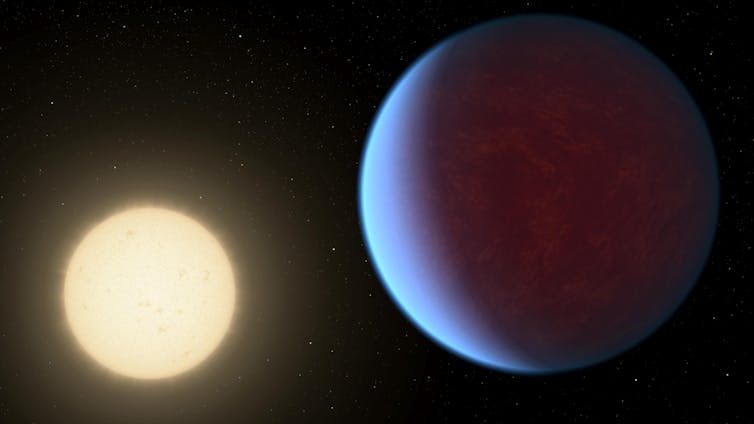
Some exoplanets, like the one shown in this illustration, may have atmospheres that could make them potentially suitable for life.
NASA/JPL-Caltech via AP

Habitable Zone Planets: How Scientists Search for Liquid Water Beyond Earth

Morgan Underwood, Rice University

When astronomers search for planets that could host liquid water on their surface, they start by looking at a star’s habitable zone. Water is a key ingredient for life, and on a planet too close to its star, water on its surface may “boil”; too far, and it could freeze. This zone marks the region in between.

But being in this sweet spot doesn’t automatically mean a planet is hospitable to life. Other factors, like whether a planet is geologically active or has processes that regulate gases in its atmosphere, play a role.

The habitable zone provides a useful guide to search for signs of life on exoplanets – planets outside our solar system orbiting other stars. But what’s in these planets’ atmospheres holds the next clue about whether liquid water — and possibly life — exists beyond Earth.

On Earth, the greenhouse effect, caused by gases like carbon dioxide and water vapor, keeps the planet warm enough for liquid water and life as we know it. Without an atmosphere, Earth’s surface temperature would average around zero degrees Fahrenheit (minus 18 degrees Celsius), far below the freezing point of water.

The boundaries of the habitable zone are defined by how much of a “greenhouse effect” is necessary to maintain the surface temperatures that allow for liquid water to persist. It’s a balance between sunlight and atmospheric warming.

Many planetary scientists, including me, are seeking to understand if the processes responsible for regulating Earth’s climate are operating on other habitable zone worlds. We use what we know about Earth’s geology and climate to predict how these processes might appear elsewhere, which is where my geoscience expertise comes in.
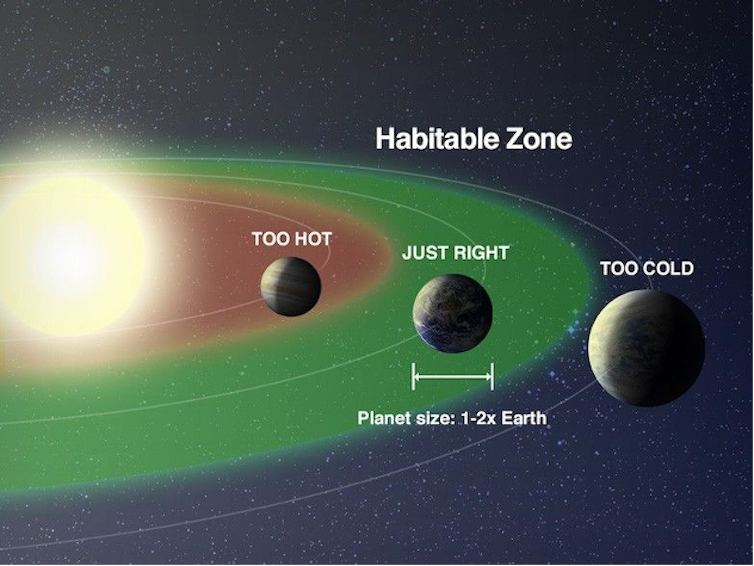
A diagram showing three planets orbiting a star: The one closes to the star is labeled 'too hot,' the next is labeled 'just right,' and the farthest is labeled 'too cold.'
Picturing the habitable zone of a solar system analog, with Venus- and Mars-like planets outside of the ‘just right’ temperature zone.
NASA

Why the habitable zone?

The habitable zone is a simple and powerful idea, and for good reason. It provides a starting point, directing astronomers to where they might expect to find planets with liquid water, without needing to know every detail about the planet’s atmosphere or history.

Its definition is partially informed by what scientists know about Earth’s rocky neighbors. Mars, which lies just outside the outer edge of the habitable zone, shows clear evidence of ancient rivers and lakes where liquid water once flowed.

Similarly, Venus is currently too close to the Sun to be within the habitable zone. Yet, some geochemical evidence and modeling studies suggest Venus may have had water in its past, though how much and for how long remains uncertain.

These examples show that while the habitable zone is not a perfect predictor of habitability, it provides a useful starting point.

Planetary processes can inform habitability

What the habitable zone doesn’t do is determine whether a planet can sustain habitable conditions over long periods of time. On Earth, a stable climate allowed life to emerge and persist. Liquid water could remain on the surface, giving slow chemical reactions enough time to build the molecules of life and let early ecosystems develop resilience to change, which reinforced habitability.

Advertisement
Get More From A Face Cleanser And Spa-like Massage

Life emerged on Earth, but continued to reshape the environments it evolved in, making them more conducive to life.

This stability likely unfolded over hundreds of millions of years, as the planet’s surface, oceans and atmosphere worked together as part of a slow but powerful system to regulate Earth’s temperature.

A key part of this system is how Earth recycles inorganic carbon between the atmosphere, surface and oceans over the course of millions of years. Inorganic carbon refers to carbon bound in atmospheric gases, dissolved in seawater or locked in minerals, rather than biological material. This part of the carbon cycle acts like a natural thermostat. When volcanoes release carbon dioxide into the atmosphere, the carbon dioxide molecules trap heat and warm the planet. As temperatures rise, rain and weathering draw carbon out of the air and store it in rocks and oceans.

If the planet cools, this process slows down, allowing carbon dioxide, a warming greenhouse gas, to build up in the atmosphere again. This part of the carbon cycle has helped Earth recover from past ice ages and avoid runaway warming.

Even as the Sun has gradually brightened, this cycle has contributed to keeping temperatures on Earth within a range where liquid water and life can persist for long spans of time.

Now, scientists are asking whether similar geological processes might operate on other planets, and if so, how they might detect them. For example, if researchers could observe enough rocky planets in their stars’ habitable zones, they could look for a pattern connecting the amount of sunlight a planet receives and how much carbon dioxide is in its atmosphere. Finding such a pattern may hint that the same kind of carbon-cycling process could be operating elsewhere.

The mix of gases in a planet’s atmosphere is shaped by what’s happening on or below its surface. One study shows that measuring atmospheric carbon dioxide in a number of rocky planets could reveal whether their surfaces are broken into a number of moving plates, like Earth’s, or if their crusts are more rigid. On Earth, these shifting plates drive volcanism and rock weathering, which are key to carbon cycling.
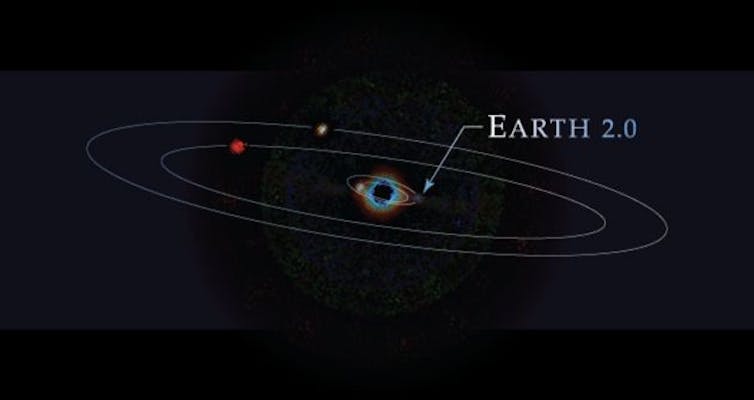
A diagram showing a few small planets orbiting a star.
Simulation of what space telescopes, like the Habitable Worlds Observatory, will capture when looking at distant solar systems.
STScI, NASA GSFC

Keeping an eye on distant atmospheres

The next step will be toward gaining a population-level perspective of planets in their stars’ habitable zones. By analyzing atmospheric data from many rocky planets, researchers can look for trends that reveal the influence of underlying planetary processes, such as the carbon cycle.

Scientists could then compare these patterns with a planet’s position in the habitable zone. Doing so would allow them to test whether the zone accurately predicts where habitable conditions are possible, or whether some planets maintain conditions suitable for liquid water beyond the zone’s edges.

This kind of approach is especially important given the diversity of exoplanets. Many exoplanets fall into categories that don’t exist in our solar system — such as super Earths and mini Neptunes. Others orbit stars smaller and cooler than the Sun.

The datasets needed to explore and understand this diversity are just on the horizon. NASA’s upcoming Habitable Worlds Observatory will be the first space telescope designed specifically to search for signs of habitability and life on planets orbiting other stars. It will directly image Earth-sized planets around Sun-like stars to study their atmospheres in detail.

Advertisement
Get More From A Face Cleanser And Spa-like Massage
NASA’s planned Habitable Worlds Observatory will look for exoplanets that could potentially host life.

Instruments on the observatory will analyze starlight passing through these atmospheres to detect gases like carbon dioxide, methane, water vapor and oxygen. As starlight filters through a planet’s atmosphere, different molecules absorb specific wavelengths of light, leaving behind a chemical fingerprint that reveals which gases are present. These compounds offer insight into the processes shaping these worlds.

The Habitable Worlds Observatory is under active scientific and engineering development, with a potential launch targeted for the 2040s. Combined with today’s telescopes, which are increasingly capable of observing atmospheres of Earth-sized worlds, scientists may soon be able to determine whether the same planetary processes that regulate Earth’s climate are common throughout the galaxy, or uniquely our own.

Morgan Underwood, Ph.D. Candidate in Earth, Environmental and Planetary Sciences, Rice University

This article is republished from The Conversation under a Creative Commons license. Read the original article.

Dive into “The Knowledge,” where curiosity meets clarity. This playlist, in collaboration with STMDailyNews.com, is designed for viewers who value historical accuracy and insightful learning. Our short videos, ranging from 30 seconds to a minute and a half, make complex subjects easy to grasp in no time. Covering everything from historical events to contemporary processes and entertainment, “The Knowledge” bridges the past with the present. In a world where information is abundant yet often misused, our series aims to guide you through the noise, preserving vital knowledge and truths that shape our lives today. Perfect for curious minds eager to discover the ‘why’ and ‘how’ of everything around us. Subscribe and join in as we explore the facts that matter.  https://stmdailynews.com/the-knowledge/

The Knowledge

Asteroid 1998 KY26: Can Sunlight Explain Its Motion?

Sunlight may explain the unusual motion of asteroid 1998 KY26. A new study casts doubt on the dark comet theory, and Japan has canceled its planned visit.

Published

on

Last Updated on November 20, 2026 by Daily News Staff

Feature Image Prompt — Asteroid 47186 cP6
Artist’s illustration of asteroid 1998 KY26. Sunlight pressure and heat radiated by the asteroid may explain the small deviations in its orbit.

A tiny asteroid about the length of a school bus has been drifting slightly off the path astronomers would predict from gravity alone. The object, known as 1998 KY26, spins once every five minutes and 21 seconds. One of the strongest explanations for its unusual motion comes from a familiar source: sunlight. 

In a 2025 study, researchers led by NASA’s Jet Propulsion Laboratory modeled two small forces acting on the roughly 36-foot-wide asteroid. Sunlight exerts pressure when it strikes the surface, and the asteroid gets another tiny push as it radiates heat back into space. When the team accounted for the asteroid’s irregular shape and rapid spin, the model closely matched its observed trajectory. 

A newer study published in Icarus casts doubt on another explanation. Astronomers had proposed that escaping water vapor might give KY26 a gentle push without producing a visible tail, making it a candidate for what scientists call a “dark comet.” But temperature simulations found that even the object’s coldest regions would be too warm to hold on to buried water ice over long periods. The findings make long-lived ice a less likely source of the asteroid’s extra acceleration. 

A close-up look was planned for 2031, when Japan’s Hayabusa2 spacecraft was due to rendezvous with KY26. On November 17, Japan’s space agency announced that ion-engine trouble had forced a change of plans. The spacecraft is now slated to fly past a different asteroid, 2015 BM510, in April 2028. 

Sources

Related reading on STM Daily News

https://stmdailynews.com/asteroid-1999-an10-earth-flyby-2027/

Start Your Morning Informed

Get the STM Morning Brief delivered to your inbox every weekday with breaking news, transportation updates, technology, science, and trending stories.

STM News Brief Ad 2

We don’t spam! Read our privacy policy for more info.

Continue Reading

astronomy

Large Asteroid 1999 AN10 Will Safely Pass Earth in August 2027

A large asteroid, 1999 AN10, will safely pass Earth on August 7, 2027, at roughly the Moon’s distance. The flyby could offer binocular views and valuable opportunities for scientific study.

Published

on

Last Updated on November 15, 2026 by Daily News Staff

A close approach near the Moon’s distance could give skywatchers a chance to spot the asteroid with binoculars.

Illustration of asteroid 1999 AN10 passing near Earth against a star-filled background.
Artist’s illustration of asteroid 1999 AN10, which will safely pass Earth on August 7, 2027. Not to scale.

A large asteroid will sweep past Earth on August 7, 2027, offering scientists a valuable research opportunity and skywatchers a potential binocular target. The asteroid, known as 1999 AN10, will safely miss our planet.

How close will asteroid 1999 AN10 come to Earth?

NASA’s Jet Propulsion Laboratory predicts the space rock will pass roughly 242,000 miles (390,000 kilometers) from Earth’s center—about the same distance as the Moon. That is close in astronomical terms, but the predicted flyby poses no impact threat.

Its exact size remains uncertain. JPL estimates a diameter of about 800 meters, or half a mile, while noting considerable uncertainty. Upcoming observations could help researchers better determine its dimensions, shape, and surface features.

Although 1999 AN10 is classified as a potentially hazardous asteroid, that designation describes its orbital proximity and size. It does not mean the asteroid is expected to strike Earth during this encounter.

Can you see the asteroid in August 2027?

For astronomy enthusiasts, the flyby could provide a memorable observing opportunity. JPL predicts the asteroid will reach approximately magnitude 7.5 on the night of August 6–7, making it a possible target for binoculars or small telescopes under suitable conditions. It is expected to be too faint to see with the unaided eye.

Scientists also plan radar observations that could reveal detailed surface features. The encounter offers a chance to learn more about a large near-Earth asteroid as it passes safely through our cosmic neighborhood.

Explore more astronomy and science stories in The Knowledge at STM Daily News.

Sources:

● NASA/JPL, Goldstone Radar Observations Planning: https://echo.jpl.nasa.gov/asteroids/1999an10.2027.goldstone.planning.html

● EarthSky, Mountain-sized asteroid 1999 AN10 to pass close to Earth in 2027: https://earthsky.org/space/mountain-sized-asteroid-1999-an10-pass-close-to-earth-aug-7-2027/

Advertisement
Get More From A Face Cleanser And Spa-like Massage
Continue Reading

Science

October Meteor Showers Give Phoenix Skywatchers a Reason to Look Up

Phoenix skywatchers have several chances to catch October’s meteor showers. Here’s when to watch the Taurids and Orionids—and how moonlight affects the view.

Published

on

Last Updated on October 10, 2026 by Daily News Staff

PHOENIX — October is bringing several opportunities to spot shooting stars over the Valley, with the Draconids reaching their October 8–9 peak and more meteor activity ahead.

The Draconids remain active through October 10, although viewers should expect a light display as the peak passes. Under favorable conditions, the shower typically produces only a handful of meteors per hour. timeanddate.com

Illustration of Orionid meteor shower above Arizona mountains and saguaro cacti, with a sky chart labeling Orion, Betelgeuse, and the shower’s radiant.
An illustrated view of the Orionid meteor shower above the Arizona desert. The shower peaks October 21–22, 2026.

Next, the Southern Taurids have an annual activity peak around October 14. Known for occasional bright fireballs, the shower continues into November. The stronger Orionids peak on the night of October 21 into the morning of October 22, typically producing 10–20 meteors per hour under dark skies. A bright Moon will interfere with this year’s display. American Meteor Society

Phoenix Meteor Showers October 2026: When to Watch

The Orionids originate from debris left by Halley’s Comet. For Phoenix viewers, the best opportunity will be after moonset and before dawn, weather permitting. City lights will further reduce the number visible. amsmeteors.org

NASA recommends finding a viewing area away from streetlights, allowing about 30 minutes for eyes to adjust, and watching a broad stretch of sky. No telescope is needed—just a comfortable chair and patience. NASA Science

ECurious about what’s happening above us? Explore more space stories and science explainers in The Knowledge at STM Daily News.xplore more space, science and everyday

Continue Reading

Trending