

The Knowledge
Potential signs of life on distant planets sound exciting – but confirmation can take years
The prospect of detecting signs of life on distant planets is indeed exhilarating; however, confirming such findings often requires an extensive timeframe, potentially spanning several years.


Olivia Harper Wilkins, Dickinson College
Astronomers can use telescopes to find specific molecules in the atmospheres of neighboring planets, in nebulae – clouds of interstellar dust and gas – hundreds or thousands of light-years away, or in galaxies beyond the far reaches of the Milky Way.
So far, astronomers have found more than 350 molecules in the spaces between and around stars in just under a hundred years – the first such molecule was reported in 1937. Each year, the cosmic chemical stockroom grows by anywhere from a handful to a couple of dozen new finds. Many of these molecules are precursors to biomolecules, meaning they might provide hints about life’s origins elsewhere in the cosmos.
As an astrochemist, my research is all about chemicals found in space, especially in distant cosmic clouds where infant stars are born. Even so, the precise observations captured by these telescopes never cease to amaze me.
With this ongoing boom in astrochemical census data, there is a lot to be excited about. Sometimes, however, this excitement can be premature. Finding molecules in places people will likely never visit is no simple task, so vetting and sometimes correcting these observations is a continual process – especially for molecules whose signals aren’t as strong.
‘Seeing’ molecules in space
Astronomers can’t visit neighboring planets, let alone distant star-forming regions. So, how do they see what is out there?
Astronomers observe the cosmos with telescopes that collect all different wavelengths of electromagnetic energy. For astrochemistry, they typically use radio telescopes. These satellite-dishlike instruments are used to “see” radio waves, which have wavelengths much longer than the human eye can perceive.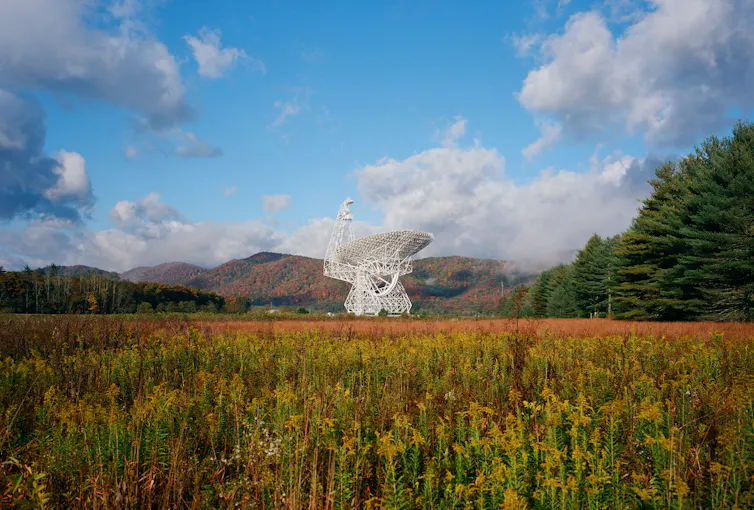
When molecules freely tumble around as gases in space, they rotate, and this motion releases energy in the form of photons, or electromagnetic particles. Different types of rotations require different levels of energy. Each photon carries that energy with it to a telescope, which records its signal. The more photons of a given energy, the stronger that signal.
If a radio telescope records all of the expected signals for a given molecule – its spectrum – then astronomers can confidently say that they have detected that molecule.
Infrared telescopes, such as the James Webb Space Telescope, or telescopes that detect visible light, such as the Hubble Space Telescope, can also be used for astrochemistry. Both kinds of telescopes, however, collect chemical signals, which are often more difficult to distinguish from one another.
Knowing what to look for
Behind every discovery of a new molecule in space is months or even years of work to capture a chemical’s “fingerprints,” or its spectrum.
I spent about a year doing this kind of work at the University of Cologne in Germany as a Fulbright research fellow. There, I used computer models of astrophysically interesting chemicals to predict what their spectra would look like.
In the lab, I injected the chemicals into a glass tube held under vacuum to mimic conditions in space. Using sensitive instruments, I recorded what a radio telescope would see if it were looking at only that molecule.
Astronomers had already found some of these molecules in space, and my colleagues and I were reexamining them, but we were also looking at molecules that we predicted might exist somewhere in space.
I worked with a team of scientists to adjust the computer inputs over and over until the simulated spectra matched the experimental data. When simulated spectra matched the experiments, that meant that the simulated spectra reliably modeled what a molecule’s fingerprint looks like in space. Reliable model spectra allow astronomers to detect chemical features at frequencies beyond what they can measure in the laboratory.
While my contributions to the Cologne team didn’t lead to a discovery of a new molecule in space, I gained an appreciation for the work behind the scenes of molecule discovery. The laboratory measurements are done precisely so that astronomers can be confident in their detections.
When detections get cloudy
Even with powerful radio telescopes and thorough experiments, some detections aren’t quite as clear as astronomers would like them to be. Sometimes, the signals are too faint for astronomers to be totally confident that they represent the molecules they think they do. Other times, there are too many molecule signals crowded together, causing different signals to blend.
Scientists have detected molecules relevant to biological processes back on Earth in comets and the atmospheres of other planets. These detections are exciting, but most scientists exercise caution to avoid jumping to conclusions because those molecules generally can exist outside of living things.
Sometimes, however, the excitement overshadows the caution and leads to premature conclusions.
Scientists often get excited when new molecules, especially biologically relevant molecules, are potentially present, and they want to share those findings with the world. Some researchers are also concerned about being the first to publish a new result, especially because a lot of telescope data is publicly available after a brief proprietary period.
Perhaps one of the most exciting nondiscoveries in astrochemistry was that of glycine in interstellar space more than 20 years ago. Glycine is the simplest amino acid, a type of molecule essential for life as we know it. Finding this molecule in a nebula would change how scientists think about the evolution of life’s ingredients.
Follow-up studies showed that key signals were missing in the initial report of glycine. As a result, astrochemists now generally agree that glycine had not been found in star-forming nebulae.

More recently, another molecular discovery has been scrutinized: the potential detection of phosphine in Venus’ atmosphere. Unlike with glycine, scientists have not yet agreed on whether phosphine, which is associated with some biological processes on Earth, is indeed present on Venus.
Initial reports of phosphine on Venus spurred chatter about biosignatures and evidence of potential life on Earth’s much hotter sister planet. However, follow-up studies by other scientists couldn’t confirm the initial results.
Over the past five years, scientists have continued to try to confirm or definitively refute Venusian phosphine.
Vetting claims
When reading about discoveries of new molecules in interstellar space or on other planets, how can you be confident in the detections you are reading about? It’s important to watch out for flashy headlines that claim signs of life have been found elsewhere in the universe. Molecule discoveries that rely on only one or two signals being detected are generally less reliable than those based on five or more signals.
For discoveries that tease hints of life on other worlds, other scientists are almost certainly going to try to reproduce the results. If you wait a few months for the initial fanfare to die down, you can do a web search to see what new results have come out to support – or refute – the original claim.
Olivia Harper Wilkins, Assistant Professor of Chemistry, Dickinson College
This article is republished from The Conversation under a Creative Commons license. Read the original article.
MORE NEWS. MORE STORIES. MORE DAILY.
STMDailyNews.com


unknown
Pentagon Releases Second Batch of UFO Files: New Videos, Testimony, and Unexplained Encounters
The Pentagon has released a second batch of UFO and UAP files, including military videos, witness testimony, Apollo mission records, and unexplained aerial encounters.

Last Updated on May 30, 2026 by Rod Washington
Public fascination with UFOs and UAPs continues to grow after the Pentagon released a second batch of declassified files tied to unexplained aerial phenomena. The new release expands upon the first wave of disclosures issued earlier this month and includes additional military videos, eyewitness testimony, audio recordings, and historical government documents.
While officials continue to stress that there is no confirmed evidence of extraterrestrial life, the latest tranche of files has intensified debate surrounding unexplained sightings involving military personnel, radar systems, and infrared tracking technology.
What Was Included in the Second Release?
The second batch was published through the government’s Presidential Unsealing and Reporting System for UAP Encounters (PURSUE).
According to the Pentagon, the latest release includes:
- More than 220 additional files
- Over 40 newly released videos
- Dozens of audio recordings
- Intelligence reports
- First-hand accounts from military and civilian witnesses
The Pentagon says these cases remain unresolved because investigators lacked sufficient data to make definitive conclusions. Officials also stated that additional releases are expected in the coming weeks.

New Military Videos Draw Attention
Among the most discussed materials are infrared military videos showing unusual formations and unidentified objects moving across restricted airspace.
One widely discussed video reportedly shows four unidentified objects flying in formation near Iran in 2022, captured using U.S. military infrared systems.
Another newly released report describes “orange orbs” that allegedly maneuvered near military aircraft during a mission connected to a sensitive government facility. Witnesses claimed the objects:
- Changed formation rapidly
- Approached aircraft at close range
- Appeared to pursue fighter jets before disappearing
According to one intelligence officer’s testimony, personnel were left “virtually speechless” following the encounter.
Apollo Mission Audio and Historical Records
The release also contains historical NASA-era materials involving Apollo missions and Cold War-era sightings.
One document includes audio from the Apollo 12 mission in which astronauts discussed mysterious “streaks of light” seen during their journey. NASA previously suggested the phenomenon may have been caused by internal visual effects experienced in spaceflight conditions.
The second release also includes reports from Sandia, New Mexico, where military personnel documented more than 200 sightings involving green fireballs, discs, and glowing objects between 1948 and 1950.
Pentagon Response Remains Cautious
Despite the excitement surrounding the files, the Pentagon maintains its position that:
- There is no verified evidence of extraterrestrial technology
- Many cases may eventually receive conventional explanations
Investigators say possible explanations can include:
- Drones
- Atmospheric phenomena
- Classified technology
- Sensor anomalies
- Insufficient data
Officials emphasized that unresolved does not automatically mean extraterrestrial.
Public Reaction and Skepticism
Reaction to the latest disclosure has been mixed.
Some UFO researchers believe the releases represent unprecedented government transparency and could encourage deeper scientific investigation. Others argue that many videos remain blurry, incomplete, or lacking critical technical context needed for meaningful analysis.
Skeptics also note that some materials in the first release had already circulated publicly for years, while others may involve ordinary objects captured under unusual conditions.
Still, public interest remains intense because the U.S. government is now openly acknowledging that some military encounters cannot currently be explained with available evidence.
Why the UAP Story Continues to Grow
The modern UAP discussion has evolved far beyond traditional UFO folklore.
Today the issue is increasingly viewed as:
- A national security concern
- An aviation safety issue
- A scientific mystery requiring improved data collection
Organizations now involved include:
- NASA
- All-domain Anomaly Resolution Office (AARO)
- Intelligence agencies
- Congressional oversight committees
The Pentagon has stated that additional batches of declassified files will continue to be released on a rolling basis as records are reviewed and approved for public disclosure.
The Bottom Line
The second release of Pentagon UAP files does not confirm alien visitation or extraterrestrial spacecraft. However, it does represent one of the most extensive public disclosures of unexplained aerial incident records in modern history.
Whether future investigations reveal advanced technology, misidentified phenomena, or something entirely unexpected, the UAP debate is no longer confined to the fringes of popular culture. It has become an ongoing subject of government transparency, scientific curiosity, and public fascination.
Related External Links
Stay updated with the latest UAP and breaking news coverage at STM Daily News.

Science
Sixth year of drought in Texas and Oklahoma leaves ranchers facing wildfires and bracing for another tough year

Joel Lisonbee, University of Colorado Boulder and William Baule, Texas A&M University
Cattle auctions aren’t often all-night affairs. But in Texas Lake Country in June 2022, ranchers facing dwindling water supplies and dried out pastures amid a worsening drought sold off more than 4,000 animals in an auction that lasted nearly 24 hours – about 200 cows an hour.
It was the height of a drought that has gripped the Southern Plains for the past six years – a drought that is still holding on in much of the region in 2026.
The drought cost the agriculture industry across Kansas, Oklahoma and Texas an estimated US$23.6 billion in lost crops, higher feed costs and selling off cattle from 2020 through 2024 alone. As rangeland dried out, it has also fueled wildfires, including several in Texas in early 2026.
Historically, droughts of this magnitude happen in the Southern Plains about once a decade, but the severe droughts of this century have been lasting longer, leaving water supplies, native rangelands and farms with little time to recover before the next one hits.
Many cattle producers and rangelands were still recovering from a severe 2010-2015 drought when a flash drought hit western Texas in spring 2020, marking the beginning of the current multibillion-dollar, multiyear and multistate drought. Ample spring rainfall in 2025 and severe flooding in central Texas that year weren’t enough to end the drought, and a powerful winter storm in late January 2026 missed the driest parts of the region.
In a recent study with colleagues at the Southern Regional Climate Center and the National Integrated Drought Information System, we assessed the causes and damage from the ongoing drought in the Southern Plains.
We found three key reasons for the enduring drought and its damage: rising temperatures and a La Niña climate pattern; water supply shortages; and lingering economic impacts from the previous drought.
Weather and climate helped drive the drought
The Southern Plains is known to be a hot spot for rapid drought development, and the ongoing drought that started in 2020 is no exception.
Documented “flash droughts” – defined as periods of rapid drought onset or intensification of existing droughts – occurred at least five times in the region from 2020 to 2025. As global temperatures rise and climates warm, research warns that the frequency and severity of flash drought events will increase.
For the southern part of the Southern Plains, winter precipitation is closely linked to the El Niño–Southern Oscillation, a climate pattern that affects weather around the world. Five of the past six years exhibited a La Niña pattern, which typically means the region sees winters that are warmer and drier than normal.
La Niña was likely the primary driver – although not the only driver – of the drought for Texas and southwest Oklahoma, and one of the reasons drought conditions have continued into 2026.
The Southern Plains have a long history with severe droughts. The Dust Bowl of the early 1930s may be the best-known example. But a history with drought doesn’t make it any easier to manage when crops and water supplies dry up.
Deeply rooted water shortages
The heat and dryness since 2020 have left many of the region’s rivers, reservoirs and even groundwater reserves well below average.
San Antonio’s reservoirs all reached record-low levels in 2024 and 2025, as did the Edwards Aquifer, which provides water for roughly 2.5 million people. They were still low as 2026 began. Surface water and groundwater resources across central and western Texas have been depleted to the point that even a few big storms can’t replenish them.
A few major rivers flow into the Southern Plains from other drought-affected regions. Consider the Rio Grande, which begins in Colorado and winds through New Mexico and along Texas’ southern border: Not only has the Lower Rio Grande valley in southern Texas missed out on needed precipitation this winter, so did the Rio Grande headwaters in southern Colorado.
Colorado is facing a snow drought in winter 2026, as is much of the western U.S. If it continues, there will be less snowmelt come summer to feed rivers, such as the Rio Grande, or fill reservoirs. In early February, the Elephant Butte, Amistad and Falcon reservoirs, along the Rio Grande, were only 11%, 34%, and 20% full, respectively.
Lingering economic impacts
Like water supplies, the economy doesn’t just recover when the rains return.
One of the reasons the current drought has been so costly is that parts of the region had not fully recovered from the 2010-2015 drought when the latest one began in 2020. With only a five-year break between droughts, the landscape behaved like someone with an already weakened immune system who caught a cold.
During the 2010-2015 drought, cattle producers in Texas sold off about 20% of the statewide herd as water became scarce and rangeland dried up. Rebuilding a herd after a drought is a slow process. Pasture recovery can take a year or more, and a newborn heifer will take two years to mature and produce her own first calf.
Cattle herds had still not returned to pre-2010 levels when the 2022 drought peak forced another mass sell-off. From 2020 through 2024, Texas’s herd size declined from 13.1 million to 12 million; Oklahoma’s declined from 5.3 million to 4.7 million; and Kansas’ declined from 6.5 million to 6.15 million.
https://datawrapper.dwcdn.net/5IT1s/1
Looking beyond livestock, a large percentage of the Southern Plains’ crops failed in 2022, the peak year of the drought. In Texas, 25% of the corn crop was planted but never harvested, and 45% of the soybean crop was similarly abandoned. A normal season would have yielded a $2.4 billion cotton crop in Texas, but 74% of that crop was abandoned, slashing its value to roughly $640 million.
Ending the Southern Plains drought
Is the end in sight? With La Niña fading in early 2026 and its opposite, El Niño, potentially on the horizon, there’s a chance for wetter conditions that could reduce the drought in the fall and winter months of 2026.
But the Southern Plains still have to get through spring and summer first. Ending a drought like this requires consistent precipitation over several months, and drought conditions are likely to get worse before they get better.
This article, originally published Feb. 9, 2026, has been updated with new wildfires in Texas.
Joel Lisonbee, Senior Associate Scientist, Cooperative Institute for Research in the Environmental Sciences, University of Colorado Boulder and William Baule, Research Assistant Professor in Atmospheric Sciences, Texas A&M University
This article is republished from The Conversation under a Creative Commons license. Read the original article.
STM Daily News is a vibrant news blog dedicated to sharing the brighter side of human experiences. Emphasizing positive, uplifting stories, the site focuses on delivering inspiring, informative, and well-researched content. With a commitment to accurate, fair, and responsible journalism, STM Daily News aims to foster a community of readers passionate about positive change and engaged in meaningful conversations. Join the movement and explore stories that celebrate the positive impacts shaping our world.
The Knowledge
Mosquitoes carrying malaria are evolving more quickly than insecticides can kill them – researchers pinpoint how

Jacob A Tennessen, Harvard University
The fight against infectious disease is a race against evolution. Bacteria become resistant to antibiotics. Viruses adapt to spread more quickly. Diseases transmitted by insects present another evolutionary front: Insects themselves can evolve resistance to the poisons that people use to kill them.
In particular, the mosquito-borne disease malaria kills over 600,000 people annually. Since World War II, people have battled malaria with insecticides – chemical weapons intended to kill Anopheles mosquitoes infected with the Plasmodium parasites that cause the disease.
However, mosquitoes are quickly evolving counterstrategies that make these insecticides ineffective, putting millions of people at greater risk of deadly infection. My colleagues and I have newly published research showing how.
Insecticide resistance threatens public health
As an evolutionary geneticist, I study natural selection – the basis for adaptive evolution. Genetic variants that best promote survival can replace less advantageous versions, causing species to change. Anopheles mosquitoes are frustratingly adept at evolving.
In the mid-1990s, most African Anopheles were susceptible to pyrethroids, a popular type of insecticide originally derived from chrysanthemums. Anopheles control relies on two pyrethroid-based methods: insecticide-treated bed nets to protect sleepers, and indoor residual spraying of insecticide against the walls of homes. These two methods alone likely prevented over a half-billion cases of malaria between 2000 and 2015.
However, mosquitoes today from Ghana to Malawi are often able to survive insecticide concentrations 10 times the previously lethal dose. Along with Anopheles control efforts, agriculture also inadvertently exposes mosquitoes to pyrethroids and contributes to insecticide resistance.
In some African locales, Anopheles is already showing resistance to all four main classes of insecticide used for malaria control.
Adaptation in Latin American mosquitoes
Anopheles mosquitoes and the malaria-causing Plasmodium also occur outside Africa, where insecticide resistance is less well-researched.
In much of South America, the main malaria vector is Anopheles darlingi. This mosquito species has diverged evolutionarily from the African vectors so extensively that it might be a different genus, Nyssorhynchus. Along with colleagues from eight countries, I analyzed over 1,000 Anopheles darlingi genomes to understand its genetic diversity, including any recent changes due to human activity. My collaborators collected these mosquitoes at 16 locations ranging from the Atlantic coast of Brazil to the Pacific side of the Andes in Colombia.
We found that, like its African counterparts, Anopheles darlingi shows extremely high genetic diversity – more than 20 times that of humans – indicating that very large populations of this insect exist. A species with such a vast gene pool is well poised to adapt to new challenges. The right mutation giving it the advantage it needs is more likely to pop up when there are so many individuals. And once that mutation starts to spread, it’s protected by numbers since it won’t be wiped out if a few mosquitoes die by chance.
In contrast, bald eagles in the contiguous U.S. were never able to evolve resistance against the insecticide DDT and approached extinction. Evolution is more efficient among millions of insects than mere thousands of birds. And indeed, we saw signals of adaptive evolution in the resistance-related genes of Anopheles darlingi occurring over the past few decades.
Mosquitoes evolve to detoxify poisons
Insecticides like pyrethroids and DDT share the same molecular target: channels in nerve cells that can open and close. When open, the nerve cell stimulates other cells. These insecticides force the channels to remain open and continuously fire, causing paralysis and death. However, insects can evolve resistance by changing the shape of the channel itself.
Earlier genetic scans performed by other researchers had not detected this type of resistance in Anopheles darlingi, and neither did ours. Instead, we found that resistance is evolving in another way: a group of genes encoding enzymes that break down toxic compounds. High activity of these enzymes, called P450, frequently underlies resistance to insecticides in other mosquitoes. The same cluster of P450 genes has changed independently at least seven times across South America since insecticide use began in the mid-20th century.
In French Guiana, a different set of P450 genes exhibits a similar evolutionary pattern, cementing the clear connection between these enzymes and adaptation. Moreover, when we exposed mosquitoes to pyrethroids in sealed bottles, differences among the P450 genes of individual mosquitoes were linked to the length of time they stayed alive.
Insecticide-heavy campaigns against malaria have been only sporadic in South America and may not be the main driver behind this evolution. Instead, it’s possible that mosquitoes are being exposed indirectly to agricultural insecticides. Intriguingly, we saw the strongest signs of evolution in places where farming is prevalent.
Toward more sophisticated vector control
Despite new vaccines and other recent advances against malaria, mosquito control remains essential for reducing disease.
Some countries are launching trials of gene drives to control malaria, which involve forcing a genetic modification into a mosquito population to reduce their numbers or their tolerance for Plasmodium. Such prospects are exciting, though the relentless adaptability of mosquitoes could be an obstacle.
I and others are revising methods to efficiently test for emerging insecticide resistance. Genome-scale sequencing remains important to detect new or unexpected evolutionary responses. The risk of adaptation is highest under a continuous, strong selection pressure, so minimizing, switching and staggering pesticides can help thwart resistance.
Success in the fight against evolving resistance will require a coordinated effort of monitoring, and reacting accordingly. Unlike evolution, humans can think ahead.
Jacob A Tennessen, Research Scientist in Immunology and Infectious Diseases, Harvard University
This article is republished from The Conversation under a Creative Commons license. Read the original article.
The science section of our news blog STM Daily News provides readers with captivating and up-to-date information on the latest scientific discoveries, breakthroughs, and innovations across various fields. We offer engaging and accessible content, ensuring that readers with different levels of scientific knowledge can stay informed. Whether it’s exploring advancements in medicine, astronomy, technology, or environmental sciences, our science section strives to shed light on the intriguing world of scientific exploration and its profound impact on our daily lives. From thought-provoking articles to informative interviews with experts in the field, STM Daily News Science offers a harmonious blend of factual reporting, analysis, and exploration, making it a go-to source for science enthusiasts and curious minds alike. https://stmdailynews.com/category/science/




