

News
Broncos ‘Private’ Stadium Plan: How Tax Breaks and Infrastructure Can Still Cost the Public Millions
Broncos ‘Private’ Stadium Plan: In September 2025, the Denver Broncos announced plans for a new privately financed stadium. However, scrutiny arises as public funds often subsidize these projects, obscuring true financing sources. This raises concerns about the long-term financial impact on taxpayers, who may shoulder broader costs beyond construction, including infrastructure and social ramifications.

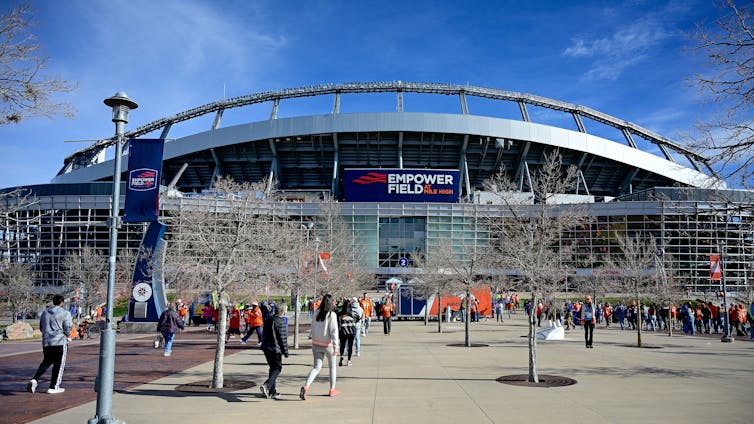
Geoffrey Propheter, University of Colorado Denver
Broncos say their new stadium will be ‘privately financed,’ but ‘private’ often still means hundreds of millions in public resources
The Denver Broncos announced in early September 2025 their plan to build a privately financed football stadium. The proposal received a lot of attention and praise.
Across the five major sports leagues in the U.S. – the NBA, NHL, NFL, MLB and MLS – only 20% of facilities are privately owned.
I’ve studied the intersection of state and local public finance and pro sports for two decades. This experience has led me to approach claims of private financing with suspicion.
Private dollars are often masked as public dollars in these arrangements. https://www.youtube.com/embed/zwv34Lpo0ec?wmode=transparent&start=0 A Fox31 Denver news report aired in November 2025 about the Broncos’ plans for a new stadium.
Private vs public dollars
In theory, what counts as private or public dollars is uncontroversial. Dollars are public when government has a legal claim over them – otherwise, they are private.
The public versus private dollar distinction matters when accounting for who is contributing how much to a sports facility. When public dollars are allowed to count as private dollars, a project proposal looks more enticing than it is, in fact.
For instance, lawmakers regularly allow team owners to count public dollars as private dollars. The Sacramento City Council agreed to let the NBA’s Sacramento Kings count their property tax payments for the city-owned arena as private contributions to the overall cost of financing the arena. But property taxes are public dollars that in other instances go toward public services like schools and road repairs.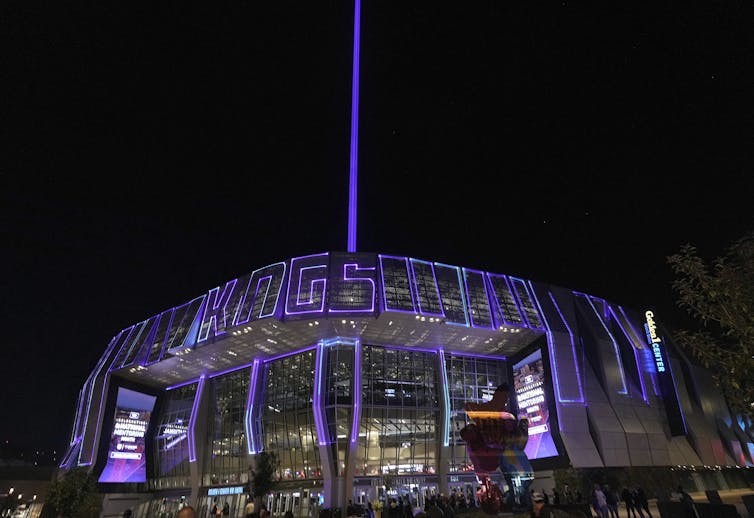
Team owners building private facilities also typically receive public dollars through tax breaks, which is government spending in disguise. Property tax exemptions, sales and use tax exemptions on materials and machinery, and income tax credits are common forms of government givebacks to sports team owners.
I’ve estimated that property tax exemptions alone, among facilities in the five major leagues, have cost state and local governments US$20 billion cumulatively over the life of teams’ leases, 42% of which would have gone to K-12 education.
Rental payments spent on facilities are not private dollars
Many facilities and their infrastructure are funded through public debt secured in part by team rental payments. Lawmakers, media and consultants often view projects secured by rents as privately financed, in part or whole.
However, rental income in exchange for use or operation of public property should not be counted as private dollars.
Here’s a thought experiment. Suppose state lawmakers allocated the rent paid for use of campground sites in a state park to pay for new campground bathrooms. Are the bathrooms privately funded?
The flaw in concluding “yes” arises from a failure to appreciate that lawmakers, through policy, create legal claims over certain dollars. All dollars start as private dollars, but through the tax system, lawmakers transfer ownership of some dollars to the public.
It is the government landlord’s choice, a policy decision, to spend the rental income on the rented property, a choice available to them only if they own the rental income in the first place.
Yet lawmakers regularly allow teams, both professional and minor league, to count rental payments as private contributions. This accounting makes sports subsidies look less generous than they actually are.
Looking beyond construction
Facilities not only need to be constructed but also operated, maintained and eventually upgraded. Roads, sewer lines, overpasses, game-day security and emergency response and public policies to mitigate gentrification caused by a facility are all common taxpayer-funded touchpoints. In addition, facilities have preconstruction costs such as land acquisition, soil remediation and site preparation, as well as later costs such as demolition and remediation for the land’s next use.
Focusing on privately financed construction and ignoring all other aspects of a project’s development and operation is misleading, potentially contributing to lawmakers making inefficient and expensive policy decisions.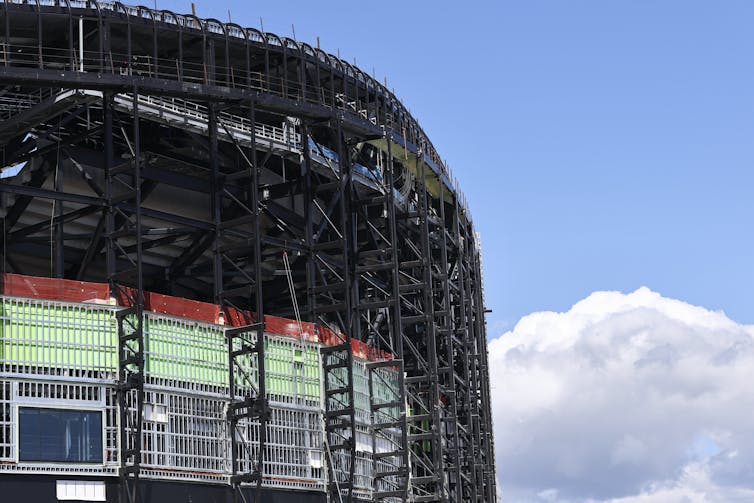
By way of example, the Council of the District of Columbia approved a subsidy agreement last year with the NFL’s Commanders. The stadium would be financed, constructed and operated by the team owner, who would pay $1 in rent per year and remit no property taxes. In exchange for financing the stadium privately, the owner receives exclusive development rights to 20 acres of land adjacent to the stadium for the next 90 years.
The stadium is expected to cost the owner $2.5 billion, with the city contributing $1.3 billion for infrastructure.
But the city also gives up market rental income between $6 billion and $25 billion,depending on future land appreciation rates, that it could make on the 20 acres.
In other words, the rent discount alone means the city gives up revenue equal to multiple stadiums in exchange for the Commanders providing one. It is as if the council has a Lamborghini, traded it straight up for a Honda Civic, and then praised themselves for their negotiation acumen that resulted in a “free” Civic.
The Broncos’ proposed stadium
As of January 2026, Denver taxpayers know only that the Broncos stadium construction will be privately financed and that public dollars will be spent on some infrastructure.
Being enamored with such a proposal is similar to being offered a $1 billion yacht at a 75% discount. In my experience, there are two types of public officials: one will want to spend $250 million to save $750 million, while the other will ask whether $250 million for a yacht is an appropriate use of taxpayer resources given existing needs elsewhere.
My hope is that lawmakers better appreciate the many ways government participation in sports facility development, including privately financed ones, imposes serious risks and costs for current and future taxpayers. What is the expected total cost of the stadium project over its life? How much of the life cost would public resources cover? Could public resources generate greater benefits in an alternative use? How much will it cost to mitigate or compensate those affected by a project’s expected negative side effects, such as gentrification, congestion, pollution and crime?
Read more of our stories about Colorado.
Geoffrey Propheter, Associate Professor, School of Public Affairs, University of Colorado Denver
This article is republished from The Conversation under a Creative Commons license. Read the original article.
Discover more from Daily News
Subscribe to get the latest posts sent to your email.


Daily News
Bad Bunny’s Super Bowl Halftime Show Fits the NFL’s Long Game to Win Latin America
The NFL aims to expand its reach into Latin America through strategic marketing and high-profile performers like Bad Bunny at the Super Bowl halftime show. While the choice has sparked controversy, particularly among conservatives, the league sees it as a business move to attract more fans, particularly in Mexico and Brazil.
Last Updated on February 7, 2026 by Daily News Staff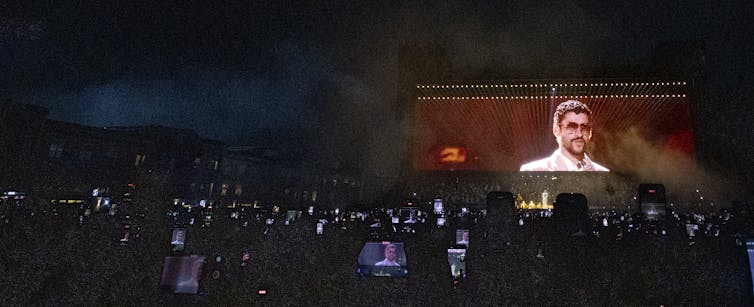
Jared Bahir Browsh, University of Colorado Boulder
Bad Bunny’s Super Bowl show is part of long play drawn up by NFL to score with Latin America
Donald Trump, it is fair to assume, will be switching channels during this year’s Super Bowl halftime show.
The U.S. president has already said that he won’t be attending Super Bowl LX in person, suggesting that the venue, Levi’s Stadium in Santa Clara, California, was “just too far away.” But the choice of celebrity entertainment planned for the main break – Puerto Rican reggaeton star Bad Bunny and recently announced pregame addition Green Day – didn’t appeal. “I’m anti-them. I think it’s a terrible choice. All it does is sow hatred. Terrible,” Trump told the New York Post.
National Football League Commissioner Roger Goodell likely didn’t have the sensibilities of the U.S. president in mind when the choice of Bad Bunny was made.
One of the top artists in the world, Bad Bunny performs primarily in Spanish and has been critical of immigration enforcement, which factored into the backlash in some conservative circles to the choice. Bad Bunny’s anti-ICE comments at this year’s Grammy Awards will have only stoked the ire of some conservatives.
But for the NFL hierarchy, this was likely a business decision, not a political one. The league has its eyes on expansion into Latin America; Bad Bunny, they hope, will be a ratings-winning means to an end. It has made such bets in the past. In 2020, Shakira and Jennifer Lopez were chosen to perform, with Bad Bunny making an appearance. The choice then, too, was seen as controversial.
Raising the flag overseas
As a teacher and scholar of critical sports studies, I study the global growth of U.S.-based sports leagues overseas.
Some, like the National Basketball Association, are at an advantage. The sport is played around the globe and has large support bases in Asia – notably in the Philippines and China – as well as in Europe, Australia and Canada.
The NFL, by contrast, is largely entering markets that have comparatively little knowledge and experience with football and its players.
The league has opted for a multiprong approach to attracting international fans, including lobbying to get flag football into the 2028 Olympics in Los Angeles.
Playing the field
When it comes to the traditional tackle game, the NFL has held global aspirations for over three-quarters of a century. Between 1950-1961, before they merged, the NFL and American Football League played seven games against teams in Canada’s CFL to strengthen the relationship between the two nations’ leagues.
Developing a fan base south of the border has long been part of the plan.
The first international exhibition game between two NFL teams was supposed to take place in Mexico City in 1968. But Mexican protest over the economy and cost of staging the Olympics that year led the game, between the Detroit Lions and Philadelphia Eagles, to be canceled.
Instead, it was Montreal that staged the first international exhibition match the following year.
In 1986, the NFL added an annual international preseason game, the “American Bowl,” to reach international fans, including several games in Mexico City and one in Monterrey.
But the more concerted effort was to grow football in the potentially lucrative, and familiar, European market.
After several attempts by the NFL and other entities in the 1970s and ’80s to establish an international football league, the NFL-backed World League of Football launched in 1991. Featuring six teams from the United States, one from Canada and three from Europe, the spring league lost money but provided evidence that there was a market for American football in Europe, leading to the establishment of NFL Europe.
But NFL bosses have long had wider ambitions. The league staged 13 games in Tokyo, beginning in 1976, and planned exhibitions for 2007 and 2009 in China that were ultimately canceled. These attempts did not have the same success as in Europe.
Beyond exhibitions
The NFL’s outreach in Latin America has been decades in the making. After six exhibition matches in Mexico between 1978 and 2001, the NFL chose Mexico City as the venue of its first regular season game outside the United States.
In 2005, it pitted the Arizona Cardinals against the San Francisco 49ers at Estadio Azteca in Mexico City. Marketed as “Fútbol Americano,” it drew the largest attendance in NFL history, with over 103,000 spectators.
The following year, Goodell was named commissioner and announced that the NFL would focus future international efforts on regular-season games.
The U.K. was a safe bet due to the established stadium infrastructure and the country’s small but passionate fan base. The NFL International Series was played exclusively in London between 2007 and 2016.
But in 2016, the NFL finally returned to Mexico City, staging a regular-season game between the Oakland – now Las Vegas – Raiders and Houston Texans.
And after the completion of upgrades to Latin America’s largest stadium, Estadio Azteca, the NFL will return to Mexico City in 2026, along with games in Munich, Berlin and London. Future plans include expanding the series to include Sydney, Australia, and Rio de Janeiro, Brazil, in 2026.
The International Player Pathway program also offers players from outside the United States an opportunity to train and earn a roster spot on an NFL team. The hope is that future Latin American players could help expand the sport in their home countries, similar to how Yao Ming expanded the NBA fan base in China after joining the Houston Rockets, and Shohei Ohtani did the same for baseball in Japan while playing in Los Angeles.
Heading south of the border
The NFL’s strategy has gained the league a foothold in Latin America.
Mexico and Brazil have become the two largest international markets for the NFL, with nearly 40 million fans in each of the nations.
Although this represents a fraction of the overall sports fans in each nation, the raw numbers match the overall Latino fan base in the United States. In recent years the NFL has celebrated Latino Heritage Month through its Por La Cultura campaign, highlighting Latino players past and present.
Latin America also offers practical advantages. Mexico has long had access to NFL games as the southern neighbor to the United States, with the Dallas Cowboys among the most popular teams in Mexico.
For broadcasters, Central and South America offer less disruption in regards to time zones. Games in Europe start as early as 6:30 a.m. for West Coast fans, whereas Mexico City follows Central time, and Brasilia time is only one to two hours ahead of Eastern time.
The NFL’s expansion plans are not without criticism. Domestically, fans have complained that teams playing outside the U.S. borders means one less home game for season-ticket holders. And some teams have embraced international games more than others.
Another criticism is the league, which has reported revenues of over US$23 billion during the 2024-25 season – nearly double any other U.S.-based league – is using its resources to displace local sports. There are also those who see expansion of the league as a form of cultural imperialism. These criticisms often intersect with long-held ideas around the league promoting militarism, nationalism and American exceptionalism.
Bad Bunny: No Hail Mary attempt
For sure, the choice of Bad Bunny as the halftime pick is controversial, given the current political climate around immigration. The artist removed tour dates on the U.S. mainland in 2025 due to concerns about ICE targeting fans at his concerts, a concern reinforced by threats from the Department of Homeland Security that they would do just that at the Super Bowl.
But in sticking with Bad Bunny, the NFL is showing it is willing to face down a section of its traditional support and bet instead on Latin American fans not just tuning in for the halftime show but for the whole game – and falling in love with football, too.
Jared Bahir Browsh, Assistant Teaching Professor of Critical Sports Studies, University of Colorado Boulder
This article is republished from The Conversation under a Creative Commons license. Read the original article.
Discover more from Daily News
Subscribe to get the latest posts sent to your email.
family fun
Jurassic Quest Brings Life-Size Dinosaurs to Phoenix in February 2026
Jurassic Quest is roaring back into Phoenix in February 2026 with towering life-size dinosaurs, interactive exhibits, and hands-on activities for kids and families at the Arizona State Fairgrounds.

Last Updated on February 7, 2026 by Daily News Staff

Phoenix, AZ — Jurassic Quest, billed as North America’s largest traveling dinosaur experience, is set to return to Arizona with a limited engagement at the Arizona State Fairgrounds from February 6–8, 2026.
The family-friendly attraction features life-size animatronic dinosaurs, immersive walk-through exhibits, and hands-on activities designed to blend entertainment with education. Guests will encounter towering recreations of iconic species such as Tyrannosaurus rex and Spinosaurus, along with interactive fossil digs, dinosaur rides, inflatables, and meet-and-greet opportunities with baby dinosaurs.
Jurassic Quest has become a popular touring event across the United States, particularly among families with young children. The experience combines museum-style displays with high-energy attractions, allowing visitors to explore at their own pace. Most attendees spend one to two hours navigating the exhibit.
The event will take place at the Arizona State Fairgrounds, located at 1826 W. McDowell Road in Phoenix, with multiple daily sessions scheduled throughout the weekend.
Tickets and additional event details are available through the official Jurassic Quest website.
- Jurassic Quest Phoenix 2026 – Official Event Page
- Arizona State Fairgrounds – Venue Information
- More Entertainment News from STM Daily News
- Family & Kid-Friendly Events on STM Daily News
Discover more from Daily News
Subscribe to get the latest posts sent to your email.
STM Daily News
Chinamaxxing: The Viral Trend Turning Geopolitics Into Aesthetic Fantasy
A viral social media trend called “Chinamaxxing” is turning geopolitics into aesthetic comparison—revealing more about generational frustration than China itself.


At first glance, the videos seem harmless enough.
Clean subways gliding into spotless stations. Neon skylines glowing at night. Clips of high-speed trains, cashless stores, orderly crowds. Overlaid text reads something like, “Meanwhile in China…” or “They figured it out.”
This is “Chinamaxxing,” a loosely defined but increasingly visible social media trend where mostly young users frame China as a model of efficiency, stability, and modernity—often in contrast to life in the West.
What makes the trend notable isn’t just its subject, but its tone. Chinamaxxing is rarely explicit political advocacy. It’s not a manifesto. It’s a mood. Aesthetic admiration blended with subtle critique, delivered through short, visually compelling clips that invite comparison without context.
And that’s precisely why it has sparked debate.
What Is “Chinamaxxing,” Really?
Despite the provocative name, Chinamaxxing isn’t a coordinated movement or ideology. It’s better understood as an algorithm-driven pattern—a recurring style of content that rewards certain visuals and emotional cues.
Most Chinamaxxing content emphasizes:
- Infrastructure and urban design
- Technology embedded in daily life
- Perceived order and efficiency
- Implicit contrast with Western dysfunction
What it typically omits:
- Political repression and censorship
- State surveillance
- Limits on speech and dissent
- The lived diversity of Chinese experiences
The result is a highly curated portrayal—less about China as a nation, and more about what viewers want to believe is possible somewhere else.
Why It’s Gaining Traction Now
The rise of Chinamaxxing says as much about the West as it does about China.
For many young users, particularly Gen Z, the backdrop is familiar: rising housing costs, student debt, healthcare anxiety, political polarization, and a growing sense that institutions no longer function as promised.
In that environment, visually persuasive content showing order and functionality carries emotional weight. It offers relief from chaos—real or perceived.
Social platforms amplify this effect. Short-form video rewards clarity, contrast, and immediacy. A clean subway platform communicates more in five seconds than a policy analysis ever could. Nuance does not trend well. Aesthetics do.
The Social and Political Criticism
Critics argue Chinamaxxing crosses a line from curiosity into distortion.
By focusing exclusively on infrastructure and surface-level efficiency, the trend risks:
- Normalizing authoritarian governance through lifestyle framing
- Reducing political systems to consumer experiences
- Ignoring the tradeoffs that make such systems possible
Supporters counter that Western media has long flattened China into a single negative narrative, and that admiration for specific aspects of another society is not the same as endorsing its government.
Both perspectives, however, miss something important.
What the Trend Actually Reveals
Chinamaxxing isn’t primarily about China. It’s about disillusionment.
It reflects a generation that:
- Feels let down by existing systems
- Engages politics emotionally rather than institutionally
- Uses visual culture to express dissatisfaction indirectly
In this context, China becomes a projection surface—not because it is perfect, but because it appears functional.
That distinction matters.
Why This Matters
Chinamaxxing highlights how political understanding is evolving in the digital age. Governance is increasingly consumed not through debate or civic participation, but through comparison clips, memes, and aesthetics.
The risk isn’t admiration. It’s oversimplification.
When complex societies are reduced to visuals alone, public discourse loses depth. But when those visuals resonate, they also signal real unmet needs: stability, competence, and trust in institutions.
Ignoring that signal would be a mistake.
The STM Daily News Perspective
Chinamaxxing is not an endorsement, a conspiracy, or a joke. It is a cultural artifact—one that reflects generational anxiety, algorithmic storytelling, and the widening gap between expectations and reality.
The question it raises isn’t whether China is better.
It’s why so many people feel their own systems are no longer working.
Related Reading
- BBC News: China Coverage and Global Context
- The Atlantic: Technology, Media, and Internet Culture Analysis
- Pew Research Center: Global Attitudes and Political Perception
- The New York Times: China and International Affairs
- Brookings Institution: China Policy and Global Governance
More on This Topic from STM Daily News
Stay tuned to STM Daily News for more stories exploring internet culture, social media trends, and how digital platforms shape public perception. We’ll be publishing in-depth pieces that break down the societal impact of viral phenomena like Chinamaxxing, the psychology behind online political trends, and the evolving language of Gen Z culture.
Want alerts? Be sure to subscribe to our newsletter for the latest insights and analysis.
Author

Discover more from Daily News
Subscribe to get the latest posts sent to your email.





