

Entertainment
Muppets at 50: How Jim Henson’s Felt Icons Became a Billion-Dollar Franchise That Still Prints Money
The Muppets, created by Jim Henson, have thrived for over 50 years, starting with “Sam and Friends” in 1955 and gaining fame through “The Muppet Show” and various films. Despite challenges, including Henson’s passing in 1990 and subsequent ownership changes, The Muppets remain culturally significant, entertaining generations globally.


It’s easy making green: Muppets continue to make a profit 50 years into their run
Jared Bahir Browsh, University of Colorado Boulder
A variety show that’s still revered for its absurdist, slapstick humor debuted 50 years ago. It starred an irreverent band of characters made of foam and fleece.
Long after “The Muppet Show”‘s original 120-episode run ended in 1981, the legend and legacy of Miss Piggy, Fozzie Bear, Gonzo and other creations concocted by puppeteer and TV producer Jim Henson have kept on growing. Thanks to the Muppets’ film franchise and the wonders of YouTube, the wacky gang is still delighting, and expanding, its fan base.
As a scholar of popular culture, I believe that the Muppets’ reign, which began in the 1950s, has helped shape global culture, including educational television. Along the way, the puppets and the people who bring them to life have earned billions in revenue.
Johnny Carson interviews Muppet creator Jim Henson, Kermit and other Muppets on the ‘Tonight Show’ in 1975, ahead of one of an early ‘The Muppet Show’ pilot.
Kermit’s origin story
Muppets, a portmanteau of marionette and puppet, first appeared on TV in the Washington, D.C., region in 1955, when Henson created a short sketch show called “Sam and Friends” with his future wife, Jane Nebel.
Their motley cast of puppets, including a lizardlike character named Kermit, sang parody songs and performed comedy sketches.
Henson’s creations were soon popping up in segments on other TV shows, including “Today” and late-night programs. Rowlf the Dog appeared in Canadian dog food commercials before joining “The Jimmy Dean Show” as the host’s sidekick.
After that show ended, Rowlf and Dean performed on the “Ed Sullivan Show,” where Kermit had occasionally appeared since 1961.
Rowlf the Dog and Jimmy Dean reprise their schtick on the ‘Ed Sullivan Show’ in 1967.
From ‘Sesame Street’ to ‘SNL’
As Rowlf and Kermit made the rounds on variety shows, journalist Joan Ganz Cooney and psychologist Lloyd Morrisett were creating a new educational program. They invited Henson to provide a Muppet ensemble for the show.
Henson waived his performance fee to maintain rights over the characters who became the most famous residents of “Sesame Street.” The likes of Oscar the Grouch, Cookie Monster and Big Bird were joined by Kermit who, by the time the show premiered in 1969, was identified as a frog.
When “Sesame Street” became a hit, Henson worried that his Muppets would be typecast as children’s entertainment. Another groundbreaking show, aimed at young adults, offered him a chance to avoid that.
“Saturday Night Live’s” debut on NBC in 1975 – when the show was called “Saturday Night” – included a segment called “The Land of Gorch,” in which Henson’s grotesque creatures drank, smoked and cracked crass jokes.
“The Land of Gorch” segments ended after “Saturday Night Live’s” first season. ‘Saturday Night Live’s’ first season included ‘Land of Gorch’ sketches that starred creatures Jim Henson made to entertain grown-ups.
Miss Piggy gets her closeup
“The Muppet Show” was years in the making. ABC eventually aired two TV specials in 1974 and 1975 that were meant to be pilots for a U.S.-produced “Muppet Show.”
After no American network picked up his quirky series, Henson partnered with British entertainment entrepreneur Lew Grade to produce a series for ATV, a British network, that featured Kermit and other Muppets. The new ensemble included Fozzie Bear, Animal and Miss Piggy – Muppets originally performed by frequent Henson collaborator Frank Oz.
“The Muppet Show” parodied variety shows on which Henson had appeared. Connections he’d made along the way paid off: Many celebrities he met on those shows’ sets would guest star on “The Muppet Show,” including everyone from Rita Moreno and Lena Horne to Joan Baez and Johnny Cash.
“The Muppet Show,” which was staged and shot at a studio near London, debuted on Sept. 5, 1976, in the U.K, before airing in syndication in the United States on stations like New York’s WCBS.
As the show’s opening and closing theme songs changed over time, they retained a Vaudeville vibe despite the house band’s preference for rock and jazz.
The Muppets hit the big screen
“The Muppet Show” was a hit, amassing a global audience of over 200 million. It won many awards, including a Primetime Emmy for outstanding comedy-variety or music series – for which it beat “Saturday Night Live” – in 1978.
While his TV show was on the air, Henson worked on the franchise’s first film, “The Muppet Movie.” The road film, released in 1979, was another hit: It earned more than US$76 million at the box office.
“The Muppet Movie” garnered two Academy Award nominations for its music, including best song for “Rainbow Connection.” It won a Grammy for best album for children.
The next two films, “The Great Muppet Caper,” which premiered in 1981, and “The Muppets Take Manhattan,” released in 1984, also garnered Oscar nominations for their music.
As ‘The Muppet Movie’ opens, Statler and Waldorf tell a security guard of their heckling plans.
‘Fraggle Rock’ and the Disney deal
The cast of “The Muppet Show” and the three films took a break from Hollywood while Henson focused on “Fraggle Rock,” a TV show for kids that aired from 1983-1987 on HBO.
Like Henson’s other productions, “Fraggle Rock” featured absurdist humor – but its puppets aren’t considered part of the standard Muppets gang. This co-production between Henson, Canadian Broadcast Corporation and British producers was aimed at international markets.
The quickly conglomerating media industry led Henson to consider corporate partnerships to assist with his goal of further expanding the Muppet media universe.
In August 1989, he negotiated a deal with Michael Eisner of Disney who announced at Disney-MGM Studios an agreement in principle to acquire The Muppets, with Henson maintaining ownership of the “Sesame Street” characters.
The announcement also included plans to open Muppet-themed attractions at Disney parks.
But less than a year later, on May 16, 1990, Henson died from a rare and serious bacterial infection. He was 53.
At the end of ‘Fraggle Rock’s’ run, its characters look for new gigs.
Of Muppets and mergers
Henson’s death led to the Disney deal’s collapse. But the company did license The Muppets to Disney, which co-produced “The Muppet Christmas Carol” in 1992 and “Muppet Treasure Island” in 1996 with Jim Henson Productions, which was then run by Jim’s son, Brian Henson.
In 2000, the Henson family sold the Muppet properties to German media company EM.TV & Merchandising AG for $680 million. That company ran into financial trouble soon after, then sold the Sesame Street characters to Sesame Workshop for $180 million in late 2000. The Jim Henson Company bought back the remaining Muppet properties for $84 million in 2003.
In 2004, Disney finally acquired The Muppets and most of the media library associated with the characters.
Disney continued to produce Muppet content, including “The Muppet’s Wizard of Oz” in 2005. Its biggest success came with the 2011 film “The Muppets,” which earned over $165 million at the box office and won the Oscar for best original song “Man or Muppet.”
“Muppets Most Wanted,” released in 2014, earned another $80 million worldwide, bringing total global box office receipts to over $458 million across eight theatrical Muppets movies.
The ‘Muppet Show’ goes on
The Muppets continue to expand their fandom across generations and genres by performing at live concerts and appearing in several series and films.
Through these many hits and occasional bombs, and the Jim Henson Company’s personnel changes, the Muppets have adapted to changes in technology and tastes, making it possible for them to remain relevant to new generations.
That cast of characters made of felt and foam continue to entertain fans of all ages. Although many people remain nostalgic over “The Muppet Show,” two prior efforts to reboot the show proved short-lived.
But when Disney airs its “The Muppet Show” anniversary special on Feb. 4, 2026, maybe more people will get hooked as Disney looks to reboot the series
‘The Muppet Show’ will be back – for at least one episode – on Feb. 4, 2026.
Jared Bahir Browsh, Assistant Teaching Professor of Critical Sports Studies, University of Colorado Boulder
This article is republished from The Conversation under a Creative Commons license. Read the original article.




Forgotten Genius Fridays
Octavia E. Butler: The Black Woman Who Helped Change Science Fiction
Discover how Octavia E. Butler transformed science fiction, explored Black identity, and helped shape Afrofuturism through her groundbreaking novels.

Forgotten Genius Friday | The Knowledge | STM Daily News
Octavia E. Butler: The Woman Who Reimagined the Future
When we think about science fiction, we often picture spaceships, robots, alien civilizations, and futuristic technology. But what happens when science fiction becomes a way to explore racism, inequality, human survival, and the consequences of our choices?
That is exactly what Octavia E. Butler brought to the genre.
Long before Afrofuturism became a widely recognized cultural movement, Butler was creating extraordinary stories that placed Black characters—especially Black women—at the center of imagined futures.
Her work challenged conventional ideas about who could be a hero, whose experiences mattered, and what science fiction could accomplish.
A Young Girl With a Powerful Imagination
Octavia Estelle Butler was born on June 22, 1947, in Pasadena, California.
Raised primarily by her mother and grandmother after her father’s death, Butler grew up shy and found comfort in books and storytelling.
Her mother worked as a domestic employee, and Butler sometimes accompanied her to work. Those experiences exposed her to the racial and economic inequalities that would later influence her fiction.
As a child, Butler loved science fiction, but she noticed something missing: people who looked like her.
Rather than accepting that absence, she began creating stories of her own.
She would eventually become one of the most influential writers in speculative fiction.
Breaking Barriers in Science Fiction
During the 1970s, mainstream American science fiction was largely associated with white male writers and protagonists.
Butler entered that literary world with a different perspective.
Her first published novel, Patternmaster, appeared in 1976. It introduced readers to a world shaped by extraordinary mental abilities, social hierarchies, and struggles for power.
Butler continued developing complex stories that explored humanity’s relationship with authority, identity, biology, and survival.
In 1979, she published one of her best-known novels, Kindred.
The book follows Dana, a Black woman living in 1970s California who is repeatedly transported back to a Maryland plantation before the Civil War.
Through Dana’s experiences, Butler forced readers to confront the brutality of American slavery and its continuing influence on the present.
Rather than treating history as something safely confined to the past, Kindred makes that history immediate and deeply personal.
Imagining the Future—and Warning Us About It
In 1993, Butler published Parable of the Sower, a novel set in a collapsing American society struggling with economic inequality, environmental destruction, violence, and weakened institutions.
Its central character, Lauren Olamina, is a young Black woman who develops a philosophy called Earthseed while searching for a way to survive and build a community.
The novel takes place beginning in 2024, making its imagined future particularly striking to modern readers.
Butler followed it with Parable of the Talents in 1998, continuing her examination of social instability, religious extremism, authoritarianism, and the struggle to create a better future.
Her novels were not literal predictions. They were works of speculative fiction that used recognizable social trends to ask difficult questions about where humanity might be headed.
Octavia Butler and Afrofuturism
Afrofuturism brings together African and African diasporic experiences with science fiction, technology, history, mythology, and imaginative visions of the future.
While artists such as Sun Ra and George Clinton explored cosmic identity through music, performance, and futuristic imagery, Butler used literature to investigate power, history, and humanity’s possible futures.
Her novels frequently placed Black women in situations where they had to navigate extraordinary challenges and reshape the societies around them.
Butler’s work is widely discussed within Afrofuturist scholarship, although her literary contributions also extend beyond any single cultural label.
She demonstrated that Black people did not have to remain secondary characters in someone else’s vision of the future.
They could be the architects of entirely new worlds.
Recognition and a Lasting Legacy
Butler received some of science fiction’s most significant honors, including Hugo and Nebula Awards.
In 1995, she became the first science-fiction writer to receive a MacArthur Fellowship, often called a genius grant.
Her work also included the Xenogenesis trilogy, later collected as Lilith’s Brood, which explored humanity’s encounter with an extraterrestrial species and raised questions about consent, adaptation, identity, and survival.
Butler died on February 24, 2006, at age 58.
Yet her influence has continued to grow.
Her novels are studied in classrooms, discussed by scholars, and embraced by new generations of readers and creators interested in science fiction, social justice, and Afrofuturism.
A Genius Who Made Us Think Differently About Tomorrow
Octavia E. Butler was more than a science-fiction author.
She was a visionary storyteller who understood that imagining the future also meant examining the past and questioning the present.
Her stories asked readers to consider how power operates, how communities survive, and how human beings might change.
And perhaps her greatest contribution was demonstrating that the future belongs in the imagination of everyone.
Why Octavia E. Butler Belongs in Forgotten Genius Friday
At STM Daily News, our Forgotten Genius Friday series celebrates extraordinary individuals whose ideas, innovations, and accomplishments helped shape our world, even if their stories aren’t widely known. Octavia E. Butler fits that mission perfectly. Although she received prestigious literary awards and recognition during her lifetime, her influence extends far beyond science fiction. Like the inventors, scientists, and trailblazers we’ve featured in this series, Butler challenged barriers, defied expectations, and opened doors for future generations. Through her imagination, she helped redefine who could tell stories about humanity’s future—and who could be at the center of those stories. Her inclusion in Forgotten Genius Friday reminds us that genius isn’t limited to laboratories and inventions. Sometimes, it begins with a pen, a powerful imagination, and the courage to envision a different world.
Sources and fact-checking
The Huntington Library holds Butler’s literary archive and confirms the chronology of her major novels, awards, and career. The MacArthur Foundation independently documents her 1995 fellowship.
- Official Octavia E. Butler biography
- The Huntington — Octavia E. Butler Papers
- MacArthur Foundation — Octavia Butler
- The Huntington — Telling My Stories exhibition
For more stories about overlooked innovators, writers, scientists, and visionaries who changed our world, explore The Knowledge and Forgotten Genius Friday at STM Daily News.

Entertainment
Lights, Camera, Snackers: How Aspiring Filmmakers Can Enter to Win $25,000
The director’s chair is open and the opportunity to create the next great snack-sized movie could be yours. Aspiring filmmakers and creators have the chance to turn a prewritten script into an original short film for a $25,000 prize.

Lights, Camera, Snackers: How Aspiring Filmmakers Can Enter to Win $25,000
(Feature Impact) The director’s chair is open and the opportunity to create the next great snack-sized movie could be yours.
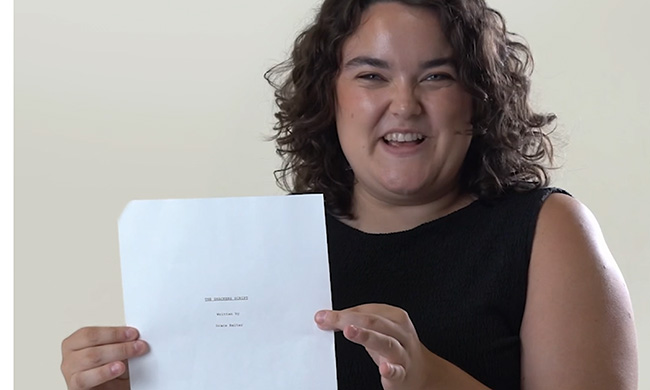
For the second year, Bumble Bee is bringing back its Tuna “Cans”Film Festival, giving aspiring filmmakers and creators the chance to turn a script written by comedian and actress, Grace Reiter, into an original short film starring its deliciously convenient tuna Snackers.
Watch the video to learn more!
“I love a chance to support those starting out in the film industry – and this time, I’m partnering with Bumble Bee for the Tuna Cans Film Festival to do it,” Reiter said. “Plus, I’m making it easy: I already wrote the script.”
Using Reiter’s scripted lines, creators can make the story entirely their own, bringing their vision to life through original characters, settings, music, editing and creative flair.
The creative brief is simple: The finished film must be 60 seconds or less and Bumble Bee Snackers™ need to get their moment in the spotlight.
Plus, the stakes are bigger than ever: The winning filmmaker will take home a $25,000 grand prize to help make their filmmaking dreams a reality.
Creators can submit their original short film by Oct. 23, 2026, at 11:59 p.m. PT.
The film can be funny, dramatic, unexpected or all three. The lines are already written but the order, arrangement and any additions are open to creative interpretation. Now it’s time to see what you can do with it.
Visit tunacansfilmfest.com, where you can find Reiter’s original script, submission instructions and complete contest details, to get started.
SOURCE:
Bumble Bee

Last Updated on October 9, 2026 by Daily News Staff
From haunted mazes after dark to daytime trick-or-treating with Snoopy, Knott’s offers two ways to celebrate Halloween in 2026.
BUENA PARK, Calif. — Halloween season is underway at Knott’s Berry Farm, where visitors can choose between the nighttime frights of Knott’s Scary Farm and the playful daytime activities of Knott’s Spooky Farm.
For readers planning a Southern California outing this October, the two celebrations offer different ways to get into the Halloween spirit.
Scary Farm brings new nightmares after dark
Knott’s Scary Farm runs on select nights through October 31, 2026, transforming the park with haunted mazes, scare zones, shows, and more than 1,000 creatures, according to Knott’s.
Two new mazes join this year’s lineup. Inked turns a cartoonist’s creations into a nightmare, while Unearthed sends visitors into an excavation where an ancient evil has awakened.
Also new for 2026 is Color Collect, an activity in which guests use an interactive lantern to activate pillars around the park and collect six colors.
Scary Farm requires its own paid event admission. As of October 4, online single-night tickets are advertised from $65, with taxes potentially additional. Knott’s does not recommend the event for children under 13.
Spooky Farm offers daytime Halloween fun
For families seeking a gentler celebration, Knott’s Spooky Farm takes place Thursdays through Sundays, September 24–October 31, plus October 12, according to the park’s events calendar, which lists the additional date as Columbus Day.
Children can trick-or-treat through Ghost Town, enjoy games and spooky stories with Snoopy and the Peanuts characters, and show off their Halloween outfits at Snoopy’s Spooktacular Costume Party.
Other activities include the Creepy Critters of Calico, cookie decorating in the pumpkin patch, and performances by the Bob Baker Marionette Theater. Cookie decorating carries an additional fee.
The daytime celebration gives families a chance to enjoy Halloween decorations, treats, and entertainment together before the nighttime haunt begins.
Planning your visit
Knott’s Berry Farm is located at 8039 Beach Boulevard in Buena Park, California. Before heading out, check the park’s official calendar for your chosen date, operating hours, admission options, and event policies.
Whether your Halloween plans call for a bag of candy or a trip through a haunted maze, Knott’s has a seasonal celebration to match.
Keep the fun going: Visit STM Daily News for more entertainment news, theme park updates, and stories worth sharing.
Official sources
- Knott’s Scary Farm: attractions and tickets
- Knott’s Spooky Farm: activities and entertainment
- Knott’s Berry Farm: seasonal event dates
Information checked October 4, 2026. Event schedules, offerings, and ticket prices may change.






