

The Knowledge
Artemis II crew brought a human eye and storytelling vision to the photos they took on their mission
Artemis II crew: Artemis II’s astronaut photos show how human perspective and storytelling make space imagery feel authentic—especially in an era of AI-generated visuals.

Christye Sisson, Rochester Institute of Technology
In early April 2026, the Artemis II mission captivated me and millions of people watching from across the world. The crew’s courage, skill and infectious wonder served as tangible proof of human persistence and technological achievement, all against the mysterious backdrop of space.
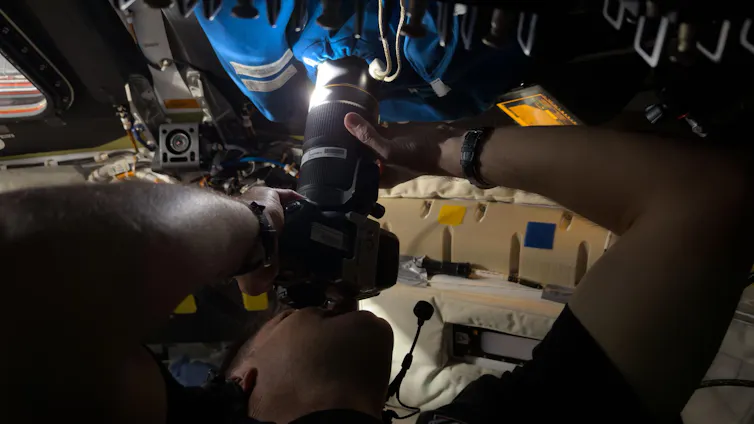
People back on Earth got to witness the mission through remarkable photos of space captured by astronauts. Images created and shared by astronauts underscore how photography builds a powerful, authentic connection that goes beyond what technology alone can capture.
As a photographer and the director of the Rochester Institute of Technology’s School of Photographic Arts and Sciences, I am especially drawn to how these photographs have been at the center of the public’s collective experience of this mission.
In an era when image authenticity is often questioned and with the capabilities of autonomous, AI-driven imaging, NASA’s choice to train astronauts in photography has placed meaning over convenience and prioritized their human perspectives and creativity.
Capturing space from the crew’s perspective
Photography was not originally placed as a high priority in NASA’s Apollo era. The astronauts only took photographs if they had the chance and all their other tasks were complete.
Thanks largely in part to public response to those images from Apollo, including “Earthrise” and the “Blue Marble” being widely credited for helping catalyze the modern environmental movement, NASA shifted its approach to utilize photography to help capture the public’s imagination by training their astronauts in photographic practices.
The Artemis II mission’s photographs have helped cut through the increasing volume of artificially generated images circulating on social media. NASA’s social media releases of the crew’s photographs have garnered thousands of shares and comments.
This excitement could be explained by the novelty of photos from space, but these images also distinguish themselves as products of astronauts experiencing these sights and interpreting them through their photographs. These differences require an important distinction around where technology ends and humanity begins.
Human perspective versus AI tools
Photography has long integrated AI-powered software and data-driven tools in a variety of ways: to process raw images, fill in missing color information, drive precise focus and guide image editing, among others. These modern technological assists help human photographers realize their vision.
Artificial intelligence is also increasingly capable of operating machinery competently and autonomously, from cars to drones and cameras.
And AI can generate convincing, realistic images and videos from nothing more than a text prompt, using readily available tools.
Researchers train AI to mimic patterns informed by millions of sample images, and the algorithm can then either take or create a photograph based on what it predicts would be the most likely version of a successful, believable image.
Human-created photos are rooted in direct observation, intent and lived experience, while AI images – or choices made by AI-driven tools – are not. While both can produce compelling and believable visuals, the human photographs carry emotional power because the photographer is drawing from their experiences and perspective in that moment to tell an authentic story.
Artemis II photographs resonate, not only because they are historic, but because they reflect the deliberate choices and intent of a human being in that specific moment and context. The exposure, camera setting, lens choice and composition are all dictated by the astronaut’s vision, skill, perspective and experience. Each image is unique in comparison with the others. These choices give the images narrative power, anchoring them in human perspective.
Images to tell a story
Photographers choose what to include in the final version of their image to tell a story. In the Artemis II images, this human perspective comes out. In the “Earthset” photo, you see a striking juxtaposition of the Moon’s monochromatic, textured surface in the foreground against a slivered, bright Earth.
The choice to include both in the frame contrasts these objects literally and figuratively, inviting comparison. It creates a narrative where Earth is contrasted against the Moon – life is contrasted against the absence of it.
Another photo shows the nightside of the whole Earth, featuring the Sun’s halo, auroras and city lights. The choice to include the subtle framing of the window of the capsule in the lower left corner reminds the viewer where and how this image was captured: by a human, inside a capsule, hurtling through space. That detail grounds the photograph in the human perspective.
Both photos are reminiscent of Earthrise and the Blue Marble. These past images hold a place in the global collective consciousness, shaped by a shared historical moment.
The Artemis II photographs are anchored in this collective moment of lived human experience, yet also shaped by each astronaut’s viewpoint. The crew’s unique perspectives exemplify photography’s transformative power by inviting viewers to engage emotionally and intellectually with their journey. These photographs share the astronauts’ awe and wonder and affirm the value of human creativity and its ability to connect us in a captured moment.
Christye Sisson, Professor of Photographic Sciences, Rochester Institute of Technology
This article is republished from The Conversation under a Creative Commons license. Read the original article.
Dive into “The Knowledge,” where curiosity meets clarity. This playlist, in collaboration with STMDailyNews.com, is designed for viewers who value historical accuracy and insightful learning. Our short videos, ranging from 30 seconds to a minute and a half, make complex subjects easy to grasp in no time. Covering everything from historical events to contemporary processes and entertainment, “The Knowledge” bridges the past with the present. In a world where information is abundant yet often misused, our series aims to guide you through the noise, preserving vital knowledge and truths that shape our lives today. Perfect for curious minds eager to discover the ‘why’ and ‘how’ of everything around us. Subscribe and join in as we explore the facts that matter. https://stmdailynews.com/the-knowledge/


unknown
Did Jackie Gleason See Aliens? Inside the Strange Nixon–UFO Legend
Jackie Gleason reportedly told his wife that President Richard Nixon arranged for him to view preserved extraterrestrial bodies at a Florida Air Force base. Here is what we know—and why the remarkable story remains unverified.

The beloved comedian reportedly told his wife that President Richard Nixon arranged for him to view preserved extraterrestrial bodies at a Florida Air Force base. Decades later, the extraordinary story remains fascinating—but unverified.
Jackie Gleason is remembered as “The Great One,” the larger-than-life entertainer who turned bus driver Ralph Kramden into one of television’s most enduring characters on The Honeymooners. Away from the cameras, however, Gleason had another consuming interest: UFOs, psychic phenomena and the possibility of extraterrestrial life.
That interest eventually became the foundation of one of the strangest stories ever associated with an American president and a Hollywood celebrity. According to Gleason’s second wife, Beverly McKittrick, her husband came home late one night in 1973 and claimed that President Richard Nixon had helped him see the preserved bodies of extraterrestrial beings at Homestead Air Force Base in Florida.
Did Jackie Gleason really see aliens?
The honest answer is that we do not know. The allegation is remarkable, but the available evidence never rises above an uncorroborated story attributed to Gleason years after the supposed event.
Gleason’s fascination with UFOs was real
There is little question that Gleason took the UFO subject seriously. He reportedly assembled a substantial personal library devoted to UFOs, the paranormal and related mysteries. His unusual circular home in New York—often nicknamed “The Mothership”—only strengthened his public association with flying saucers, although its distinctive architecture is not evidence of an extraterrestrial encounter.
Gleason also had a genuine social connection with Nixon. The two men shared an interest in golf and spent time together in Florida. That documented friendship is the factual starting point from which the more sensational story grew.
The alleged trip to Homestead Air Force Base
McKittrick said that Gleason returned to their Florida home at about 11:30 one evening looking disturbed. According to her account, he told her that Nixon had arrived without the usual presidential entourage and taken him to Homestead Air Force Base, south of Miami.
Once there, Gleason allegedly entered a secured building where he saw small humanoid bodies preserved inside glass-topped containers. Published versions differ over the number of bodies and some physical details, but they generally describe child-sized beings with oversized heads.
Importantly, McKittrick did not claim to have accompanied the men or witnessed anything at the base. Her account was based entirely on what she said Gleason told her after returning home.
The story became public in 1983, years after the alleged visit and after the couple had divorced. It circulated widely through tabloid reporting, UFO publications and later books, gradually becoming part of UFO folklore.
Why the story remains unverified
No authenticated photograph, visitor record, military document or firsthand statement from Nixon has emerged to confirm the alleged trip. Gleason also never provided investigators with a signed affidavit describing the experience.
UFO researcher Larry Bryant reportedly sought records from Homestead and tried to obtain a statement from Gleason, but those efforts produced no confirming documentation. Gleason’s refusal to address the account publicly has sometimes been portrayed as suspicious, but silence is not proof that an event occurred.
There is another important complication: McKittrick later expressed uncertainty about her former husband’s story.
During telephone interviews conducted by researcher Kenny Young in 2003, she stood by her recollection that Gleason told her he had seen “dead aliens.” She also acknowledged that, as the years passed, she wondered whether he might have invented the explanation because he had been out late. She declined to appear on camera and said the story should be authenticated first.
Her later comments do not establish that the account was false, but they considerably weaken any attempt to treat it as verified history.
Could a president have slipped away unnoticed?
Some versions of the legend emphasize that Nixon supposedly drove to Gleason’s house alone and then entered a military installation without his Secret Service detail. Presidents have occasionally sought privacy or slipped away from tightly managed schedules, but a secret nighttime excursion of this nature would have involved serious security and logistical obstacles.
The claim becomes even more difficult to accept when we consider what Nixon allegedly revealed. If the United States possessed extraterrestrial bodies, granting a comedian personal access to them would have represented an extraordinary breach of national security—with no apparent official purpose and no surviving documentation.
None of that makes the episode logically impossible. It does, however, mean that the story requires exceptionally strong evidence. That evidence has never appeared.
A compelling legend, not a confirmed encounter
The Jackie Gleason story endures because it combines three irresistible ingredients: a famous comedian fascinated by UFOs, a secretive American president and a nighttime visit to a military base containing an alleged government secret.
What can be established is that Gleason was deeply interested in UFOs, knew Nixon and was said by his former wife to have made an extraordinary claim. What cannot be established is that Nixon took him to Homestead Air Force Base or that preserved extraterrestrial bodies were ever stored there.
So, did Jackie Gleason see aliens?
Perhaps he believed that he did—or perhaps he simply told an unforgettable story. Until corroborating evidence emerges, the alleged encounter belongs in the intriguing borderland between celebrity history and American UFO mythology.
Sources and further reading
- The Black Vault: Jackie Gleason and the Pickled Alien
- University of Miami Libraries: The Jackie Gleason Collection
- U.S. Department of Defense: All-domain Anomaly Resolution Office
Step into The Unknown, where STM Daily News explores the strange phenomena, unexplained encounters and enduring mysteries that continue to challenge what we think we know. From UFO sightings and paranormal events to historical mysteries and unusual scientific discoveries, we examine the stories, evidence and competing explanations—without losing our sense of wonder. https://stmdailynews.com/science/unknown/
The Knowledge
Benjamin O. Davis Jr.: From West Point Isolation to Four-Star General
Benjamin O. Davis Jr. endured racial isolation at West Point before becoming a pioneering military aviator, commander of the Tuskegee Airmen and the first Black general officer in the U.S. Air Force. His extraordinary career ultimately earned him four stars.
Forgotten Genius Fridays | STM Daily News
For four years at West Point, fellow cadets tried to isolate Benjamin O. Davis Jr.
They wouldn’t room with him. They excluded him socially. Outside of official duties, other cadets largely refused to speak to him.
The intention was clear: make life so difficult that he would leave.
Benjamin O. Davis Jr. didn’t leave.
He graduated.
And the young officer who endured isolation at West Point would eventually command some of America’s most celebrated fighter pilots, help lead the integration of the U.S. Air Force and finish his remarkable journey wearing four stars.
The Son of a Pioneer
Benjamin Oliver Davis Jr. was born in Washington, D.C., on December 18, 1912.
Military service was already part of the Davis household.
His father, Benjamin O. Davis Sr., was a career Army officer who would make history in 1940 as the first Black general officer in the U.S. Army and U.S. armed forces.
The younger Davis developed another ambition.
He wanted to fly.
But in the segregated American military of the era, becoming a Black military aviator wasn’t simply difficult.
The opportunity effectively didn’t exist.
Davis would first have to prove himself somewhere else.
Four Years of Isolation at West Point
Davis entered the United States Military Academy at West Point in July 1932.
He encountered racial hostility almost immediately.
White cadets subjected Davis to what amounted to a prolonged campaign of social isolation. He roomed alone and generally ate without other cadets speaking to him.
The National Park Service records that Davis nevertheless persevered, graduating in June 1936 in the top 20 percent of his class. He was the fourth African American to graduate from West Point.
Years later, Davis recalled the purpose of the treatment: it was intended to make him buckle.
He refused.
That determination would become one of the defining characteristics of his military career.
An Officer Who Wanted to Fly
Graduation didn’t eliminate the barriers.
Davis was commissioned as a second lieutenant of infantry. After assignments including Fort Benning, Georgia, he became a professor of military science at Tuskegee Institute in Alabama.
Then an opportunity appeared that would change American military aviation.
The Army began establishing a program to train Black military pilots at Tuskegee.
Davis entered advanced flying school in 1941.
On March 7, 1942, the first class of five Black Army Air Forces fighter pilots graduated from Tuskegee.
Benjamin O. Davis Jr. was among them.
He finally had his wings.
Taking the 99th to War
Davis transferred to the Army Air Corps and became commander of the 99th Fighter Squadron.
In April 1943, he traveled with the squadron to North Africa.
Flying P-40 Warhawks, the Black pilots were finally entering combat.
But their abilities would soon be challenged from within their own military.
Reports questioning the combat performance of the 99th threatened the future of Black military aviation.
Davis returned to Washington and defended his pilots before War Department officials.
The squadron continued fighting.
Its combat performance helped answer the critics more convincingly than prejudice ever could.
Commanding the 332nd
Davis subsequently assumed command of the 332nd Fighter Group, which eventually brought together the 99th, 100th, 301st and 302nd Fighter Squadrons.
Operating from Italy, the group flew bomber escort and other combat missions over Europe.
Eventually flying P-51 Mustangs distinguished by their red-painted tails, the pilots became associated with one of the most recognizable names in American aviation history:
The Red Tails.
Davis didn’t simply command from behind a desk.
He flew combat missions himself.
During the war, his leadership and combat service earned decorations including the Silver Star and Distinguished Flying Cross.
The Tuskegee Airmen were demonstrating something segregation had attempted to deny—that Black Americans could perform highly demanding aviation missions and lead combat organizations.
From Tuskegee to an Integrated Air Force
World War II ended, but Davis’s military career continued.
In 1947, the United States Air Force became an independent military service.
Then, in 1948, President Harry S. Truman issued Executive Order 9981, establishing a policy of equality of treatment and opportunity in the armed forces regardless of race, color, religion or national origin.
Davis became involved in the Air Force’s efforts to implement integration.
The officer who had once been deliberately isolated because of his race was now helping a military service move away from institutional segregation.
Another War
Davis continued advancing.
During the Korean War era, he commanded the 51st Fighter-Interceptor Wing in Korea.
His responsibilities continued expanding through assignments in the United States, Europe and Asia.
Then another barrier fell.
On October 27, 1954, Davis received his temporary promotion to brigadier general.
He became the first Black general officer in the United States Air Force.
His father’s historic achievement now had an extraordinary parallel.
Benjamin O. Davis Sr. had become the Army’s first Black general.
Benjamin O. Davis Jr. had become the Air Force’s first.
Three Stars
Davis continued climbing through the senior leadership of the Air Force.
He became a major general and, in 1965, lieutenant general.
His assignments included command of the 13th Air Force in the Philippines and service as deputy commander in chief of U.S. Strike Command.
By the time Davis retired from active military service on February 1, 1970, the cadet who had once eaten alone at West Point was wearing three stars.
But history wasn’t quite finished with Benjamin O. Davis Jr.
The Fourth Star
Twenty-eight years after his retirement, Davis returned to the national spotlight.
On December 9, 1998, President Bill Clinton advanced the retired lieutenant general to the rank of general.
Four stars.
The moment carried enormous symbolism.
The cadet other students had refused to speak to had become one of the highest-ranking officers in American military history.
Yet an important distinction should be remembered: Davis was not the first Black four-star general in the Air Force. That milestone belonged to Daniel “Chappie” James Jr., who reached four-star rank while on active duty in 1975.
Davis’s fourth star nevertheless represented recognition of an extraordinary career spanning some of the most significant transformations in twentieth-century American military history.
The Davis Legacy
Benjamin O. Davis Jr. died on July 4, 2002, at age 89.
His life tells an extraordinary American story.
His father began his Regular Army career with the Buffalo Soldiers and became America’s first Black general officer.
The son endured four years of racial isolation at West Point.
He became one of the first five Black Army pilots trained at Tuskegee.
He commanded the 99th Fighter Squadron.
He led the 332nd Fighter Group.
He helped the Air Force navigate integration.
He commanded forces during the Cold War.
And eventually, he wore four stars.
The Davis family story spans generations of American military history—from the Buffalo Soldiers to the Tuskegee Airmen and from segregation to integration.
Benjamin O. Davis Sr. broke one barrier.
The Tuskegee Airmen shattered assumptions about Black military aviation.
And Benjamin O. Davis Jr. carried that legacy from West Point into the skies—and ultimately to the highest ranks of the United States Air Force.
Two generations. One extraordinary legacy.
Forgotten Genius Fridays is an STM Daily News series highlighting innovators, pioneers and historical figures whose achievements deserve a larger place in our collective memory.
Sources and Related Reading
U.S. Air Force — General Benjamin O. Davis Jr. biography
National Park Service — Benjamin O. Davis Jr.
National Museum of the United States Army — Benjamin O. Davis Jr.
More more stories like this, please visit our Forgotten Genius Friday!
Forgotten Genius Fridays
The Tuskegee Airmen: The Red Tails Who Fought Two Wars
The Tuskegee Airmen were far more than the legendary Red Tail fighter pilots. Thousands of pilots, mechanics, instructors and support personnel challenged segregation while helping fight World War II—and their achievements helped change the U.S. military.
A Forgotten Genius Special | STM Daily News
They were training to fight America’s enemies overseas while confronting discrimination in the country they had volunteered to defend. The Red Tails.
They became known as the Tuskegee Airmen.
Their story is often reduced to an image of Black fighter pilots flying red-tailed P-51 Mustangs over Europe during World War II. But the real story was much larger.
The Tuskegee Airmen included pilots, mechanics, instructors, navigators, bombardiers, radio operators, parachute riggers, medical personnel, meteorologists, cooks, clerks, control-tower personnel and many others who helped make military aviation possible.
The National Park Service describes more than 16,000 people as participants in the broader Tuskegee experience.
Together, they helped challenge one of the most persistent prejudices in the American military: the racist assumption that Black Americans lacked the intelligence, discipline or ability required to become successful military aviators.
They proved otherwise.
An Experiment Built on a False Assumption
In January 1941, Secretary of War Henry L. Stimson authorized the formation of a Black pursuit squadron.
The 99th Pursuit Squadron, later redesignated the 99th Fighter Squadron, was activated in March 1941.
Because the American military remained segregated, Black aviators weren’t simply incorporated into existing flying units. A separate training program was established around Tuskegee, Alabama.
Flight training took place at Moton Field, while Tuskegee Army Air Field provided advanced military flight training.
What military officials regarded as an experiment would ultimately help demonstrate that the restrictions placed upon Black aviators had nothing to do with their abilities.
More Than Pilots
The name “Tuskegee Airmen” can be misleading if we imagine only the men sitting inside fighter cockpits.
Aircraft don’t fly because of pilots alone.
They require mechanics.
Fuel crews.
Radio operators.
Meteorologists.
Armorers.
Dispatchers.
Parachute riggers.
Medical personnel.
Instructors.
Navigators.
Engineers.
Control-tower operators.
Administrative personnel.
And many others.
Women were part of the Tuskegee experience as well. According to the National Park Service, women worked as mechanics, control-tower operators, aircraft fuselage technicians, gate guards, secretaries and clerks. Three permanent female parachute riggers helped train hundreds of cadets in the proper packing and maintenance of parachutes.
The Tuskegee story was therefore not simply the story of several hundred pilots.
It was the story of an entire aviation community.
Taking the Fight Overseas
The 99th Fighter Squadron deployed overseas in 1943.
Flying Curtiss P-40 Warhawks, its pilots entered combat in the Mediterranean theater, operating from North Africa and later Sicily and Italy.
The Tuskegee program continued expanding.
Three additional Black fighter squadrons—the 100th, 301st and 302nd—became part of the 332nd Fighter Group.
And the man who would eventually command them had already experienced another form of racial isolation.
His name was Benjamin O. Davis Jr.
The son of America’s first Black Army general had graduated from West Point in 1936 after fellow cadets subjected him to years of deliberate social isolation.
Now Davis was leading Black American fighter pilots into combat.
The Red Tails
The 332nd eventually transitioned to the aircraft that became most closely associated with the Tuskegee Airmen:
The North American P-51 Mustang.
The tails of the group’s aircraft were painted red to identify the unit.
The distinctive markings helped produce one of the most famous nicknames in American military aviation:
The Red Tails.
Operating primarily from Italy, the 332nd escorted heavy bombers deep into enemy territory while also attacking ground targets.
Escort duty was extraordinarily important.
American bombers flying deep into enemy territory were vulnerable to German fighters. Escort pilots had to remain close enough to protect the bombers while simultaneously watching for enemy aircraft.
The Tuskegee Airmen developed an impressive record performing that mission.
The Legend — and the Reality
One claim became particularly famous after the war:
The Tuskegee Airmen never lost a bomber they escorted to enemy fighters.
It is an inspiring story.
It also isn’t completely accurate.
Research by Air Force historian Daniel Haulman using wartime mission reports found that 27 bombers being escorted by the 332nd Fighter Group were shot down by enemy aircraft.
Those losses occurred during seven of the group’s 179 bomber escort missions for the Fifteenth Air Force.
But correcting the legend doesn’t diminish their accomplishment.
In fact, the documented record remains impressive.
Research comparing the 332nd with other P-51 fighter groups in the Fifteenth Air Force found that the Tuskegee Airmen lost substantially fewer escorted bombers to enemy aircraft than the other groups examined.
The truth doesn’t weaken their story.
The truth makes their achievement real.
Fighting Two Wars
The enemy wasn’t confined to the skies over Europe.
Black servicemen returned from missions defending democracy overseas while still confronting segregation at American military installations and throughout American society.
This contradiction became part of the broader Double V campaign during World War II—the call for victory against fascism abroad and racial discrimination at home.
Tuskegee personnel repeatedly challenged discriminatory military policies.
One of the most significant confrontations occurred in 1945 at Freeman Field, Indiana, when Black officers protested restrictions that prevented them from using an officers’ club reserved for white officers.
Their resistance became known as the Freeman Field Mutiny.
The confrontation demonstrated that the Tuskegee story wasn’t simply about proving Black Americans could fly airplanes.
It was also about demanding the rights that should accompany wearing the same uniform.
Changing More Than Aviation
The Tuskegee Airmen didn’t single-handedly desegregate the United States military.
But their performance undermined one of the principal arguments used to justify segregation—that Black servicemen could not perform highly technical or demanding military assignments as effectively as white servicemen.
Three years after the Tuskegee flying program began sending pilots into combat, President Harry S. Truman issued Executive Order 9981 on July 26, 1948, establishing a federal policy of equality of treatment and opportunity in the armed services regardless of race, color, religion or national origin.
Military integration would take additional years to implement.
But the old assumptions had become increasingly difficult to defend.
A Legacy Larger Than the Red Tails
The Tuskegee Airmen eventually became symbols of perseverance, military excellence and the long struggle to expand opportunity within America’s armed forces.
In 2007, the Tuskegee Airmen collectively received the Congressional Gold Medal in recognition of their service.
Yet perhaps the best way to understand their achievement is not through mythology.
They didn’t need a perfect combat record to make history.
They trained in a system created because many officials doubted Black Americans could become military aviators.
They went into combat.
They flew.
They fought.
They protected bomber formations.
They maintained aircraft.
They trained pilots.
And thousands of people behind the scenes made those missions possible.
They demonstrated through performance what segregation had attempted to deny.
And among the men leading them was the son of America’s first Black Army general.
His name was Benjamin O. Davis Jr.
His journey had taken him from isolation at West Point to the cockpit of a military aircraft and command of the 332nd Fighter Group.
But his story was far from finished.
Next Friday on Forgotten Genius Fridays: Benjamin O. Davis Jr. — From West Point Isolation to Four-Star General.
Forgotten Genius Fridays is an STM Daily News series exploring innovators, pioneers and historical figures whose achievements deserve a larger place in our collective memory.
Sources & Related Links
National Park Service — Tuskegee Airmen History & Culture documents the broad definition of the Tuskegee Airmen and the many ground and support occupations involved.
Air Force Historical Support Division — Tuskegee Airmen provides an excellent military chronology of the 99th Fighter Squadron and 332nd Fighter Group.
National Park Service — Tuskegee Airmen National Historic Site is especially useful for Moton Field, training and the Red Tails.
National Park Service — And There Were Women provides material for an often-overlooked part of the story: women who participated in the Tuskegee experience.
Congress authorized a Congressional Gold Medal for the Tuskegee Airmen collectively, recognizing their military record and its role in inspiring reform in the armed forces; the presentation ceremony took place in 2007.
Explore more fascinating stories, videos, and articles on The Knowledge at STM Daily News!





