

Health and Life Insurance
Lessons in Life Insurance: 4 Reasons Getting It May Be Easier Than You Think
Life is the most valuable thing you have – and like all valuable things, it should be insured. Even thinking about life insurance can be stressful, so it’s one of those things that’s easy to put off and tell yourself you’ll do another day. Consider these four ways to make getting life insurance simpler than you thought.


Lessons in Life Insurance: 4 Reasons Getting It May Be Easier Than You Think
(Feature Impact) Life is the most valuable thing you have – and like all valuable things, it should be insured. Even thinking about life insurance can be stressful, so it’s one of those things that’s easy to put off and tell yourself you’ll do another day.
If that’s how you feel, you aren’t alone. According to the 2026 Life Happens Life Insurance Survey, nearly half (46%) of U.S. adults have getting life insurance on their to-do list but plan to deal with it later or not at all. Confusion, procrastination and cost concerns are among the main reasons people kick this can down the road, according to 45% of respondents.
Yet the survey also uncovered an interesting disconnect: 69% of Americans said they personally know someone who had life insurance or whose family used a life insurance policy, most often a parent or parent figure (33%), but still haven’t made getting coverage a priority.
“Life insurance isn’t unfamiliar to most Americans,” Life Happens Executive Director Brian Steiner said. “The challenge is turning that awareness into action. People may think life insurance is something they can deal with later, but waiting can leave the people they love financially vulnerable. Getting started doesn’t have to be complicated, and professional guidance can help you find protection that fits your needs and budget.”
Consider these four ways to make getting life insurance simpler than you thought.
Watch this video to learn more
1. Find a policy that’s a fit.
Roughly 4 in 10 survey respondents reported feeling overwhelmed, anxious or some combination of both about planning for life insurance, with 12% citing thinking it’ll be too expensive as a reason they’ve delayed looking into, buying or updating life insurance.
The good news: There’s a policy that’s right for your current needs. It may be term life insurance, which provides protection for a specific period of time, like to cover a mortgage or tuition for children. There’s also permanent life insurance, which offers lifelong protection, as long as you pay the premiums.
2. Take advantage of digital tools
One-quarter of respondents said they’d be more likely to look into life insurance if they learned it was easier to get than they thought, and digital tools can help make that demand a reality.
It can take as little as two minutes to find out how much you need, for example, with the life insurance needs calculator from the nonprofit Life Happens. Just answer a few simple questions to estimate the amount of life insurance coverage you may need to take care of your family.
3. It’s about protection, not perfection.
Part of the anxiety around life insurance may be the perception that it should be perfect. For more than 1 in 5 survey participants, the plan is to seriously look at it when they feel more financially stable, and another 12% simply said they’ll do it when they’re older.
However, life insurance doesn’t have to check all the boxes for every stage of your life – you can find what works for your family right now then adjust as things change over time.
4. Professional help is available.
Perhaps the biggest hurdle to tackling life insurance is the feeling that you’re in it alone. Overall, 55% of respondents said if they learned life insurance may be easier to get than they expected, they’d be more likely to start the process.
With professional help only a few clicks away, you can rest assured you’re on the path to a life insurance fit that’s right for you by visiting findapro.lifehappens.org.
Photo courtesy of Shutterstock

SOURCE:


Women's Health
Menopause changes your mouth. Most women have no idea.
Menopause changes your mouth: Many women are familiar with the most talked-about symptoms of menopause – hot flashes, disrupted sleep, brain fog and mood swings. Far fewer know that dry mouth and sensitive teeth belong on that list too.

Menopause changes your mouth. Most women have no idea.
(Sheeka Sanahori) Many women are familiar with the most talked-about symptoms of menopause – hot flashes, disrupted sleep, brain fog and mood swings. Far fewer know that dry mouth and sensitive teeth belong on that list too.
There’s a name for it: menopause mouth. According to survey data from Delta Dental Insurance Company, 83% of women 40 and older in menopause aren’t aware of any of its symptoms.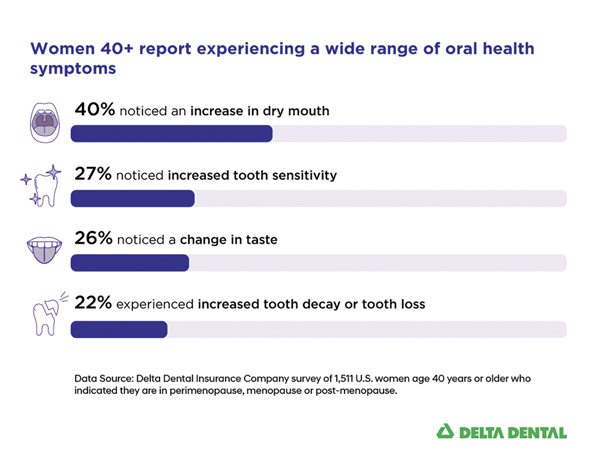
What menopause mouth feels like
Forty percent say they have noticed an increase in dry mouth. Another 27% have noticed more tooth sensitivity in recent months, and 26% say things taste different than they used to. You tell yourself it’s something else. You’re not drinking enough water; you’ve been brushing too hard. Menopause isn’t the first thing that comes to mind.
It adds up. Forty-five percent say oral symptoms associated with menopause, such as tooth pain, dry mouth or gum inflammation, take a toll on their confidence, mood or mental health.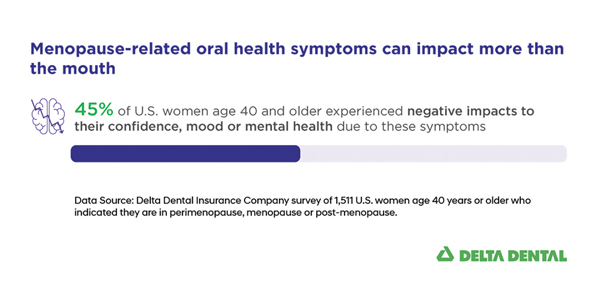
Menopause affects the whole body, mentally and physically. So why is the mouth left out?
Even after learning about this connection, 30% of women say they can’t find information about menopause-related oral health concerns. It isn’t that no one is willing to discuss it.
What makes the conversation hard to start
Three-quarters of dentists say they are comfortable discussing menopause with patients. They just want to know who they’re talking to. Most say they would want more patient history, or to know a patient was in menopause, before raising the subject. Forty-five percent say they would not bring up how menopause affects oral health unless a patient asked.
Dentists also believe that patients are already informed. Ninety-four percent say their patients are at least somewhat aware that menopause can affect oral health. So a patient says nothing about her dry mouth, because it doesn’t seem like a dental problem. The dentist doesn’t bring it up either, assuming someone already has.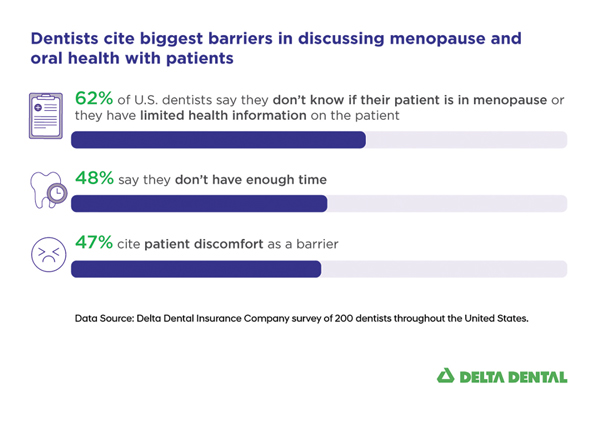
Women are asking for the information
Nearly nine in 10 women say it would help to receive specific instructions during dental visits about managing oral health during menopause. And 69% say they would be more likely to book an appointment if a primary care provider or OB-GYN had told them menopause affects oral health.
No matter who brings it up, the conversation is one worth having. Hormonal changes during menopause can increase the risk of tooth loss or tooth decay, gum disease, receding gumline or loss of jawbone density. Discussing new oral symptoms with a dentist can help women identify potential problems and address them early.
How to start the conversation with your dentist
Your dentist probably doesn’t know you’re in menopause. Start there.
Questions worth asking:
- “Could the changes I’m noticing be related to menopause?”
- “I haven’t had a cavity in 30 years, and now I have two. Could that be tied to hormonal changes?”
- “What can I do about dry mouth?”
- “Are there symptoms I should watch for?”
- “Should I adjust my oral care routine?”
Any one of these questions can get the conversation started.
Methodology
Delta Dental Insurance Company commissioned Atomik Research to conduct two online surveys between June 25 and July 2, 2025.
The first surveyed 200 dentists throughout the United States. The margin of error is +/- 7 percentage points with a 95% confidence level.
The second surveyed 1,511 women ages 40 or older throughout the United States. To qualify, participants had to indicate they are in perimenopause, menopause or post-menopause. Those who were not sure which stage they were in, or who indicated they were not yet in one of the three stages, were excused from participation. The margin of error is +/- 3 percentage points with a 95% confidence level
Atomik Research, part of 4media group, is an independent market research agency.
Photo courtesy of Shutterstock
SOURCE:
Delta Dental Insurance Company
Health and Life Insurance
Medicare Open Enrollment Ends Dec. 7: Give Your Plan a Check-up
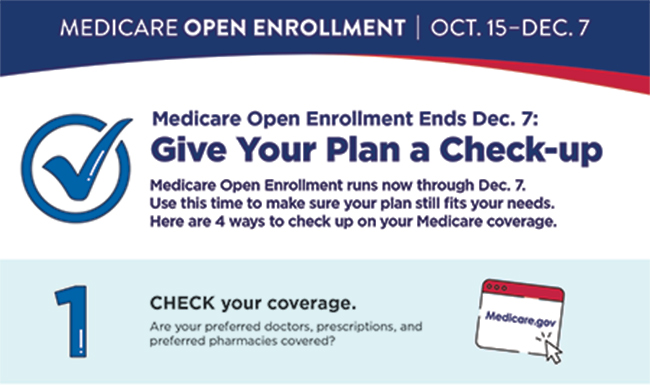
Medicare Open Enrollment Ends Dec. 7: Medicare Open Enrollment runs now through Dec. 7. Use this time to make sure your plan still fits your needs with these four steps.
Medicare Open Enrollment Ends Dec. 7: Give Your Plan a Check-up
(Feature Impact) Medicare Open Enrollment runs now through Dec. 7. Use this time to make sure your plan still fits your needs. Medicare.gov is your official source for Open Enrollment. Compare every Medicare health and drug plan available in your area. You can easily compare Medicare plan costs, side-by-side, by simply entering the prescription drugs you take. If you prefer to talk with someone, call 1-800-MEDICARE (1-800-633-4227), available 24/7, to review your options and get your questions answered.
Information provided by the U.S. Department of Health & Human Services.


SOURCE:
Centers for Medicare and Medicaid Services
Health and Life Insurance
Review Your Medicare Coverage Options: Open Enrollment is Through Dec. 7
Medicare Coverage Options: Medicare Open Enrollment is your opportunity to give your Medicare plan a check-up. Plans change every year, and now is the time to check if a new plan could be better for you.

Review Your Medicare Coverage Options: Open Enrollment is Through Dec. 7
(Feature Impact)Medicare Open Enrollment is your opportunity to give your Medicare plan a check-up. Plans change every year, and now is the time to check if a new plan could be better for you.
If you have Medicare, taking the time to review your coverage options each fall is one of the most important health decisions you can make.
Give Your Medicare Plan a Check-up
- Check your coverage. Ensure your preferred doctors, prescriptions and preferred pharmacies are covered.
- Check your costs. Look at premiums, deductibles, copays and other out-of-pocket costs.
- Check for changes. See what will be different in your plan for the coming year.
- Check your options. Compare plans side by side based on the prescriptions you take. Find the right plan for your health needs and your budget. Make sure your drugs are covered.
Now is the one time you can make changes to your health and prescription drug plans and find a plan that’s better for you. Medicare Open Enrollment is your opportunity to review and compare options and take control of your expenditures and coverage.
 Medicare plans change annually and so does your health. What worked for you last year may be different than what will work best this year. A review of your options can help you secure a plan best fit to your current lifestyle and health needs – while potentially saving you hundreds of dollars on out-of-pocket costs.
For instance, a person with Medicare compared drug plans to find the best costs and coverage for their prescriptions, including a blood thinner and a common cholesterol medication. Using medicare.gov, they found the yearly cost for a Medicare drug plan and these prescriptions ranged from $1,356-2,965. By choosing the lowest-cost plan, they saved more than $1,600 while keeping their essential medications covered.
Medicare.gov is the Official Source
For all your Open Enrollment needs, Medicare.gov is your official source. It’s the trusted resource to help you navigate Open Enrollment, allowing you to explore and compare every available Medicare health and drug plan available in your area. If you prefer speaking with someone directly, call 1-800-MEDICARE to connect with a team of experts who are available 24/7 to help you review your options and answer any questions about your Medicare coverage.
To get started, go to Medicare.gov and click on “Find Plans Now.” For the best shopping experience, log in or create a Medicare account. You can easily compare plan costs, side by side, based on the medications you take. Make sure the plan you choose covers your prescription drugs and your doctors.
Don’t Wait – Open Enrollment Ends Dec. 7
If you miss the Dec. 7 deadline, you may need to wait a full year before you can make any changes to your coverage. That’s why getting started early is important. Make sure you give yourself enough time to review and compare your options. You’ll want to consider factors like costs, benefits and prescription drug plans.
Medicare Open Enrollment is the perfect time to plan for the future and prioritize your health. Making sure you have a health plan that can support you in your wellness journey is critical, so don’t wait. Start reviewing your Medicare plan options today at Medicare.gov.
Information provided by the U.S. Department of Health & Human Services.
Photos courtesy of Shutterstock
SOURCE:
Centers for Medicare and Medicaid Services




