

The Bridge
Federal judge rules that Louisiana shalt not require public schools to post the Ten Commandments

Charles J. Russo, University of Dayton
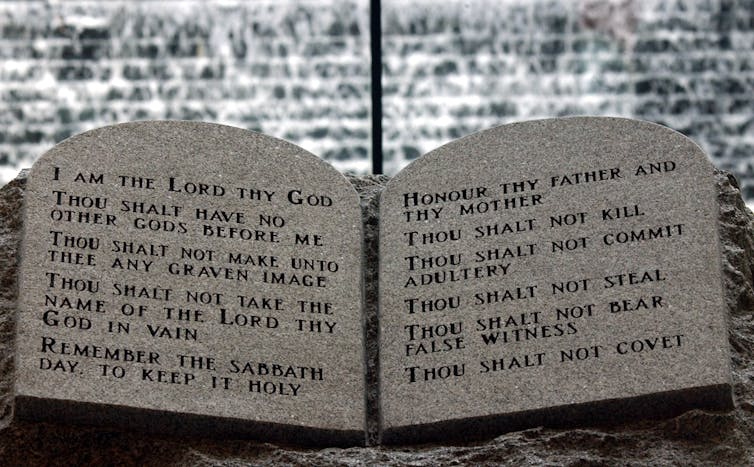
Do the Ten Commandments have a valid place in U.S. classrooms? Louisiana’s Legislature and governor insist the answer is “yes.” But on Nov. 12, 2024, a federal judge said “no.”
U.S. District Judge John W. deGravelles blocked the state’s controversial House Bill 71, which Gov. Jeff Landry had signed into law on June 19, 2024. The measure would have required all schools that receive public funding to post a specific version of the commandments, similar to the King James translation of the Bible used in many, but not all, Protestant churches. It is not the same version used by Catholics or Jews.
Officials were also supposed to post a context statement highlighting the role of the Ten Commandments in American history and could display the Pilgrims’ Mayflower Compact, the Declaration of Independence and the Northwest Ordinance of 1787, a federal enactment to settle the frontier – and the earliest congressional document encouraging the creation of schools.
The law’s defenders argued that its purpose was not only religious, but historical. Judge deGravelles, though, firmly rejected that argument, striking down HB 71 as “unconstitutional on its face and in all applications.” The law had an “overtly religious” purpose, he wrote, in violation of the First Amendment, according to which “Congress shall make no law respecting an establishment of religion, or prohibiting the free exercise thereof.”
Regardless of the Ten Commandments’ impact on civil law, there was a clear religious intent behind Louisiana’s law. During debate over its passage, for example, the bill’s author, state Rep. Dodie Horton said, “I’m not concerned with an atheist. I’m not concerned with a Muslim. I’m concerned with our children looking and seeing what God’s law is.”
Louisiana Attorney General Liz Murrill has said she intends to appeal the judge’s ruling.
As someone who teaches and researches law around religion and education, with an eye toward defending religious freedom, I believe this is an important test case at a time when the Supreme Court’s thinking on religion and public education is becoming more religion-friendly – perhaps the most it has ever been.
How SCOTUS has ruled before
Litigation over the Ten Commandments is not new. More than 40 years ago, in Stone v. Graham, the Supreme Court rejected a Kentucky statute that mandated displays of the Ten Commandments in classrooms.
The court reasoned that the underlying law violated the First Amendment’s establishment clause – “Congress shall make no law respecting an establishment of religion” – because the mandate lacked a secular purpose.
The justices were not persuaded by a small notation on posters that described the Ten Commandments as the “fundamental legal code of Western Civilization and the Common Law of the United States.”
Twenty-five years later, the Supreme Court again took up cases challenging public displays of the Ten Commandments, although not in schools. This time, the justices reached mixed results.
The first arose in Kentucky where officials had erected a county courthouse display of texts including the Ten Commandments, the Magna Carta, the Declaration of Independence and a biblical citation. In a 2005 ruling in McCreary County, Kentucky v. American Civil Liberties Union of Kentucky the five-member majority agreed that the display of the Ten Commandments violated the establishment clause, largely because it lacked a secular legislative purpose.
On the same day, though, the Supreme Court reached the opposite result in Van Orden v. Perry, a case from Texas. The court upheld the constitutionality of a display of the Ten Commandments on the grounds of the state capitol as one of 17 monuments and 21 historical markers commemorating Texas’ history.
Unlike the fairly new display in Kentucky, the one in Texas, which had existed since the early 1960s, was erected using private funds. The court permitted the Ten Commandments to remain because, despite their religious significance, the Texas monument was a more passive display, not posted on the courthouse door.
Louisiana’s law
Louisiana’s law would have required public school officials to display framed copies of the Ten Commandments in all public school classrooms. Posters were supposed to be at least 11-by-14 inches and printed with a large, easily readable font. The legislation would have allowed, but did not require, officials to use state funds to purchase these posters. Displays could also be received as donations or purchased with gifted funds.
The bill’s author, Horton, previously sponsored Louisiana’s law mandating that “In God We Trust” be posted in public school classrooms.
In defending the Ten Commandments proposal, Horton said it honors the country’s origins.
“The Ten Commandments are the basis of all laws in Louisiana,” she told fellow lawmakers, “and given all the junk our children are exposed to in classrooms today, it’s imperative that we put the Ten Commandments back in a prominent position.”
Justifying the bill, Horton pointed to Kennedy v. Bremerton School District, a 2022 Supreme Court decision. Here, the justices held that educational officials could not prevent a football coach from praying on the field at the end of games because he engaged in personal religious observance protected by the First Amendment.
“The landscape has changed,” she said.
New frontier
Indeed it has.
For decades, the Supreme Court used a three-part measure called the Lemon v. Kurtzman test to assess whether a government action violated the establishment clause. Under this test, when a government action or policy intersects with religion, it had to meet three criteria. A policy had to have a secular legislative purpose; its principal or primary effect could neither advance nor inhibit religion; and it could not result in excessive entanglement between state and religious officials.
Another test the Supreme Court sometimes applied, stemming from Lynch v. Donnelly in 1984, invalidated governmental actions appearing to endorse religion.
The majority of the current court, though, abandoned both the Lemon and endorsement tests in Kennedy v. Bremerton. Writing for the court, Justice Neil Gorsuch ruled that “the Establishment Clause must be interpreted by ‘reference to historical practices and understandings.’” He added that the court “long ago abandoned Lemon and its endorsement test offshoot.”
What that new historical practices and understandings standard means remains to be seen.
More than 80 years ago, in West Virginia State Board of Education v. Barnette the Supreme Court decided in a 6-3 opinion that students cannot be compelled to salute the American flag, which includes reciting the words “under God” in the Pledge of Allegiance, if doing so goes against their religious beliefs. While H.B. 71 does not require students to recite the Ten Commandments, they would be constantly exposed to its presence in their classrooms, reducing them to what the judge described as a “captive audience” – violating their parents’ rights to the free exercise of religion.
In 1962’s Engel v. Vitale, the Supreme Court’s first case on prayer in public schools, the majority observed that “the Founders of our Constitution [recognized] that religion is too personal, too sacred, too holy,” to permit civil authorities to impose particular beliefs. I see no reason to abandon that view.
This is an updated version of an article originally published on June 4, 2024.
Charles J. Russo, Joseph Panzer Chair in Education and Research Professor of Law, University of Dayton
This article is republished from The Conversation under a Creative Commons license. Read the original article.
STM Daily News is a vibrant news blog dedicated to sharing the brighter side of human experiences. Emphasizing positive, uplifting stories, the site delivers inspiring, informative, and well-researched content. With a commitment to accurate, fair, and responsible journalism, STM Daily News aims to foster a community of readers passionate about positive change and engaged in meaningful conversations. Join the movement and explore stories that celebrate the positive impacts shaping our world.


STM Blog | Commentary | October 14, 2026
The viral allegations involving Texas Roadhouse and the treatment of Black customers raised an understandably disturbing question: Could diners trust that they were being served safely and respectfully?
After reviewing available coverage again on October 14, STM Daily News did not locate new verified evidence establishing that the alleged food tampering occurred. We also did not locate a publicly released final report from the outside firm the company said it hired.
The central distinction remains unchanged: the allegations have not been substantiated in the reporting reviewed, while Texas Roadhouse says its investigation points to a hoax.
What the available reporting says
In August, social media posts alleged that restaurant workers deliberately tampered with food served to Black customers. The claims circulated widely and prompted calls for a boycott. Texas Roadhouse said it had not identified current or former employees connected to the accusations.
In reporting updated August 26, KTXS noted that the viral post did not identify a particular restaurant location and that there was no verified evidence connecting the claims to a Texas Roadhouse employee.
The company told the outlet it had found no credible evidence of food tampering. It also said the original Facebook post had been deleted, some users had retracted posts amplifying the claims, and an outside firm had been engaged to investigate the accusations’ source and motives. These details come from August coverage, rather than a new October announcement.
What remains unresolved publicly
Our latest review did not locate a final outside investigation report that readers could examine. We therefore cannot describe that investigation as complete or independently assess its findings.
The company’s description of the claims as a hoax should continue to be attributed to Texas Roadhouse. Likewise, the allegations should not be repeated as though they describe a confirmed incident.
Not locating a new public report does not establish whether investigative work has continued privately. It means the public information we found does not support a stronger conclusion.
Why careful wording still matters
For Black diners, allegations of racist mistreatment can strike a painful nerve. Everyone deserves to sit down for a meal without worrying that their race could make them a target.
Taking that concern seriously requires credible complaints to be investigated thoroughly. It also requires care before assigning blame to a restaurant, a location, or its workers.
Social media can spread a warning far beyond its original audience before anyone verifies the underlying claim. Once that happens, a correction or clarification may never reach everyone who saw the accusation.
That makes transparency essential. Restaurants should explain what they have investigated and what they can substantiate. Those sharing accusations should be equally willing to share corrections and acknowledge uncertainty.
For now, the responsible position is to keep the evidence and the allegations separate. If new, verifiable findings become public, they should be assessed on their merits.
Join the conversation: What do you look for before trusting a viral warning about a business? Share your thoughts in the comments, and keep the conversation respectful.
Editor’s note: This is an October 14 status review of previously reported allegations. It does not announce a new investigative finding.
Sources
- KTXS: Viral post alleges Texas Roadhouse mistreated Black customers; company responds — Includes the company’s statement and explains the lack of verified evidence connecting the allegations to an employee or location.
- Houston Chronicle: Texas Roadhouse investigates Facebook hoax alleging racist food tampering — Covers the company’s denial and its decision to hire an outside investigative firm.
- MySA: Texas Roadhouse faces social media backlash over viral allegations — Details how the claims spread and the restaurant chain’s response.
Related reading
- Snopes: Posts claim Texas Roadhouse servers contaminated Black customers’ food — Examines the viral allegations.
- Restaurant Business: Texas Roadhouse says post alleging racist practices was a hoax — Restaurant industry coverage of the controversy.
- Texas Roadhouse official website — Company information and customer contact options.


Food Truths
Soul Food Has African Roots—and a Distinct Black American History
Soul food connects African heritage with generations of Black American creativity and community. Here’s why shared roots and a distinct cultural identity both deserve recognition.

Last Updated on October 15, 2026 by Daily News Staff
Shared ancestry connects the African diaspora. It also makes understanding each community’s food traditions worth the effort.
A debate over who can claim soul food raises a question larger than any social media argument: When does a shared cultural inheritance become a distinct tradition?
People across Africa and the African diaspora have foods that evoke home, family, comfort, and belonging. Recognizing that connection is valuable. But using “soul food” as a general description of comforting food is different from identifying the cuisine historically known by that name.
Soul food is a distinctly African American culinary tradition with African roots, shaped by generations of Black life in the United States. Recognizing its American development does not erase Africa. Recognizing Africa should not erase what Black Americans created.
African Roots, American Development
Enslaved Africans arrived with agricultural knowledge, cooking skills, and food traditions. They adapted those traditions to unfamiliar surroundings and unequal access to food, drawing on available ingredients and encounters with Indigenous and European foodways.
Okra, black-eyed peas, and vegetable-centered cooking offer important connections to African traditions. Corn and cornmeal reflect Indigenous American agriculture. These ingredients and influences became part of an evolving food culture rather than remaining unchanged copies of dishes from another continent. [1]
The distinction is between ancestry and development. A cuisine can descend from older traditions and acquire its own identity through the experiences of the people who preserve and transform it.
More Than a Story About Scraps
Slavery and deprivation belong in this history. Enslaved people supplemented restricted food supplies through gardening and other means, and used small amounts of meat to season vegetables. But telling the entire story as “making something out of scraps” understates their knowledge and creativity.
Black food history also includes seafood work, farming, skilled cooking, and enterprise. The Smithsonian’s account of Black foodways, for example, documents African Americans’ extensive involvement in harvesting, processing, and selling oysters. [2]
These were people with expertise. Their contributions deserve recognition as culinary work and cultural creation.
Why the Name Matters
The food traditions are older than the widespread use of the name “soul food.” The term became prominent during the 1960s, amid movements asserting Black identity and cultural pride. Smithsonian histories describe the soul food movement as celebrating foods that mainstream America had often disparaged. [3]
That context gives the name meaning beyond a meal that tastes good or brings comfort.
For some families, a pot of greens or a pan of cornbread carries memories of relatives, church dinners, holidays, and recipes learned by watching someone cook. Calling those foods “soul food” places them within a particular cultural story.
Southern Roots Traveled
Soul food also developed beyond the South. During the Great Migration, Black Americans carried Southern food traditions into new cities and neighborhoods, preserving familiar dishes while adapting their cooking. Smithsonian programming connects that movement directly to soul food’s development. [4]
That helps explain how a cuisine rooted in the South became part of Black community life across the country.
It also makes geography an imperfect test of authenticity. Soul food cooked in London can still be African American soul food. A cuisine’s cultural origins do not change simply because someone prepares it elsewhere.
Shared Heritage Does Not Mean Identical Cultures
Africa is a continent of many food traditions. The diaspora is similarly diverse. African American, Afro-Caribbean, Afro-Latin American, and Black British identities encompass different histories and relationships to food.
Someone may use “soul food” figuratively to describe a cherished family dish. That emotional use is understandable. The difficulty arises when it becomes a historical claim that all Black cuisines are versions of the same named tradition.
Shared ingredients and ancestry establish connections; they do not make distinct cuisines interchangeable.
A useful conversation would ask which dishes are related, what techniques survived, and how different communities adapted them. That approach gives people more history to appreciate.
Respect Through Recognition
Defending soul food’s African American identity need not become an attack on Africans, Caribbean people, or Black Britons. Equally, celebrating connections across the diaspora should include respect for Black Americans’ particular contributions.
Anyone can cook, enjoy, study, and share soul food. Cultural recognition does not require closing the kitchen door. It requires crediting the people and history behind the cuisine.
Soul food’s African roots and African American identity belong in the same sentence. Both deserve to be remembered.
What dish connects you most strongly to your family’s history—and who taught you to make it? Share your story in the comments.
Explore more food stories and culinary traditions in STM Daily News’ Food & Drink section.
Sources and Further Reading
- African and Native American Foodways and Resilience: From 1619 to COVID-19 — Research on food traditions, adaptation, and cultural resilience.
- Black Foodways and Cuisine — National Museum of African American History and Culture.
- African American History Highlights — National Museum of American History, including the soul food movement.
- Cooking Up History — National Museum of American History programming on migration and soul food.
Community
Mariska Hargitay and Purina Team Up to Help Domestic Violence Survivors Keep Their Pets Safe
Mariska Hargitay and Purina are raising awareness about a heartbreaking reality: Many domestic violence survivors delay escaping abuse because they cannot bring their pets. Discover how the Purple Leash Project is helping families and animals find safety together.

Purple Leash Project takes center stage at U.S. Women’s National Team match, raising awareness about a heartbreaking choice facing abuse survivors and their beloved pets.
By STM Daily News | Lifestyle & Pets | October 12, 2026
WASHINGTON, D.C. — For many people, pets are more than companions. They’re family, providing comfort, unconditional love, and emotional support during life’s most difficult moments. But for survivors of domestic violence, the bond with a beloved pet can create an unexpected obstacle when trying to escape an abusive environment.
Actress and longtime domestic violence advocate Mariska Hargitay joined Purina and the U.S. Women’s National Soccer Team on October 10, 2026, to shine a spotlight on this often-overlooked issue.
During the team’s match against Spain at Audi Field in Washington, D.C., Hargitay served as Purina’s Honorary Captain, helping promote the company’s Purple Leash Project, an initiative designed to help domestic violence survivors find safety without leaving their pets behind.
The appearance was part of Domestic Violence Awareness Month, observed every October.


When Escaping Abuse Means Leaving a Pet Behind
For someone experiencing domestic violence, leaving an abusive relationship can be dangerous and emotionally overwhelming. The situation becomes even more complicated when pets are involved.
According to statistics cited by Purina:
- Only 20% of domestic violence shelters allow pets.
- 48% of survivors delay leaving an abusive situation because they cannot take their pets with them.
These figures illustrate a significant barrier to safety.
For survivors whose pets provide emotional stability and companionship, the possibility of abandoning an animal can be devastating. Some may also fear that an abusive partner will harm a pet left behind.
The Purple Leash Project seeks to eliminate that difficult choice by helping domestic violence shelters become more accommodating to animals.
What Is the Purple Leash Project?
The Purple Leash Project is a partnership between Purina and RedRover, a nonprofit organization dedicated to helping animals and strengthening the human-animal bond.
Through grants and financial assistance, the initiative supports domestic violence shelters and social service organizations by funding:
- Renovations that make shelters pet-friendly.
- On-site and off-site housing for survivors’ pets.
- Essential pet supplies and accommodations.
- Necessary veterinary services for animals entering shelter programs.
According to Purina, the initiative has already provided nearly 70 grants totaling more than $2.2 million across over 30 states.
The company has also established a goal of helping provide one million safe nights for survivors and their pets by the end of 2030.
The ultimate objective is simple: Nobody should have to choose between personal safety and protecting a beloved animal.
Mariska Hargitay Brings the Message to the Soccer Field
Hargitay, widely recognized for portraying Olivia Benson on Law & Order: Special Victims Unit, has spent years advocating for survivors of domestic violence and sexual assault.
Her participation in the U.S. Women’s National Team event brought additional visibility to the Purple Leash Project.
During the pre-match ceremonies, Hargitay participated in the ceremonial coin toss alongside Cassidy, a 75-pound Golden Retriever therapy dog, and Cassidy’s handler, Patrice “Pat” Eller.
Cassidy and Eller are part of a Pet Partners therapy team that helps provide comfort to children who may be required to testify in court.
Their presence illustrated the important role animals can play in helping people cope with traumatic experiences.
“Seeing the Purple Leash Project take the field helped turn the stadium into a powerful show of support for survivors and the pets they love,” Hargitay said in a statement released by Purina.
She also emphasized the importance of reducing the stigma surrounding domestic violence and creating more safe spaces where survivors and their pets can recover together.
A Special Soccer Scarf Supporting Survivors and Pets
To encourage fans to participate in the initiative, Purina and U.S. Soccer introduced a limited-edition Courageous & Comfy Soccer Scarf.
The officially licensed scarf is available through the Purple Leash Project’s online store.
According to Purina, 100% of every scarf purchase is donated to RedRover, supporting the effort to help survivors and their pets remain together.
Fans interested in supporting the initiative can visit:
Purple Leash Project Scarf Store
Additional information about the initiative is available at:
Bringing Pets Into the Soccer Experience
Beyond raising awareness for domestic violence survivors, Purina used the event to highlight the relationship between sports fans and their pets.
At Audi Field, the company introduced the Purina Club, a temporary pet-friendly seating area where fans could attend the match with their dogs.
The initiative reflects Purina’s growing involvement in soccer, including collaborations with U.S. Soccer and pet-centered activities associated with the 2026 FIFA World Cup.
While these efforts celebrate the companionship pets bring to everyday life, the Purple Leash Project addresses a more serious reality: For some individuals, the ability to remain with their animals can influence whether they can safely leave an abusive situation.
Why the Human-Animal Bond Matters
Anyone who has experienced the companionship of a dog, cat, or another beloved pet understands how deeply animals can become part of a family.
Pets offer familiarity, routine, comfort, and emotional connection. During times of uncertainty, those relationships can become especially meaningful.
For survivors of domestic violence, maintaining that bond can provide an important source of reassurance while rebuilding their lives.
The Purple Leash Project recognizes that protecting survivors and protecting their animals are often interconnected needs.
“At Purina, we believe survivor safety shouldn’t require sacrifice,” said Nina Leigh Krueger, CEO of Purina, in the company’s announcement.
That philosophy is at the heart of the initiative’s mission to expand access to safe, pet-friendly shelter accommodations.
How You Can Help
Supporting survivors and their pets doesn’t necessarily require a major financial commitment.
Individuals can learn more about the Purple Leash Project, support participating organizations, share information about pet-friendly domestic violence shelters, or contribute to nonprofit programs that help families and animals in crisis.
Organizations such as RedRover also provide resources designed to strengthen the human-animal bond and assist animals during emergencies.
Learn more at RedRover.org.
For anyone currently experiencing domestic violence in the United States, confidential assistance is available through the National Domestic Violence Hotline at 1-800-799-SAFE (7233) or TheHotline.org. If immediate danger exists, call 911.
A Safer Future for Survivors and Their Pets
The partnership between Purina, Mariska Hargitay, RedRover, and U.S. Soccer demonstrates how public awareness campaigns can help bring attention to problems that often remain unseen.
For survivors of domestic violence, the path to safety should not mean having to abandon a loyal companion.
And for the pets who depend on their families, remaining together can mean everything.
By helping shelters accommodate animals, the Purple Leash Project is working toward a future where survivors and their pets can escape dangerous situations, find stability, and begin healing together.
More Lifestyle & Pet Stories From STM Daily News
At STM Daily News, we believe stories about pets are also stories about people, families, communities, and the powerful connections that make life meaningful.
Explore more stories about animal welfare, pet care, family life, and community initiatives in our Lifestyle section at STM Daily News.
Stay informed. Stay connected. Discover stories that matter.
Sources and Additional Resources
- Purina — Purple Leash Project
- RedRover — Animal Welfare and Crisis Support
- National Domestic Violence Hotline
- U.S. Soccer
Source: Nestlé Purina PetCare press release, October 11, 2026. Statistics and grant figures attributed to Purina.






