Economy
How new SNAP restrictions could hit Greater Pittsburgh’s food access and economy
New SNAP work requirements and retailer rules could reduce food assistance across Greater Pittsburgh, increasing food insecurity while hurting families, independent grocers and the regional economy.

Amelia B. Finaret, Allegheny College
Food assistance is one of the most effective tools for fighting poverty in America. New federal rules are testing that reputation.
The Supplemental Nutrition Assistance Program, better known as SNAP, helps low-income people afford groceries. The program’s benefits reach far beyond the grocery bill, with research linking the program to better outcomes for K-12 students and improved overall health among participants.
However, new federal policy changes are making the program harder for many families to use, and participation is shrinking.
In Pennsylvania’s Allegheny County, the number of people who get SNAP benefits has decreased by about 12% since 2025. SNAP enrollment rates vary widely across the Greater Pittsburgh metropolitan area – from 31% of residents in Fayette County to just 13% in Butler County.
In Allegheny County, where Pittsburgh is located, approximately 17,000 people have already lost their benefits. That’s the second-highest total of any county in Pennsylvania. Roughly 162,000 Allegheny County residents receive SNAP, or about 14% of the county’s population.
Across the country, states like Arizona and Florida are seeing similar effects from these SNAP changes. The specifics vary by state, but the underlying pressures on food assistance are shared nationwide.
As a food economist and clinical dietition working in western Pennsylvania, I have seen how SNAP policy changes affect real people firsthand. Many of my patients are having more trouble making ends meet over the past few years, especially as grocery prices have risen roughly 25% in nominal terms since 2022 – a jump that has outpaced wage growth for many low-income households.
New SNAP work requirements
In November 2025, Pennsylvania began implementing the federal government’s expanded work requirements. The rules previously applied to adults ages 18 to 54 without a disability or dependent children, but they now reach up to age 64. Under these rules, these adults must work, volunteer or take part in education or training programs for at least 20 hours a week to keep receiving SNAP benefits.
Certain groups are especially likely to be affected by this rule change, including early retirees, first-time moms, children and people with disabilities who haven’t applied or been approved for disability benefits.
Stricter and more expansive work requirements increase SNAP benefit denials and reduce the number of people who get benefits, including among women who may become pregnant.
The new work requirements could also worsen food insecurity, which occurs when people cannot obtain enough safe and nutritionally adequate food for an active and healthy life.
Up to 5.4 million people nationwide could lose some or all of their SNAP benefits under the expanded work requirements, including 1.5 million children.
In Allegheny County, 43% of food-insecure children were likely ineligible for SNAP and similar benefits in 2025 because their household incomes exceeded 185% of the federal poverty line – US$61,050 for a family of four in 2026.
Stricter rules for SNAP retailers
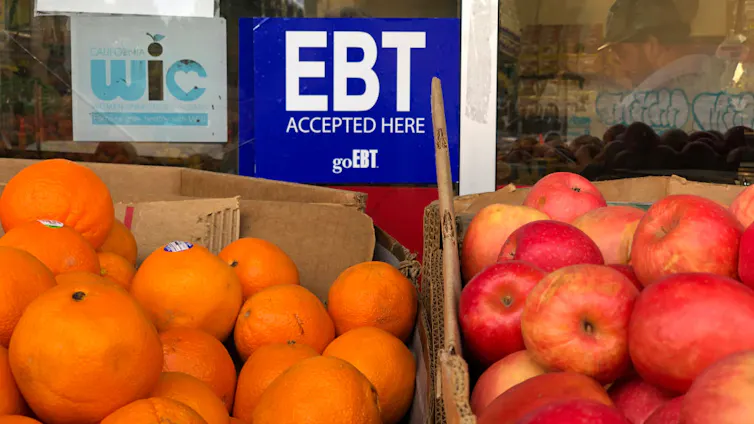
Supermarkets and other stores that sell food must be certified to accept SNAP benefits for payment. Beyond helping individual households, SNAP spending boosts local economies, as those benefits get spent at grocery stores and other retailers.
Retailers that sell food are now required to offer seven varieties of foods in each of four staple food categories: grains, vegetables and fruits, dairy, and protein. Stores could meet the new requirements for grains, for example, by offering corn tortillas, whole wheat bread, white bread, brown rice, white rice, oats and infant cereal for sale.
In the 12th and 17th congressional districts that make up Allegheny County, 10.4% and 8.7% of people, respectively, live in areas where it is difficult to get healthy foods. According to data from the Institute for Local Self-Reliance, there are 191 grocery stores in these districts, about 28% of which are either small chains or independent stores that may have a harder time complying with the new requirements.
Between 2017 and 2023, the number of SNAP-authorized stores in Allegheny County increased by 13%, but this trend could reverse under the new rules.
While the stated goal of the new rules is to increase the availability of healthier foods, simply requiring stores to stock them doesn’t mean that customers will eat a better diet. Whether these new retailer policies ultimately improve diets is an open question.
Additional restrictions on purchases
Some states are placing additional restrictions on what people can buy with benefits. Purchasing hot prepared foods, alcohol, vitamins or diapers with SNAP benefits was already prohibited, but 23 states are now restricting the use of benefits to buy sugar-sweetened beverages and some other items that contribute to nutritionally inadequate diets.
While Pennsylvania has not adopted those additional restrictions, some of its neighboring states, such as Ohio and West Virginia, have.
SNAP helps people pay for groceries, but the benefit amount is typically less than what a household would spend on food. SNAP covers some of what a family would’ve spent on groceries anyway, leaving that money for other needs – rent, diapers, utility bills and the like. As a result, research shows the program doesn’t significantly change what or how much people eat, on average.
In my view, as food insecurity remains high in Allegheny County, policies that make it harder for local residents to get SNAP benefits risk weakening one of the nation’s most effective economic support programs.
Read more of our stories about Pittsburgh and Pennsylvania.
Amelia B. Finaret, Associate Professor of Business and Economics and Nutrition, Allegheny College
This article is republished from The Conversation under a Creative Commons license. Read the original article.




The Knowledge
Where Does Federal Money Go? The Biggest Costs Behind the Budget
Where does federal money go? Part two of our National Debt Explained series examines the biggest expenses in the 2025 budget and how spending connects to government borrowing.

The Knowledge | National Debt Explained, Part 2
When discussing debt, ask: Who borrowed the money? That question helps distinguish a family’s finances from the federal budget. Our first episode explained why your credit card balance is separate from the national debt. Now comes the next question: What does the federal government spend money on?
Much of it pays for retirement benefits, health coverage, national defense, public services, and interest on previous borrowing.
Social Security was the largest individual program in fiscal year 2025, costing approximately $1.6 trillion. But combine the major health care programs—including Medicare, Medicaid, and health insurance subsidies—and their spending reached about $1.8 trillion, exceeding Social Security alone. cbo.gov
The figures below cover October 1, 2024, through September 30, 2025.Major expense FY 2025 spending What it supports Social Security About $1.6 trillion Retirement, survivor, and disability benefits Medicare, net $988 billion Health coverage for older adults and certain people with disabilities Net interest $970 billion Cost of servicing publicly held federal debt, after subtracting interest income Discretionary defense $893 billion Military personnel, operations, equipment, and research Medicaid $668 billion Federal contribution toward health coverage and care for eligible people
These are selected expenses, not the entire budget. Medicare spending is shown after premiums and other offsetting receipts. The combined health care total already includes Medicare and Medicaid, so it should not be added to those rows. cbo.gov
The government also supports veterans’ health care, transportation, education, housing assistance, courts, law enforcement, scientific research, disaster response, and environmental protection. Nondefense discretionary spending totaled approximately $980 billion in 2025, covering many of these services. Some funding for these areas falls elsewhere in the budget. cbo.gov
Federal spending falls into three broad groups:
- Mandatory spending: Payments governed by existing eligibility rules and benefit formulas, including Social Security and major health programs.
- Discretionary spending: Funding lawmakers control through appropriations legislation, including most defense spending and many public services.
- Net interest: The expense of servicing publicly held federal debt, minus government interest income. cbo.gov
Interest deserves attention because it pays for borrowing already undertaken. In 2025, net interest exceeded discretionary defense spending. Congressional Budget Office
A program’s cost does not automatically translate into an equal increase in national debt. Taxes and other receipts finance much of federal spending. Social Security and Medicare’s hospital insurance program receive dedicated payroll taxes, while Medicare also collects premiums.
In 2025, federal spending totaled approximately $7 trillion, compared with $5.2 trillion in revenue. The roughly $1.8 trillion shortfall was the deficit, requiring borrowing. Understanding national debt therefore means examining both what government spends and what it collects. cbo.gov
Explore more explanations behind the headlines at STM Daily News, home of The Knowledge.
Sources for this episode
- CBO: The Federal Budget in Fiscal Year 2025 — Overview of spending, revenue, deficits, and debt interest.
- CBO: Mandatory Spending in Fiscal Year 2025 — Breakdown of Social Security, Medicare, Medicaid, and other benefit programs.
- CBO: Discretionary Spending in Fiscal Year 2025 — Defense spending and services including transportation, education, and veterans’ health care.
- CBO: Overview of the FY 2025 Budget Infographics — Highlights the largest expenses and broader budget trends.
Related reading
- U.S. Treasury: Understanding the National Debt — What federal debt represents and how borrowing works.
- U.S. Treasury: Understanding the National Deficit — Explains the difference between an annual deficit and accumulated debt.
- U.S. Treasury: Federal Spending — Additional context about where federal money goes.

Daily News
Whose Debt Is the National Debt?
The national debt isn’t Americans’ credit card balances added together. This simple explainer separates federal borrowing from household debt and explains the difference between debt and a deficit.
Last Updated on October 11, 2026 by Daily News Staff
The Knowledge | STM Daily News
When you hear “national debt,” do you picture everyone’s credit card balances added together? The name can create that impression, but the national debt and household debt measure different borrowing.
The U.S. national debt is money the federal government owes. Your personal credit card balance is not included.
Federal debt versus household debt
The Treasury defines national debt as the federal government’s total outstanding borrowing accumulated over the country’s history. Household debt covers borrowing by individuals and families, including mortgages, credit cards, auto loans, and student loans.
|Type of debt |Who borrowed? |Examples |
|————–|————————|————————————————–|
|National debt |Federal government |Outstanding Treasury securities |
|Household debt|Individuals and families|Credit cards, mortgages, auto loans, student loans|
Putting a $500 purchase on your credit card increases your personal balance. It does not add $500 to the national debt.
How does the national debt grow?
When federal spending exceeds tax collections and other revenue, the government runs a budget deficit. Treasury sells securities to borrow money to cover the gap.
Consider a simplified, hypothetical example: the government collects $5 trillion and spends $6 trillion in one year. That leaves a $1 trillion deficit requiring financing.
A deficit measures a shortfall over a period, usually a year. Debt measures outstanding borrowing accumulated over time. Repeated deficits generally increase that debt. Interest on existing borrowing is also a federal expense.
Does paying off your credit card reduce the national debt?
Paying off a card reduces what you owe your lender. It does not directly repay Treasury borrowing. Household debt and government debt can influence the same economy, but they remain separate obligations.
When discussing debt, ask: Who borrowed the money? That one question helps distinguish a family’s finances from the federal budget.
Find more explanations of the ideas behind the headlines at STM Daily News, home of The Knowledge.
Sources
● U.S. Treasury: Understanding the National Debt
● U.S. Treasury: Understanding the National Deficit
● Federal Reserve Bank of New York: Household Debt and Credit Report
Last Updated on September 17, 2026 by Daily News Staff
HOLLYWOOD, Calif. — Paramount’s century-long connection to Hollywood could be facing one of its biggest challenges yet, as the entertainment giant reportedly prepares for the possibility of moving major operations out of California amid an escalating legal battle over its proposed acquisition of Warner Bros. Discovery.
Paramount has informed the offices of Los Angeles Mayor Karen Bass and California Attorney General Rob Bonta that it is prepared to formally announce plans to leave California, according to reporting Wednesday from TheWrap. Paramount has not formally announced a relocation, and a company spokesperson declined to comment to the publication.
The potential move centers on Paramount Skydance’s proposed approximately $110 billion acquisition of Warner Bros. Discovery, a deal being challenged on antitrust grounds by California and a coalition of 11 other states, along with a separate challenge from the Writers Guild of America. California Attorney General Rob Bonta argues that combining the two entertainment companies could reduce competition, potentially leading to higher prices and fewer choices for consumers.
A court agreement currently prevents Paramount and Warner Bros. Discovery from completing the merger until June 1, 2027, or until after a court decision on the states’ claims, whichever comes first. The antitrust case is scheduled for trial in March 2027.
Paramount’s Hollywood Future
At the center of the controversy is Paramount’s historic studio complex at 5555 Melrose Avenue in Hollywood, one of the entertainment industry’s most recognizable properties.
The Los Angeles Times reported that Paramount CEO David Ellison has told associates that he would prefer to remain in Los Angeles. However, Paramount’s board has reportedly approved a contingency plan that could move the company’s headquarters out of Hollywood, and Ellison has indicated that the company is prepared to sell its historic studio properties and relocate operations if the merger remains stalled.
Tennessee, Texas and Georgia have emerged in reports as potential destinations should Paramount ultimately decide to relocate.
The financial pressure is significant. Beginning October 1, Paramount faces a roughly $7 million-per-day additional payment obligation tied to delays in completing the Warner Bros. Discovery transaction. Paramount has asked the federal court to require the states and the Writers Guild of America to post a $1.88 billion bond to cover potential costs associated with the delay.
What’s at Stake for Los Angeles?
A Paramount departure could extend far beyond the loss of a famous Hollywood address.
An economic analysis cited by TheWrap estimates that a large-scale Paramount departure could put as many as 57,980 full-time jobs, $21.2 billion in annual economic output and approximately $1.17 billion in state and local tax revenue at risk. Those figures represent an economic-impact scenario rather than a prediction that all of those losses would necessarily occur.
There are competing concerns about the merger itself. Los Angeles County analysis has estimated that completing the Paramount-Warner Bros. combination could also eliminate thousands of entertainment and related jobs because of consolidation. Opponents of the merger, including entertainment unions, have raised concerns about reduced competition and employment, while supporters argue that reaching a settlement could help prevent Paramount from moving operations out of California.
Mayor Bass has said she remains focused on protecting Los Angeles entertainment jobs and keeping Hollywood’s entertainment industry centered in the city. Bonta’s office, meanwhile, has maintained that California will continue enforcing its antitrust laws while remaining open to good-faith discussions. There is still an opportunity for the dispute to be resolved before Paramount makes a final decision about its California operations. Paramount Skydance and representatives for California Attorney General Rob Bonta are scheduled to participate in court-ordered settlement talks on October 14 and 15. The discussions could potentially resolve the antitrust dispute and clear a path for Paramount’s proposed Warner Bros. Discovery acquisition. For now, Paramount has made no official announcement that it is leaving California. The company declined to comment on reports Wednesday that it was preparing to announce a departure. That leaves the future of Paramount’s Hollywood operations — including its historic Melrose Avenue studio — uncertain as the legal and financial pressure surrounding the merger continues to build. Settlement Talks Scheduled
For now, the gates at Paramount remain firmly planted on Melrose Avenue.
Settlement Talks Scheduled
There is still an opportunity for the dispute to be resolved before Paramount makes a final decision about its California operations.
Paramount Skydance and representatives for California Attorney General Rob Bonta are scheduled to participate in court-ordered settlement talks on October 14 and 15. The discussions could potentially resolve the antitrust dispute and clear a path for Paramount’s proposed Warner Bros. Discovery acquisition.
For now, Paramount has made no official announcement that it is leaving California. The company declined to comment on reports Wednesday that it was preparing to announce a departure.
That leaves the future of Paramount’s Hollywood operations — including its historic Melrose Avenue studio — uncertain as the legal and financial pressure surrounding the merger continues to build.uilding around the Warner Bros. Discovery deal, the question of whether one of Hollywood’s most historic studios will continue calling California home has moved from speculation to a potentially consequential decision for Los Angeles and its entertainment industry.
STM Daily News will continue monitoring the Paramount-Warner Bros. Discovery dispute and what it could mean for Hollywood, entertainment workers and the future of film and television production in California.
Source and Related Reading
- California Attorney General — Agreement Halting Paramount/Warner Bros. Merger — Primary source explaining the states’ antitrust challenge and agreement delaying completion of the merger.
- Los Angeles Times — Paramount and Bonta Ordered Into Settlement Talks — Reports the October 14–15 settlement meetings and current state of the dispute.
- Los Angeles Times — Paramount’s Possible Hollywood Exit — Detailed reporting on the relocation contingency, potential destinations and implications for Los Angeles.
- Reuters — DOJ Backs Bond Demand in Paramount-Warner Fight — Covers the $1.88 billion bond dispute, $7 million daily fee and March trial.
- TheWrap — Paramount Preps California Exit — Reports the latest developments surrounding Paramount’s potential departure.