

gaming
Inworld AI: 99% of gamers are excited by the potential of smart NPCs powered by advanced artificial intelligence

With progress in generative AI heralding new potential for multiple industries, a new report from Inworld AI finds that the majority of gamers crave more personality from NPCs in video games
SAN FRANCISCO /PRNewswire/ — Inworld AI, a developer platform for advanced NPC behavior and dialogue, today released the findings of its new report ‘Gamer Attitudes to NPCs.’ In the first study of its kind, the report surveyed over 1,000 gamers in the US aged 16-50 and found high levels of excitement about the potential of AI in video games. Specifically, there was an overwhelming consensus that recent advancements in AI could change the face of gaming and usher in a new era of immersion and interaction with NPCs (non-playable characters) with individual personalities and the ability to converse unscripted voice-to-voice with the help of ChatGPT-like language models and multimodal behavior and perception systems.
The report found that:
● 84% of gamers agree that current NPCs make a positive difference to gameplay
● Over half (52%) dislike repetitive NPC dialogue
● 76% want to see NPCs with better situational awareness
● 78% would spend more time playing games with advanced AI NPCs
● 81% would be willing to pay more for a game with advanced AI NPCs
A long time (not) coming
NPCs have been a part of video gaming from as far back as the 1970s. Despite significant technological advancements in motion capture, graphics rendering, animation, and modeling, the technology that powers the behavior of NPCs has remained stagnant. In other words, NPCs have not developed personalities of their own or the ability to respond to players unscripted. This is despite the fact that the report found that 84% of players today believe NPCs are a crucial addition to gameplay, with an important role in building immersive stories and worlds.
Meaningful interaction promotes excitement and loyalty…
The report highlighted the importance of narratives and storylines to the majority of players. Meaningful interactions with NPCs were heavily sought after, with only 9% of players dismissing or avoiding NPCs during gameplay altogether. A large minority (40%) even admitted to talking to as many NPCs as possible to unlock more story content. Equally, 91% interacted with NPCs on some level and 78% said they would spend more time playing a game with ‘intelligent’ NPCs.
Kylan Gibbs, Co-Founder and CPO Inworld AI said: “ Humans are storytellers. We’re drawn to narratives that help us to make sense of the world around us. The same thing is true in the gaming world – the more immersive and believable a story is, the more we want to stay inside it. So it’s really no surprise that so many gamers want to unlock deeper stories through these NPC interactions.”
…and poor quality promotes frustration and derision
While trolling is most prevalent among younger gamers (39% of 16-24 year olds troll NPCs), across all age groups, it was apparent that gamers willingly and regularly watch NPCs doing ‘stupid’ things – particularly when the characters were two-dimensional and poor quality. The typical NPC characteristics that were most disliked by players were: repetitive dialogue, walking in circles, and inability to adapt to changes in games (disliked by 52%, 33% and 30% of players respectively.) Other traits such as awkward movements and lack of variation also contributed to their disconnect from NPCs.
A missed opportunity for artificial intelligence
Despite these frustrations however, only a tiny minority (5%) view current NPCs as pointless. “Gamers care deeply about NPCs,” continued Kylan. “They have a huge impact on gameplay but gamers are frustrated with the fact that they haven’t evolved. With advanced AI NPCs, there’s an opportunity for games to give players more of the immersive and realistic interactions with NPCs that gamers want.”
A large majority (76%) want better situational awareness from NPCs, and 60% would like to see more interactive dialogue and a sense of humor. Understanding these requirements and being able to cater to them proved to be an appealing concept for almost all gamers surveyed. The report noted that 79% of respondents said they were excited by the promise of AI NPCs, with 88% believing they would make a game more immersive. This is in tandem with 99% believing the inclusion of advanced AI NPCs would positively impact gameplay, and 81% willing to pay for the experience.
Florin Radu, Head of Partnerships, concluded: “Advances in AI have real potential to bring NPCs to life and revolutionize the way gamers interact with them. At Inworld, we’re leveraging this technology to make NPCs smarter and more interactive, so as to enrich game narratives and make gameplay more immersive. It’s little surprise that gamers are excited by the possibility of having a unique experience with NPCs every time they play – and it’s precisely this excitement that we think will result in many more developers including advanced AI NPCs in their games in the near future.“
Gamer Attitudes to NPCs 2023 can be downloaded here https://inworld.ai/whitepapers/future-of-npcs
Notes to editors:
A survey of 1,002 US gamers aged 16-50 was conducted during the months of October and November 2022 by Bryter Research on behalf of Inworld AI, using an online questionnaire. Participants were randomly selected from a panel of online gamers. The study aimed to examine gaming behavior and attitudes to NPCs within the given age range.
Qualitative data examples:
“I think they’re an important part of world-building. I always make an effort to talk to every NPC I can. They can offer tips, give side quests, have items for sale, can be entertaining, and help present the lore of a game or series.” – Female, 28 years old
“I like that you can really interact and get real-time responses to your questions and interactions. This would really add depth and richness to games.” – Female, 38 years old
“I love playing RPGs and MMORPGs, but prefer player-versus-environment to player-versus-player and enjoy interacting with NPCs more than random players. Advanced AI NPCs would definitely make me more emotionally attached to RPGs and would make them more enjoyable!” – Female, 50 years old
“As a hobbyist game dev, I like the concept of advanced AI NPCs a lot. The interactive elements of this are pretty amazing, and this could completely change how NPCs are created. Open Worlds/ MMOs and even Roguelikes would greatly benefit from this.” – Male, 37 years old
“I like that the dialogue is not scripted. Advanced AI NPCs are more like real characters and react to the world around them. I would love to be able to interact with an AI version of Lamar from GTA 5. I think he would have some hilarious and witty responses to whatever questions I asked.” – Male, 24 years old
“NPCs can either make or break a game by adding or detracting from the game’s immersion and believability. When I play, I literally insert myself into my character’s world and make decisions based on what my character would think about situations, places, and the people they meet–including NPCs.” – Non-binary, 23 years old
“Fallout 4 is a great game but the dialog options for companion characters were terrible and repetitive.” – Male, 44 years old
“Animal Crossing lacks diverse dialog options and leaves the game boring and dull with each character archetype.” – Male, 22 years old
“I like to take their money and chase them. Usually they run and I catch up to them and beat them up and take their money. This adds to the fun of Grand Theft Auto.” – Male, 27 years old
About Inworld AI
Inworld is a developer platform for adding advanced NPC behavior and dialogue to games and real-time experiences. We use over 20 AI models to create lifelike, engaging, and expressive characters that mimic the dynamic nature of human interaction.
Inworld is run by a team of experts and pioneers in the fields of conversational AI, generative models, and the gaming and entertainment industry. Inworld’s founders previously launched API.AI, renamed Dialogflow after being acquired by Google. Inworld’s Chief Creative Officer, Academy Award-winner John Gaeta, also brings decades of experience from the gaming and entertainment industry through his work on the Matrix movies, his role in founding Lucasfilm’s Immersive Entertainment Division, and as Executive Creative Producer on Epic Games’ The Matrix Awakens.
Inworld’s team of engineers, designers, inventors, creatives, scientists, and technologists are building the tech that will revolutionize NPCs.
SOURCE Inworld AI


Tech
Professional gaming is brutal on the body – inside the growing field of treating esports injuries
Professional gaming can cause serious physical and mental strain, including wrist injuries, back pain, vision problems and sleep disturbances. As esports grows, specialists are developing new prevention and rehabilitation strategies to protect players.

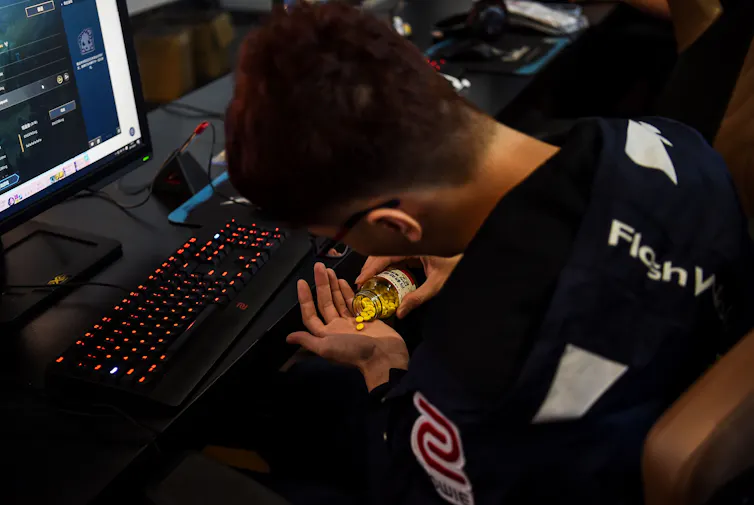
Erica D. Henn, Temple University
Chinese esports player Jian “Uzi” Zi-hao was more than a star “League of Legends” player: He was so talented that his team structured its entire strategy around his abilities, funneling resources to him and another teammate, Shi “Ming” Sen-Ming, so the duo could lead the team to victory. Over the course of his career, he earned more than US$500,000 in tournament prize money.
And yet in 2020, Jian announced his retirement, his storied career cut short by chronic wrist and arm injuries.
He was 25 years old.
Video games have a reputation for keeping people glued to the couch. But for those who compete against the best players in the world, gaming can be surprisingly physically and mentally taxing.
The strain of ‘climbing the ladder’
The best esports players often have grinding schedules. They’re expected to regularly practice, participate in scrimmages and compete in official matches. Even at the recreational level, esports players cite the mental toll: playing for hours a day, every day, to hone their skills so they can “climb the ladder.”
A 2021 study of Portuguese esports players found that 37% experienced anxiety and depression, and 45% experienced sleep disturbances. The most common physical injuries in esports generally fall under eye problems and musculoskeletal issues.
Prolonged screen time leads to many types of vision problems in gamers, from the more common eye fatigue to a decreased ability to focus. Furthermore, the light emitted from screens appears to contribute to sleep disturbances by disrupting the release of melatonin, the hormone that helps regulate your sleep-wake cycle.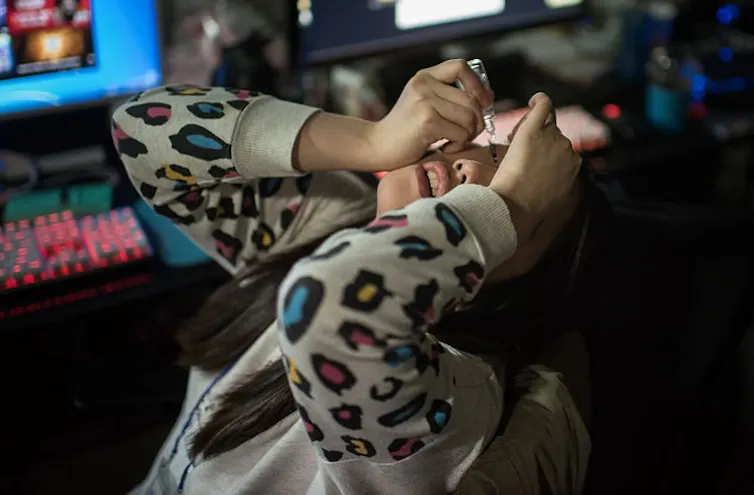
Many esport players – professional or otherwise – also battle hand and wrist pain, with repetitive button-smashing causing injuries such as carpal tunnel syndrome, tendonitis and “gamer’s thumb,” which arises from overuse or irritation of the tendons around the thumb and wrist. Many of the overuse injuries seen among video game players are also familiar to assembly-line workers, whose jobs can involve similarly repetitive movements.
Then there are the back injuries. Players can remain seated for three or more hours without a break, and this prolonged sitting can take a toll on the lower back and spine.
The sedentary nature of esports has also led to a lesser-known – sometimes fatal – injury called deep vein thrombosis: a blood clot, often in the leg, that can become life-threatening if it travels to the lungs. In 2011, British gamer Chris Staniforth – who would play for as long as 12 hours at a time – died of the condition.
Preventative measures
As more esports injury research has been published, more treatment and prevention strategies have emerged.
Top esports teams now have physical therapists, performance psychologists, athletic trainers and even massage therapists on staff to optimize the performance and recovery of their players.
Teams often incorporate group exercise activities to both build rapport among players and reduce the risk of injuries. During competition, proper positioning of the spine and limbs has become an essential injury prevention strategy. For example, selecting a chair that encourages an upright posture can reduce pain and injury risk, especially when gamers couple ergonomics with an exercise program that centers on functional strength, mobility and stretching of the upper limbs.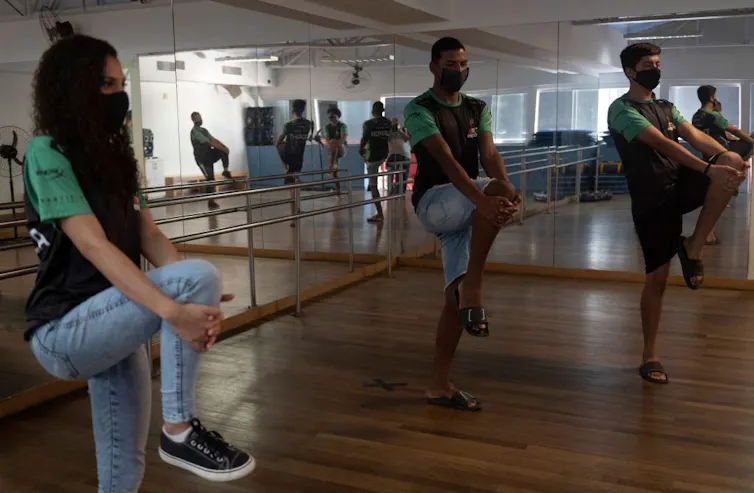
Looking to the stage
When esports began gaining mainstream popularity in the 1990s and early 2000s, its proponents were eager to draw comparisons to traditional sports and athletic competition. The parallels helped establish esports’ legitimacy and gave non-gamers a familiar framework for understanding the competition.
As esports became a big business and a lucrative career path, players and teams hired a web of support staff – trainers, coaches and therapists – that mirrored the structure of professional sports. In this vein, a lot of esports injury research has pulled from the training methods of traditional sports.
However, as a scholar of exercise science, I think injury treatment and prevention strategies could be further improved by seeing esports competitors as more like musicians and dancers than football players and basketball players.
Performance optimization and injury research on professional performing artists has existed for centuries, and I think it represents a valuable, untapped resource. That’s because the physical and mental stresses experienced during musical performance have a lot in common with esports competition: long stretches of sitting; small, dexterous hand movements; and performing without the real-time input of a coach.
For example, biomechanics research has found similar patterns of forearm muscle fatigue among esports players and piano players. However, no studies to date have directly compared the two groups.
And what if the interest in joint hypermobility or hand size among performing artists were translated to esport populations? Could popular piano warm-up exercises be effective for esports athletes who use keyboards?
Even research on sports like car racing might offer valuable insights. As with gamers, many people overlook how physically demanding car racing can be – and yes, that includes sitting for extended periods of time.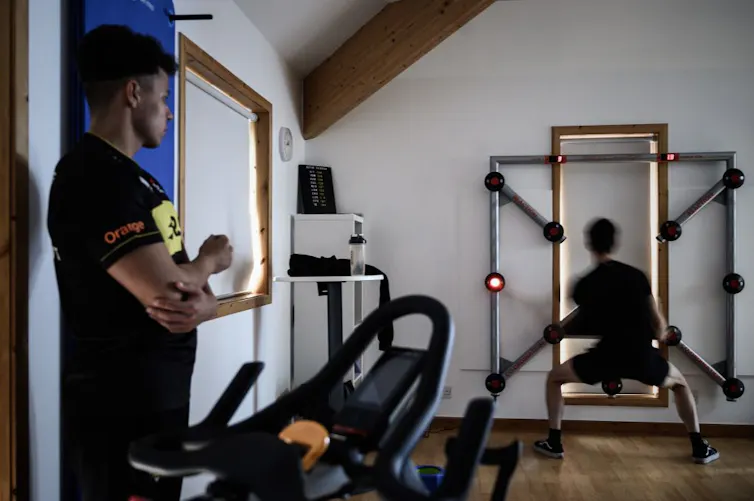
Prevention and rehabilitation techniques continue to improve. Even Jian, the player who retired in 2020, returned to play for a few splits, or partial seasons, in 2022 and 2023.
In July 2023, “League of Legends” star Lee “Faker” Sang-hyeok was relegated to the bench due to cubital tunnel syndrome, an injury that emerges from arm and hand overuse.
Through a treatment plan that included changing his gaming posture and intensive physical therapy, Lee was able to return to play just a month later. He went on to win three consecutive world championships, with his support team helping prevent recurrence of injury throughout each season.
Thanks to his rehabilitation, Lee’s fans will be able to follow his hunt for his fourth “League of Legends” World Championship, which kicks off in October 2026 in the United States.
Sienna Cinti assisted with the research and writing of this article.
Erica D. Henn, Assistant Professor of Kinesiology and Exercise Science, Temple University
This article is republished from The Conversation under a Creative Commons license. Read the original article.
📰 Enjoying STM Daily News? Join the conversation!
💬 Leave a comment, share your thoughts, and subscribe to our newsletter for the latest stories, updates, and “News You Can Use This Moment!” delivered to your inbox.
Stay connected with STM Daily News!
health and wellness
Millions of mobile gamers prize stress relief over winning
Mobile Gamers Prize Stress: In the school’s car pickup line, five minutes before it starts moving. In the doctor’s office waiting room for an appointment that you’ve been heavily anticipating. In bed, just before going to sleep. In these transitional moments, many people reach for their phones — not to scroll, but to play.

Millions of mobile gamers prize stress relief over winning
(Sheeka Sanahori) In the school’s car pickup line, five minutes before it starts moving. In the doctor’s office waiting room for an appointment that you’ve been heavily anticipating. In bed, just before going to sleep. In these transitional moments, many people reach for their phones — not to scroll, but to play.
According to a June 2026 survey of more than 128,000 KashKick mobile gamers, playing a mobile game is more than a way to pass the time. Stress relief and relaxation are the top reasons respondents play, beating out entertainment and fun. As KashKick reports, for many people, this means mobile games are less a simple distraction and more a coping mechanism for the daily stress of life.
A quick reset for life’s transitional moments
Most respondents identify as women, and 60% live in households that earn less than $50,000 per year. In the ranking of their reasons for playing, stress relief and relaxation topped the list, with boredom relief, entertainment and fun close behind.
The ranking reads less like a profile of a gaming hobby and more like a profile of a coping behavior.
More than half of the respondents play games daily or multiple times a day. When they reach for a mobile game, about 53% of the time it’s for a short session—usually 30 minutes or less. Where and when people play tells its own story: 58% play in bed before going to sleep and 40% play in the bathroom. These are private, solitary moments, not the times people typically plan entertainment into their day.
Coping with stress by gaming
To understand why respondents play games for stress relief more than for fun, it helps to look at who they are. Among those surveyed, 19% say they’re unemployed or looking for work, and 60% live in lower-income households. There are likely some areas of their life where they must make every dollar stretch to cover the things they need.
The survey findings coincide with research from the American Psychological Association’s 2025 Stress in America report. According to the report, 18% of men and 22% of women under age 65 rate their stress level at eight or higher on a scale of one to 10. Although the KashKick survey didn’t measure stress, respondents are mostly women and fall within the age and income groups the APA found to carry the most stress.
The APA’s report also describes loneliness as a major strain for Americans. The KashKick survey didn’t measure feelings of isolation, but 55% prefer to play alone, and 60% rarely or never discuss their gameplay with friends or family.
Overall, the survey identifies a group of people who have found a routine, low-cost approach to cope with stress. They’re not necessarily there to get the highest score. They’re playing a mobile game to help them navigate a day that, with all of life’s to-dos and challenges, could quickly feel overwhelming.
Methodology
The KashKick Gaming Habits Survey was fielded from June 8, 2026, through Aug. 10, 2026, among KashKick members in the United States who play mobile games. The Gaming Habits Survey was available to all members on KashKick’s Surveys page post-profile completion. The survey received 128,218 total responses, with question-level response counts ranging from approximately 109,793 to 128,218 depending on attrition. All findings describe KashKick mobile gamers and should not be interpreted as representative of U.S. mobile gamers overall. Industry and stress context references publicly available data from the American Psychological Association, Statista, and Newzoo.
Photo courtesy of Shutterstock

SOURCE:
KashKick
📰 Enjoying STM Daily News? Join the conversation!
💬 Leave a comment, share your thoughts, and subscribe to our newsletter for the latest stories, updates, and “News You Can Use This Moment!” delivered to your inbox.
Stay connected with STM Daily News!


LIGHTSPEED STUDIOS used GDC 2026 to spotlight the next phase of its “Original IP Initiative,” outlining a proprietary development framework aimed at building high-end, original AAA games for a global audience. The studio said the initiative, first introduced at GDC 2025, now includes active development of a new globally driven blockbuster title and a more formalized system for shaping future intellectual property.
A major part of that strategy came from newly appointed Creative Director Feng Zhu, who described a structured approach to original game creation centered on strong visual identity, disciplined worldbuilding, and repeatable production methods. During his GDC session, Zhu introduced the studio’s “90:10 Balance” philosophy, where 90% of a game is grounded in real-world references like authentic locations, historical context, and realistic proportions, while the remaining 10% is used to deliver the creative hooks, tension, and storytelling elements that define the title’s identity.
LIGHTSPEED also emphasized its investment in production infrastructure, including a purpose-built in-house motion capture facility in Los Angeles. Led by Motion Capture Studio Manager Kristin Gallagher, the studio says the facility is designed to handle complex performance capture with greater efficiency, supported by a custom API and advanced technical pipeline developed jointly by teams in LA and across the company’s global network.

The announcement reinforces LIGHTSPEED STUDIOS’ broader ambition to grow beyond service and co-development work into a stronger portfolio of original blockbuster properties. Best known as a co-developer of PUBG MOBILE and the developer of the upcoming Last Sentinel, the company says its long-term focus is on delivering cinematic, culturally resonant game experiences built for players worldwide.
Related Links
Source
Visit the Entertainment section on STM Daily News for the latest entertainment news, movie updates, TV coverage, music stories, pop culture trends, and event highlights.




