home improvement
The New Rules of Remodeling: How to Balance Style, Durability and Cost
New Rules of Remodeling: Homeowners are approaching exterior remodeling with a sharper focus than ever before. Higher material costs, longer project timelines and a growing emphasis on long-term value are reshaping how they make decisions. The most effective projects begin with thoughtful planning and product selection while keeping an eye on long-term outcomes. To get a better understanding of these updated guidelines, consider this guidance.


The New Rules of Remodeling: How to Balance Style, Durability and Cost
(Feature Impact) Homeowners are approaching exterior remodeling with a sharper focus than ever before. Higher material costs, longer project timelines and a growing emphasis on long-term value are reshaping how they make decisions.
The “new rules of remodeling” are clear: Success depends on striking the right balance between style, durability and overall cost of ownership.
Curb appeal still matters, but not at the expense of performance or maintenance demands. Likewise, upfront savings mean little if materials require frequent repair or replacement. The most effective projects begin with thoughtful planning and product selection while keeping an eye on long-term outcomes.
To get a better understanding of these updated guidelines, consider this guidance from the home remodeling experts at Westlake Royal Building Products, a leader in the manufacturing of siding and accessories, trim and moulding, roofing, stone, windows and outdoor living.
Planning Takes Precedence
Digital tools are playing a larger role in helping homeowners make informed decisions earlier in the remodeling process. In fact, nearly 30% of homeowners plan to invest more than 10 hours researching before hiring a contractor, highlighting a shift toward more deliberate, front-loaded planning, according to Modernize’s 2025 Homeowner Insights survey. Platforms like Design Canvas reflect this change. The tool allows users to visualize exterior renovations using realistic previews, experiment with materials and color palettes and generate product lists, all before beginning construction.
This kind of planning reduces uncertainty and helps avoid costly mid-project changes, which is part of a broader trend: More homeowners are investing significant time toward researching projects upfront to ensure smarter, more efficient execution. Homeowners can now test design choices, align expectations with budgets and move forward with greater confidence.
“With the launch of our new website and Design Canvas, our goal was to create a seamless and inspiring experience that reflects the innovation and breadth of our product offerings,” said Steve Booz, vice president of marketing at Westlake Royal Building Products. “This is a launch pad where customers can explore everything Westlake Royal has to offer, discover the right products for their next project and bring their visions to life through creativity, education and interactive design.”
Durability is as Important as Style
 Once the homeowner establishes a clear vision, material selection becomes the next critical step. That is particularly true for siding, which plays a central role in both aesthetics and protection.
Products like TruExterior Lap Siding demonstrate how manufacturers are responding to modern homeowner priorities. Designed to replicate the look of traditional cedar, it delivers the depth and shadow lines associated with classic wood siding, without the vulnerabilities that often come with it.
Its poly-ash composition provides resistance to warping, cracking and splitting while maintaining dimensional stability in varying climates. The material can be installed with standard tools, painted in a wide range of colors and even used in ground-contact applications. These attributes translate to lower maintenance requirements and fewer long-term repair costs.
This combination of aesthetic flexibility and durability directly supports the new remodeling framework. Homeowners no longer need to choose between appearance and performance. They can achieve both while staying within budget.
Cost and Timing are Still Deciding Factors
Timing and cost efficiency also factor into the equation. Projects that begin with clear planning and reliable materials tend to move more smoothly, avoiding delays tied to redesigns, product substitutions or unexpected maintenance considerations, which can also help keep the project on budget.
Ultimately, the new rules of remodeling are less about tradeoffs and more about alignment. Style, durability and cost are no longer competing priorities. Rather, they are interconnected elements of a successful project.
As the remodeling landscape continues to change, those who approach projects with this balanced mindset will be best positioned to achieve results that look better, last longer and cost less over the long haul. Explore products and design tools to assist with your next project at westlakeroyalbuildingproducts.com.

SOURCE:
Westlake Royal Building Products
🏡 Planning your next home project? Explore expert tips, DIY ideas, product reviews, and the latest home improvement news in Consumer Corner. Share your experiences in the comments and subscribe to the STM Daily News newsletter for practical advice and fresh inspiration delivered straight to your inbox.


home improvement
4 Ways to Make Room for Better Living
Make Room for Better Living: Oftentimes, making your home better suited for your needs starts with rethinking how the doors open. Whether you’re remodeling or building a new home, understanding the options can help you choose doors – and the installation hardware behind them – that make rooms more comfortable and convenient.
Last Updated on November 16, 2026 by Daily News Staff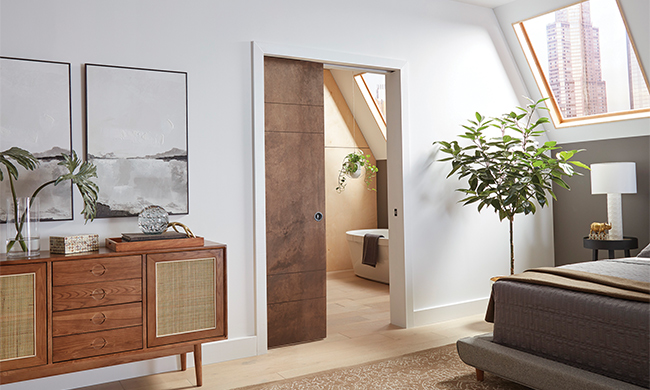
4 Ways to Make Room for Better Living
A bathroom door that bumps into the vanity. A closet interior that’s awkward to reach. A home office that needs a little separation from family activity. Oftentimes, making your home better suited for your needs starts with rethinking how the doors open.
Sliding, folding and pocket doors offer practical ways to improve everyday spaces without adding square footage. Whether you’re remodeling or building a new home, understanding the options can help you choose doors – and the installation hardware behind them – that make rooms more comfortable and convenient.
Consider these four ways to put your doors to work from the experts at Johnson Hardware, who make easy-to-install hardware systems in the U.S.:
Free Up Floor Space with Pocket Doors
In bathrooms, kitchen pantries and laundry rooms, a swinging door can compete with storage, taking up to 14 square feet of floor space and interrupting traffic flow. Pocket doors slide into the wall, freeing the area a hinged door needs to swing open.
Made for single pocket doors in compact rooms or two converging doors for larger openings between adjoining spaces, pocket door hardware with its soft-close feature helps doors glide gently into the open and closed positions, reducing slamming. Discuss pocket doors early in your project so your building professional can plan for the space needed inside the wall.
 Keep Essentials Handy with Bypass and Multi-Pass Doors
A frequently used mudroom, hallway or bedroom closet can look more organized with sliding bypass or multi-pass doors. The panels travel on separate tracks and slide past one another, letting you reach different sections without doors swinging into the room.
Options like Johnson’s bypass and multi-pass hardware systems help keep walkways clear while concealing storage or everyday clutter. Ask your designer or remodeler about panel arrangements and soft-close options that suit the opening based on how you’ll use the space.
Add Flexibility with Wall-Mount Sliding Doors
If you want the space-saving benefits of a sliding door but a pocket door isn’t practical, wall-mount doors travel along a track outside the wall. With easy-to-install hardware systems, making the switch from a swinging door can be a quick, practical room upgrade.
Often called barn doors, they can complement many decorating styles, from traditional painted wood to contemporary glass designs. Wall-mount sliding doors work well in home offices, bedrooms, laundry rooms and pantries, where soft-close and soft-open hardware can help reduce noise. Plan for clear wall space beside the opening so the door has room to slide.
Open Up Storage with Full-Access Bifold Doors
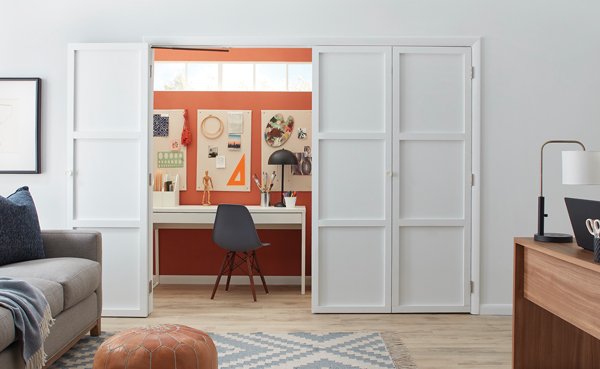
A closet can hold more than clothes. It might become a craft station, compact workspace or convenient place for laundry supplies.
Bifold doors use hinged panels that fold together as they open. Unique 1601 Full-Access Bifold Door Hardware goes a step further, allowing panels to fold flat against adjacent walls for full access across the opening. That makes it easier to reach shelves, organize supplies and use the space inside.
Thoughtful door hardware choices can make everyday routines easier, from reaching pantry shelves to creating a quiet place to work. As you plan your project, ask your designer, architect, remodeler or building contractor how pocket, sliding and folding door hardware systems can help make better use of your space.
For more ideas, visit johnsonhardware.com.
SOURCE:

Health
Radon is the second leading cause of lung cancer. 8 in 10 US adults have never tested their home for it
Decades of public health campaigns have reinforced the connection between smoking and lung cancer, helping people understand that their choices can influence their health. Despite radon being the second-leading cause of lung cancer, many have never tested their home for it.

Radon is the second leading cause of lung cancer. 8 in 10 US adults have never tested their home for it
(Sheeka Sanahori) Avoid tobacco products. Eat a healthy diet. Get recommended cancer screenings. Most U.S. adults recognize these behaviors as ways to lower their cancer risk or catch cancer early. Decades of public health campaigns have reinforced the connection between smoking and lung cancer, helping people understand that their choices can influence their health.
But U.S. adults are far less likely to recognize a risk factor they can’t control through daily habits. Radon – an odorless, invisible gas that forms naturally in the ground – is the second leading cause of lung cancer, but new research from the Prevent Cancer Foundation finds that 8 in 10 U.S. adults have never tested their home for radon. The findings are based on the Foundation’s annual Early Detection Survey of more than 7,000 U.S. adults, conducted in January 2026.
With recent high-profile lung cancer cases, such as the October diagnosis of Pope Leo XIV, who is not known to have a history of smoking cigarettes, more people are paying attention to other risk factors for lung cancer, especially for people who have never smoked.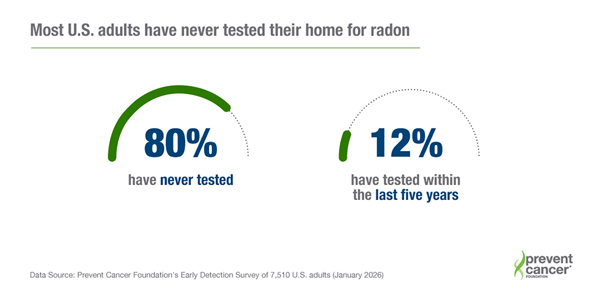
Testing for radon is last on the list
When asked about preventive behaviors, 77.5% say avoiding tobacco lowers their cancer risk. Three out of four say eating a healthy diet and getting routine cancer screenings make a difference, too. More than half also named regular exercise, limiting alcohol and protecting themselves from harmful UV rays.
Testing their home for radon ranked last on the list of preventive behaviors, with only 28% listing it as a way to reduce their cancer risk.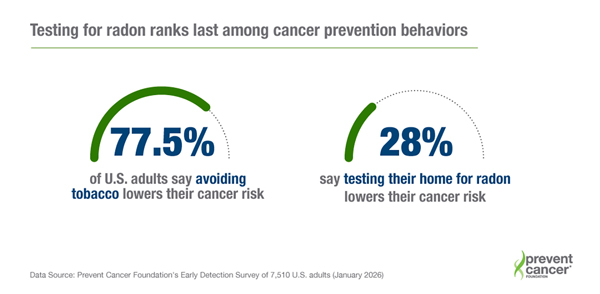
Most homes go untested in every region
Radon hasn’t reached the same level of public awareness as tobacco use, diet and exercise. U.S. adults appear to overlook an environmental risk that could be inside their own homes. Eighty percent of U.S. adults report never having their homes tested for radon, and only 12% have tested within the last five years. The U.S. Environmental Protection Agency (EPA) recommends testing every two years.
In the Northeast, about 7 in 10 people (72%) have never tested their home for radon. That percentage increases for the Midwest (79%), West (82%) and South (83%). Unlike cigarettes, radon does not produce smoke and is odorless, so a test is the only way to detect its presence.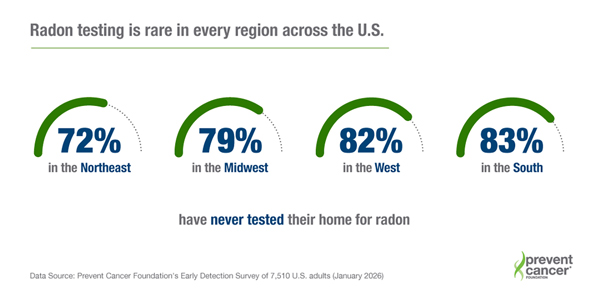
What it takes to find out
Radon can enter homes through the ground when uranium underneath decays. Once it’s inside, it gets trapped. People can live with high radon levels without knowing it, in older homes and new construction alike. Breaking ground on undisturbed land during construction can release more radon.
Renters can either test themselves or ask their landlord whether the home has been tested and request the results. Landlord requirements vary by state.
Test kits are inexpensive and available online and at home improvement stores. The EPA recommends taking action to reduce radon levels at 4 picocuries per liter (pCi/L) or higher, and notes that levels below that may still carry risk. If levels are high, a mitigation system can bring them down.
Beyond radon, the EPA and other health authorities cite avoiding tobacco and secondhand smoke as the most significant steps people can take to lower lung cancer risk, along with following screening guidelines based on personal risk factors.
Methodology
The Prevent Cancer Foundation commissioned Atomik Research to conduct the Foundation’s fourth annual Early Detection Survey of U.S. adults. The study consists of an online survey questionnaire, which includes several repeated measures from a previous year’s questionnaire and a primary data set gathered from a sample of 7,510 adults located throughout the United States. The sample consists of adults 21 years of age or older, and researchers implemented several demographic-based quotas in order to achieve sample characteristics similar to the overall U.S. population of adults 21 and older.
Researchers controlled for demographic variables such as biological sex, age group classification, race/ethnicity, parental status, geographic region, employment status and community classifications (e.g., urban or rural classification).
The margin of error of the overall sample is +/-1 percentage point with a confidence level of 95%. Fieldwork took place between Jan. 10 and Jan. 30, 2026. Atomik Research is an independent market research agency.
Percentages may not add up to 100% due to computer rounding, and/or the acceptance of multiple responses.
Photo courtesy of Shutterstock (family playing)
SOURCE:
Prevent Cancer Foundation
home improvement
4 Tips to Reduce Heating Costs at Home
Reduce Heating Costs at Home: If the thought of heating bills is making your wallet shiver, it may be time to get proactive with a plan. It only takes a few simple steps to reduce ongoing heating costs without sacrificing comfort at home.

4 Tips to Reduce Heating Costs at Home
(Feature Impact) Winter is coming, and if the thought of heating bills is making your wallet shiver, it may be time to get proactive with a plan. It only takes a few simple steps to reduce ongoing heating costs without sacrificing comfort at home.
Consider these tips to warm your home more efficiently, minimize heat loss and keep your energy bills under control this winter.
Get Your Heating System Inspected
No matter what kind of heating system you use, proper maintenance can help it operate more efficiently, thereby reducing costs. A technician can check for issues with your furnace, boiler or heat pump; clean the components; and ensure it’s performing as expected. You can also perform DIY tasks you feel comfortable with; even replacing a dirty furnace filter can make an immediate difference to airflow and efficiency.
Set Your Thermostat Wisely
To balance savings and comfort, keep your thermostat set to a reasonable temperature. Experts often advise aiming for 68 F as the sweet spot during winter days and lowering it closer to 60 F at night or when you’re away from home. Consider upgrading to a smart thermostat, which can learn your preferences and automatically adjust to energy-saving temperatures when you’re asleep or at work.
Add Insulation
Heat rises and a poorly insulated attic can allow warmth to escape and force your system to work harder to replenish it. Adding extra insulation can help keep the lower floors heated, so check your attic for any thin areas or gaps. Doors and windows are other common places where heat escapes, since glass is a poor insulator and weatherstripping can break down over time. Check for drafts, replace seals as needed and consider using heavy thermal curtains or window insulation film to further reduce heat loss.
Dress Warmly at Home
It’s a sentence often repeated by parents when a kid reaches for the thermostat: “If you’re cold, put on a sweater.” As it turns out, this is solid financial advice – it’s much cheaper to warm yourself than to warm the entire home. Dress in layers and keep cozy blankets nearby, including electric blankets or heated clothing for extra comfort on chilly days.
Discover more home and lifestyle tips at eLivingtoday.com.
Photo courtesy of Unsplash
SOURCE:
eLivingtoday.com