

The Knowledge
What Are Javelinas? The Desert’s Misunderstood “Wild Pigs?”
What are javelinas


If you live in Arizona, chances are you’ve seen or heard about javelinas roaming neighborhoods, especially at dawn or dusk. But what exactly are these animals—and are they dangerous?
Javelinas, officially known as collared peccaries, are often mistaken for wild pigs. However, they’re actually a completely different species native to the Americas.
@stmblog They look like pigs… but they’re not 🐗❌ Meet Arizona’s javelinas! hhtps://stmdailynews.com #Javelina #ArizonaWildlife #PhoenixAZ #DesertLife #WildlifeFacts #NowYouKnow #STMdailynews #UrbanWildlife #DidYouKnow #NatureExplained ♬ original sound – STMDailyNews
Not a Pig: Meet the Collared Peccary
The collared peccary (Pecari tajacu) is a small, hoofed mammal with a stocky build and coarse, bristly fur. They get their nickname “javelina” from Spanish, meaning “little javelin,” referring to their sharp tusks.
- Length: 3–4 feet
- Weight: 40–60 pounds
- Color: Gray to black with a lighter “collar”
- Distinct trait: Strong musky odor from a scent gland
Where Do Javelinas Live?
Javelinas thrive in desert environments and are commonly found across Arizona, including the Phoenix metro area. As urban development expands, encounters with humans have become more frequent.
Behavior: Why You See Them in Groups
Javelinas are social animals that travel in groups called “squadrons,” typically made up of 6 to 12 individuals. These groups help protect them from predators and navigate their environment.
They are most active during cooler parts of the day—early morning and evening—especially during Arizona’s hot summers.
What Do Javelinas Eat?
Despite their tough appearance, javelinas are herbivores. Their diet mainly includes:
- Prickly pear cactus (a favorite)
- Mesquite beans
- Roots and desert vegetation
Are Javelinas Dangerous?
Javelinas are generally not aggressive toward humans, but they can become defensive if they feel threatened—especially if they are protecting their young or are approached by dogs.
Important safety tips:
- Do not feed javelinas
- Keep pets on a leash
- Secure trash and outdoor food sources
- Give them plenty of space
Why Are They Showing Up in Neighborhoods?
Urban expansion into desert habitats has increased human-wildlife interactions. Easy access to food—like garbage, pet food, and landscaping plants—also attracts javelinas into residential areas.
Final Thoughts
Javelinas are an important part of the desert ecosystem and usually pose little risk when left alone. Understanding their behavior is the key to peacefully coexisting with these unique animals.
Related External Links & Further Reading
- Arizona Game & Fish Department – Living With Javelina
- National Park Service – Javelina (Saguaro National Park)
- Arizona-Sonora Desert Museum – Javelina Natural History
- Encyclopaedia Britannica – Peccary Overview
- Texas Parks & Wildlife – Collared Peccary
Dive into “The Knowledge,” where curiosity meets clarity. This playlist, in collaboration with STMDailyNews.com, is designed for viewers who value historical accuracy and insightful learning. Our short videos, ranging from 30 seconds to a minute and a half, make complex subjects easy to grasp in no time. Covering everything from historical events to contemporary processes and entertainment, “The Knowledge” bridges the past with the present. In a world where information is abundant yet often misused, our series aims to guide you through the noise, preserving vital knowledge and truths that shape our lives today. Perfect for curious minds eager to discover the ‘why’ and ‘how’ of everything around us. Subscribe and join in as we explore the facts that matter. https://stmdailynews.com/the-knowledge/
Author


Laela Sayigh, Woods Hole Oceanographic Institution
Human fascination with bottlenose dolphins goes back thousands of years, at least as early as Greek mythology.
But it wasn’t until the 1960s that methodical research into dolphin communication began. Scientists like John Lilly and the husband-and-wife team of Melba and David Caldwell tried various experiments to decipher the sounds dolphins can make.
The Caldwells figured out a way to record isolated animals in human care. They discovered that each individual dolphin communicated mostly with one unique whistle, which they called the “signature whistle.” Researchers now know that these whistles convey identities much like human names do. Dolphins use them to stay in touch with each other in their murky habitat, where vision is limited. It’s like announcing “I’m over here!” when someone can’t see you.
This discovery is foundational to my own research. I’ve been studying communication in wild dolphins since the mid-1980s, when I joined my mentor Peter Tyack in documenting signature whistles in wild dolphins for the first time. Our team’s research focused on a resident community of free-ranging bottlenose dolphins in waters near Sarasota, Florida, where I continue to work today.
This collaborative study, led by Randall Wells of Brookfield Zoo Chicago’s Sarasota Dolphin Research Program, involves numerous researchers from a variety of institutions, who study different aspects of dolphin biology, health, ecology and behavior. Begun in 1970, this is the longest-running research project on a population of wild cetaceans – whales, dolphins and porpoises – in the world.
Recording and observing
Researchers know the age, sex and maternal relatedness of almost all of the approximately 170 dolphins in the Sarasota community. This depth of knowledge provides an unprecedented opportunity to study communication in a wild cetacean species.
The dolphins in the Sarasota project are periodically subject to brief catch-and-release health assessments, during which researchers, including me, briefly handle individual dolphins.
Our team attaches suction-cup hydrophones directly onto each dolphin’s melon – that is, its forehead. We then record the dolphins continuously throughout the health assessments, taking notes on who is being recorded when, and what is happening at the time.
This is how my colleagues and I were able to confirm that wild dolphins, like captive animals, produced large numbers of individually distinctive signature whistles when briefly isolated from other dolphins. Through observations and recordings of known free-swimming dolphins, we were further able to confirm that they produced these same signature whistles in undisturbed contexts.
We have organized these recordings into the Sarasota Dolphin Whistle Database, which now contains nearly 1,000 recording sessions of 324 individual dolphins. More than half of the dolphins in the database have been recorded more than once.
We identify each dolphin’s signature whistle based on its prevalence: In the catch-and-release context, about 85% of the whistles that dolphins produced are signature whistles. We can identify these visually, by viewing plots of frequency vs. time called spectrograms.

Signature whistles and ‘motherese’
The Sarasota Dolphin Whistle Database has proved to be a rich resource for understanding dolphin communication. For instance, we have discovered that some calves develop signature whistles similar to those of their mothers, but many do not, raising questions about what factors influence signature whistle development.
We have also found that once developed, signature whistles are highly stable over an animal’s lifetime, especially for females. Males often form strong pair bonds with another adult male, and in some instances, their whistles become more similar to one another over time. We are still trying to understand when and why this occurs.
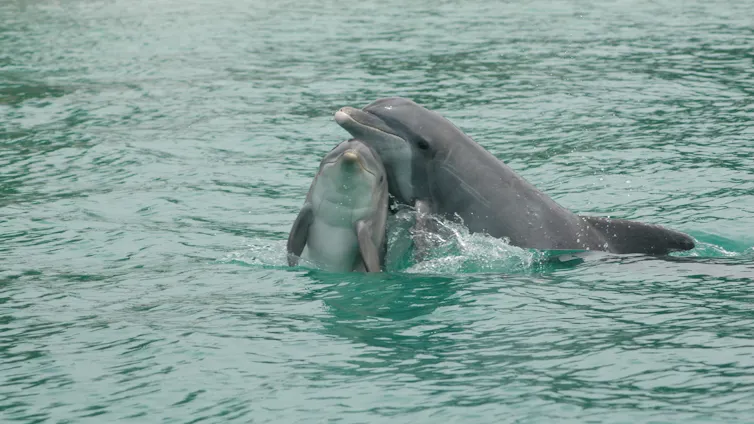
Dolphin mothers modify their signature whistles when communicating with their calves by increasing the maximum frequency, or pitch. This is similar to human caregivers using a higher-pitched voice when communicating with young children – a phenomenon known as “motherese.”
Slowed recording of a bottle-nosed dolphin without her calf, then with her calf. Courtesy of Laela Sayigh of Woods Hole Oceanographic Institution, and Brookfield Zoo Chicago’s Sarasota Dolphin Research Program. These sounds were obtained under a federal scientific research permit issued to R. Wells of SDRP.72 KB (download)
Also similar to humans is how dolphins will initiate contact with another dolphin by imitating their signature whistle – what we call a signature whistle copy. This is similar to how you would use someone’s name to call out to them.
Our team is interested in finding out if dolphins also copy whistles of others who aren’t present, potentially talking about them. We have seen evidence of this in our recordings of dolphins during health assessments, which provide a rare context to document this phenomenon convincingly. But we still have more work to do to confirm that these are more than chance similarities in whistles.
Shared whistle types
Another exciting development has been our recent discovery of shared whistle types — ones that are used by multiple animals and that are not signature whistles. We call these non-signature whistles.
I could hardly believe my ears when I first discovered a repeated, shared non-signature whistle type being produced by multiple dolphins in response to sounds we play back to them through an underwater speaker. We had previously believed that these non-signature whistles were somewhat random, but now I was hearing many different dolphins making a similar whistle type.
Our team originally had been using the playbacks to try to determine whether dolphins use “voice cues” to recognize each other – similar to how you can recognize the voice of someone you know. Although we found that dolphins did not use voice cues, our discovery of shared non-signature whistle types has led to an entirely new research direction.
So far, I’ve identified at least 20 different shared non-signature whistle types, and I am continuing to build our catalog. We are hoping that artificial intelligence methods may help us categorize these whistle types in the future.
To understand how these shared non-signature whistle types function, we are carrying out more playback experiments, filming the dolphins’ responses with drones. We’ve found that one such whistle often leads the dolphins to swim away, suggesting a possible alarm-type function. We have also found that another type might be an expression of surprise, as we have seen animals produce it when they hear unexpected stimuli.
More difficult, more interesting
So far, the main takeaway from our experiments has been that dolphin communication is complex and that there are not going to be one-size-fits-all responses to any non-signature whistle type. This isn’t surprising, given that, like us, these animals have complicated social relationships that could affect how they respond to different sound types.
For instance, when you hear someone call your name, you may respond differently if you are with a group of people or alone, or if you recently had an argument with someone, or if you’re hungry and on your way to eat.
Our team has a lot more work ahead to sample as many dolphins in as many contexts as possible, such as different ages, sexes, group compositions and activities.
This makes my job more difficult – and far more interesting. I feel lucky every day I am able to spend working on the seemingly infinite number of fascinating research questions about dolphin communication that await answers.
This article has been corrected to better describe how dolphins respond to playback whistles.
Read more stories from The Conversation about Florida.
Laela Sayigh, Senior Research Specialist, Cetacean Communication, Woods Hole Oceanographic Institution
This article is republished from The Conversation under a Creative Commons license. Read the original article.
Dive into “The Knowledge,” where curiosity meets clarity. This playlist, in collaboration with STMDailyNews.com, is designed for viewers who value historical accuracy and insightful learning. Our short videos, ranging from 30 seconds to a minute and a half, make complex subjects easy to grasp in no time. Covering everything from historical events to contemporary processes and entertainment, “The Knowledge” bridges the past with the present. In a world where information is abundant yet often misused, our series aims to guide you through the noise, preserving vital knowledge and truths that shape our lives today. Perfect for curious minds eager to discover the ‘why’ and ‘how’ of everything around us. Subscribe and join in as we explore the facts that matter. https://stmdailynews.com/the-knowledge/
Last Updated on April 11, 2026 by Daily News Staff
April 10, 2026 — NASA’s Artemis II crew has safely returned to Earth, marking the successful completion of the first crewed mission to the Moon’s vicinity in more than 50 years.
Credit: NASA/Joel Kowsky
The Orion spacecraft splashed down in the Pacific Ocean off the coast of California at 5:07 p.m. PDT, carrying NASA astronauts Reid Wiseman, Victor Glover, Christina Koch, and Canadian astronaut Jeremy Hansen back home after a nearly 10-day journey through deep space.
🚀 A Mission for the Record Books
During the mission, the crew traveled a total of 694,481 miles, reaching a maximum distance of 252,756 miles from Earth—farther than any humans have ever gone, surpassing the Apollo 13 record set in 1970.
Launched on April 1 aboard NASA’s powerful Space Launch System (SLS) rocket, Artemis II tested critical systems needed for future missions, including life support, navigation, and deep space communication.
🌕 Science, Exploration, and Stunning Views
While orbiting the Moon, the astronauts captured more than 7,000 images, including views of the lunar far side, a rare solar eclipse, and detailed observations of craters, lava flows, and surface features.
The mission also included scientific experiments to better understand how the human body responds to deep space conditions, helping prepare for longer missions to the Moon and Mars.
🛰️ Safe Return and Recovery
Following splashdown, recovery teams quickly reached the spacecraft and transported the crew by helicopter to the USS John P. Murtha for initial medical evaluations. The astronauts are expected to return to NASA’s Johnson Space Center for further assessments.
🌍 What Comes Next
With Artemis II complete, NASA is now turning its focus to Artemis III, the next mission aimed at landing astronauts on the Moon and establishing a long-term human presence.
The success of Artemis II marks a major step forward in humanity’s return to deep space—and the beginning of a new era of exploration.
For more information on NASA’s Artemis program, visit the official NASA website.
🔗 Source & Further Reading
- NASA Blog: Artemis II Flight Day 10 – Re-entry Live Updates
- NASA Artemis II Mission Overview
- NASA Artemis Program – Return to the Moon
- Orion Spacecraft Details and Technology
- NASA Image and Video Library (Artemis II Photos & Media)
Dive into “The Knowledge,” where curiosity meets clarity. This playlist, in collaboration with STMDailyNews.com, is designed for viewers who value historical accuracy and insightful learning. Our short videos, ranging from 30 seconds to a minute and a half, make complex subjects easy to grasp in no time. Covering everything from historical events to contemporary processes and entertainment, “The Knowledge” bridges the past with the present. In a world where information is abundant yet often misused, our series aims to guide you through the noise, preserving vital knowledge and truths that shape our lives today. Perfect for curious minds eager to discover the ‘why’ and ‘how’ of everything around us. Subscribe and join in as we explore the facts that matter. https://stmdailynews.com/the-knowledge/
Space and Tech
Astronaut Victor Glover is the latest in a long line of Black American explorers − including York, the enslaved man who played a key role in the Lewis and Clark expedition

Last Updated on April 10, 2026 by Daily News Staff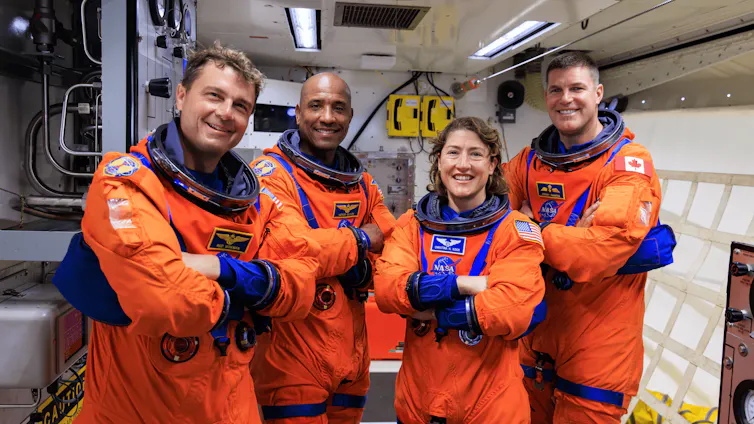
Craig Fehrman, Indiana University
Astronaut Victor Glover
In April 2026, four astronauts are scheduled to fly around the Moon. As part of NASA’s Artemis II mission, they will become the first humans to do so in half a century. One crew member, pilot Victor Glover, will become the first Black astronaut to ever orbit the Moon.
Glover’s achievement is worth celebrating. But it’s also worth remembering that he belongs to a long and underappreciated history. America’s first Black explorer didn’t fly an Apollo rocket or sail with the U.S. Exploring Expedition. He traveled with Lewis and Clark, and he was known by a single name: York.
I’m a historian who spent five years writing a book about Lewis and Clark, and I found new documents that show York was one of the most important people on their expedition. Even in a party that could number as many as 45 men, York stood out – for his courage, his skill and his sacrifices that helped the famous captains reach the Pacific Ocean.
York’s life as a slave

York was born in Virginia around 1770. Growing up, he was a creative and sociable child, unusually tall with dark hair and a dark complexion – “black as a bear,” a contemporary noted.
He was also enslaved by the Clarks. William Clark, who was around the same age, was also unusually tall, though his hair was a rusty red, and sometimes the boys played together. But the playing stopped once York turned 9 or 10. That’s when he joined the adult slaves in working full time. That’s also when he began to note the differences between his life and William’s – differences that became only clearer once William started ordering him around.
In the 1780s, the Clark household headed to Kentucky. York met a Black woman there and married her. He also became William’s “body servant.”
A body servant was a slave who stayed close to his owner and prioritized his comfort, laying out his clothes and serving his meals. When Meriwether Lewis asked Clark to join his expedition, in 1803, Clark ordered York to accompany him.
Perhaps York was excited for this adventure. Perhaps he was not – it would be punishing, and he would be separated from his wife.
Either way, York didn’t have a choice.
The Corps of Discovery
York proved his worth from the start. Once they reached St. Louis, the soldiers, later known as the Corps of Discovery, rushed to raise winter quarters. Working in hail and snow, York and the others built log huts. They needed rough planks for their tables and bunks, but the carpenters had only a single whipsaw to make them. They chose two men to operate this crucial tool. One of them was York.
On May 14, 1804, the corps began ascending the Missouri River. York helped row and tow the party’s barge, which was the size of a semi-truck trailer. He carried a rifle and hunted – according to the expedition’s journals, he was only the fifth named member to bring down a buffalo. York cooked for the captains. He collected scientific specimens. He nursed the sick, including several soldiers and, later on, Sacagawea, a Shoshone woman who would also prove essential to the expedition’s success.
The soldiers were not always kind in return. During this period, officers rarely brought along enslaved body servants. York’s race probably made some of the men angry or uncomfortable. One day, someone threw so much sand in his face that it nearly blinded him. Clark claimed it was “in fun,” but he also wrote that York was “very near losing his eyes,” and no one else got cruelly sprayed with sand.
That fall, during councils with Native leaders, York played a surprising and vital role. The Arikara, Mandan and Hidatsa all crowded in to see him and to touch his skin. They had never met a Black person before, and York showed off his strength and played with the Native children. Later, the Arikara said York was “the most marvelous” thing about the corps.
The next year, the expedition crossed the Rockies and the Continental Divide. York’s most important – and most overlooked – contributions came soon after. On the Columbia River and its tributaries, the party had to dig out five new canoes and then paddle them through treacherous rapids.
Lewis and Clark allowed only their best rivermen on these foaming, rock-riven waters. One of them was almost certainly York. During my research, I found an unpublished letter in which Clark praised York’s ability to “manage the boats.”
Just as important, York was a strong swimmer, a rare thing in an era when many people never learned to swim.
York’s life as an explorer
On the Columbia River, the corps survived a series of terrifying choke points – soggy hazards they referred to as the “Long Narrows” and the “Great Chute.” After that came the ocean. They had traveled together for more than 4,000 miles (6,400 kilometers), and when the captains asked the men to vote on where to put their final winter quarters, they made sure to ask York, too.
It was the latest sign that his role had changed during this epic journey. But those changes began with York. In the West, he found ways to make choices and assert himself. He sent a buffalo robe to his wife in Kentucky. When Clark told him to scale back his performances for Native people, York ignored him – because he wanted to, and because he could.
York’s vote was also evidence that, like Victor Glover today, he was an official American explorer, a key member of a sprawling, federally funded mission. From 1804 to 1806, the government devoted a larger percentage of its budget to the corps than it devotes to NASA today.
Part of that money was earmarked for York. The Army gave officers who brought along their slaves a monthly ration or its cash equivalent. When the corps made it home, the government paid US$274.57 for York’s labor, a sum similar to what the privates received. But that money didn’t go to York. It went to Clark.
The hidden history of Black explorers
There have been many Black explorers in American history. Thomas Jefferson launched other expeditions besides Lewis and Clark’s, and those expeditions also included enslaved people, though their names have not survived. Isaiah Brown served on the Wheeler Survey, which mapped the West in greater detail after the Civil War. Matthew Henson accompanied Robert Peary on his Arctic expeditions, which received some federal support. More recently, NASA has depended on Black astronauts such as Guy Bluford, Mae Jemison and Jeanette Epps, among others.
York and Victor Glover are, for now, the first and most recent examples of this inspiring tradition. But their contributions go beyond that. When the captains asked York to vote on the winter quarters, they were acknowledging in some small way that he’d proven he was more than a body servant.
Of course, York had always been more than that. It just took 4,000 miles for Lewis and Clark to see it.
Craig Fehrman, Adjunct instructor at the Media School, Indiana University
This article is republished from The Conversation under a Creative Commons license. Read the original article.
🧠 Forgotten Genius Fridays
A Short-Form Series from The Knowledge by STM Daily News
Every Friday, STM Daily News shines a light on brilliant minds history overlooked.
Forgotten Genius Fridays is a weekly collection of short videos and articles dedicated to inventors, innovators, scientists, and creators whose impact changed the world—but whose names were often left out of the textbooks.
From life-saving inventions and cultural breakthroughs to game-changing ideas buried by bias, our series digs up the truth behind the minds that mattered.
Each episode of The Knowledge runs 30–90 seconds, designed for curious minds on the go—perfect for YouTube Shorts, TikTok, Reels, and quick reads.
Because remembering these stories isn’t just about the past—it’s about restoring credit where it’s long overdue.
🔔 New episodes every Friday
📺 Watch now at: stmdailynews.com/the-knowledge
🧠 Now you know.





