

Community
What if universal rental assistance were implemented to deal with the housing crisis?
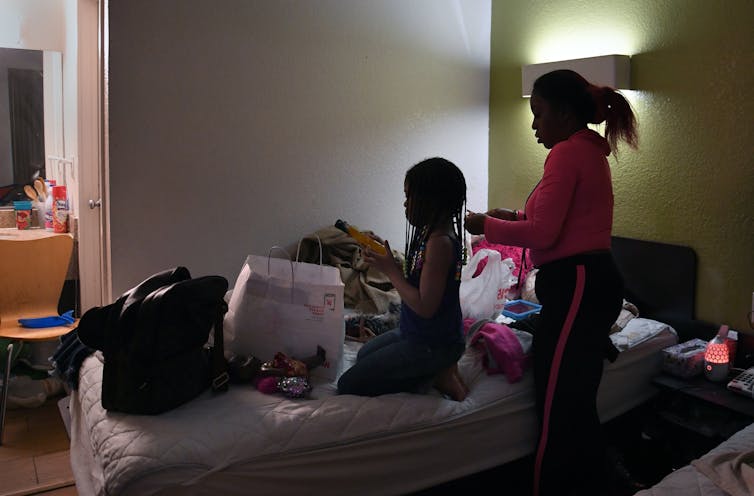
A significant number of American families facing unaffordable rents are living in motels. While many believe a housing shortage causes high rents, experts suggest that expanding rental assistance is more effective. Making subsidies available to all eligible low-income households could tackle this affordability crisis significantly.

What if universal rental assistance were implemented to deal with the housing crisis?
Alex Schwartz, The New School and Kirk McClure, University of Kansas
If there’s one thing that U.S. politicians and activists from across the political spectrum can agree on, it’s that rents are far too high.
Many experts believe that this crisis is fueled by a shortage of housing, caused principally by restrictive regulations.
Rents and home prices would fall, the argument goes, if rules such as minimum lot- and house-size requirements and prohibitions against apartment complexes were relaxed. This, in turn, would make it easier to build more housing.
As experts on housing policy, we’re concerned about housing affordability. But our research shows little connection between a shortfall of housing and rental affordability problems. Even a massive infusion of new housing would not shrink housing costs enough to solve the crisis, as rents would likely remain out of reach for many households.
However, there are already subsidies in place that ensure that some renters in the U.S. pay no more than 30% of their income on housing costs. The most effective solution, in our view, is to make these subsidies much more widely available.
A financial sinkhole
Just how expensive are rents in the U.S.?
According to the U.S. Department of Housing and Urban Development, a household that spends more than 30% of its income on housing is deemed to be cost-burdened. If it spends more than 50%, it’s considered severely burdened. In 2023, 54% of all renters spent more than 30% of their pretax income on housing. That’s up from 43% of renters in 1999. And 28% of all renters spent more than half their income on housing in 2023.
Renters with low incomes are especially unlikely to afford their housing: 81% of renters making less than $30,000 spent more than 30% of their income on housing, and 60% spent more than 50%.
Estimates of the nation’s housing shortage vary widely, reaching up to 20 million units, depending on analytic approach and the time period covered. Yet our research, which compares growth in the housing stock from 2000 to the present, finds no evidence of an overall shortage of housing units. Rather, we see a gap between the number of low-income households and the number of affordable housing units available to them; more affluent renters face no such shortage. This is true in the nation as a whole and in nearly all large and small metropolitan areas.
Would lower rents help? Certainly. But they wouldn’t fix everything.
We ran a simulation to test an admittedly unlikely scenario: What if rents dropped 25% across the board? We found it would reduce the number of cost-burdened renters – but not by as much as you might think.
Even with the reduction, nearly one-third of all renters would still spend more than 30% of their income on housing. Moreover, reducing rents would help affluent renters much more than those with lower incomes – the households that face the most severe affordability challenges.
The proportion of cost-burdened renters earning more than $75,000 would fall from 16% to 4%, while the share of similarly burdened renters earning less than $15,000 would drop from 89% to just 80%. Even with a rent rollback of 25%, the majority of renters earning less than $30,000 would remain cost-burdened.
Vouchers offer more breathing room
Meanwhile, there’s a proven way of making housing more affordable: rental subsidies.
In 2024, the U.S. provided what are known as “deep” housing subsidies to about 5 million households, meaning that rent payments are capped at 30% of their income.
These subsidies take three forms: Housing Choice Vouchers that enable people to rent homes in the private market; public housing; and project-based rental assistance, in which the federal government subsidizes the rents for all or some of the units in properties under private and nonprofit ownership.
The number of households participating in these three programs has increased by less than 2% since 2014, and they constitute only 25% of all eligible households. Households earning less than 50% of their area’s median family income are eligible for rental assistance. But unlike Social Security, Medicare or food stamps, rental assistance is not an entitlement available to all who qualify. The number of recipients is limited by the amount of funding appropriated each year by Congress, and this funding has never been sufficient to meet the need.
By expanding rental assistance to all eligible low-income households, the government could make huge headway in solving the rental affordability crisis. The most obvious option would be to expand the existing Housing Choice Voucher program, also known as Section 8.
The program helps pay the rent up to a specified “payment standard” determined by each local public housing authority, which can set this standard at between 80% and 120% of the HUD-designated fair market rent. To be eligible for the program, units must also satisfy HUD’s physical quality standards.
Unfortunately, about 43% of voucher recipients are unable to use it. They are either unable to find an apartment that rents for less than the payment standard, meets the physical quality standard, or has a landlord willing to accept vouchers.
Renters are more likely to find housing using vouchers in cities and states where it’s illegal for landlords to discriminate against voucher holders. Programs that provide housing counseling and landlord outreach and support have also improved outcomes for voucher recipients.
However, it might be more effective to forgo the voucher program altogether and simply give eligible households cash to cover their housing costs. The Philadelphia Housing Authority is currently testing out this approach.
The idea is that landlords would be less likely to reject applicants receiving government support if the bureaucratic hurdles were eliminated. The downside of this approach is that it would not prevent landlords from renting out deficient units that the voucher program would normally reject.
Homeowners get subsidies – why not renters?
Expanding rental assistance to all eligible low-income households would be costly.
The Urban Institute, a nonpartisan think tank, estimates it would cost about $118 billion a year.
However, Congress has spent similar sums on housing subsidies before. But they involve tax breaks for homeowners, not low-income renters. Congress forgoes billions of dollars annually in tax revenue it would otherwise collect were it not for tax deductions, credits, exclusions and exemptions. These are known as tax expenditures. A tax not collected is equivalent to a subsidy payment.
For example, from 1998 through 2017 – prior to the tax changes enacted by the first Trump administration in 2017 – the federal government annually sacrificed $187 billion on average, after inflation, in revenue due to mortgage interest deductions, deductions for state and local taxes, and for the exemption of proceeds from the sale of one’s home from capital gains taxes. In fiscal year 2025, these tax expenditures totaled $95.4 billion.
Moreover, tax expenditures on behalf of homeowners flow mostly to higher-income households. In 2024, for example, over 70% of all mortgage-interest tax deductions went to homeowners earning at least $200,000.
Broadening the availability of rental subsidies would have other benefits. It would save federal, state and local governments billions of dollars in homeless services. Moreover, automatic provision of rental subsidies would reduce the need for additional subsidies to finance new affordable housing. Universal rental assistance, by guaranteeing sufficient rental income, would allow builders to more easily obtain loans to cover development costs.
Of course, sharply raising federal expenditures for low-income rental assistance flies in the face of the Trump administration’s priorities. Its budget proposal for the next fiscal year calls for a 44% cut of more than $27 billion in rental assistance and public housing.
On the other hand, if the government supported rental assistance in amounts commensurate with the tax benefits given to homeowners, it would go a long way toward resolving the rental housing affordability crisis.
This article is part of a series centered on envisioning ways to deal with the housing crisis.
Alex Schwartz, Professor of Urban Policy, The New School and Kirk McClure, Professor of Urban Planning, University of Kansas
This article is republished from The Conversation under a Creative Commons license. Read the original article.
Discover more from Daily News
Subscribe to get the latest posts sent to your email.


Feeding America is marking National Agriculture Day by recognizing farmers, ranchers, and producers as key partners in the fight against hunger.
In a March 24 press release, the organization said the agricultural community plays a vital role in helping food banks and pantries deliver fresh, nutritious food to families across the country. Feeding America noted that produce, dairy, and protein are among the most requested foods by neighbors facing hunger and make up half of all food distributed through its network.
The organization said that in 2025, its network worked with growers to rescue 971 million pounds of fresh produce, helping redirect surplus food to communities in need. Feeding America also pointed to federal nutrition and farm support programs, saying government purchases from U.S. growers provide more than 20% of the food distributed through its network.
Ami McReynolds, Feeding America’s chief advocacy and community partnerships officer, said supporting farmers is directly connected to helping families access healthy meals. The organization is also urging Congress to support additional farm aid and a Farm Bill that strengthens nutrition programs.
Feeding America said a recent poll found that 95% of voters view hunger as a nonpartisan issue, reinforcing support for collaborative solutions between agriculture, food banks, and policymakers.
Related Links
Source Links
The Bridge is a section of the STM Daily News Blog meant for diversity, offering real news stories about bona fide community efforts to perpetuate a greater good. The purpose of The Bridge is to connect the divides that separate us, fostering understanding and empathy among different groups. By highlighting positive initiatives and inspirational actions, The Bridge aims to create a sense of unity and shared purpose. This section brings to light stories of individuals and organizations working tirelessly to promote inclusivity, equality, and mutual respect. Through these narratives, readers are encouraged to appreciate the richness of diverse perspectives and to participate actively in building stronger, more cohesive communities.
https://stmdailynews.com/the-bridge
Author

Discover more from Daily News
Subscribe to get the latest posts sent to your email.
Community
McDonald’s First Job Confessional Turns Career Stories Into Free Meal Opportunity
McDonald’s is launching First Job Confessional, a campaign inviting fans to share first job stories for a chance to receive a $15 gift card in select cities.


First Job Confessional
McDonald’s is putting first jobs in the spotlight with a new campaign that asks fans to share the real-world skills they gained early in their working lives. Launched on National Employee Appreciation Day, the brand’s First Job Confessional invites people to reflect on how those first roles helped shape their careers — and, in some cases, earn a free meal in the process.
The campaign is built around a simple idea: first jobs often teach lasting skills that deserve more recognition. Whether someone learned problem-solving while babysitting, communication during a lunch rush, or teamwork behind a counter, McDonald’s is framing those experiences as valuable career foundations. The company says those are the same kinds of skills employers continue to prioritize as workplace demands evolve.

How the First Job Confessional Works
In select cities, McDonald’s is setting up confessional booths designed to look like ordering kiosks. But instead of placing a meal order, participants can record a story about their first job and the skills they picked up along the way. Those who take part in person will have the opportunity to receive a $15 McDonald’s gift card, while supplies last.
Fans who cannot attend in person can still join online by posting their stories using #FirstJobConfessional. McDonald’s says selected videos may also be featured on its YouTube channel, extending the campaign beyond the live events.
External Related Links
- McDonald’s corporate article: McDonald’s is Asking Fans to Get Real About Their First Job Skills in Exchange for Free Meals
- McDonald’s 1 in 8: First Job Confessional
- McDonald’s 1 in 8 home page
- Marketing Dive coverage of the campaign
- Parade coverage of the First Job Confessional tour
Source Links
- Original PRNewswire press release from McDonald’s USA, LLC
- McDonald’s official corporate story
- McDonald’s 1 in 8 First Job Confessional page
- McDonald’s 1 in 8 official website
The Bridge is a section of the STM Daily News Blog meant for diversity, offering real news stories about bona fide community efforts to perpetuate a greater good. The purpose of The Bridge is to connect the divides that separate us, fostering understanding and empathy among different groups. By highlighting positive initiatives and inspirational actions, The Bridge aims to create a sense of unity and shared purpose. This section brings to light stories of individuals and organizations working tirelessly to promote inclusivity, equality, and mutual respect. Through these narratives, readers are encouraged to appreciate the richness of diverse perspectives and to participate actively in building stronger, more cohesive communities.
https://stmdailynews.com/the-bridge
Discover more from Daily News
Subscribe to get the latest posts sent to your email.
Entertainment
Subaru Cherry Blossom Festival Returns to Philadelphia March 28-29, Celebrating 100 Years of Sakura Friendship


Subaru Cherry Blossom Festival
Philadelphia’s annual Subaru Cherry Blossom Festival will return to Fairmount Park on Saturday, March 28, and Sunday, March 29, 2026, with a special focus on the 100th anniversary of Japan’s gift of cherry trees to the city. Hosted by the Japan America Society of Greater Philadelphia and Subaru of America, Inc., the two-day event will run from 10 a.m. to 5 p.m. at the Horticulture Center and Shofuso Japanese Cultural Center.
Organizers say the family-friendly, dog-friendly festival will feature live music, Japanese cultural performances, cosplay and alternative fashion shows, karaoke, tea ceremonies, calligraphy, ikebana demonstrations, a vendor fair, artist alley, and a food court highlighting Japanese and Asian cuisine. A “Prettiest in Pink” Pet Contest & Parade is also scheduled for Sunday, March 29. The event comes after the festival drew more than 25,000 attendees in 2025 and will expand its footprint this year to improve the visitor experience.
General admission is $15 in advance and $20 at the gate, while children under 12 and JASGP members can attend for free. Organizers said the festival will be held rain or shine, with parking available at the Highmark Mann Center for $10 per vehicle. More information and tickets are available at PhillySakura.org.
STM Daily News’ Entertainment section delivers the latest on movies, television, music, pop culture, events, and industry buzz. From breaking news and trending stories to feature coverage and community-centered entertainment reporting, it keeps readers connected to what’s happening on screen, on stage, and beyond.
Discover more from Daily News
Subscribe to get the latest posts sent to your email.





