

The Knowledge
What Is a Gustnado?
A gustnado may look like a tornado, but it’s a different weather phenomenon. Learn what a gustnado is, how it forms, and why it’s usually weaker.

Last Updated on December 18, 2025 by Daily News Staff
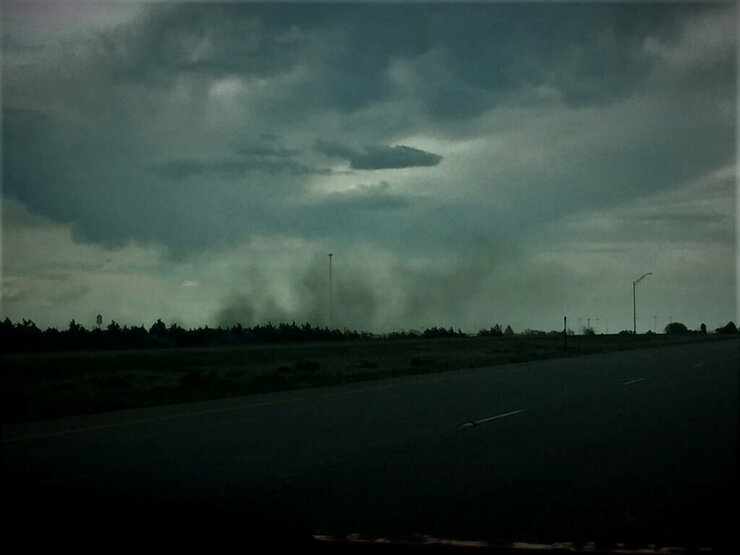
A gustnado east of Limon, Colorado. Image Credit: Jessica Kortekaas
Severe weather can produce dramatic sights—but not every spinning column of air is a tornado.
A [gustnado](chatgpt://generic-entity?number=0) is a brief, ground-level swirl of rotating air that forms along a thunderstorm’s gust front. Gustnadoes often appear suddenly, kicking up dust or debris, which can make them look more dangerous than they actually are.
Unlike tornadoes, gustnadoes do not connect to a storm’s rotating updraft. Because of this, they are usually weaker, short-lived, and difficult to detect on weather radar.
Gustnadoes typically last only seconds to a few minutes and are most commonly spotted in dry regions, where loose soil makes their rotation visible.
The takeaway: If it’s spinning near the ground ahead of a storm, it may look intense—but it’s not always a tornado.
Learn the differences between tornadoes, dust devils, and other rotating weather phenomena in our STM Daily News Knowledge Series.


Daily News
Major Construction Begins on Metro’s East San Fernando Valley Light Rail Line
LA Metro has moved the East San Fernando Valley Light Rail Transit Project into major construction. The 6.7-mile Van Nuys Boulevard line will add 11 stations, connect with the G Line and regional rail services, and is now targeted for completion in early 2032.
After years of utility relocation and planning, LA Metro is moving into major construction on a new rail line along Van Nuys Boulevard. The milestone also comes with a revised early-2032 completion target.
LA Metro has officially marked the beginning of major construction on the East San Fernando Valley Light Rail Transit Project, moving one of the region’s most important rail projects from preparatory work into full-scale construction.
Metro held a groundbreaking ceremony on October 19, 2026, for the 6.7-mile line, which will run along Van Nuys Boulevard from the G Line busway north to San Fernando Road in Pacoima. The project will add 11 light-rail stations serving Van Nuys, Panorama City, Arleta and Pacoima.
This was not the project’s first groundbreaking. Metro held an earlier ceremony in December 2022 when crews began relocating utility infrastructure. The new milestone is more consequential for riders: the major-construction phase covers the guideway, stations, traction-power substations, rail systems and a maintenance and storage facility.
From utility work to a new rail corridor
The project has spent several years in utility relocation, property acquisition, design and other early work. Metro’s current construction timeline shows major work continuing from 2026 through 2032, with phased traffic changes and K-rail installations expected along Van Nuys Boulevard.
When completed, trains are expected to operate every seven to 10 minutes during peak periods. The line will connect directly with the G Line and provide access to the Van Nuys Metrolink and Amtrak station. It is also expected to become an important transfer point for the future Sepulveda Transit Corridor and a planned Metrolink station in Pacoima.
The corridor already has a substantial transit market. Metro reported that bus Lines 233 and 761, which serve Van Nuys Boulevard, recorded nearly 20,000 boardings in September 2026. The agency also says approximately 19 percent of households in the project area lack access to a car, compared with about 8 percent countywide.
Those figures help explain why this project matters beyond its construction footprint. It is intended to give residents in some of the Valley’s most transit-dependent communities more reliable access to jobs, schools, healthcare and the wider regional transit network.
The opening target has moved to 2032
Metro’s current project page lists an estimated completion date of early 2032. That is later than the 2031 opening forecast the agency publicized when it celebrated an $893-million federal grant in September 2024. Earlier plans were more optimistic still: when utility work began in 2022, Metro said the first segment could open between 2028 and 2030.
The project’s financial scale has also grown clearer. In May 2026, the Metro Board established a life-of-project budget of approximately $3.999 billion and authorized the next phase of its progressive design-build contract with San Fernando Transit Constructors, a joint venture of Skanska and Stacy and Witbeck.
That authorization increased the construction contract’s value to roughly $2.431 billion. Funding for the larger project combines federal, state and local sources, including revenue from Los Angeles County’s Measure M transportation sales tax.
Rail returns to Van Nuys Boulevard
The East San Fernando Valley line will restore passenger rail to Van Nuys Boulevard for the first time since Pacific Electric ended streetcar service there in 1952. It will also become the first major new Metro rail project in the San Fernando Valley since the subway reached North Hollywood in 2000.
The historical parallel is significant. Van Nuys Boulevard once developed around electric railway service before the region shifted heavily toward automobiles and buses. Metro is now rebuilding rail in the same broad corridor, but as part of a modern network designed to connect local riders with bus rapid transit, regional rail and future high-capacity projects.
The current project ends in Pacoima. Metro continues to study a separate 2.5-mile northern extension that would reach the Sylmar/San Fernando Metrolink station. That extension is not included in the segment now entering major construction.
For riders, the October groundbreaking does not mean trains are imminent. Several years of disruptive and technically complex work remain, and the schedule has already moved beyond earlier forecasts. Still, it represents a tangible transition: the East San Fernando Valley line is no longer primarily a planning exercise or utility-relocation program. Metro has begun building the infrastructure that will carry trains.
That makes this a major step in Los Angeles County’s long effort to restore frequent rail transit to communities that lost it generations ago—and another chapter in The Long Track Back.
Primary sources
- LA Metro: Major construction will soon be underway
- LA Metro project page: East San Fernando Valley Light Rail Transit
- LA Metro Board meeting, May 28, 2026 — project budget and contract authorization
- LA Metro: $893 million federal grant announcement, September 6, 2024
- LA Metro: Advanced utility-work groundbreaking, December 2, 2022
This article is part of The Long Track Back, STM Daily News’ continuing coverage of how Los Angeles is rebuilding and expanding a passenger-rail network after decades of automobile-centered grow

For generations, the Santa Monica Pier sign has marked the start of a day at the beach. Now, the familiar blue neon landmark is preparing for a journey of its own.
Santa Monica scheduled removal of the 1941 sign for October 20–22, with shipment to Las Vegas anticipated October 26. The timetable is subject to change, according to the city’s October 19 announcement.
The temporary removal accompanies replacement of the aging bridge connecting Ocean Avenue to the pier. It also creates an opportunity to preserve the historic sign.
YESCO will restore it at its Las Vegas facility. The company’s experience includes work on the “Welcome to Fabulous Las Vegas” sign.
Crews will repair neon tubing, treat rust, repaint components and address structural needs while retaining historic features. The sign will remain in secure storage during bridge construction.
Once the project is finished, it will return above the new bridge at a slightly greater height for visibility and vehicle clearance. The city’s latest announcement targets project completion by 2028, ahead of the Los Angeles Olympics and Paralympics.
Meanwhile, visitors can photograph a lighted, half-scale replica near Pier Burger.
For anyone who associates that glowing arch with Southern California memories, its absence will be noticeable. The restoration is intended to ensure future generations can make memories beneath it, too.
Source: City of Santa Monica — October 19, 2026 announcement
Related Links
- City of Santa Monica: Official sign restoration announcement — October 19, 2026. Primary source for removal dates, shipment to Las Vegas, YESCO’s restoration work and the sign’s planned return.
- Santa Monica Daily Press: Sign restoration during bridge rebuild — October 20, 2026. Additional local reporting on the project and visitor access.
- LAist: Sign removal and how to watch — Reporting on the removal schedule and public viewing opportunities.
Follow more Southern California stories at STM Daily News.
Forgotten Genius Fridays
Octavia E. Butler: The Black Woman Who Helped Change Science Fiction
Discover how Octavia E. Butler transformed science fiction, explored Black identity, and helped shape Afrofuturism through her groundbreaking novels.
Forgotten Genius Friday | The Knowledge | STM Daily News
Octavia E. Butler: The Woman Who Reimagined the Future
When we think about science fiction, we often picture spaceships, robots, alien civilizations, and futuristic technology. But what happens when science fiction becomes a way to explore racism, inequality, human survival, and the consequences of our choices?
That is exactly what Octavia E. Butler brought to the genre.
Long before Afrofuturism became a widely recognized cultural movement, Butler was creating extraordinary stories that placed Black characters—especially Black women—at the center of imagined futures.
Her work challenged conventional ideas about who could be a hero, whose experiences mattered, and what science fiction could accomplish.
A Young Girl With a Powerful Imagination
Octavia Estelle Butler was born on June 22, 1947, in Pasadena, California.
Raised primarily by her mother and grandmother after her father’s death, Butler grew up shy and found comfort in books and storytelling.
Her mother worked as a domestic employee, and Butler sometimes accompanied her to work. Those experiences exposed her to the racial and economic inequalities that would later influence her fiction.
As a child, Butler loved science fiction, but she noticed something missing: people who looked like her.
Rather than accepting that absence, she began creating stories of her own.
She would eventually become one of the most influential writers in speculative fiction.
Breaking Barriers in Science Fiction
During the 1970s, mainstream American science fiction was largely associated with white male writers and protagonists.
Butler entered that literary world with a different perspective.
Her first published novel, Patternmaster, appeared in 1976. It introduced readers to a world shaped by extraordinary mental abilities, social hierarchies, and struggles for power.
Butler continued developing complex stories that explored humanity’s relationship with authority, identity, biology, and survival.
In 1979, she published one of her best-known novels, Kindred.
The book follows Dana, a Black woman living in 1970s California who is repeatedly transported back to a Maryland plantation before the Civil War.
Through Dana’s experiences, Butler forced readers to confront the brutality of American slavery and its continuing influence on the present.
Rather than treating history as something safely confined to the past, Kindred makes that history immediate and deeply personal.
Imagining the Future—and Warning Us About It
In 1993, Butler published Parable of the Sower, a novel set in a collapsing American society struggling with economic inequality, environmental destruction, violence, and weakened institutions.
Its central character, Lauren Olamina, is a young Black woman who develops a philosophy called Earthseed while searching for a way to survive and build a community.
The novel takes place beginning in 2024, making its imagined future particularly striking to modern readers.
Butler followed it with Parable of the Talents in 1998, continuing her examination of social instability, religious extremism, authoritarianism, and the struggle to create a better future.
Her novels were not literal predictions. They were works of speculative fiction that used recognizable social trends to ask difficult questions about where humanity might be headed.
Octavia Butler and Afrofuturism
Afrofuturism brings together African and African diasporic experiences with science fiction, technology, history, mythology, and imaginative visions of the future.
While artists such as Sun Ra and George Clinton explored cosmic identity through music, performance, and futuristic imagery, Butler used literature to investigate power, history, and humanity’s possible futures.
Her novels frequently placed Black women in situations where they had to navigate extraordinary challenges and reshape the societies around them.
Butler’s work is widely discussed within Afrofuturist scholarship, although her literary contributions also extend beyond any single cultural label.
She demonstrated that Black people did not have to remain secondary characters in someone else’s vision of the future.
They could be the architects of entirely new worlds.
Recognition and a Lasting Legacy
Butler received some of science fiction’s most significant honors, including Hugo and Nebula Awards.
In 1995, she became the first science-fiction writer to receive a MacArthur Fellowship, often called a genius grant.
Her work also included the Xenogenesis trilogy, later collected as Lilith’s Brood, which explored humanity’s encounter with an extraterrestrial species and raised questions about consent, adaptation, identity, and survival.
Butler died on February 24, 2006, at age 58.
Yet her influence has continued to grow.
Her novels are studied in classrooms, discussed by scholars, and embraced by new generations of readers and creators interested in science fiction, social justice, and Afrofuturism.
A Genius Who Made Us Think Differently About Tomorrow
Octavia E. Butler was more than a science-fiction author.
She was a visionary storyteller who understood that imagining the future also meant examining the past and questioning the present.
Her stories asked readers to consider how power operates, how communities survive, and how human beings might change.
And perhaps her greatest contribution was demonstrating that the future belongs in the imagination of everyone.
Why Octavia E. Butler Belongs in Forgotten Genius Friday
At STM Daily News, our Forgotten Genius Friday series celebrates extraordinary individuals whose ideas, innovations, and accomplishments helped shape our world, even if their stories aren’t widely known. Octavia E. Butler fits that mission perfectly. Although she received prestigious literary awards and recognition during her lifetime, her influence extends far beyond science fiction. Like the inventors, scientists, and trailblazers we’ve featured in this series, Butler challenged barriers, defied expectations, and opened doors for future generations. Through her imagination, she helped redefine who could tell stories about humanity’s future—and who could be at the center of those stories. Her inclusion in Forgotten Genius Friday reminds us that genius isn’t limited to laboratories and inventions. Sometimes, it begins with a pen, a powerful imagination, and the courage to envision a different world.
Sources and fact-checking
The Huntington Library holds Butler’s literary archive and confirms the chronology of her major novels, awards, and career. The MacArthur Foundation independently documents her 1995 fellowship.
- Official Octavia E. Butler biography
- The Huntington — Octavia E. Butler Papers
- MacArthur Foundation — Octavia Butler
- The Huntington — Telling My Stories exhibition
For more stories about overlooked innovators, writers, scientists, and visionaries who changed our world, explore The Knowledge and Forgotten Genius Friday at STM Daily News.




