astronomy
Mars: New Evidence of Life-Friendly Environment
New evidence reveals Mars’ life-friendly past: fossil rivers, lakes, organic molecules, and cyclical climate patterns.

Last Updated on September 6, 2025 by Daily News Staff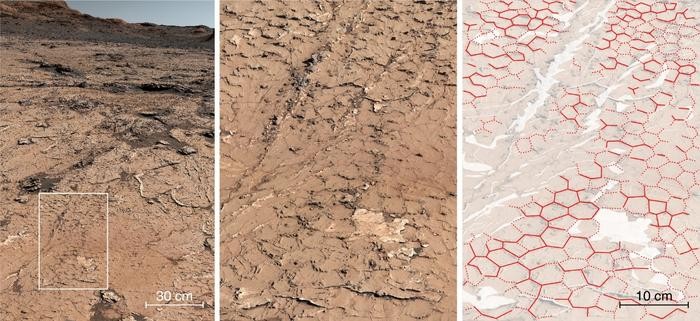
A hexagonal fossil pattern in sedimentary rocks analysed by Curiosity on the 3154th day of its journey through the Gale Crater on Mars.
« Mars: new evidence of an environment conducive to the emergence of life
Mars, the red planet, has always captivated the imagination of scientists and space enthusiasts alike. Recent findings by the CNRS (Centre National de Recherche Scientifique) shed light on the possibility of Mars having once harbored an environment conducive to the emergence of life. This discovery has significant implications for understanding the potential for extraterrestrial life.
Preserved Ancient Terrain:
Unlike Earth, Mars lacks the constant renewal of its surface through plate tectonics. This unique characteristic has resulted in preserving vast areas abundant in fossil rivers and lakes dating back billions of years. Previous explorations, notably NASA’s Curiosity rover, had already detected simple organic molecules, indicating the presence of geological and possibly biological processes.
Ideal Environmental Conditions:
The recent research conducted by a team from CNRS and other institutions unveiled the discovery of hexagonal patterns in sedimentary layers dating from 3.8 to 3.6 billion years ago. These patterns, similar to those found in seasonal basins on Earth, are the first fossil evidence of a sustained, cyclical, regular Martian climate with dry and wet seasons. Such an environment allows molecules to repeatedly interact at varying concentrations, creating ideal conditions for the formation of complex organic compounds, including RNA, which are crucial precursors to life.
Implications for Future Exploration:
These new findings provide scientists with a fresh perspective on large-scale images collected by orbiting spacecraft, revealing numerous terrains with similar compositions. By pinpointing the locations that exhibit the necessary conditions for the emergence of life, researchers can focus their future explorations and investigations. Mars, with its preserved ancient terrain, holds the potential to unlock the secrets of natural processes that led to the origin of life, which may no longer exist on Earth.
The CNRS research team’s discovery of hexagonal patterns and deposits of salts on Mars offers compelling evidence of an environment that once fostered the emergence of life. These findings fuel excitement and curiosity about the possibility of extraterrestrial life in our solar system. As exploration efforts continue, scientists will delve further into Mars’ past, unraveling its mysteries and providing valuable insights into the origins of life, both on our neighboring planet and potentially beyond.
For more reading Please visit:
https://www.nature.com/articles/s41586-023-06220-3
https://stmdailynews.com/category/science/astronomy/


The Knowledge
Asteroid 1998 KY26: Can Sunlight Explain Its Motion?
Sunlight may explain the unusual motion of asteroid 1998 KY26. A new study casts doubt on the dark comet theory, and Japan has canceled its planned visit.
Last Updated on November 20, 2026 by Daily News Staff

A tiny asteroid about the length of a school bus has been drifting slightly off the path astronomers would predict from gravity alone. The object, known as 1998 KY26, spins once every five minutes and 21 seconds. One of the strongest explanations for its unusual motion comes from a familiar source: sunlight.
In a 2025 study, researchers led by NASA’s Jet Propulsion Laboratory modeled two small forces acting on the roughly 36-foot-wide asteroid. Sunlight exerts pressure when it strikes the surface, and the asteroid gets another tiny push as it radiates heat back into space. When the team accounted for the asteroid’s irregular shape and rapid spin, the model closely matched its observed trajectory.
A newer study published in Icarus casts doubt on another explanation. Astronomers had proposed that escaping water vapor might give KY26 a gentle push without producing a visible tail, making it a candidate for what scientists call a “dark comet.” But temperature simulations found that even the object’s coldest regions would be too warm to hold on to buried water ice over long periods. The findings make long-lived ice a less likely source of the asteroid’s extra acceleration.
A close-up look was planned for 2031, when Japan’s Hayabusa2 spacecraft was due to rendezvous with KY26. On November 17, Japan’s space agency announced that ion-engine trouble had forced a change of plans. The spacecraft is now slated to fly past a different asteroid, 2015 BM510, in April 2028.
Sources
EarthSky, November 20, 2026. Paul Scott Anderson covers the unusual motion of 1998 KY26, the proposed explanations, and the cancellation of Hayabusa2’s planned visit. Mystery space object moves in strange ways- Solar radiation and the orbit. The 2025 study found that sunlight pressure and heat emitted by the asteroid could reproduce its observed trajectory. The Astrophysical Journal Letters
— Radiation Forces and Trajectory of Hayabusa2 Target 1998 KY26
- The new water-ice study. Temperature modeling suggests buried water ice would have difficulty surviving over long periods. Icarus
— Thermally Unfavorable Conditions of Volatile Existence in Near-Earth Asteroid 1998 KY26
- Size and rotation. The team used optical and radar observations to revise the asteroid’s estimated diameter and spin rate. Nature Communications
— 1998 KY26 Is Smaller and Rotating Faster Than Previously Known
- Hayabusa2 mission change. JAXA’s November 17 briefing details the switch from the KY26 rendezvous to a flyby of 2015 BM510. JAXA mission briefing (PDF, Japanese)
· Jiji Press coverage in English
Related reading on STM Daily News
- Large Asteroid 1999 AN10 Will Safely Pass Earth in August 2027
- Asteroid Apophis: An Exciting Encounter with Earth
- Interstellar Visitor 3I/ATLAS Surprises Astronomers With Growing Tail and Strange Chemistry
astronomy
Large Asteroid 1999 AN10 Will Safely Pass Earth in August 2027
A large asteroid, 1999 AN10, will safely pass Earth on August 7, 2027, at roughly the Moon’s distance. The flyby could offer binocular views and valuable opportunities for scientific study.
Last Updated on November 15, 2026 by Daily News Staff
A close approach near the Moon’s distance could give skywatchers a chance to spot the asteroid with binoculars.
A large asteroid will sweep past Earth on August 7, 2027, offering scientists a valuable research opportunity and skywatchers a potential binocular target. The asteroid, known as 1999 AN10, will safely miss our planet.
How close will asteroid 1999 AN10 come to Earth?
NASA’s Jet Propulsion Laboratory predicts the space rock will pass roughly 242,000 miles (390,000 kilometers) from Earth’s center—about the same distance as the Moon. That is close in astronomical terms, but the predicted flyby poses no impact threat.
Its exact size remains uncertain. JPL estimates a diameter of about 800 meters, or half a mile, while noting considerable uncertainty. Upcoming observations could help researchers better determine its dimensions, shape, and surface features.
Although 1999 AN10 is classified as a potentially hazardous asteroid, that designation describes its orbital proximity and size. It does not mean the asteroid is expected to strike Earth during this encounter.
Can you see the asteroid in August 2027?
For astronomy enthusiasts, the flyby could provide a memorable observing opportunity. JPL predicts the asteroid will reach approximately magnitude 7.5 on the night of August 6–7, making it a possible target for binoculars or small telescopes under suitable conditions. It is expected to be too faint to see with the unaided eye.
Scientists also plan radar observations that could reveal detailed surface features. The encounter offers a chance to learn more about a large near-Earth asteroid as it passes safely through our cosmic neighborhood.
Explore more astronomy and science stories in The Knowledge at STM Daily News.
Sources:
● NASA/JPL, Goldstone Radar Observations Planning: https://echo.jpl.nasa.gov/asteroids/1999an10.2027.goldstone.planning.html
● EarthSky, Mountain-sized asteroid 1999 AN10 to pass close to Earth in 2027: https://earthsky.org/space/mountain-sized-asteroid-1999-an10-pass-close-to-earth-aug-7-2027/

Science
October Meteor Showers Give Phoenix Skywatchers a Reason to Look Up
Phoenix skywatchers have several chances to catch October’s meteor showers. Here’s when to watch the Taurids and Orionids—and how moonlight affects the view.

Last Updated on October 10, 2026 by Daily News Staff
PHOENIX — October is bringing several opportunities to spot shooting stars over the Valley, with the Draconids reaching their October 8–9 peak and more meteor activity ahead.
The Draconids remain active through October 10, although viewers should expect a light display as the peak passes. Under favorable conditions, the shower typically produces only a handful of meteors per hour. timeanddate.com

Next, the Southern Taurids have an annual activity peak around October 14. Known for occasional bright fireballs, the shower continues into November. The stronger Orionids peak on the night of October 21 into the morning of October 22, typically producing 10–20 meteors per hour under dark skies. A bright Moon will interfere with this year’s display. American Meteor Society
The Orionids originate from debris left by Halley’s Comet. For Phoenix viewers, the best opportunity will be after moonset and before dawn, weather permitting. City lights will further reduce the number visible. amsmeteors.org
NASA recommends finding a viewing area away from streetlights, allowing about 30 minutes for eyes to adjust, and watching a broad stretch of sky. No telescope is needed—just a comfortable chair and patience. NASA Science
ECurious about what’s happening above us? Explore more space stories and science explainers in The Knowledge at STM Daily News.xplore more space, science and everyday