Connect with us

Blog

Is Mars really red? A physicist explains the planet’s reddish hue and why it looks different to some telescopes

Published

on

file 20250513 56 vwwqg9.jpg?ixlib=rb 4.1
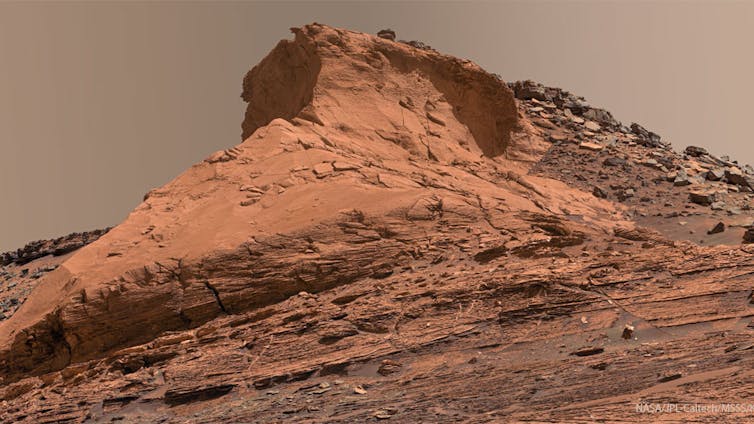
Siccar Point, photographed by the Curiosity rover, is near Mars’ Gale Crater.
NASA/JPL-Caltech/MSSS; Processing & License: Kevin M. Gill

David Joffe, Kennesaw State University

Curious Kids is a series for children of all ages. If you have a question you’d like an expert to answer, send it to CuriousKidsUS@theconversation.com.


Is Mars really as red as people say it is? – Jasmine, age 14, Everson, Washington


People from cultures across the world have been looking at Mars since ancient times. Because it appears reddish, it has often been called the red planet.

The English name for the planet comes from the Romans, who named it after their god of war because its color reminded them of blood. In reality, the reddish color of Mars comes from iron oxide in the rocks and dust covering its surface.

Your blood is also red because of a mixture of iron and oxygen in a molecule called hemoglobin. So in a way, the ancient connection between the planet Mars and blood wasn’t completely wrong. Rust, which is a common form of iron oxide found here on Earth, also often has a reddish color.

Rust flakes on metal.
Iron oxide, found in rust on old metal machinery, is the compound that colors rocks and dust on Mars’ surface reddish brown.
Lars Hammar/Flickr, CC BY-NC-SA

In my current research on exoplanets, I observe different types of signals from planets beyond Earth. Lots of interesting physics goes into how researchers perceive the colors of planets and stars through different types of telescopes.

Observing Mars with probes

If you look closely at pictures of Mars taken by rovers on its surface, you can see that most of the planet isn’t purely red, but more of a rusty brown or tan color.

A photo showing the front of a lander as well as dusty, rocky terrain.
You can see Mars’ rusty color in this photo taken by the Viking lander.
NASA/JPL

Probes sent from Earth have taken pictures showing rocks with a rusty color. A 1976 picture from the Viking lander, the very first spacecraft to land on Mars, shows the Martian ground covered with a layer of rusty orange dust.

Not all of Mars’ surface has the same color. At the poles, its ice caps appear white. These ice caps contain frozen water, like the ice we usually find on Earth, but these ice caps are also covered by a layer of frozen carbon dioxide – dry ice.

This layer of dry ice can evaporate very quickly when sunlight shines on it and grows back again when it becomes dark. This process causes the white ice caps to grow and shrink in size depending on the Martian seasons.

A photo of Mars from space. It looks reddish brown in color, with white clouds at the poles.
This picture from the Hubble Space Telescope shows the planet with the same rusty color covering large parts of its surface.
NASA, ESA, Zolt G. Levay (STScI)

Beyond visible light

Mars also gives off light in colors that you can’t see with your eyes but that scientists can measure with special cameras on telescopes.

Light itself can be thought of not only as a wave but also as a stream of particles called photons. The amount of energy carried by each photon is related to its color. For example, blue and violet photons have more energy than orange and red photons.

A diagram of the electromagnetic spectrum, with radio, micro and infrared waves having a longer wavelength than visible light, while UV, X-ray and gamma rays have shorter wavelengths than visible light.
The rainbow of visible light that you can see is only a small slice of all the kinds of light. Some telescopes can detect light with a longer wavelength, such as infrared light, or light with a shorter wavelength, such as ultraviolet light. Others can detect X-rays or radio waves.
Inductiveload, NASA/Wikimedia Commons, CC BY-SA

Ultraviolet photons have even more energy than the photons you can see with your eyes. These photons are found in direct sunlight, and because they have so much energy, they can damage the cells in your body. You can use sunscreen to protect yourself from them.

Infrared photons have less energy than the photons you can see with your eyes, and you don’t need any special protection from them. This is how some types of night-vision goggles work: They can see light in the infrared spectrum as well as the visible color spectrum. Scientists can take pictures of Mars in the infrared spectrum using special cameras that work almost like night-vision goggles for telescopes.

Two photos of Mars from space -- one labeled 'visible true color' that looks reddish brown and one labeled 'infrared false color' that looks green and red.
The Hubble Space Telescope could take pictures in both visible light and infrared light.
NASA, James Bell (Cornell University), Justin Maki (NASA-JPL), Mike J. Wolff (SSI)

The colors on the infrared picture aren’t really what the infrared light looks like, because you can’t see those colors with your eyes. They are called “false colors,” and researchers add them to look at the picture more easily.

When you compare the visible color picture and the infrared picture, you can see some of the same features – and the ice caps are visible in both sets of colors.

Advertisement
Get More From A Face Cleanser And Spa-like Massage
Mars shown from space, colored gray, green and brown.
A UV view of Mars with the MAVEN spacecraft.
NASA/LASP/CU Boulder

NASA’s MAVEN spacecraft, launched in 2013, has even taken pictures with ultraviolet light, giving scientists a different view of both the surface of Mars and its atmosphere.

Each new type of picture tells scientists more about the Martian landscape. They hope to use these details to answer questions about how Mars formed, how long it had active volcanoes, where its atmosphere came from and whether it had liquid water on its surface.

Astronomers are always looking for new ways to take telescope pictures outside of the regular visible spectrum. They can even make images using radio waves, microwaves, X-rays and gamma rays. Each part of the spectrum they can use to look at an object in space represents new information they can learn from.

Even though people have been looking at Mars since ancient times, we still have much to learn about this fascinating neighbor.


Hello, curious kids! Do you have a question you’d like an expert to answer? Ask an adult to send your question to CuriousKidsUS@theconversation.com. Please tell us your name, age and the city where you live.

And since curiosity has no age limit – adults, let us know what you’re wondering, too. We won’t be able to answer every question, but we will do our best.

David Joffe, Associate Professor of Physics, Kennesaw State University

This article is republished from The Conversation under a Creative Commons license. Read the original article.

Dive into “The Knowledge,” where curiosity meets clarity. This playlist, in collaboration with STMDailyNews.com, is designed for viewers who value historical accuracy and insightful learning. Our short videos, ranging from 30 seconds to a minute and a half, make complex subjects easy to grasp in no time. Covering everything from historical events to contemporary processes and entertainment, “The Knowledge” bridges the past with the present. In a world where information is abundant yet often misused, our series aims to guide you through the noise, preserving vital knowledge and truths that shape our lives today. Perfect for curious minds eager to discover the ‘why’ and ‘how’ of everything around us. Subscribe and join in as we explore the facts that matter.  https://stmdailynews.com/the-knowledge/

Advertisement
Get More From A Face Cleanser And Spa-like Massage

aerospace

Boom Supersonic Update 2026: Overture Progress, XB-1 Milestones, and What’s Next

Boom Supersonic’s 2026 update: XB-1 test success, Overture production timeline, funding progress, and the challenges facing the return of commercial supersonic travel.

Published

on

By STM Daily News Staff

The race to bring back commercial supersonic travel is accelerating once again, led by Boom Supersonic, a Colorado-based aerospace company aiming to succeed where Concorde left off. As of 2026, the company has achieved meaningful technical milestones—but still faces significant financial, regulatory, and industrial hurdles.

Here’s a comprehensive look at where Boom stands today, and what it means for the future of high-speed air travel.

Boom Supersonic’s 2026 update: XB-1 test success, Overture production timeline, funding progress, and the challenges facing the return of commercial supersonic travel.
Image Credit: Boom Supersonic

XB-1 Demonstrator Completes Historic Test Program

Boom’s experimental aircraft, the XB-1, has successfully completed its flight test campaign, marking a critical step toward validating the company’s supersonic technology.

  • Achieved multiple supersonic flights in 2025
  • Demonstrated aerodynamic stability and performance
  • Tested “boomless cruise” capabilities to reduce sonic disturbances

The XB-1 program served as a scaled demonstrator for the company’s flagship commercial jet, proving that modern materials, software, and engine integration can support efficient supersonic flight.

With testing complete, the aircraft is expected to be preserved as a prototype, representing a turning point in private-sector aerospace innovation.


Overture: Boom’s Commercial Supersonic Jet

The centerpiece of Boom’s vision is the Overture, a next-generation supersonic passenger aircraft designed to carry between 60 and 80 passengers at speeds approaching Mach 1.7.

Current projected timeline:

  • Prototype rollout: Targeted for 2026
  • First flight: Expected around 2027
  • Commercial service entry: Late 2020s (estimated 2029–2030)

Unlike Concorde, which catered primarily to elite travelers, Boom aims to position Overture with business-class pricing, potentially expanding access to faster global travel.

The aircraft is also being designed with sustainability in mind, including compatibility with sustainable aviation fuel (SAF).


Funding and Financial Momentum

In recent developments, Boom Supersonic secured an additional $100 million in funding, reinforcing investor confidence in the company’s long-term vision.

However, building a supersonic passenger aircraft remains one of the most capital-intensive challenges in aviation. Continued fundraising and strategic partnerships will be essential as the company moves from prototype to production.


Boomless Cruise: A Potential Game-Changer

One of Boom’s most significant innovations is its focus on “boomless cruise,” a method of flying supersonically without producing an audible sonic boom on the ground.

Advertisement
Get More From A Face Cleanser And Spa-like Massage

If proven viable at scale, this technology could influence regulatory changes—particularly in the United States, where overland supersonic flight is currently restricted.

The ability to fly faster-than-sound over land would unlock major domestic routes, dramatically reducing travel times between cities like New York and Los Angeles.


Manufacturing Challenges and Delays

Despite technical progress, Boom’s manufacturing ambitions face uncertainty. A planned production facility in North Carolina has experienced delays, raising questions about when large-scale assembly will begin.

Scaling production from prototype to commercial aircraft remains one of the most difficult phases of any aerospace program, requiring supply chain coordination, workforce development, and regulatory alignment.


Industry Skepticism Remains

While Boom has secured interest from major airlines, skepticism persists within the aviation industry.

Key concerns include:

  • Certification complexity and regulatory approval timelines
  • Operational costs versus ticket pricing
  • Long-term demand for supersonic travel

Even airline executives have expressed cautious optimism, with some suggesting the project’s success remains uncertain.


The Bigger Picture: A Defining Decade for Supersonic Travel

Boom Supersonic has moved beyond concept and into real-world testing, demonstrating that modern supersonic flight is technically achievable.

However, the next phase—bringing Overture to market—will determine whether supersonic passenger travel becomes a viable industry once again or remains an ambitious experiment.

If successful, Boom could redefine global travel times. If not, it will join a long list of bold aerospace ventures that struggled to overcome economic reality.


Sources and External Links

Dive into “The Knowledge,” where curiosity meets clarity. This playlist, in collaboration with STMDailyNews.com, is designed for viewers who value historical accuracy and insightful learning. Our short videos, ranging from 30 seconds to a minute and a half, make complex subjects easy to grasp in no time. Covering everything from historical events to contemporary processes and entertainment, “The Knowledge” bridges the past with the present. In a world where information is abundant yet often misused, our series aims to guide you through the noise, preserving vital knowledge and truths that shape our lives today. Perfect for curious minds eager to discover the ‘why’ and ‘how’ of everything around us. Subscribe and join in as we explore the facts that matter.  https://stmdailynews.com/the-knowledge/

View recent photos

Unlock fun facts & lost history—get The Knowledge in your inbox!

We don’t spam! Read our privacy policy for more info.

Advertisement
Get More From A Face Cleanser And Spa-like Massage
Continue Reading

The Knowledge

Metrolink Offers Fare-Free Rides for Earth Day 2026 Across Southern California

Metrolink offers fare-free rides for Earth Day 2026 across Southern California, encouraging sustainable travel and reduced emissions.

Published

on

Last Updated on April 21, 2026 by Daily News Staff

Metrolink Offers Fare-Free Rides for Earth Day 2026
Image Credit: Metrolink

Metrolink Offers Fare-Free Rides for Earth Day 2026

LOS ANGELES — April 22, 2026 — In a continued push toward sustainable transportation, Metrolink will once again offer systemwide free rides on Earth Day, inviting commuters and travelers to leave their cars behind and explore a cleaner way to move across the region.

A One-Day Opportunity to Ride Free

On Wednesday, April 22, passengers can board any Metrolink train — including the Arrow service — without purchasing a ticket. The initiative is part of the broader celebration of Earth Day, encouraging environmentally conscious travel choices.

The fare-free program is designed to appeal to both regular riders and first-time users, particularly those navigating Southern California’s persistent traffic congestion and rising fuel costs.

ml earth emailheader eng.jpg
Image Credit: Metrolink

Encouraging Sustainable Travel Habits

“Earth Day is a reminder that small changes, like choosing public transit over driving one day a week, can have a meaningful impact on our environment,” said Doug Chaffee, chair of the Metrolink Board.

With gas prices continuing to strain household budgets, the agency hopes the initiative will inspire more residents to consider rail as part of their regular commute.

Regional Connections Expand Access

Metrolink’s Earth Day promotion aligns with similar efforts by other Southern California transit providers. Riders can seamlessly connect to services operated by: LA Metro and the Orange County Transportation AuthorityRiverside County Transportation CommissionSan Bernardino County Transportation Authority and Ventura County Transportation Commission.

These partnerships extend the reach of fare-free travel across a six-county region, making it easier for riders to explore destinations without relying on personal vehicles.

Service Adjustments and Rider Tips

Passengers should note that trains will operate on a reduced weekday schedule, implemented earlier this spring. Despite the adjustment, all Metrolink lines and station cities remain in service.

For those planning a trip:

  • No ticket is required — simply board the train
  • Bikes are welcome, with capacity ranging from three bikes per standard car to nine in designated bike cars
  • A curated destination guide highlights attractions within walking or biking distance of stations

Environmental and Economic Impact

Metrolink is also promoting its Personal Impact Calculator, a digital tool that allows riders to estimate how switching from driving to rail can reduce greenhouse gas emissions and lower fuel expenses.

A Broader Trend in Public Transit

Fare-free transit days have gained traction nationwide as agencies look to boost ridership and promote sustainability. Southern California’s expansive commuter rail network makes it particularly well-suited for such initiatives, offering a viable alternative to one of the country’s most car-dependent regions.


Bottom Line

Metrolink’s Earth Day promotion is more than a one-day free ride — it’s a strategic effort to shift commuter behavior, reduce environmental impact, and showcase the convenience of regional rail. For Southern Californians, April 22 presents a low-risk opportunity to rethink how they travel.

Advertisement
Get More From A Face Cleanser And Spa-like Massage

Source: Metrolink

https://metrolinktrains.com/news/metrolink-goes-fare-free-for-earth-day-on-april-22

Dive into “The Knowledge,” where curiosity meets clarity. This playlist, in collaboration with STMDailyNews.com, is designed for viewers who value historical accuracy and insightful learning. Our short videos, ranging from 30 seconds to a minute and a half, make complex subjects easy to grasp in no time. Covering everything from historical events to contemporary processes and entertainment, “The Knowledge” bridges the past with the present. In a world where information is abundant yet often misused, our series aims to guide you through the noise, preserving vital knowledge and truths that shape our lives today. Perfect for curious minds eager to discover the ‘why’ and ‘how’ of everything around us. Subscribe and join in as we explore the facts that matter.  https://stmdailynews.com/the-knowledge/

Continue Reading

Science

New Glenn’s Third Mission Set for April 19 as Blue Origin Advances Commercial Space Capabilities

Published

on

CAPE CANAVERAL, Fla. — Blue Origin has confirmed the launch window for the third mission of its heavy-lift New Glenn rocket, marking another step forward in the company’s expanding role in commercial spaceflight.

New Glenn’s Third Mission
Image Credit: Blue Origin

New Glenn’s Third Mission

Launch Details and Timeline

The mission is scheduled to lift off no earlier than Sunday, April 19, 2026, from Launch Complex 36 at Cape Canaveral Space Force Station. The two-hour launch window opens at 6:45 a.m. EDT (10:45 UTC) and closes at 8:45 a.m. EDT (12:45 UTC).

Viewers can follow the mission through a live webcast hosted by Blue Origin, beginning approximately 30 minutes before liftoff.

Mission Payload: Expanding Space-Based Connectivity

At the heart of the mission is the deployment of the BlueBird 7 satellite, developed by AST SpaceMobile. The satellite is designed to enhance a growing direct-to-smartphone broadband network, an emerging technology aimed at delivering connectivity to standard mobile devices without the need for ground-based towers.

BlueBird 7 will contribute to expanding network capacity and is expected to support initial service rollout plans targeted for 2026. The broader initiative reflects a significant shift in how satellite infrastructure could complement terrestrial telecom systems, particularly in underserved or remote regions.

Reusability Milestone: Booster Returns Again

A key feature of this mission is the planned reuse of New Glenn’s first-stage booster, “Never Tell Me The Odds.” The booster previously demonstrated a successful launch and landing during the rocket’s second mission in November, underscoring Blue Origin’s commitment to reusable rocket technology—a cornerstone of cost reduction and operational efficiency in modern spaceflight.

If successful, this mission will further validate the reliability of the New Glenn system and strengthen its competitiveness in a market increasingly shaped by reusable launch vehicles.

Industry Context: Competing in a Rapidly Evolving Market

The New Glenn program represents Blue Origin’s answer to heavy-lift launch demands, positioning the company alongside major players such as SpaceX. As satellite constellations grow in scale and ambition, reliable and cost-effective launch services have become a critical component of the global space economy.

The inclusion of commercial payloads like BlueBird 7 highlights the increasing collaboration between aerospace firms and telecommunications providers, signaling a future where space-based infrastructure plays a central role in everyday connectivity.

Looking Ahead

With its third mission, New Glenn continues to build momentum as a next-generation launch platform. The combination of reusable hardware, commercial partnerships, and advanced payload capabilities places this launch among the most closely watched developments in the 2026 spaceflight calendar.

For ongoing updates, mission tracking, and live coverage, audiences can follow Blue Origin across its digital platforms or visit its official website.

Advertisement
Get More From A Face Cleanser And Spa-like Massage

Source

Blue Origin Official Announcement – New Glenn Third Mission

Related External Links


Explore the latest in innovation, AI, gadgets, startups, and digital trends in STM Daily News’ Techsection.

Continue Reading

Trending

