
Connect with us

Economy

Fed rate cut is attempt to prevent recession without sending prices soaring

Published

on

Fed rate cut
The Fed’s job can seem like a balancing act.
Dimitri Otis/DigitalVision via Getty Images

Fed rate cut is attempt to prevent recession without sending prices soaring

Ryan Herzog, Gonzaga University

The Federal Reserve on Sept. 17, 2025, cut its target interest rate as it shifts focus from fighting inflation to supporting the choppy labor market.

As financial markets expected, the Fed lowered rates a quarter point to a range of 4% to 4.25%, its first cut since December 2024.

The Fed’s decision to begin cutting rates comes as evidence mounts that the U.S. labor market is losing momentum. The headline unemployment rate has stayed steady at near record lows, but the underlying trends are more concerning.

At the same time, the fight against inflation is not over yet. While a cooling jobs market could lead to a recession, cutting rates too much could drive inflation higher.

So if you’re the Fed, what do you do?

I’m an economist who tracks labor market data and monetary policy, examining how changes in hiring, wages and unemployment influence the Federal Reserve’s efforts to steer the economy. There’s an incredibly large amount of data the Fed, investors, economists like me and many others use to understand the state of the economy – and much of it often tells conflicting stories.

Here are some the data points I’ve been following most closely to better understand where the U.S. economy might go from here – and the tough choices the Fed has to make.
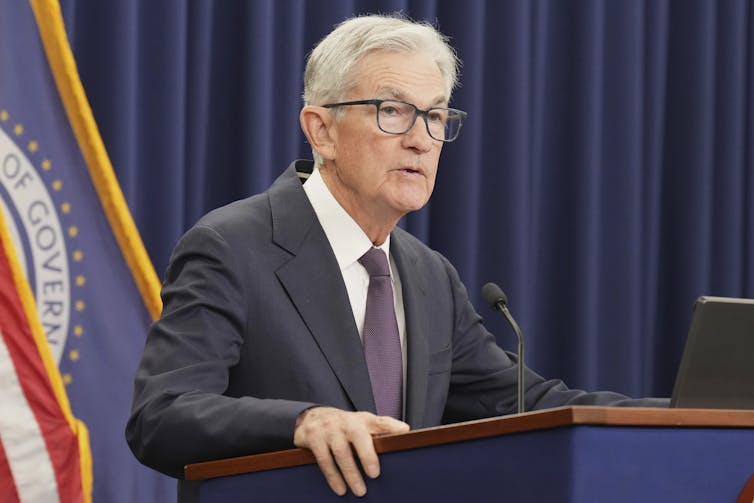
a bespectacled white man in a suit stands before a podium with a micrphone
Fed Chairman Jerome Powell speaks during a news conference after the rate-cut decision.
AP Photo/Jacquelyn Martin

Underlying trouble in the labor market

The labor market looks stable on the surface, but more granular data tells a different story.

The unemployment rate has remained close to historic lows at 4.3% as of August 2025, according to the U.S. Bureau of Labor Statistics.

But the number of long-term unemployed – people out of work for 27 weeks or longer – rose to 1.9 million in August, up 385,000 from a year earlier. These workers now make up 25.7% of all unemployed people, the highest share since February 2022. Persistent long-term joblessness often signals deeper cracks forming in the labor market.

At the same time, new claims for unemployment benefits are spiking. Initial claims for unemployment insurance – a leading indicator of labor market stress – jumped by 27,000 to 263,000 for the week ending Sept. 6, according to the U.S. Department of Labor. That’s the sharpest increase in months and well above economists’ forecasts. It suggests layoffs are becoming more common.

Advertisement
Get More From A Face Cleanser And Spa-like Massage

We also got news that past payroll growth was overstated. In a process the Bureau of Labor Statistics undertakes annually to double-check its data, the bureau recently revised its jobs data downward from April 2024 through March 2025 by 911,000. In other words, the economy created roughly 75,000 fewer jobs per month than previously reported. This implies the labor market was weaker than it appeared all along.

Finally, workers are losing confidence. The Federal Reserve Bank of New York reported in August that the confidence of people who lost their jobs in finding another fell to its lowest level – 44.9% – since it started surveying consumers in June 2013. That’s another sign workers are feeling less secure about their prospects.

Taken together, these data points paint a clear picture: The labor market is not collapsing, but it is softening. That helps explain why the Fed is beginning to cut rates now – hoping to stimulate spending – before the job market breaks more sharply.

packages of bacon and other meat are on display in a grocery store
Prices of meat and other groceries have been on the rise recently.
Scott Olson/Getty Images

Tariffs are complicating the inflation data

Even as the labor market softens, tariffs are pushing certain prices higher than they otherwise would be, complicating the Federal Reserve’s effort to bring inflation down.

Government data shows that businesses have begun passing the costs of President Donald Trump’s new import tariffs to consumers. In August, clothing prices rose 0.5% and grocery prices rose 0.6%, with especially strong gains for tariff-sensitive items such as coffee.

Lower-income households are getting hit hardest because they spend more of their budget on imported goods, which tend to be the lower-cost items most affected by tariffs. A report from the Yale Budget Lab found that core goods prices are about 1.9% above pre-2025 trends as tariffs raise costs for basic items such as appliances and electronics.

Phillip Swagel, director of the Congressional Budget Office, said recently that Trump’s tariffs have pushed inflation higher than CBO analysts had expected, even as overall economic activity has weakened since January.

Typically, a slowdown in the labor market is met with slower inflation. But while the CBO now projects that the tariffs will reduce the federal budget deficit by about US$4 trillion over the next decade – roughly $3.3 trillion in new revenue and $700 billion in lower debt service costs – but it will come at the cost of near-term upward pressure on prices.

This creates a difficult balancing act for the Fed: Cut rates too quickly, and tariff-driven price pressures could reignite inflation; move too slowly, and the softening labor market could tip into recession.
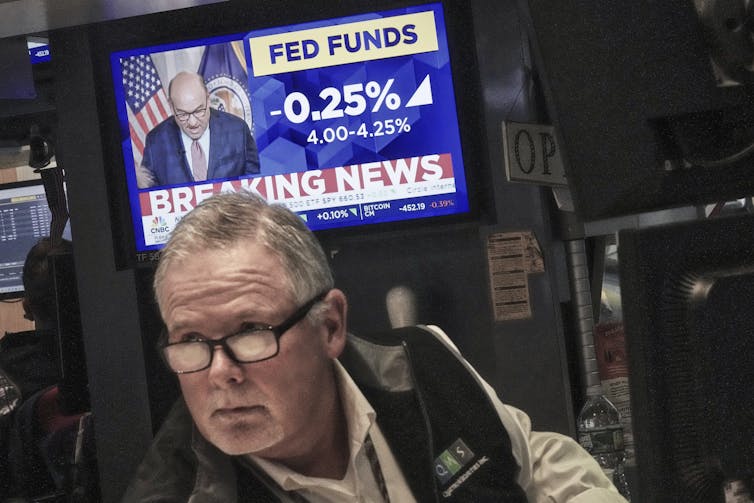
a bespectacled white man in a vest look on as a tv screen shows news of fed rate cut behind him
Traders react to the Fed news.
AP Photo/Richard Drew

A narrow path to a soft landing

As it resumes cutting rates, the Federal Reserve is trying to thread a narrow needle – easing policy enough to keep the labor market from cracking while not reigniting inflation, which is proving stickier in part because of tariffs.

Markets are betting the Fed will keep cutting. The futures market is betting the Fed will cut rates by another half point by the end of the year. And the one-year Treasury yield has dropped about 150 basis points (1.5%) since June, signaling that investors expect a series of rate cuts through 2025 and into 2026.

At its latest meeting, the Fed signaled two more rate cuts in 2025 and at least one rate cut in 2026.

Advertisement
Get More From A Face Cleanser And Spa-like Massage

Such cuts would ultimately bring the federal funds rate closer to 3% and hopefully reduce 30-year mortgage rates to around 5% – from an average of 6.35% as of Sept. 11. If the labor market continues to weaken – with jobless claims climbing, payrolls revised down and more workers stuck in long-term unemployment – that expectation will likely harden into consensus.

But the path is far from certain. Cutting rates too quickly could cause inflation to spike, while going too slow could lead to further deterioration in the labor market. Either outcome would jeopardize the Fed’s credibility – whether by appearing unable to control prices or by allowing unemployment to rise unnecessarily. That would undermine its ability to influence markets and enforce its dual mandate of maximum employment and stable prices.

Another tricky issue is Trump’s public campaign to push the Fed to cut rates – appearing to do his bidding could also undercut Fed credibility. For what it’s worth, the Sept. 17 rate cut appears driven less by politics than by economic data. The Fed itself was projecting a year ago that rates would be much lower today than they actually are, suggesting it’s been following the data.

The economy appears to be slowing but remains resilient, which is why the Fed is likely to move gradually. The risk is that the window for a soft landing is closing. The coming months will determine whether the Fed can ease early enough to avoid recession, or whether it has already waited too long.

Ryan Herzog, Associate Professor of Economics, Gonzaga University

This article is republished from The Conversation under a Creative Commons license. Read the original article.

Continue Reading
Advertisement SodaStream USA, inc

Entertainment

Paramount Prepares for Possible California Exit Amid Warner Bros. Merger Battle

Published

on

Last Updated on September 17, 2026 by Daily News Staff

HOLLYWOOD, Calif. — Paramount’s century-long connection to Hollywood could be facing one of its biggest challenges yet, as the entertainment giant reportedly prepares for the possibility of moving major operations out of California amid an escalating legal battle over its proposed acquisition of Warner Bros. Discovery.

Paramount is reportedly preparing for a possible California exit as its $110 billion Warner Bros. Discovery merger faces an antitrust battle.
Studio weighs California exit amid Warner Bros. merger battle

Paramount has informed the offices of Los Angeles Mayor Karen Bass and California Attorney General Rob Bonta that it is prepared to formally announce plans to leave California, according to reporting Wednesday from TheWrap. Paramount has not formally announced a relocation, and a company spokesperson declined to comment to the publication.

The potential move centers on Paramount Skydance’s proposed approximately $110 billion acquisition of Warner Bros. Discovery, a deal being challenged on antitrust grounds by California and a coalition of 11 other states, along with a separate challenge from the Writers Guild of America. California Attorney General Rob Bonta argues that combining the two entertainment companies could reduce competition, potentially leading to higher prices and fewer choices for consumers.

A court agreement currently prevents Paramount and Warner Bros. Discovery from completing the merger until June 1, 2027, or until after a court decision on the states’ claims, whichever comes first. The antitrust case is scheduled for trial in March 2027.

Paramount’s Hollywood Future

At the center of the controversy is Paramount’s historic studio complex at 5555 Melrose Avenue in Hollywood, one of the entertainment industry’s most recognizable properties.

The Los Angeles Times reported that Paramount CEO David Ellison has told associates that he would prefer to remain in Los Angeles. However, Paramount’s board has reportedly approved a contingency plan that could move the company’s headquarters out of Hollywood, and Ellison has indicated that the company is prepared to sell its historic studio properties and relocate operations if the merger remains stalled.

Tennessee, Texas and Georgia have emerged in reports as potential destinations should Paramount ultimately decide to relocate.

The financial pressure is significant. Beginning October 1, Paramount faces a roughly $7 million-per-day additional payment obligation tied to delays in completing the Warner Bros. Discovery transaction. Paramount has asked the federal court to require the states and the Writers Guild of America to post a $1.88 billion bond to cover potential costs associated with the delay.

What’s at Stake for Los Angeles?

A Paramount departure could extend far beyond the loss of a famous Hollywood address.

An economic analysis cited by TheWrap estimates that a large-scale Paramount departure could put as many as 57,980 full-time jobs, $21.2 billion in annual economic output and approximately $1.17 billion in state and local tax revenue at risk. Those figures represent an economic-impact scenario rather than a prediction that all of those losses would necessarily occur.

Advertisement
Get More From A Face Cleanser And Spa-like Massage

There are competing concerns about the merger itself. Los Angeles County analysis has estimated that completing the Paramount-Warner Bros. combination could also eliminate thousands of entertainment and related jobs because of consolidation. Opponents of the merger, including entertainment unions, have raised concerns about reduced competition and employment, while supporters argue that reaching a settlement could help prevent Paramount from moving operations out of California.

Mayor Bass has said she remains focused on protecting Los Angeles entertainment jobs and keeping Hollywood’s entertainment industry centered in the city. Bonta’s office, meanwhile, has maintained that California will continue enforcing its antitrust laws while remaining open to good-faith discussions.

Settlement Talks Scheduled

There is still an opportunity for the dispute to be resolved before Paramount makes a final decision about its California operations.

Paramount Skydance and representatives for California Attorney General Rob Bonta are scheduled to participate in court-ordered settlement talks on October 14 and 15. The discussions could potentially resolve the antitrust dispute and clear a path for Paramount’s proposed Warner Bros. Discovery acquisition.

For now, Paramount has made no official announcement that it is leaving California. The company declined to comment on reports Wednesday that it was preparing to announce a departure.

That leaves the future of Paramount’s Hollywood operations — including its historic Melrose Avenue studio — uncertain as the legal and financial pressure surrounding the merger continues to build.

For now, the gates at Paramount remain firmly planted on Melrose Avenue.

Settlement Talks Scheduled

There is still an opportunity for the dispute to be resolved before Paramount makes a final decision about its California operations.

Paramount Skydance and representatives for California Attorney General Rob Bonta are scheduled to participate in court-ordered settlement talks on October 14 and 15. The discussions could potentially resolve the antitrust dispute and clear a path for Paramount’s proposed Warner Bros. Discovery acquisition.

Advertisement
Get More From A Face Cleanser And Spa-like Massage

For now, Paramount has made no official announcement that it is leaving California. The company declined to comment on reports Wednesday that it was preparing to announce a departure.

That leaves the future of Paramount’s Hollywood operations — including its historic Melrose Avenue studio — uncertain as the legal and financial pressure surrounding the merger continues to build.uilding around the Warner Bros. Discovery deal, the question of whether one of Hollywood’s most historic studios will continue calling California home has moved from speculation to a potentially consequential decision for Los Angeles and its entertainment industry.

STM Daily News will continue monitoring the Paramount-Warner Bros. Discovery dispute and what it could mean for Hollywood, entertainment workers and the future of film and television production in California.

Source and Related Reading

Continue Reading

Economy

Bridging the Gap Between Military Experience and Civilian Careers: 5 Tips for Veterans

Published

on

Bridging the Gap Between Military Experience and Civilian Careers: 5 Tips for Veterans

(Feature Impact) Every year, approximately 200,000 service men and women transition from military life to corporate America. Finding the right civilian career is a transition, but it’s an opportunity to leverage military leadership and mission-driven talent.

Traditional hiring processes often focus on conventional resumes, but forward-thinking organizations recognize military experience as a competitive advantage in today’s workforce. The resilience, integrity and adaptability of America’s veterans and military families make them uniquely positioned to drive growth and innovation in their communities.

“Veterans bring unmatched discipline, adaptability and a results-driven mindset that directly translates to high-impact corporate careers,” said Drew Matheson, senior director at Capital One’s Commercial Bank and retired U.S. Army infantry officer. “While military experience doesn’t always fit perfectly on a traditional paper resume, employers like Capital One who know how to decode these unique leadership skills are able to unlock an incredible pipeline of proven performers.”

To help transitioning service members successfully navigate this career pivot, military community leaders at Capital One offer these five essential tips for service members entering the civilian workforce:18007 B detail embed2

Start With What You’ve Already Earned

Opportunity starts with preparation. Beyond the well-known Post-9/11 GI Bill, which can cover tuition, housing and books, transitioning service members can look into vocational rehab or the SkillBridge program, which allows them to do civilian internships during the last 180 days of service. Many employers also offer internal tuition reimbursement programs. Taking the time to proactively map out these benefits ensures you aren’t leaving valuable opportunities or money on the table.

Find Employers with Veteran Support Structures

With almost half of veterans leaving their first post-military job within a year, according to research published by the Institute for Veterans and Military Families and VetAdvisor, finding the right culture and community is key to a successful transition. Look for employers with active veteran networks and dedicated mentorship.

For example, Capital One’s Salute Business Resource Group serves as a thriving internal community of more than 6,000 members, offering peer support, year-round professional development and mentorship for veterans, reservists and military spouses. Additionally, partner organizations like Hiring Our Heroes provide career workshops, fellowships and job fairs to ensure you’re employment-ready from day one.

Lean Into and Translate Your Soft Skills

Veterans bring a distinct competitive advantage to the applicant pool. You should confidently lean into the cross-functional “soft skills” learned in the line of duty such as risk management, crisis resolution and building trust under high-pressure scenarios.

The trick is translating these capabilities out of military jargon on your resume. Swap military terms like “NCOIC” for “Operations Manager” or “commanded” for “directed.” To make this easier, look for military-friendly employers that employ dedicated military recruiters who specialize in decoding military resumes to align skills with the right roles.

Prioritize Support for the Whole Family

Military service is a family commitment, and the transition out of uniform affects everyone. Military spouses often face unique career hurdles, including frequent relocations and employment gaps. When evaluating employers, look for companies that offer holistic benefits and flexible structures.

For example, Capital One, recognized by “U.S. Veterans Magazine” as a Top Veteran Employer and Top Military Spouse Employer, actively supports military spouses and families through dedicated spouse hiring initiatives and internal support mechanisms. Furthermore, look for organizations that support continued military training and active-duty leave, ensuring military associates never have to choose between their service and their careers.

Build Your Civilian Network Early

In the military, your network is built in. In the civilian world, you have to cultivate it. Long before your terminal leave begins, connect with veterans who work at companies you admire. Reach out for brief, 15-minute informational interviews to learn about their transition journeys rather than simply asking for a job. With more than 70% of civilian jobs filled through networking, according to estimates from Career Horizons, making organic connections early is a powerful tool for getting your foot in the door.

Advertisement
Get More From A Face Cleanser And Spa-like Massage

To find additional resources and learn more about how to support the hiring of veterans and military spouses, visit CapitalOneCareers.com/Military.

Photo courtesy of Shutterstock collect?v=1&tid=UA 482330 7&cid=1955551e 1975 5e52 0cdb 8516071094cd&sc=start&t=pageview&dl=http%3A%2F%2Ftrack.familyfeatures track

SOURCE:

Capital One

Continue Reading

Economy

U.S. Consumer Confidence Slips as Americans Grow More Cautious About the Future

U.S. consumer confidence edged lower in August as Americans became more pessimistic about jobs, income and business conditions over the next six months, despite improved views of the current economy.

Published

on

NEW YORK — U.S. consumer confidence edged lower in August as Americans expressed greater concern about future business conditions, jobs and household income, even as their assessment of the current economy improved.

U.S. consumer confidence slipped in August 2026 as Americans grew more concerned about jobs, income and future business conditions.

The Conference Board reported that its Consumer Confidence Index fell 0.8 points to 89.4 in August, down from 90.2 in July.

The relatively small decline, however, masks a widening gap between how consumers view conditions today and what they expect in the months ahead.

The Present Situation Index, which measures consumers’ assessment of current business and labor market conditions, climbed 6.8 points to 121.2, reversing three consecutive months of declines.

Meanwhile, the Expectations Index, which measures the short-term outlook for income, business and employment conditions, dropped 5.8 points to 68.2.

“Consumer confidence moderated slightly in August for a second consecutive month,” Dana M. Peterson, chief economist at The Conference Board, said in the organization’s Aug. 25 release.

Jobs Look Better Today — But Consumers Worry About Tomorrow

Americans’ perceptions of the current labor market improved considerably during August. About 27% said jobs were plentiful, up from 24.4% in July, while 19.5% said jobs were hard to get, down from 21.7%.

The outlook for the next six months was considerably weaker.

Only 14.6% expected more jobs to become available, compared with 16.4% in July. At the same time, 26.1% expected fewer jobs.

Consumers were also less optimistic about their incomes. About 17.6% expected their income to increase, down from 19.5% in July, while 13.8% expected their income to decline.

Prices Remain on Consumers’ Minds

Inflation continues to influence how Americans feel about the economy. According to The Conference Board, consumers’ written responses frequently mentioned prices, oil and gasoline, food and groceries, trade, jobs, and war or conflict.

Average and median expectations for inflation over the next 12 months also increased slightly.

Advertisement
Get More From A Face Cleanser And Spa-like Massage

Interest rates remain another concern. More than six in 10 consumers — 61.3% — expected interest rates to rise over the next year, although that was slightly lower than the 62% recorded in July.

Consumers Are Still Planning to Spend

The softer outlook hasn’t eliminated Americans’ willingness to make purchases.

Auto-buying expectations remained strong on a six-month moving-average basis, while homebuying expectations declined slightly in August but remained on a longer-term upward trend after hitting decade lows in early 2024.

Restaurants, bars and takeout; utilities; and streaming, internet and mobile services ranked among consumers’ leading planned service expenses.

Consumers were less enthusiastic about discretionary activities including movies, personal-travel hotels, airfare, amusement parks, museums and historical sites.

Why It Matters

The August numbers paint a mixed picture of the American consumer.

People are seeing some improvement in the economy they are experiencing today, particularly in the labor market. But their expectations for the next six months are becoming noticeably more cautious.

That divide matters because consumer spending represents a major part of U.S. economic activity. If concerns about employment, inflation and household income begin translating into reduced spending, weakening confidence could eventually become more significant for the broader economy.

For now, the August survey suggests Americans haven’t stopped spending — but they’re increasingly keeping an eye on what may be coming next.

The preliminary August Consumer Confidence Survey was conducted online for The Conference Board by Toluna. The survey period was Aug. 3–16, 2026.

Advertisement
Get More From A Face Cleanser And Spa-like Massage

Source: The Conference Board, August 2026 Consumer Confidence Survey®, released Aug. 25, 2026.

STM Daily News Economy News Brief

Sources

Related Economic Data

Continue Reading

Trending