Connect with us

STM Blog

Emergency alerts may not reach those who need them most in Colorado

Published

on

Emergency alerts
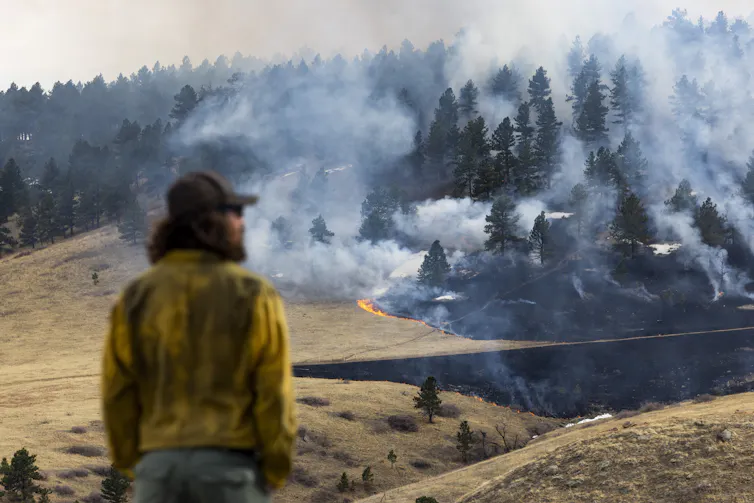
A firefighter watches as the NCAR Fire burns on March 26, 2022, in Boulder, Colo.
Michael Ciaglo via Getty Images

Emergency alerts may not reach those who need them most in Colorado

Carson MacPherson-Krutsky, University of Colorado Boulder; Mary Angelica Painter, University of Colorado Boulder, and Micki Olson, University at Albany, State University of New York

Many Coloradans may never get an alert that could save their life during a disaster.

And the alerts that go out may not easily be understood by the people who do get them.

We are social scientists who study emergency alerts and warnings, the challenges that exist in getting emergency information to the public, and ways to fix these issues.

Research two of us – Carson MacPherson-Krutsky and Mary Painter – did with researcher Melissa Villarreal shows only 4 in 10 Colorado residents have opted in to receive local emergency alerts. And many alerts may not be written with complete information, translated into the languages residents speak, or put into formats accessible to people with vision or hearing loss. This means some of our most vulnerable neighbors could miss crucial information during a crisis.

A decentralized alert system

Alerts are complex. They can come from a variety of official sources, including 911 centers, weather forecast centers and others. Alerts can also come in many forms, ranging from emails and texts to sirens and radio broadcasts.

Our study, mandated and funded by Colorado House Bill 23-1237, focused on understanding alert systems in Colorado after the Grizzly Creek Fire in 2020 and the Marshall Fire in 2021.
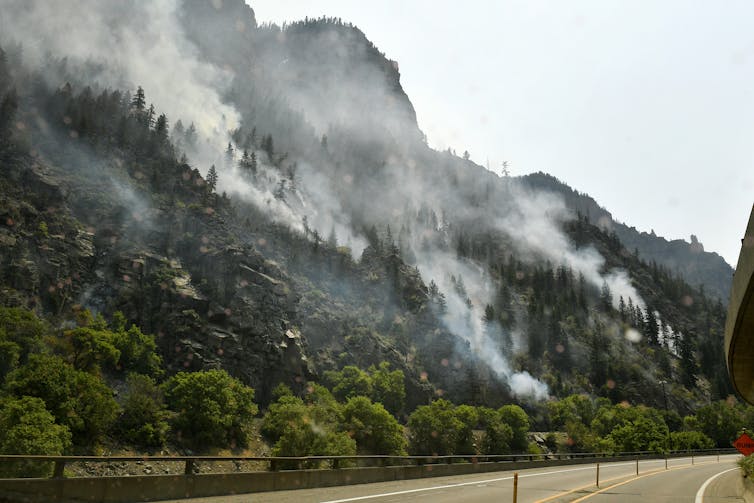
Smoke billows from a rocky and mountainous forest near an empty highway.
The Grizzly Creek Fire burns down hillsides along I-70 in Glenwood Canyon on Aug. 17, 2020, near Glenwood Springs, Colo.
Helen H. Richardson/MediaNews Group/The Denver Post via Getty Images

These fires were destructive and highlighted issues related to emergency alerting. Alerts about the fires and calls to evacuate were delayed and inconsistently received. Most were only available in English despite census data that shows 1 in 10 residents of Eagle and Garfield counties speak Spanish at home and only “speak English less than ‘very well.’”

The resulting legislation focused on how to make emergency alerts in Colorado accessible to all, but especially those with disabilities and with limited-English proficiency.

As social scientists who study disasters, we know that hazards, like earthquakes and wildfires, reveal inequities and that certain groups fare worse and take longer to recover. People with disabilities have higher rates of death from disasters. This is not because these populations are inherently less able to respond, but because emergency planning and systems may not account for their specific needs.

Our Colorado study used interviews and a statewide survey of 222 officials that send alerts to better understand the challenges of providing alerts across the state and reaching at-risk populations.

A patchwork system

The state of Colorado does not have a uniform alert system. Local areas determine the alert systems they will use.

Advertisement
Reveal Your Skin's Youthful Radiance with FOREO's LUNA 2 Facial Massager. Shop Now For $199

Some alerts get sent through systems that require people to opt in. This means that people sign up and choose to receive notifications. Neighboring counties often use different opt-in alert systems, meaning individuals who travel to different counties for work or recreation may need to register for multiple systems. Examples of these systems include Everbridge, used by Boulder County, and CodeRed, used by Adams and Park counties.
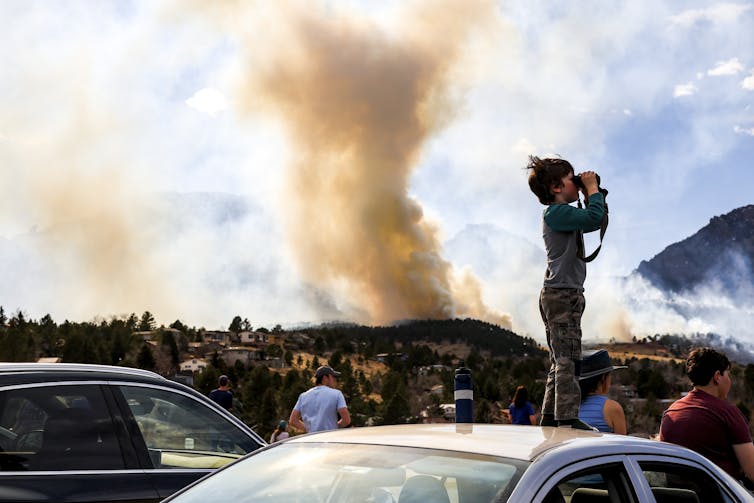
A boy stands on top of a car, peering through binoculars, as orange smoke billows in the background.
Amitai Beh, 6, watches the NCAR Fire on March 26, 2022 in Boulder, Colo..
Michael Ciaglo/Stringer via Getty Images

The success of these systems in an emergency relies on the community signing up for alerts.

We found that registering for alert systems was a barrier for everyone, but especially those with limited-English proficiency and with disabilities. This is because they may not be aware of the systems that are accessible to them or they are wary of providing personal information, and depending on their location, alerts may only be offered in English.
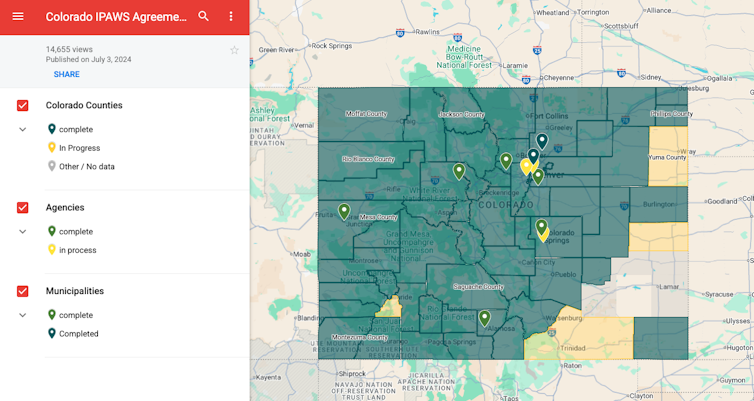
Most of the Colorado counties either have Integrated Public Alert and Warning System (IPAWS) approval or are in the process of getting approval. Some counties on the Eastern Plains, like Otero and Kiowa counties, have not started the process.
The current status of Integrated Public Alert and Warning System alerting entities across Colorado. Green means there’s an approved alerting authority, yellow indicates the region is in the process of becoming an alerting authority, and gray means the area has not begun the process.
Colorado Division of Homeland Security & Emergency Management, CC BY-ND

Another system is “opt out,” meaning people will receive alerts by default unless they turn them off. These include Wireless Emergency Alerts, or WEAs. These messages get broadcast through cellphone towers to phones in a specific geographic area. So if you have a cellphone in a WEA alert boundary, you will get an alert. WEAs are used in Colorado to target specific regions in danger, such as an area that needs to evacuate or for an Amber Alert.

There is no national standard or guidance for opt-in or opt-out systems, which can lead to inconsistencies in how people get alerts.

Lack of resources limits alerting authorities

We found that though authorities often want to provide alerts in other languages and accessible formats, they have significant resource constraints. Time, staff, money or training can all limit the level of accessibility they can provide.

Sixty-four percent of the authorities we surveyed said they lacked funding to make alerts more inclusive.

More than a third of our respondents didn’t know if their systems could provide alerts in languages other than English or for people with disabilities. This speaks to a need for better training on how these systems work and how to use them effectively.

An alert is complete if it includes information about the source, hazard, location and time. Recently, researchers found that fewer than 10% of all Nationwide Wireless Emergency Alerts issued from 2012 to 2022 were complete.

One of us – Micki Olson – worked with the federal government to develop the Message Design Dashboard to help alerting authorities craft clear and comprehensive emergency messages.

Fifty-six out of 64 counties in Colorado are an Integrated Public Alert and Warning System authority, which means they can send alerts across multiple platforms at once. This can improve alert access since it broadens who alerts reach.

Not all counties have this option, and even the ones who do, don’t always use it. In our study, authorities noted limited staff capacity, funds and lack of time prevents them from getting or using the IPAWS system.

Advertisement
Reveal Your Skin's Youthful Radiance with FOREO's LUNA 2 Facial Massager. Shop Now For $199

“We simply do not have the resources, both financial and people, to deploy all of these systems,” a survey respondent from Gunnison County said.

Alert systems were not built to be accessible

The final issue we identified is that alert systems were not developed with accessible options and functionality like video or image options. For example, people who are blind or have low vision won’t have access to a message unless they enable text-speech features on their phone in advance.

The WEA system only allows alerts to be sent in English or Spanish. Characters like accents and tildes cannot be included. Expansion of language options was planned but is now on hold for unclear reasons. Some counties have the resources to make alerts available in additional languages, but most do not.

Almost 900,000 Coloradans speak a language other than English. According to the Migration Policy Institute, more than 230,000 Coloradans have difficulty comprehending and communicating in English.

Where do we go from here?

Recent events, including the Palisades and Eaton fires in California and the devastating floods in Kerr County, Texas, demonstrate how critical it is that timely and accessible emergency alerts reach everyone, but especially the most vulnerable individuals.

However, these systems are complex, and everyone from individuals to local government can play a part in improving them.

  • Federal and local governments can allocate funds to update and standardize systems. They can also implement training and procedures to ensure alerts are effective and inclusive.
  • Authorities that send alerts can partner more closely with trusted community organizations and networks to reach diverse audiences.
  • Researchers can identify how to better tailor systems to meet community needs.
  • Individuals can learn about and sign up for alerts. To do so, visit local government websites or enter “emergency alerts” and the name of your county or city in an online search.

Carson MacPherson-Krutsky, Research Associate, Natural Hazards Center, University of Colorado Boulder; Mary Angelica Painter, Research Associate, Natural Hazards Center, University of Colorado Boulder, and Micki Olson, Senior Researcher in Emergency and Risk Communication, University at Albany, State University of New York

This article is republished from The Conversation under a Creative Commons license. Read the original article.

Author

Continue Reading
Advertisement Simply Wholesale

Community

Feeding America Highlights Farmers’ Role in Fighting Hunger on National Agriculture Day

Published

on

food love people africa. Feeding America
Photo by RDNE Stock project on Pexels.com

Feeding America is marking National Agriculture Day by recognizing farmers, ranchers, and producers as key partners in the fight against hunger.

In a March 24 press release, the organization said the agricultural community plays a vital role in helping food banks and pantries deliver fresh, nutritious food to families across the country. Feeding America noted that produce, dairy, and protein are among the most requested foods by neighbors facing hunger and make up half of all food distributed through its network.

The organization said that in 2025, its network worked with growers to rescue 971 million pounds of fresh produce, helping redirect surplus food to communities in need. Feeding America also pointed to federal nutrition and farm support programs, saying government purchases from U.S. growers provide more than 20% of the food distributed through its network.

Ami McReynolds, Feeding America’s chief advocacy and community partnerships officer, said supporting farmers is directly connected to helping families access healthy meals. The organization is also urging Congress to support additional farm aid and a Farm Bill that strengthens nutrition programs.

Feeding America said a recent poll found that 95% of voters view hunger as a nonpartisan issue, reinforcing support for collaborative solutions between agriculture, food banks, and policymakers.

Related Links

Source Links

The Bridge is a section of the STM Daily News Blog meant for diversity, offering real news stories about bona fide community efforts to perpetuate a greater good. The purpose of The Bridge is to connect the divides that separate us, fostering understanding and empathy among different groups. By highlighting positive initiatives and inspirational actions, The Bridge aims to create a sense of unity and shared purpose. This section brings to light stories of individuals and organizations working tirelessly to promote inclusivity, equality, and mutual respect. Through these narratives, readers are encouraged to appreciate the richness of diverse perspectives and to participate actively in building stronger, more cohesive communities.

https://stmdailynews.com/the-bridge

Author

  • Rod Washington

    Rod: A creative force, blending words, images, and flavors. Blogger, writer, filmmaker, and photographer. Cooking enthusiast with a sci-fi vision. Passionate about his upcoming series and dedicated to TNC Network. Partnered with Rebecca Washington for a shared journey of love and art.

    View all posts
Continue Reading

Community

McDonald’s First Job Confessional Turns Career Stories Into Free Meal Opportunity

McDonald’s is launching First Job Confessional, a campaign inviting fans to share first job stories for a chance to receive a $15 gift card in select cities.

Published

on

McDonald’s is launching First Job Confessional, a campaign inviting fans to share first job stories for a chance to receive a $15 gift card in select cities.
McDonald’s is Asking Fans to Get Real About Their First Job Skills in Exchange for Free Meals

First Job Confessional

McDonald’s is putting first jobs in the spotlight with a new campaign that asks fans to share the real-world skills they gained early in their working lives. Launched on National Employee Appreciation Day, the brand’s First Job Confessional invites people to reflect on how those first roles helped shape their careers — and, in some cases, earn a free meal in the process.

The campaign is built around a simple idea: first jobs often teach lasting skills that deserve more recognition. Whether someone learned problem-solving while babysitting, communication during a lunch rush, or teamwork behind a counter, McDonald’s is framing those experiences as valuable career foundations. The company says those are the same kinds of skills employers continue to prioritize as workplace demands evolve.

McDonald’s is launching First Job Confessional, a campaign inviting fans to share first job stories for a chance to receive a $15 gift card in select cities.
McDonald’s is Asking Fans to Get Real About Their First Job Skills in Exchange for Free Meals

How the First Job Confessional Works

In select cities, McDonald’s is setting up confessional booths designed to look like ordering kiosks. But instead of placing a meal order, participants can record a story about their first job and the skills they picked up along the way. Those who take part in person will have the opportunity to receive a $15 McDonald’s gift card, while supplies last.

Fans who cannot attend in person can still join online by posting their stories using #FirstJobConfessional. McDonald’s says selected videos may also be featured on its YouTube channel, extending the campaign beyond the live events.

External Related Links

Source Links

The Bridge is a section of the STM Daily News Blog meant for diversity, offering real news stories about bona fide community efforts to perpetuate a greater good. The purpose of The Bridge is to connect the divides that separate us, fostering understanding and empathy among different groups. By highlighting positive initiatives and inspirational actions, The Bridge aims to create a sense of unity and shared purpose. This section brings to light stories of individuals and organizations working tirelessly to promote inclusivity, equality, and mutual respect. Through these narratives, readers are encouraged to appreciate the richness of diverse perspectives and to participate actively in building stronger, more cohesive communities.

https://stmdailynews.com/the-bridge

Continue Reading

The Knowledge

Why Phoenix’s Skyline Has Stayed Low — And How It Compares to Los Angeles

Discover why Phoenix’s skyline lacks supertall skyscrapers, from FAA flight path limits near Phoenix Sky Harbor International Airport to how it compares with Los Angeles’s skyline growth.

Published

on

Last Updated on March 25, 2026 by Daily News Staff

Discover why Phoenix's skyline lacks supertall skyscrapers, from FAA flight path limits near Phoenix Sky Harbor International Airport to how it compares with Los Angeles’s skyline growth.
Tall buildings in downtown Phoenix Arizona

Phoenix is the fifth-largest city in the United States, yet its skyline doesn’t resemble other major metros like Los Angeles, Chicago, or Dallas. Despite rapid population and economic growth, downtown Phoenix has long lacked supertall skyscrapers — and until recently, didn’t even have a building tall enough to qualify as a true “skyscraper” under standard definitions.  

The Basics: Phoenix’s Height Reality

The tallest structure in Phoenix for decades has been Chase Tower, rising to about 483 feet. Under the Council on Tall Buildings and Urban Habitat definition, a skyscraper reaches at least 492 feet — which means Phoenix has technically lacked one — despite its size and population.  

@stmblog

Why doesn’t Phoenix have super tall skyscrapers? 🤔🌵 It’s not what you think… ✈️ From FAA flight paths over Phoenix Sky Harbor International Airport to the city’s sprawling growth, there’s a hidden reason the skyline stayed low for decades. But that might be changing… 👀🏙️ Phoenix Arizona CityFacts UrbanPlanning Skyline DidYouKnow Infrastructure RealEstate USCities #STMdailynews ♬ original sound – STMDailyNews – STMDailyNews

A new project, the Astra Tower, is planned to rise around 540+ feet when it breaks ground, potentially giving Phoenix its first true skyscraper.  

Airport Proximity: The FAA’s Height Grid

FAA Obstacle Evaluation & Downtown Limits

Phoenix’s skyline constraints are rooted in aviation safety.

📍 Phoenix Sky Harbor International Airport sits just a few miles from downtown.

  • The Federal Aviation Administration (FAA) regulates building heights near airports so they don’t obstruct flight paths, require planes to alter approaches, or interfere with climb-out safety.
  • In Phoenix, this results in a layered set of height limits that vary by location and elevation above sea level — often measured in feet above mean sea level (MSL) rather than simply building height from ground.  

The city’s zoning code divides downtown into multiple contour zones with distinct maximum elevation values (e.g., 1,275 ft, 1,525 ft, 1,700 ft MSL), each tied to how close it sits under airport flight paths.  

That means in some blocks you can’t build above a specific elevation even if ground levels are lower — a regulatory “roof” that varies across downtown.

City zoning also explicitly states that no building can exceed the FAA’s airport height limits, even if other bonuses or zoning allowances exist.  


Phoenix vs. Los Angeles: A Quick Comparison

Los Angeles: Higher Limits, Different Constraints

Cities like Los Angeles also have nearby airports (e.g., Los Angeles International Airport), but their key business districts aren’t directly under major flight corridors.

LA’s downtown has:

  • Taller office and residential towers
  • A financial core with dense development
  • Fewer FAA-driven overlays because the flight paths stretch past the downtown edge

Los Angeles’s tallest buildings — including Wilshire Grand Center (~1,100 ft) and U.S. Bank Tower (~1,018 ft) — were built where FAA restrictions don’t force low ceilings. FAA evaluations were conducted but didn’t cut as deeply into downtown zoning compared to Phoenix.

Phoenix, by contrast, sits right under approach and departure corridors — leading to consistent FAA involvement in almost every proposed mid- or high-rise downtown.

Advertisement
Reveal Your Skin's Youthful Radiance with FOREO's LUNA 2 Facial Massager. Shop Now For $199

Economic and Planning Philosophies

Beyond FAA rules:

  • Phoenix developed in the automobile era, with vast inexpensive land encouraging horizontal growth.  
  • Los Angeles grew earlier with heavier investment in centralized neighborhoods and higher density.
  • Phoenix’s village plan long encouraged multiple smaller hubs instead of concentrating all growth in one downtown core.  

These historical differences mean Phoenix didn’t have the same economic “pressure” to build up — even with zoning that allows significant height if FAA permits are met.


What This Means for Phoenix’s Future

Phoenix still has room to grow vertically — but:

  • FAA height contours will remain the ceiling unless flight paths change
  • Developers must secure determinations of no hazard from the FAA before going taller
  • New projects like Astra show demand for taller buildings is rising

As Phoenix’s urban core densifies and land becomes scarcer, its skyline may yet reach higher — but always within the invisible grid drawn by aviation safety.

Related External Links

Dive into “The Knowledge,” where curiosity meets clarity. This playlist, in collaboration with STMDailyNews.com, is designed for viewers who value historical accuracy and insightful learning. Our short videos, ranging from 30 seconds to a minute and a half, make complex subjects easy to grasp in no time. Covering everything from historical events to contemporary processes and entertainment, “The Knowledge” bridges the past with the present. In a world where information is abundant yet often misused, our series aims to guide you through the noise, preserving vital knowledge and truths that shape our lives today. Perfect for curious minds eager to discover the ‘why’ and ‘how’ of everything around us. Subscribe and join in as we explore the facts that matter.  https://stmdailynews.com/the-knowledge/

Continue Reading

Trending

