

Daily News
Bad Bunny’s Super Bowl Halftime Show Fits the NFL’s Long Game to Win Latin America
The NFL aims to expand its reach into Latin America through strategic marketing and high-profile performers like Bad Bunny at the Super Bowl halftime show. While the choice has sparked controversy, particularly among conservatives, the league sees it as a business move to attract more fans, particularly in Mexico and Brazil.

Last Updated on February 7, 2026 by Daily News Staff
Jared Bahir Browsh, University of Colorado Boulder
Bad Bunny’s Super Bowl show is part of long play drawn up by NFL to score with Latin America
Donald Trump, it is fair to assume, will be switching channels during this year’s Super Bowl halftime show.
The U.S. president has already said that he won’t be attending Super Bowl LX in person, suggesting that the venue, Levi’s Stadium in Santa Clara, California, was “just too far away.” But the choice of celebrity entertainment planned for the main break – Puerto Rican reggaeton star Bad Bunny and recently announced pregame addition Green Day – didn’t appeal. “I’m anti-them. I think it’s a terrible choice. All it does is sow hatred. Terrible,” Trump told the New York Post.
National Football League Commissioner Roger Goodell likely didn’t have the sensibilities of the U.S. president in mind when the choice of Bad Bunny was made.
One of the top artists in the world, Bad Bunny performs primarily in Spanish and has been critical of immigration enforcement, which factored into the backlash in some conservative circles to the choice. Bad Bunny’s anti-ICE comments at this year’s Grammy Awards will have only stoked the ire of some conservatives.
But for the NFL hierarchy, this was likely a business decision, not a political one. The league has its eyes on expansion into Latin America; Bad Bunny, they hope, will be a ratings-winning means to an end. It has made such bets in the past. In 2020, Shakira and Jennifer Lopez were chosen to perform, with Bad Bunny making an appearance. The choice then, too, was seen as controversial.
Raising the flag overseas
As a teacher and scholar of critical sports studies, I study the global growth of U.S.-based sports leagues overseas.
Some, like the National Basketball Association, are at an advantage. The sport is played around the globe and has large support bases in Asia – notably in the Philippines and China – as well as in Europe, Australia and Canada.
The NFL, by contrast, is largely entering markets that have comparatively little knowledge and experience with football and its players.
The league has opted for a multiprong approach to attracting international fans, including lobbying to get flag football into the 2028 Olympics in Los Angeles.
Playing the field
When it comes to the traditional tackle game, the NFL has held global aspirations for over three-quarters of a century. Between 1950-1961, before they merged, the NFL and American Football League played seven games against teams in Canada’s CFL to strengthen the relationship between the two nations’ leagues.
Developing a fan base south of the border has long been part of the plan.
The first international exhibition game between two NFL teams was supposed to take place in Mexico City in 1968. But Mexican protest over the economy and cost of staging the Olympics that year led the game, between the Detroit Lions and Philadelphia Eagles, to be canceled.
Instead, it was Montreal that staged the first international exhibition match the following year.
In 1986, the NFL added an annual international preseason game, the “American Bowl,” to reach international fans, including several games in Mexico City and one in Monterrey.
But the more concerted effort was to grow football in the potentially lucrative, and familiar, European market.
After several attempts by the NFL and other entities in the 1970s and ’80s to establish an international football league, the NFL-backed World League of Football launched in 1991. Featuring six teams from the United States, one from Canada and three from Europe, the spring league lost money but provided evidence that there was a market for American football in Europe, leading to the establishment of NFL Europe.
But NFL bosses have long had wider ambitions. The league staged 13 games in Tokyo, beginning in 1976, and planned exhibitions for 2007 and 2009 in China that were ultimately canceled. These attempts did not have the same success as in Europe.
Beyond exhibitions
The NFL’s outreach in Latin America has been decades in the making. After six exhibition matches in Mexico between 1978 and 2001, the NFL chose Mexico City as the venue of its first regular season game outside the United States.
In 2005, it pitted the Arizona Cardinals against the San Francisco 49ers at Estadio Azteca in Mexico City. Marketed as “Fútbol Americano,” it drew the largest attendance in NFL history, with over 103,000 spectators.
The following year, Goodell was named commissioner and announced that the NFL would focus future international efforts on regular-season games.
The U.K. was a safe bet due to the established stadium infrastructure and the country’s small but passionate fan base. The NFL International Series was played exclusively in London between 2007 and 2016.
But in 2016, the NFL finally returned to Mexico City, staging a regular-season game between the Oakland – now Las Vegas – Raiders and Houston Texans.
And after the completion of upgrades to Latin America’s largest stadium, Estadio Azteca, the NFL will return to Mexico City in 2026, along with games in Munich, Berlin and London. Future plans include expanding the series to include Sydney, Australia, and Rio de Janeiro, Brazil, in 2026.
The International Player Pathway program also offers players from outside the United States an opportunity to train and earn a roster spot on an NFL team. The hope is that future Latin American players could help expand the sport in their home countries, similar to how Yao Ming expanded the NBA fan base in China after joining the Houston Rockets, and Shohei Ohtani did the same for baseball in Japan while playing in Los Angeles.
Heading south of the border
The NFL’s strategy has gained the league a foothold in Latin America.
Mexico and Brazil have become the two largest international markets for the NFL, with nearly 40 million fans in each of the nations.
Although this represents a fraction of the overall sports fans in each nation, the raw numbers match the overall Latino fan base in the United States. In recent years the NFL has celebrated Latino Heritage Month through its Por La Cultura campaign, highlighting Latino players past and present.
Latin America also offers practical advantages. Mexico has long had access to NFL games as the southern neighbor to the United States, with the Dallas Cowboys among the most popular teams in Mexico.
For broadcasters, Central and South America offer less disruption in regards to time zones. Games in Europe start as early as 6:30 a.m. for West Coast fans, whereas Mexico City follows Central time, and Brasilia time is only one to two hours ahead of Eastern time.
The NFL’s expansion plans are not without criticism. Domestically, fans have complained that teams playing outside the U.S. borders means one less home game for season-ticket holders. And some teams have embraced international games more than others.
Another criticism is the league, which has reported revenues of over US$23 billion during the 2024-25 season – nearly double any other U.S.-based league – is using its resources to displace local sports. There are also those who see expansion of the league as a form of cultural imperialism. These criticisms often intersect with long-held ideas around the league promoting militarism, nationalism and American exceptionalism.
Bad Bunny: No Hail Mary attempt
For sure, the choice of Bad Bunny as the halftime pick is controversial, given the current political climate around immigration. The artist removed tour dates on the U.S. mainland in 2025 due to concerns about ICE targeting fans at his concerts, a concern reinforced by threats from the Department of Homeland Security that they would do just that at the Super Bowl.
But in sticking with Bad Bunny, the NFL is showing it is willing to face down a section of its traditional support and bet instead on Latin American fans not just tuning in for the halftime show but for the whole game – and falling in love with football, too.
Jared Bahir Browsh, Assistant Teaching Professor of Critical Sports Studies, University of Colorado Boulder
This article is republished from The Conversation under a Creative Commons license. Read the original article.
Discover more from Daily News
Subscribe to get the latest posts sent to your email.


STM Daily News
Chinamaxxing: The Viral Trend Turning Geopolitics Into Aesthetic Fantasy
A viral social media trend called “Chinamaxxing” is turning geopolitics into aesthetic comparison—revealing more about generational frustration than China itself.


At first glance, the videos seem harmless enough.
Clean subways gliding into spotless stations. Neon skylines glowing at night. Clips of high-speed trains, cashless stores, orderly crowds. Overlaid text reads something like, “Meanwhile in China…” or “They figured it out.”
This is “Chinamaxxing,” a loosely defined but increasingly visible social media trend where mostly young users frame China as a model of efficiency, stability, and modernity—often in contrast to life in the West.
What makes the trend notable isn’t just its subject, but its tone. Chinamaxxing is rarely explicit political advocacy. It’s not a manifesto. It’s a mood. Aesthetic admiration blended with subtle critique, delivered through short, visually compelling clips that invite comparison without context.
And that’s precisely why it has sparked debate.
What Is “Chinamaxxing,” Really?
Despite the provocative name, Chinamaxxing isn’t a coordinated movement or ideology. It’s better understood as an algorithm-driven pattern—a recurring style of content that rewards certain visuals and emotional cues.
Most Chinamaxxing content emphasizes:
- Infrastructure and urban design
- Technology embedded in daily life
- Perceived order and efficiency
- Implicit contrast with Western dysfunction
What it typically omits:
- Political repression and censorship
- State surveillance
- Limits on speech and dissent
- The lived diversity of Chinese experiences
The result is a highly curated portrayal—less about China as a nation, and more about what viewers want to believe is possible somewhere else.
Why It’s Gaining Traction Now
The rise of Chinamaxxing says as much about the West as it does about China.
For many young users, particularly Gen Z, the backdrop is familiar: rising housing costs, student debt, healthcare anxiety, political polarization, and a growing sense that institutions no longer function as promised.
In that environment, visually persuasive content showing order and functionality carries emotional weight. It offers relief from chaos—real or perceived.
Social platforms amplify this effect. Short-form video rewards clarity, contrast, and immediacy. A clean subway platform communicates more in five seconds than a policy analysis ever could. Nuance does not trend well. Aesthetics do.
The Social and Political Criticism
Critics argue Chinamaxxing crosses a line from curiosity into distortion.
By focusing exclusively on infrastructure and surface-level efficiency, the trend risks:
- Normalizing authoritarian governance through lifestyle framing
- Reducing political systems to consumer experiences
- Ignoring the tradeoffs that make such systems possible
Supporters counter that Western media has long flattened China into a single negative narrative, and that admiration for specific aspects of another society is not the same as endorsing its government.
Both perspectives, however, miss something important.
What the Trend Actually Reveals
Chinamaxxing isn’t primarily about China. It’s about disillusionment.
It reflects a generation that:
- Feels let down by existing systems
- Engages politics emotionally rather than institutionally
- Uses visual culture to express dissatisfaction indirectly
In this context, China becomes a projection surface—not because it is perfect, but because it appears functional.
That distinction matters.
Why This Matters
Chinamaxxing highlights how political understanding is evolving in the digital age. Governance is increasingly consumed not through debate or civic participation, but through comparison clips, memes, and aesthetics.
The risk isn’t admiration. It’s oversimplification.
When complex societies are reduced to visuals alone, public discourse loses depth. But when those visuals resonate, they also signal real unmet needs: stability, competence, and trust in institutions.
Ignoring that signal would be a mistake.
The STM Daily News Perspective
Chinamaxxing is not an endorsement, a conspiracy, or a joke. It is a cultural artifact—one that reflects generational anxiety, algorithmic storytelling, and the widening gap between expectations and reality.
The question it raises isn’t whether China is better.
It’s why so many people feel their own systems are no longer working.
Related Reading
- BBC News: China Coverage and Global Context
- The Atlantic: Technology, Media, and Internet Culture Analysis
- Pew Research Center: Global Attitudes and Political Perception
- The New York Times: China and International Affairs
- Brookings Institution: China Policy and Global Governance
More on This Topic from STM Daily News
Stay tuned to STM Daily News for more stories exploring internet culture, social media trends, and how digital platforms shape public perception. We’ll be publishing in-depth pieces that break down the societal impact of viral phenomena like Chinamaxxing, the psychology behind online political trends, and the evolving language of Gen Z culture.
Want alerts? Be sure to subscribe to our newsletter for the latest insights and analysis.
Author

Discover more from Daily News
Subscribe to get the latest posts sent to your email.
Entertainment
Funny, Tender, Goofy: Why Catherine O’Hara Stole Every Scene From SCTV to Schitt’s Creek
Catherine O’Hara, a beloved actor and comedian, passed away at 71. Her career spanned over 50 years, showcasing her unique comedic timing in various roles, including Delia Deetz in Beetlejuice and Moira Rose in Schitt’s Creek. O’Hara’s influence and creativity left a lasting legacy in comedy, inspiring many.
Ben McCann, Adelaide University
Funny, tender, goofy – Catherine O’Hara lit up the screen every time she showed up
Catherine O’Hara, the beloved actor and comedian who has died aged 71, occupied that rare position in contemporary screen culture: a comic actor, a cult figure and a mainstream star.
Her work spanned more than 50 years, from improv sketch comedy to Hollywood features and off-beat TV classics.
She was celebrated for her unmatched comic timing and chameleon-like character work. Her roles were often absurdist and quirky, but they hid a razor-sharp humour.
Born and raised in Toronto in a close-knit Irish Catholic family, O’Hara was one of seven siblings. She once remarked humour was part of her everyday life; storytelling, impressions and lively conversation helped hone her comedic instincts.
After high school, she worked at Toronto’s Second City Theatre, a famed breeding ground for comedy talent, and sharpened her deadpan improvisational skills.
Big break
O’Hara’s break came with Second City Television (SCTV), a sketch comedy series that rivalled Saturday Night Live in creativity and influence. Alongside contemporaries Eugene Levy, John Candy, Rick Moranis and Martin Short, she defined her distinctly smart, absurdist comedic voice.
O’Hara was not merely a performer on SCTV; she was also a writer, winning an Emmy Award for her contributions. This dual role shaped her career-long sensitivity to rhythm, language and character construction.
Unlike sketch performers who rely on repetition or catchphrases, O’Hara’s humour emerged with a different comedic logic. Audiences laughed not because the character was “funny”, but because the character took herself so seriously.
Though briefly cast on Saturday Night Live in the early 1980s, O’Hara chose to stay with SCTV when it was renewed, a decision she later described as key in letting her creative career flourish where it belonged.
The transition to film
By the mid-1980s, O’Hara was establishing herself as a screen presence. She appeared in Martin Scorsese’s offbeat black comedy After Hours (1985), and showcased her comic range in Heartburn (1986).
In 1988, she landed what would become one of her most beloved film roles: Delia Deetz in Tim Burton’s left-field Beetlejuice (1988).
Delia – a pretentious, New York art-scene social climber – allowed O’Hara to combine physical comedy and imbecilic dialogue (“A little gasoline … blowtorch … no problem”).
Burton once noted
Catherine’s so good, maybe too good. She works on levels that people don’t even know. I think she scares people because she operates at such high levels.
She went on to play Kate McCallister, the beleaguered mother in the holiday blockbusters Home Alone (1990) and Home Alone 2: Lost in New York (1992). Audiences loved the fact that this rather thinly written role became the films’ beating heart.
Working with Christopher Guest
Another distinctive phase of O’Hara’s career was her work with writer-director Christopher Guest on a series of largely improvised mockumentaries that have become cult classics.
Three standouts were Waiting for Guffman (1996), where she plays a desperate local performer in a small-town theatre troupe, and A Mighty Wind (2003), where she teamed up with old pal Levy as an ageing folk duo.
Her best turn came in Best in Show (2000), in which she and Levy played a couple competing in a national dog show. Her character Cookie Fleck remains one of the finest examples of improvised comedy on film. https://www.youtube.com/embed/Ay1cJ1QMOms?wmode=transparent&start=0
Her relentless monologues about former lovers are objectively inappropriate, yet O’Hara delivers them with such earnest enthusiasm that they become strangely compelling.
Her gift for improvisation glittered in these films: these eccentric characters were often laugh-out-loud funny – but O’Hara never mocked them.
Late success
She returned to TV in Six Feet Under (2001–05) and guest appearances on The Larry Sanders Show (1992–98) and Curb Your Enthusiasm (1999–2024). More recently, she appeared in prestige shows such as The Last of Us (2023–) and The Studio (2025–).
But it was the role of Moira Rose, the eccentric, ex-soap opera star in the Canadian sitcom Schitt’s Creek (2015–20), created by Eugene Levy and his son Dan, that would become O’Hara’s most significant late career move. And what a role it was!
Written for O’Hara’s unique talents, Moira was a larger-than-life character with a bizarre, unforgettable vocabulary, dramatic mood swings and a wardrobe that became nearly as famous as the character herself.
Feminist media scholars have noted the rarity of such complex roles for older women, particularly in comedy, making O’Hara’s performance culturally significant.
The show became a global streaming blockbuster during COVID lockdowns and O’Hara’s multi-award-winning performance became a social media phenomenon, spawning memes and viral clips.
There are so many standout moments – her drunken meltdown after losing her wigs, her audition for The Crows Have Eyes 3 and the show’s moving finale where she performs Danny Boy at Alexis’s graduation.
An enduring legacy
O’Hara had a remarkable ability to play flamboyant, self-absorbed characters who were often uproariously funny.
Many comedians and actors have cited O’Hara as an influence for her fearlessness, her ability to blend absurdity with emotional truth, and her steadfast commitment to character integrity. She influenced performers like Tina Fey, Maya Rudolph, Kate McKinnon and Phoebe Waller-Bridge.
O’Hara also refused to chase conventional stardom. Rather than choosing projects designed to flatten her eccentricities, O’Hara favoured collaborative environments that valued creativity over control.
For her, comedy was always an art of intelligence, empathy and generosity.
Ben McCann, Associate Professor of French Studies, Adelaide University
This article is republished from The Conversation under a Creative Commons license. Read the original article.
Looking for an entertainment experience that transcends the ordinary? Look no further than STM Daily News Blog’s vibrant Entertainment section. Immerse yourself in the captivating world of indie films, streaming and podcasts, movie reviews, music, expos, venues, and theme and amusement parks. Discover hidden cinematic gems, binge-worthy series and addictive podcasts, gain insights into the latest releases with our movie reviews, explore the latest trends in music, dive into the vibrant atmosphere of expos, and embark on thrilling adventures in breathtaking venues and theme parks. Join us at STM Entertainment and let your entertainment journey begin! https://stmdailynews.com/category/entertainment/
and let your entertainment journey begin!
Discover more from Daily News
Subscribe to get the latest posts sent to your email.
Last Updated on January 28, 2026 by Daily News Staff
How the polar vortex and warm ocean intensified a major US winter storm
Mathew Barlow, UMass Lowell and Judah Cohen, Massachusetts Institute of Technology (MIT)
A severe winter storm that brought crippling freezing rain, sleet and snow to a large part of the U.S. in late January 2026 left a mess in states from New Mexico to New England. Hundreds of thousands of people lost power across the South as ice pulled down tree branches and power lines, more than a foot of snow fell in parts of the Midwest and Northeast, and many states faced bitter cold that was expected to linger for days.
The sudden blast may have come as a shock to many Americans after a mostly mild start to winter, but that warmth may have partly contributed to the ferocity of the storm.
As atmospheric and climate scientists, we conduct research that aims to improve understanding of extreme weather, including what makes it more or less likely to occur and how climate change might or might not play a role.
To understand what Americans are experiencing with this winter blast, we need to look more than 20 miles above the surface of Earth, to the stratospheric polar vortex.
What creates a severe winter storm like this?
Multiple weather factors have to come together to produce such a large and severe storm.
Winter storms typically develop where there are sharp temperature contrasts near the surface and a southward dip in the jet stream, the narrow band of fast-moving air that steers weather systems. If there is a substantial source of moisture, the storms can produce heavy rain or snow.
In late January, a strong Arctic air mass from the north was creating the temperature contrast with warmer air from the south. Multiple disturbances within the jet stream were acting together to create favorable conditions for precipitation, and the storm system was able to pull moisture from the very warm Gulf of Mexico.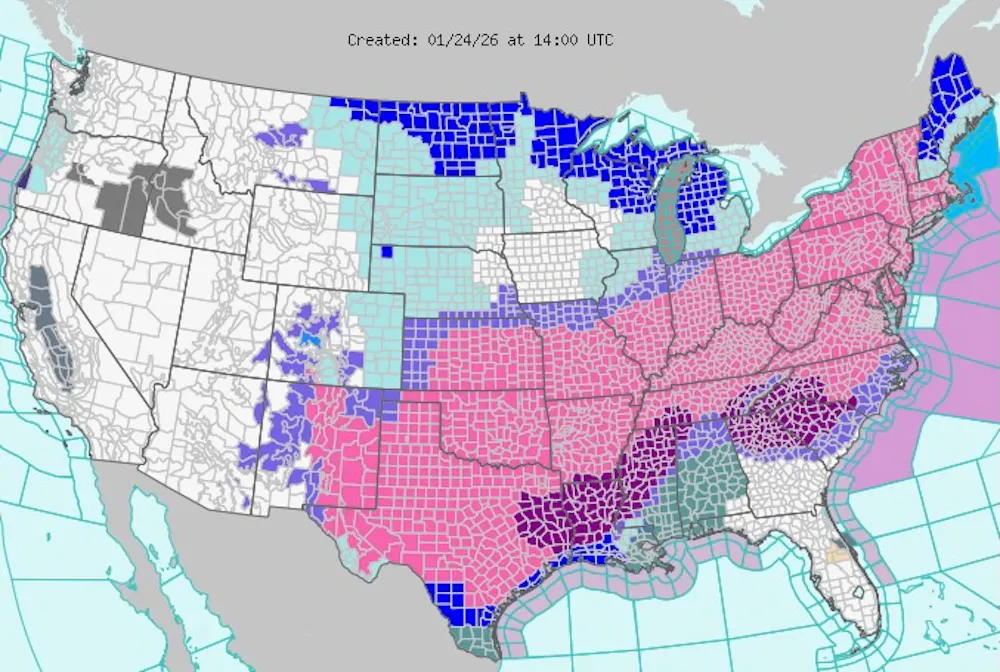
Where does the polar vortex come in?
The fastest winds of the jet stream occur just below the top of the troposphere, which is the lowest level of the atmosphere and ends about seven miles above Earth’s surface. Weather systems are capped at the top of the troposphere, because the atmosphere above it becomes very stable.
The stratosphere is the next layer up, from about seven miles to about 30 miles. While the stratosphere extends high above weather systems, it can still interact with them through atmospheric waves that move up and down in the atmosphere. These waves are similar to the waves in the jet stream that cause it to dip southward, but they move vertically instead of horizontally.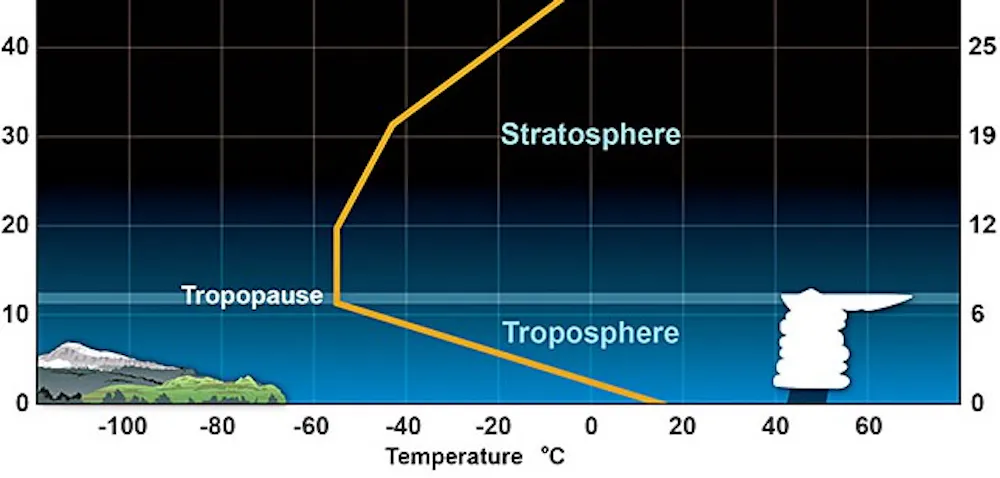
You’ve probably heard the term “polar vortex” used when an area of cold Arctic air moves far enough southward to influence the United States. That term describes air circulating around the pole, but it can refer to two different circulations, one in the troposphere and one in the stratosphere.
The Northern Hemisphere stratospheric polar vortex is a belt of fast-moving air circulating around the North Pole. It is like a second jet stream, high above the one you may be familiar with from weather graphics, and usually less wavy and closer to the pole.
Sometimes the stratospheric polar vortex can stretch southward over the United States. When that happens, it creates ideal conditions for the up-and-down movement of waves that connect the stratosphere with severe winter weather at the surface.
The forecast for the January storm showed a close overlap between the southward stretch of the stratospheric polar vortex and the jet stream over the U.S., indicating perfect conditions for cold and snow.
The biggest swings in the jet stream are associated with the most energy. Under the right conditions, that energy can bounce off the polar vortex back down into the troposphere, exaggerating the north-south swings of the jet stream across North America and making severe winter weather more likely.
This is what was happening in late January 2026 in the central and eastern U.S.
If the climate is warming, why are we still getting severe winter storms?
Earth is unequivocally warming as human activities release greenhouse gas emissions that trap heat in the atmosphere, and snow amounts are decreasing overall. But that does not mean severe winter weather will never happen again.
Some research suggests that even in a warming environment, cold events, while occurring less frequently, may still remain relatively severe in some locations.
One factor may be increasing disruptions to the stratospheric polar vortex, which appear to be linked to the rapid warming of the Arctic with climate change.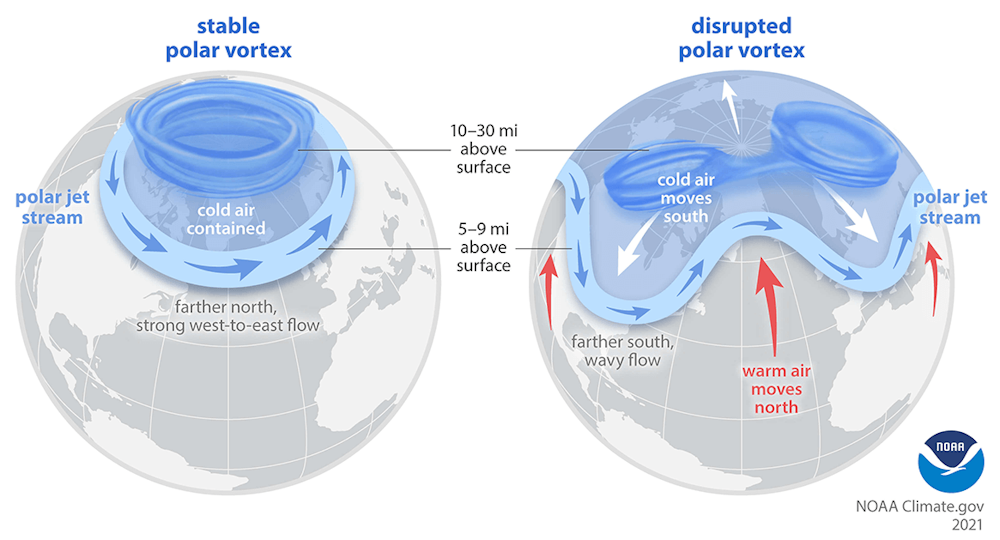
Additionally, a warmer ocean leads to more evaporation, and because a warmer atmosphere can hold more moisture, that means more moisture is available for storms. The process of moisture condensing into rain or snow produces energy for storms as well. However, warming can also reduce the strength of storms by reducing temperature contrasts.
The opposing effects make it complicated to assess the potential change to average storm strength. However, intense events do not necessarily change in the same way as average events. On balance, it appears that the most intense winter storms may be becoming more intense.
A warmer environment also increases the likelihood that precipitation that would have fallen as snow in previous winters may now be more likely to fall as sleet and freezing rain.
There are still many questions
Scientists are constantly improving the ability to predict and respond to these severe weather events, but there are many questions still to answer.
Much of the data and research in the field relies on a foundation of work by federal employees, including government labs like the National Center for Atmospheric Research, known as NCAR, which has been targeted by the Trump administration for funding cuts. These scientists help develop the crucial models, measuring instruments and data that scientists and forecasters everywhere depend on.
This article, originally published Jan. 24, 2026, has been updated with details from the weekend storm.
Mathew Barlow, Professor of Climate Science, UMass Lowell and Judah Cohen, Climate scientist, Massachusetts Institute of Technology (MIT)
This article is republished from The Conversation under a Creative Commons license. Read the original article.
The science section of our news blog STM Daily News provides readers with captivating and up-to-date information on the latest scientific discoveries, breakthroughs, and innovations across various fields. We offer engaging and accessible content, ensuring that readers with different levels of scientific knowledge can stay informed. Whether it’s exploring advancements in medicine, astronomy, technology, or environmental sciences, our science section strives to shed light on the intriguing world of scientific exploration and its profound impact on our daily lives. From thought-provoking articles to informative interviews with experts in the field, STM Daily News Science offers a harmonious blend of factual reporting, analysis, and exploration, making it a go-to source for science enthusiasts and curious minds alike. https://stmdailynews.com/category/science/
Discover more from Daily News
Subscribe to get the latest posts sent to your email.





