

The Knowledge
How dolphins communicate – new discoveries from a long‑term study in Sarasota, Florida

Laela Sayigh, Woods Hole Oceanographic Institution
Human fascination with bottlenose dolphins goes back thousands of years, at least as early as Greek mythology.
But it wasn’t until the 1960s that methodical research into dolphin communication began. Scientists like John Lilly and the husband-and-wife team of Melba and David Caldwell tried various experiments to decipher the sounds dolphins can make.
The Caldwells figured out a way to record isolated animals in human care. They discovered that each individual dolphin communicated mostly with one unique whistle, which they called the “signature whistle.” Researchers now know that these whistles convey identities much like human names do. Dolphins use them to stay in touch with each other in their murky habitat, where vision is limited. It’s like announcing “I’m over here!” when someone can’t see you.
This discovery is foundational to my own research. I’ve been studying communication in wild dolphins since the mid-1980s, when I joined my mentor Peter Tyack in documenting signature whistles in wild dolphins for the first time. Our team’s research focused on a resident community of free-ranging bottlenose dolphins in waters near Sarasota, Florida, where I continue to work today.
This collaborative study, led by Randall Wells of Brookfield Zoo Chicago’s Sarasota Dolphin Research Program, involves numerous researchers from a variety of institutions, who study different aspects of dolphin biology, health, ecology and behavior. Begun in 1970, this is the longest-running research project on a population of wild cetaceans – whales, dolphins and porpoises – in the world.
Recording and observing
Researchers know the age, sex and maternal relatedness of almost all of the approximately 170 dolphins in the Sarasota community. This depth of knowledge provides an unprecedented opportunity to study communication in a wild cetacean species.
The dolphins in the Sarasota project are periodically subject to brief catch-and-release health assessments, during which researchers, including me, briefly handle individual dolphins.
Our team attaches suction-cup hydrophones directly onto each dolphin’s melon – that is, its forehead. We then record the dolphins continuously throughout the health assessments, taking notes on who is being recorded when, and what is happening at the time.
This is how my colleagues and I were able to confirm that wild dolphins, like captive animals, produced large numbers of individually distinctive signature whistles when briefly isolated from other dolphins. Through observations and recordings of known free-swimming dolphins, we were further able to confirm that they produced these same signature whistles in undisturbed contexts.
We have organized these recordings into the Sarasota Dolphin Whistle Database, which now contains nearly 1,000 recording sessions of 324 individual dolphins. More than half of the dolphins in the database have been recorded more than once.
We identify each dolphin’s signature whistle based on its prevalence: In the catch-and-release context, about 85% of the whistles that dolphins produced are signature whistles. We can identify these visually, by viewing plots of frequency vs. time called spectrograms.

Signature whistles and ‘motherese’
The Sarasota Dolphin Whistle Database has proved to be a rich resource for understanding dolphin communication. For instance, we have discovered that some calves develop signature whistles similar to those of their mothers, but many do not, raising questions about what factors influence signature whistle development.
We have also found that once developed, signature whistles are highly stable over an animal’s lifetime, especially for females. Males often form strong pair bonds with another adult male, and in some instances, their whistles become more similar to one another over time. We are still trying to understand when and why this occurs.
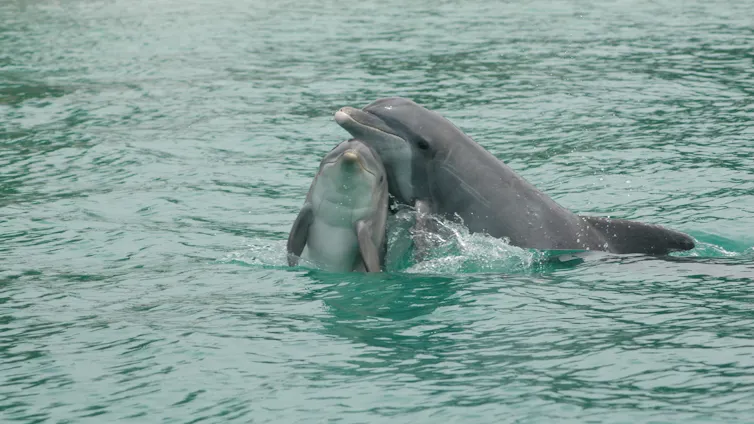
Dolphin mothers modify their signature whistles when communicating with their calves by increasing the maximum frequency, or pitch. This is similar to human caregivers using a higher-pitched voice when communicating with young children – a phenomenon known as “motherese.”
Slowed recording of a bottle-nosed dolphin without her calf, then with her calf. Courtesy of Laela Sayigh of Woods Hole Oceanographic Institution, and Brookfield Zoo Chicago’s Sarasota Dolphin Research Program. These sounds were obtained under a federal scientific research permit issued to R. Wells of SDRP.72 KB (download)
Also similar to humans is how dolphins will initiate contact with another dolphin by imitating their signature whistle – what we call a signature whistle copy. This is similar to how you would use someone’s name to call out to them.
Our team is interested in finding out if dolphins also copy whistles of others who aren’t present, potentially talking about them. We have seen evidence of this in our recordings of dolphins during health assessments, which provide a rare context to document this phenomenon convincingly. But we still have more work to do to confirm that these are more than chance similarities in whistles.
Shared whistle types
Another exciting development has been our recent discovery of shared whistle types — ones that are used by multiple animals and that are not signature whistles. We call these non-signature whistles.
I could hardly believe my ears when I first discovered a repeated, shared non-signature whistle type being produced by multiple dolphins in response to sounds we play back to them through an underwater speaker. We had previously believed that these non-signature whistles were somewhat random, but now I was hearing many different dolphins making a similar whistle type.
Our team originally had been using the playbacks to try to determine whether dolphins use “voice cues” to recognize each other – similar to how you can recognize the voice of someone you know. Although we found that dolphins did not use voice cues, our discovery of shared non-signature whistle types has led to an entirely new research direction.
So far, I’ve identified at least 20 different shared non-signature whistle types, and I am continuing to build our catalog. We are hoping that artificial intelligence methods may help us categorize these whistle types in the future.
To understand how these shared non-signature whistle types function, we are carrying out more playback experiments, filming the dolphins’ responses with drones. We’ve found that one such whistle often leads the dolphins to swim away, suggesting a possible alarm-type function. We have also found that another type might be an expression of surprise, as we have seen animals produce it when they hear unexpected stimuli.
More difficult, more interesting
So far, the main takeaway from our experiments has been that dolphin communication is complex and that there are not going to be one-size-fits-all responses to any non-signature whistle type. This isn’t surprising, given that, like us, these animals have complicated social relationships that could affect how they respond to different sound types.
For instance, when you hear someone call your name, you may respond differently if you are with a group of people or alone, or if you recently had an argument with someone, or if you’re hungry and on your way to eat.
Our team has a lot more work ahead to sample as many dolphins in as many contexts as possible, such as different ages, sexes, group compositions and activities.
This makes my job more difficult – and far more interesting. I feel lucky every day I am able to spend working on the seemingly infinite number of fascinating research questions about dolphin communication that await answers.
This article has been corrected to better describe how dolphins respond to playback whistles.
Read more stories from The Conversation about Florida.
Laela Sayigh, Senior Research Specialist, Cetacean Communication, Woods Hole Oceanographic Institution
This article is republished from The Conversation under a Creative Commons license. Read the original article.
Dive into “The Knowledge,” where curiosity meets clarity. This playlist, in collaboration with STMDailyNews.com, is designed for viewers who value historical accuracy and insightful learning. Our short videos, ranging from 30 seconds to a minute and a half, make complex subjects easy to grasp in no time. Covering everything from historical events to contemporary processes and entertainment, “The Knowledge” bridges the past with the present. In a world where information is abundant yet often misused, our series aims to guide you through the noise, preserving vital knowledge and truths that shape our lives today. Perfect for curious minds eager to discover the ‘why’ and ‘how’ of everything around us. Subscribe and join in as we explore the facts that matter. https://stmdailynews.com/the-knowledge/




unknown
Did Jackie Gleason See Aliens? Inside the Strange Nixon–UFO Legend
Jackie Gleason reportedly told his wife that President Richard Nixon arranged for him to view preserved extraterrestrial bodies at a Florida Air Force base. Here is what we know—and why the remarkable story remains unverified.

The beloved comedian reportedly told his wife that President Richard Nixon arranged for him to view preserved extraterrestrial bodies at a Florida Air Force base. Decades later, the extraordinary story remains fascinating—but unverified.
Jackie Gleason is remembered as “The Great One,” the larger-than-life entertainer who turned bus driver Ralph Kramden into one of television’s most enduring characters on The Honeymooners. Away from the cameras, however, Gleason had another consuming interest: UFOs, psychic phenomena and the possibility of extraterrestrial life.
That interest eventually became the foundation of one of the strangest stories ever associated with an American president and a Hollywood celebrity. According to Gleason’s second wife, Beverly McKittrick, her husband came home late one night in 1973 and claimed that President Richard Nixon had helped him see the preserved bodies of extraterrestrial beings at Homestead Air Force Base in Florida.
Did Jackie Gleason really see aliens?
The honest answer is that we do not know. The allegation is remarkable, but the available evidence never rises above an uncorroborated story attributed to Gleason years after the supposed event.
Gleason’s fascination with UFOs was real
There is little question that Gleason took the UFO subject seriously. He reportedly assembled a substantial personal library devoted to UFOs, the paranormal and related mysteries. His unusual circular home in New York—often nicknamed “The Mothership”—only strengthened his public association with flying saucers, although its distinctive architecture is not evidence of an extraterrestrial encounter.
Gleason also had a genuine social connection with Nixon. The two men shared an interest in golf and spent time together in Florida. That documented friendship is the factual starting point from which the more sensational story grew.
The alleged trip to Homestead Air Force Base
McKittrick said that Gleason returned to their Florida home at about 11:30 one evening looking disturbed. According to her account, he told her that Nixon had arrived without the usual presidential entourage and taken him to Homestead Air Force Base, south of Miami.
Once there, Gleason allegedly entered a secured building where he saw small humanoid bodies preserved inside glass-topped containers. Published versions differ over the number of bodies and some physical details, but they generally describe child-sized beings with oversized heads.
Importantly, McKittrick did not claim to have accompanied the men or witnessed anything at the base. Her account was based entirely on what she said Gleason told her after returning home.
The story became public in 1983, years after the alleged visit and after the couple had divorced. It circulated widely through tabloid reporting, UFO publications and later books, gradually becoming part of UFO folklore.
Why the story remains unverified
No authenticated photograph, visitor record, military document or firsthand statement from Nixon has emerged to confirm the alleged trip. Gleason also never provided investigators with a signed affidavit describing the experience.
UFO researcher Larry Bryant reportedly sought records from Homestead and tried to obtain a statement from Gleason, but those efforts produced no confirming documentation. Gleason’s refusal to address the account publicly has sometimes been portrayed as suspicious, but silence is not proof that an event occurred.
There is another important complication: McKittrick later expressed uncertainty about her former husband’s story.
During telephone interviews conducted by researcher Kenny Young in 2003, she stood by her recollection that Gleason told her he had seen “dead aliens.” She also acknowledged that, as the years passed, she wondered whether he might have invented the explanation because he had been out late. She declined to appear on camera and said the story should be authenticated first.
Her later comments do not establish that the account was false, but they considerably weaken any attempt to treat it as verified history.
Could a president have slipped away unnoticed?
Some versions of the legend emphasize that Nixon supposedly drove to Gleason’s house alone and then entered a military installation without his Secret Service detail. Presidents have occasionally sought privacy or slipped away from tightly managed schedules, but a secret nighttime excursion of this nature would have involved serious security and logistical obstacles.
The claim becomes even more difficult to accept when we consider what Nixon allegedly revealed. If the United States possessed extraterrestrial bodies, granting a comedian personal access to them would have represented an extraordinary breach of national security—with no apparent official purpose and no surviving documentation.
None of that makes the episode logically impossible. It does, however, mean that the story requires exceptionally strong evidence. That evidence has never appeared.
A compelling legend, not a confirmed encounter
The Jackie Gleason story endures because it combines three irresistible ingredients: a famous comedian fascinated by UFOs, a secretive American president and a nighttime visit to a military base containing an alleged government secret.
What can be established is that Gleason was deeply interested in UFOs, knew Nixon and was said by his former wife to have made an extraordinary claim. What cannot be established is that Nixon took him to Homestead Air Force Base or that preserved extraterrestrial bodies were ever stored there.
So, did Jackie Gleason see aliens?
Perhaps he believed that he did—or perhaps he simply told an unforgettable story. Until corroborating evidence emerges, the alleged encounter belongs in the intriguing borderland between celebrity history and American UFO mythology.
Sources and further reading
- The Black Vault: Jackie Gleason and the Pickled Alien
- University of Miami Libraries: The Jackie Gleason Collection
- U.S. Department of Defense: All-domain Anomaly Resolution Office
Step into The Unknown, where STM Daily News explores the strange phenomena, unexplained encounters and enduring mysteries that continue to challenge what we think we know. From UFO sightings and paranormal events to historical mysteries and unusual scientific discoveries, we examine the stories, evidence and competing explanations—without losing our sense of wonder. https://stmdailynews.com/science/unknown/
The Knowledge
Benjamin O. Davis Jr.: From West Point Isolation to Four-Star General
Benjamin O. Davis Jr. endured racial isolation at West Point before becoming a pioneering military aviator, commander of the Tuskegee Airmen and the first Black general officer in the U.S. Air Force. His extraordinary career ultimately earned him four stars.
Forgotten Genius Fridays | STM Daily News
For four years at West Point, fellow cadets tried to isolate Benjamin O. Davis Jr.
They wouldn’t room with him. They excluded him socially. Outside of official duties, other cadets largely refused to speak to him.
The intention was clear: make life so difficult that he would leave.
Benjamin O. Davis Jr. didn’t leave.
He graduated.
And the young officer who endured isolation at West Point would eventually command some of America’s most celebrated fighter pilots, help lead the integration of the U.S. Air Force and finish his remarkable journey wearing four stars.
The Son of a Pioneer
Benjamin Oliver Davis Jr. was born in Washington, D.C., on December 18, 1912.
Military service was already part of the Davis household.
His father, Benjamin O. Davis Sr., was a career Army officer who would make history in 1940 as the first Black general officer in the U.S. Army and U.S. armed forces.
The younger Davis developed another ambition.
He wanted to fly.
But in the segregated American military of the era, becoming a Black military aviator wasn’t simply difficult.
The opportunity effectively didn’t exist.
Davis would first have to prove himself somewhere else.
Four Years of Isolation at West Point
Davis entered the United States Military Academy at West Point in July 1932.
He encountered racial hostility almost immediately.
White cadets subjected Davis to what amounted to a prolonged campaign of social isolation. He roomed alone and generally ate without other cadets speaking to him.
The National Park Service records that Davis nevertheless persevered, graduating in June 1936 in the top 20 percent of his class. He was the fourth African American to graduate from West Point.
Years later, Davis recalled the purpose of the treatment: it was intended to make him buckle.
He refused.
That determination would become one of the defining characteristics of his military career.
An Officer Who Wanted to Fly
Graduation didn’t eliminate the barriers.
Davis was commissioned as a second lieutenant of infantry. After assignments including Fort Benning, Georgia, he became a professor of military science at Tuskegee Institute in Alabama.
Then an opportunity appeared that would change American military aviation.
The Army began establishing a program to train Black military pilots at Tuskegee.
Davis entered advanced flying school in 1941.
On March 7, 1942, the first class of five Black Army Air Forces fighter pilots graduated from Tuskegee.
Benjamin O. Davis Jr. was among them.
He finally had his wings.
Taking the 99th to War
Davis transferred to the Army Air Corps and became commander of the 99th Fighter Squadron.
In April 1943, he traveled with the squadron to North Africa.
Flying P-40 Warhawks, the Black pilots were finally entering combat.
But their abilities would soon be challenged from within their own military.
Reports questioning the combat performance of the 99th threatened the future of Black military aviation.
Davis returned to Washington and defended his pilots before War Department officials.
The squadron continued fighting.
Its combat performance helped answer the critics more convincingly than prejudice ever could.
Commanding the 332nd
Davis subsequently assumed command of the 332nd Fighter Group, which eventually brought together the 99th, 100th, 301st and 302nd Fighter Squadrons.
Operating from Italy, the group flew bomber escort and other combat missions over Europe.
Eventually flying P-51 Mustangs distinguished by their red-painted tails, the pilots became associated with one of the most recognizable names in American aviation history:
The Red Tails.
Davis didn’t simply command from behind a desk.
He flew combat missions himself.
During the war, his leadership and combat service earned decorations including the Silver Star and Distinguished Flying Cross.
The Tuskegee Airmen were demonstrating something segregation had attempted to deny—that Black Americans could perform highly demanding aviation missions and lead combat organizations.
From Tuskegee to an Integrated Air Force
World War II ended, but Davis’s military career continued.
In 1947, the United States Air Force became an independent military service.
Then, in 1948, President Harry S. Truman issued Executive Order 9981, establishing a policy of equality of treatment and opportunity in the armed forces regardless of race, color, religion or national origin.
Davis became involved in the Air Force’s efforts to implement integration.
The officer who had once been deliberately isolated because of his race was now helping a military service move away from institutional segregation.
Another War
Davis continued advancing.
During the Korean War era, he commanded the 51st Fighter-Interceptor Wing in Korea.
His responsibilities continued expanding through assignments in the United States, Europe and Asia.
Then another barrier fell.
On October 27, 1954, Davis received his temporary promotion to brigadier general.
He became the first Black general officer in the United States Air Force.
His father’s historic achievement now had an extraordinary parallel.
Benjamin O. Davis Sr. had become the Army’s first Black general.
Benjamin O. Davis Jr. had become the Air Force’s first.
Three Stars
Davis continued climbing through the senior leadership of the Air Force.
He became a major general and, in 1965, lieutenant general.
His assignments included command of the 13th Air Force in the Philippines and service as deputy commander in chief of U.S. Strike Command.
By the time Davis retired from active military service on February 1, 1970, the cadet who had once eaten alone at West Point was wearing three stars.
But history wasn’t quite finished with Benjamin O. Davis Jr.
The Fourth Star
Twenty-eight years after his retirement, Davis returned to the national spotlight.
On December 9, 1998, President Bill Clinton advanced the retired lieutenant general to the rank of general.
Four stars.
The moment carried enormous symbolism.
The cadet other students had refused to speak to had become one of the highest-ranking officers in American military history.
Yet an important distinction should be remembered: Davis was not the first Black four-star general in the Air Force. That milestone belonged to Daniel “Chappie” James Jr., who reached four-star rank while on active duty in 1975.
Davis’s fourth star nevertheless represented recognition of an extraordinary career spanning some of the most significant transformations in twentieth-century American military history.
The Davis Legacy
Benjamin O. Davis Jr. died on July 4, 2002, at age 89.
His life tells an extraordinary American story.
His father began his Regular Army career with the Buffalo Soldiers and became America’s first Black general officer.
The son endured four years of racial isolation at West Point.
He became one of the first five Black Army pilots trained at Tuskegee.
He commanded the 99th Fighter Squadron.
He led the 332nd Fighter Group.
He helped the Air Force navigate integration.
He commanded forces during the Cold War.
And eventually, he wore four stars.
The Davis family story spans generations of American military history—from the Buffalo Soldiers to the Tuskegee Airmen and from segregation to integration.
Benjamin O. Davis Sr. broke one barrier.
The Tuskegee Airmen shattered assumptions about Black military aviation.
And Benjamin O. Davis Jr. carried that legacy from West Point into the skies—and ultimately to the highest ranks of the United States Air Force.
Two generations. One extraordinary legacy.
Forgotten Genius Fridays is an STM Daily News series highlighting innovators, pioneers and historical figures whose achievements deserve a larger place in our collective memory.
Sources and Related Reading
U.S. Air Force — General Benjamin O. Davis Jr. biography
National Park Service — Benjamin O. Davis Jr.
National Museum of the United States Army — Benjamin O. Davis Jr.
More more stories like this, please visit our Forgotten Genius Friday!
Forgotten Genius Fridays
The Tuskegee Airmen: The Red Tails Who Fought Two Wars
The Tuskegee Airmen were far more than the legendary Red Tail fighter pilots. Thousands of pilots, mechanics, instructors and support personnel challenged segregation while helping fight World War II—and their achievements helped change the U.S. military.
A Forgotten Genius Special | STM Daily News
They were training to fight America’s enemies overseas while confronting discrimination in the country they had volunteered to defend. The Red Tails.
They became known as the Tuskegee Airmen.
Their story is often reduced to an image of Black fighter pilots flying red-tailed P-51 Mustangs over Europe during World War II. But the real story was much larger.
The Tuskegee Airmen included pilots, mechanics, instructors, navigators, bombardiers, radio operators, parachute riggers, medical personnel, meteorologists, cooks, clerks, control-tower personnel and many others who helped make military aviation possible.
The National Park Service describes more than 16,000 people as participants in the broader Tuskegee experience.
Together, they helped challenge one of the most persistent prejudices in the American military: the racist assumption that Black Americans lacked the intelligence, discipline or ability required to become successful military aviators.
They proved otherwise.
An Experiment Built on a False Assumption
In January 1941, Secretary of War Henry L. Stimson authorized the formation of a Black pursuit squadron.
The 99th Pursuit Squadron, later redesignated the 99th Fighter Squadron, was activated in March 1941.
Because the American military remained segregated, Black aviators weren’t simply incorporated into existing flying units. A separate training program was established around Tuskegee, Alabama.
Flight training took place at Moton Field, while Tuskegee Army Air Field provided advanced military flight training.
What military officials regarded as an experiment would ultimately help demonstrate that the restrictions placed upon Black aviators had nothing to do with their abilities.
More Than Pilots
The name “Tuskegee Airmen” can be misleading if we imagine only the men sitting inside fighter cockpits.
Aircraft don’t fly because of pilots alone.
They require mechanics.
Fuel crews.
Radio operators.
Meteorologists.
Armorers.
Dispatchers.
Parachute riggers.
Medical personnel.
Instructors.
Navigators.
Engineers.
Control-tower operators.
Administrative personnel.
And many others.
Women were part of the Tuskegee experience as well. According to the National Park Service, women worked as mechanics, control-tower operators, aircraft fuselage technicians, gate guards, secretaries and clerks. Three permanent female parachute riggers helped train hundreds of cadets in the proper packing and maintenance of parachutes.
The Tuskegee story was therefore not simply the story of several hundred pilots.
It was the story of an entire aviation community.
Taking the Fight Overseas
The 99th Fighter Squadron deployed overseas in 1943.
Flying Curtiss P-40 Warhawks, its pilots entered combat in the Mediterranean theater, operating from North Africa and later Sicily and Italy.
The Tuskegee program continued expanding.
Three additional Black fighter squadrons—the 100th, 301st and 302nd—became part of the 332nd Fighter Group.
And the man who would eventually command them had already experienced another form of racial isolation.
His name was Benjamin O. Davis Jr.
The son of America’s first Black Army general had graduated from West Point in 1936 after fellow cadets subjected him to years of deliberate social isolation.
Now Davis was leading Black American fighter pilots into combat.
The Red Tails
The 332nd eventually transitioned to the aircraft that became most closely associated with the Tuskegee Airmen:
The North American P-51 Mustang.
The tails of the group’s aircraft were painted red to identify the unit.
The distinctive markings helped produce one of the most famous nicknames in American military aviation:
The Red Tails.
Operating primarily from Italy, the 332nd escorted heavy bombers deep into enemy territory while also attacking ground targets.
Escort duty was extraordinarily important.
American bombers flying deep into enemy territory were vulnerable to German fighters. Escort pilots had to remain close enough to protect the bombers while simultaneously watching for enemy aircraft.
The Tuskegee Airmen developed an impressive record performing that mission.
The Legend — and the Reality
One claim became particularly famous after the war:
The Tuskegee Airmen never lost a bomber they escorted to enemy fighters.
It is an inspiring story.
It also isn’t completely accurate.
Research by Air Force historian Daniel Haulman using wartime mission reports found that 27 bombers being escorted by the 332nd Fighter Group were shot down by enemy aircraft.
Those losses occurred during seven of the group’s 179 bomber escort missions for the Fifteenth Air Force.
But correcting the legend doesn’t diminish their accomplishment.
In fact, the documented record remains impressive.
Research comparing the 332nd with other P-51 fighter groups in the Fifteenth Air Force found that the Tuskegee Airmen lost substantially fewer escorted bombers to enemy aircraft than the other groups examined.
The truth doesn’t weaken their story.
The truth makes their achievement real.
Fighting Two Wars
The enemy wasn’t confined to the skies over Europe.
Black servicemen returned from missions defending democracy overseas while still confronting segregation at American military installations and throughout American society.
This contradiction became part of the broader Double V campaign during World War II—the call for victory against fascism abroad and racial discrimination at home.
Tuskegee personnel repeatedly challenged discriminatory military policies.
One of the most significant confrontations occurred in 1945 at Freeman Field, Indiana, when Black officers protested restrictions that prevented them from using an officers’ club reserved for white officers.
Their resistance became known as the Freeman Field Mutiny.
The confrontation demonstrated that the Tuskegee story wasn’t simply about proving Black Americans could fly airplanes.
It was also about demanding the rights that should accompany wearing the same uniform.
Changing More Than Aviation
The Tuskegee Airmen didn’t single-handedly desegregate the United States military.
But their performance undermined one of the principal arguments used to justify segregation—that Black servicemen could not perform highly technical or demanding military assignments as effectively as white servicemen.
Three years after the Tuskegee flying program began sending pilots into combat, President Harry S. Truman issued Executive Order 9981 on July 26, 1948, establishing a federal policy of equality of treatment and opportunity in the armed services regardless of race, color, religion or national origin.
Military integration would take additional years to implement.
But the old assumptions had become increasingly difficult to defend.
A Legacy Larger Than the Red Tails
The Tuskegee Airmen eventually became symbols of perseverance, military excellence and the long struggle to expand opportunity within America’s armed forces.
In 2007, the Tuskegee Airmen collectively received the Congressional Gold Medal in recognition of their service.
Yet perhaps the best way to understand their achievement is not through mythology.
They didn’t need a perfect combat record to make history.
They trained in a system created because many officials doubted Black Americans could become military aviators.
They went into combat.
They flew.
They fought.
They protected bomber formations.
They maintained aircraft.
They trained pilots.
And thousands of people behind the scenes made those missions possible.
They demonstrated through performance what segregation had attempted to deny.
And among the men leading them was the son of America’s first Black Army general.
His name was Benjamin O. Davis Jr.
His journey had taken him from isolation at West Point to the cockpit of a military aircraft and command of the 332nd Fighter Group.
But his story was far from finished.
Next Friday on Forgotten Genius Fridays: Benjamin O. Davis Jr. — From West Point Isolation to Four-Star General.
Forgotten Genius Fridays is an STM Daily News series exploring innovators, pioneers and historical figures whose achievements deserve a larger place in our collective memory.
Sources & Related Links
National Park Service — Tuskegee Airmen History & Culture documents the broad definition of the Tuskegee Airmen and the many ground and support occupations involved.
Air Force Historical Support Division — Tuskegee Airmen provides an excellent military chronology of the 99th Fighter Squadron and 332nd Fighter Group.
National Park Service — Tuskegee Airmen National Historic Site is especially useful for Moton Field, training and the Red Tails.
National Park Service — And There Were Women provides material for an often-overlooked part of the story: women who participated in the Tuskegee experience.
Congress authorized a Congressional Gold Medal for the Tuskegee Airmen collectively, recognizing their military record and its role in inspiring reform in the armed forces; the presentation ceremony took place in 2007.
Explore more fascinating stories, videos, and articles on The Knowledge at STM Daily News!





