

Economy
How new SNAP restrictions could hit Greater Pittsburgh’s food access and economy
New SNAP work requirements and retailer rules could reduce food assistance across Greater Pittsburgh, increasing food insecurity while hurting families, independent grocers and the regional economy.

Amelia B. Finaret, Allegheny College
Food assistance is one of the most effective tools for fighting poverty in America. New federal rules are testing that reputation.
The Supplemental Nutrition Assistance Program, better known as SNAP, helps low-income people afford groceries. The program’s benefits reach far beyond the grocery bill, with research linking the program to better outcomes for K-12 students and improved overall health among participants.
However, new federal policy changes are making the program harder for many families to use, and participation is shrinking.
In Pennsylvania’s Allegheny County, the number of people who get SNAP benefits has decreased by about 12% since 2025. SNAP enrollment rates vary widely across the Greater Pittsburgh metropolitan area – from 31% of residents in Fayette County to just 13% in Butler County.
In Allegheny County, where Pittsburgh is located, approximately 17,000 people have already lost their benefits. That’s the second-highest total of any county in Pennsylvania. Roughly 162,000 Allegheny County residents receive SNAP, or about 14% of the county’s population.
Across the country, states like Arizona and Florida are seeing similar effects from these SNAP changes. The specifics vary by state, but the underlying pressures on food assistance are shared nationwide.
As a food economist and clinical dietition working in western Pennsylvania, I have seen how SNAP policy changes affect real people firsthand. Many of my patients are having more trouble making ends meet over the past few years, especially as grocery prices have risen roughly 25% in nominal terms since 2022 – a jump that has outpaced wage growth for many low-income households.
New SNAP work requirements
In November 2025, Pennsylvania began implementing the federal government’s expanded work requirements. The rules previously applied to adults ages 18 to 54 without a disability or dependent children, but they now reach up to age 64. Under these rules, these adults must work, volunteer or take part in education or training programs for at least 20 hours a week to keep receiving SNAP benefits.
Certain groups are especially likely to be affected by this rule change, including early retirees, first-time moms, children and people with disabilities who haven’t applied or been approved for disability benefits.
Stricter and more expansive work requirements increase SNAP benefit denials and reduce the number of people who get benefits, including among women who may become pregnant.
The new work requirements could also worsen food insecurity, which occurs when people cannot obtain enough safe and nutritionally adequate food for an active and healthy life.
Up to 5.4 million people nationwide could lose some or all of their SNAP benefits under the expanded work requirements, including 1.5 million children.
In Allegheny County, 43% of food-insecure children were likely ineligible for SNAP and similar benefits in 2025 because their household incomes exceeded 185% of the federal poverty line – US$61,050 for a family of four in 2026.
Stricter rules for SNAP retailers
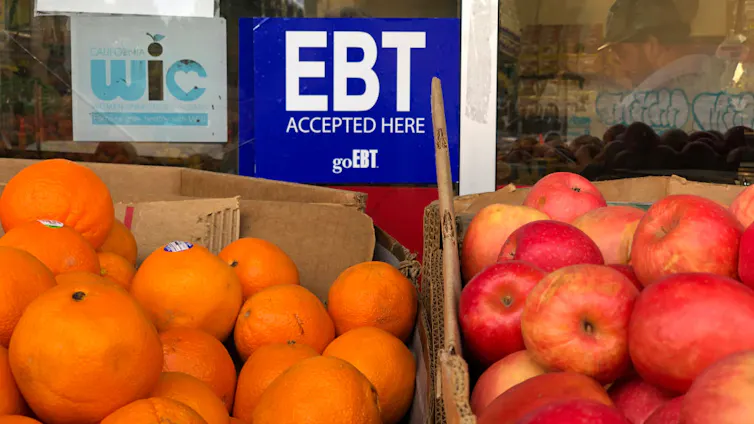
Supermarkets and other stores that sell food must be certified to accept SNAP benefits for payment. Beyond helping individual households, SNAP spending boosts local economies, as those benefits get spent at grocery stores and other retailers.
Retailers that sell food are now required to offer seven varieties of foods in each of four staple food categories: grains, vegetables and fruits, dairy, and protein. Stores could meet the new requirements for grains, for example, by offering corn tortillas, whole wheat bread, white bread, brown rice, white rice, oats and infant cereal for sale.
In the 12th and 17th congressional districts that make up Allegheny County, 10.4% and 8.7% of people, respectively, live in areas where it is difficult to get healthy foods. According to data from the Institute for Local Self-Reliance, there are 191 grocery stores in these districts, about 28% of which are either small chains or independent stores that may have a harder time complying with the new requirements.
Between 2017 and 2023, the number of SNAP-authorized stores in Allegheny County increased by 13%, but this trend could reverse under the new rules.
While the stated goal of the new rules is to increase the availability of healthier foods, simply requiring stores to stock them doesn’t mean that customers will eat a better diet. Whether these new retailer policies ultimately improve diets is an open question.
Additional restrictions on purchases
Some states are placing additional restrictions on what people can buy with benefits. Purchasing hot prepared foods, alcohol, vitamins or diapers with SNAP benefits was already prohibited, but 23 states are now restricting the use of benefits to buy sugar-sweetened beverages and some other items that contribute to nutritionally inadequate diets.
While Pennsylvania has not adopted those additional restrictions, some of its neighboring states, such as Ohio and West Virginia, have.
SNAP helps people pay for groceries, but the benefit amount is typically less than what a household would spend on food. SNAP covers some of what a family would’ve spent on groceries anyway, leaving that money for other needs – rent, diapers, utility bills and the like. As a result, research shows the program doesn’t significantly change what or how much people eat, on average.
In my view, as food insecurity remains high in Allegheny County, policies that make it harder for local residents to get SNAP benefits risk weakening one of the nation’s most effective economic support programs.
Read more of our stories about Pittsburgh and Pennsylvania.
Amelia B. Finaret, Associate Professor of Business and Economics and Nutrition, Allegheny College
This article is republished from The Conversation under a Creative Commons license. Read the original article.




financial wellness
Personal bankruptcy filings are soaring in 2026, signaling growing economic distress
Personal bankruptcy filings are climbing as inflation, high interest rates and mounting household debt strain American consumers. Although bankruptcy can provide a fresh start, financial recovery may take decades.

Jay L. Zagorsky, Boston University
The number of Americans who file for bankruptcy is growing. More than 500,000 people took this step in 2025, nearly 50% more than in 2022. And the numbers have kept on climbing, with a 12% jump in June 2026 from a year earlier as many consumers struggled to pay their bills.
I am a business school professor who has researched bankruptcies and whether, when you are at the end of your financial rope, bankruptcy helps or hurts.
I became interested in the subject while in graduate school. Not because of any courses I took, but because I ran out of money. While I was in grad school, my wife, who was keeping the family afloat, unexpectedly lost her job at the very moment our savings went to zero.
Ultimately, we didn’t declare bankruptcy, and I’ll explain later what we did to avoid it. But this near brush with that fate sparked my long-term interest in this predicament that befalls many American consumers who find themselves financially stressed out.
What’s personal bankruptcy?
Bankruptcy is a legal process for people who can’t pay their debts. Because it usually requires liquidating their assets or entering a repayment plan, Americans generally turn to it as a last resort. To declare bankruptcy you first file a petition with a federal court, which appoints a trustee to oversee your case.
But bankruptcy does not discharge all debts.
There are 19 types of debts that even bankruptcy will not wipe out. Some of the bigger categories are alimony, child support and most taxes. Student loans can be wiped out, but getting that done is difficult and it’s not an automatic part of bankruptcy proceedings.
2 conflicting goals
U.S. bankruptcy law has two big goals that contradict each other.
The first is to give honest individual debtors a “fresh start.” The process ideally reduces or eliminates enough of their debt to make it possible to earn, spend, borrow and repay money like people with a more typical financial life. In other words, personal bankruptcy can take the financial noose off debtors’ necks.
The second is to ensure that creditors get repaid as much as possible for their loans. When someone declares bankruptcy, some or maybe all of their creditors don’t get their money back. In 2024, the Americans who filed for bankruptcy had about US$75 billion in assets, but they owed their creditors about $86 billion – $11 billion more.
States and the federal government make different trade-offs between these goals. As a result there are very different limits on how much equity – the difference between market value and what you owe – debtors can keep in their primary homes and personal property after they declare bankruptcy.
Some states are quite lenient. For example, Texas bankruptcy law doesn’t limit the amount of equity in a home at all. That helps debtors get back on their feet.
Other states are extremely strict in this regard. Arkansas limits home equity after personal bankruptcy to $800, and Kentucky restricts it to $5,000. This helps creditors: Lenders can force a debtor’s house to be sold and keep much of the equity the debtor built up.
Likewise, laws protecting vehicles and other kinds of personal property belonging to people who declare bankruptcy vary widely.
2 types of personal bankruptcy
People declaring bankruptcy typically file using either Chapter 7 or Chapter 13 of the federal bankruptcy code.
About 2 in 3 people use Chapter 7, a form of financial liquidation. The bankruptcy court appoints a trustee, who then sells off all of a person’s possessions, except what is covered by the various exemptions.
The trustee then gives creditors whatever money is left after the sale. In exchange for giving up most of what someone owns, filing Chapter 7 wipes out almost all debts and gives them a fresh financial start.
For people earning moderate to high incomes and whose debts are less than $2.75 million, bankruptcy courts make them use Chapter 13.
Chapter 13 is a slower-moving process. Creditors are paid over three to five years from a person’s earnings. Debtors keep enough of their wages to cover necessary living expenses, but all other disposable income goes to creditors. Chapter 13 allows people to save their homes from foreclosure and keep their vehicles.
Bankruptcy filing rising after decline
The number of personal bankruptcies filed annually fell sharply for more than a decade before the recent uptick, hitting a low of about 368,000 in 2022, down from about 1.5 million in 2010.
That number has climbed steadily since 2022.
A 2005 law called the Bankruptcy Abuse Prevention and Consumer Protection Act sparked the earlier decline. Its goal was to make declaring bankruptcy harder and more expensive. Many creditors pushed for these changes because they felt some individuals were abusing the system.
The changes introduced income limits for eligibility to declare Chapter 7 bankruptcy. It also required people to get credit counseling before filing to see whether there was any way they could avoid bankruptcy. It also added a new obligation: Americans now take a course in financial management after they file for bankruptcy to reduce the chance of future money troubles.
One interesting study regarding the legislation’s impact found that it lowered credit card interest rates, but it also prevented some people without health insurance from wiping out their medical debts.
The 2005 changes caused the number of personal bankruptcies to plunge. That ended with the Great Recession, which lasted from late 2007 until mid-2009.
This economic downturn pushed up the number of bankruptcies dramatically. But then the number fell from 2010 until 2022, as the Great Recession’s impact gradually receded. The decline continued into the early 2020s because the stimulus checks and more generous unemployment insurance payments the government provided at the height of the COVID-19 pandemic helped keep millions of U.S. consumers afloat.
The numbers began to rise again in 2022 as American consumers began facing increasing stress from income that has not kept pace with inflation and a sharp jump in credit card interest rates.
Lasting changes
Bankruptcy stays on your credit report for up to 10 years. After that, creditors are supposed to treat people who filed for it like anyone else. A study I worked on with law professor Lois Lupica tracked what happened over two decades to both people who had and had not declared bankruptcy. We wanted to see whether those who had filed for bankruptcy really got out of their financial hole.
Our findings were a good news, bad news story. The good news was that bankruptcy was not causing permanent financial stigma. The average person who declared bankruptcy eventually caught up financially with their peers who hadn’t.
The bad news was that it took 15-25 years to recover in almost all financial dimensions. This is longer than those 10 years that the bankruptcy filing stays on your credit report.
In short, we determined that bankruptcy does give people a fresh start, but getting that reprieve takes longer than the law’s intent.
Strategies that can stave off bankruptcy
My wife and I avoided bankruptcy primarily by doing two things.
First, we switched to using cash for most of our day-to-day purchases. When our wallets were empty, we were done spending. I talk more about this in my 2025 book “The Power of Cash.”
Second, we contacted the financial company where we owed our biggest monthly payment. After providing proof of financial hardship, they were surprisingly flexible.
If these two steps are not enough for you, the next step is to consult an attorney who specializes in bankruptcy law. While there are lots of things most people can competently do on their own, filing for bankruptcy is not one of them.
Jay L. Zagorsky, Associate Professor of Business, Boston University
This article is republished from The Conversation under a Creative Commons license. Read the original article.

Travel
Alaska Airlines Announces New Nonstop Flights From Seattle to Athens and Paris
Alaska Airlines is expanding its European service with new nonstop flights from Seattle to Athens and Paris beginning in May 2027. Introductory round-trip fares start at $999.

SEATTLE — Alaska Airlines is expanding its international network with new nonstop flights connecting Seattle to Athens, Greece, and Paris, France, beginning in May 2027.

The seasonal Seattle-to-Athens route launches May 12, 2027, with three weekly flights through October. According to Alaska Airlines, it will be the first nonstop service between Seattle and Athens and the only nonstop connection between the West Coast and the Greek capital.
Service between Seattle and Paris begins May 25, 2027, operating five times weekly through October.
Both routes will feature Boeing 787-9 Dreamliner aircraft, offering lie-flat business-class suites and upgraded amenities. Alaska says Starlink Wi-Fi will become available as installation continues across its fleet through 2027.

The new destinations join Alaska’s growing international lineup from Seattle, which includes Iceland, London, Rome, Seoul, and Tokyo. The airline plans to add at least five more intercontinental destinations by 2030.
Introductory round-trip main-cabin fares start at $999 and are available for purchase in the United States through August 26, 2026, subject to restrictions. Travelers can book at Alaska Airlines.
Would you choose Athens or Paris for your next European adventure? Share your thoughts in the comments and subscribe to the STM Daily News newsletter for more travel updates.
Source: Alaska Airlines press release, August 20, 2026.
Related Links


Consumer Corner
3 Practical Ways to Build Financial Confidence
Financial Confidence: Economic uncertainty, fueled by persistent inflation, stagnant wages and a cooling job market, has led many Americans to feel like they’re falling behind, even when they’re doing many of the “right” things financially. This expert guidance can help you be more intentional with the choices you make so your spending reflects your priorities.


Building Financial Confidence
(Feature Impact) Nearly everyone is carrying some level of insecurity about their financial future, even those who are trying to plan ahead. Economic uncertainty, fueled by persistent inflation, stagnant wages and a cooling job market, has led many Americans to feel like they’re falling behind, even when they’re doing many of the “right” things financially.
Though many are paying down debt, saving for retirement and building an emergency fund, they’re still asking, “Am I doing enough?” In fact, only 21% of Americans are financially prepared and assured in their ability to protect their futures, according to Mutual of Omaha’s 2026 Protection Index Survey – a proprietary research study conducted with quantilope – which shows overall financial confidence has declined.
“Many people believe they need to wait until they have more money, more certainty or the perfect plan before taking action,” said Nate Hobson, vice president of sales, Advisor Network at Mutual of Omaha. “But financial confidence is usually built through consistency rather than perfect timing. Even small steps today can make a meaningful difference over time.”
While being financially secure means different things to different people, according to the survey – such as having little or no debt (34%), owning a home (29%), maintaining emergency savings (27%), saving for retirement (26%) or having insurance coverage (26%) – building financial confidence doesn’t have to translate to cutting out everything you enjoy. Instead, this expert guidance can help you be more intentional with the choices you make so your spending reflects your priorities.
Create a Financial Cushion
Whether it’s a car repair, medical bill or temporary loss of income, unexpected expenses happen.
Having even a modest emergency fund can reduce financial stress and reliance on credit cards or loans. If saving several months of expenses feels overwhelming, start with a smaller milestone. Consistency matters more than the starting amount.
 Put Good Financial Habits on Autopilot
One of the easiest ways to make progress is removing the need to make the same decision every month. Consider setting up automatic contributions to savings and retirement accounts, regular investment deposits and automatic bill payments, which can help you build financial security even during busy or uncertain times.
Taking a look at everyday spending habits can also make a difference. The survey showed small, everyday choices add up over time, such as cutting non-essential spending (57%), using rewards programs (54%), comparing prices or switching providers (39%) and following a monthly budget (38%). That could mean bringing your lunch to work instead of grabbing takeout, taking a few extra minutes to compare prices at the grocery store or using rewards to get more value from the purchases you’re already making.
Protect What You’re Building
Saving and investing are important pieces of financial protection, but they’re only part of the equation. Protecting income, loved ones and other financial assets is equally important.
For families, life insurance can provide financial protection during key earning and caregiving years, helping replace income if the unexpected happens. For those focused on covering final expenses, guaranteed whole life insurance can help cover funeral and other end-of-life costs. If you’re approaching or living in retirement, an annuity may provide a reliable stream of income that can complement other retirement resources and reduce uncertainty.
A financial professional can help determine which options best fit your goals and circumstances. To see how much coverage is right for your situation, Mutual of Omaha’s Life Insurance Calculator can provide a personalized estimate based on your income, financial obligations and long-term goals.
For more practical advice to build financial confidence, visit MutualofOmaha.com.
Taking Action with an Extra $1,000
If you unexpectedly received $1,000, your response with the extra cash may reveal your financial priorities and where additional planning could strengthen financial resilience.
Providing a window into Americans’ financial priorities, respondents in Mutual of Omaha’s 2026 Protection Index Report said they would:
- Pay down debt (25%)
- Add it to savings (21%)
- Use it for everyday expenses (14%)
- Invest it (9%)
Photos courtesy of Shutterstock

SOURCE:
💰 Live well and make your money work smarter! Explore the latest lifestyle tips, personal finance insights, saving strategies, and financial wellness stories on STM Daily News. Share your thoughts in the comments and subscribe to our newsletter for fresh ideas delivered straight to your inbox.





