Catch a Glimpse of the Lyrid Meteor Shower Peaking This Weekend
“Experience the Lyrid meteor shower, a celestial spectacle gracing our skies this weekend. Don’t miss out on shooting stars streaking across the night sky!”
Spring nights are set to dazzle with the arrival of the Lyrid meteor shower, marking the first of two celestial spectacles gracing our skies this season. As we gear up for a weekend of shooting stars, let’s delve into what makes the Lyrids special, how to witness their peak, and what to expect for this year’s show.
Originating from debris shed by Comet Thatcher, the Lyrid meteor shower is an annual springtime event renowned for its vibrant fireballs and occasional bursts of meteor activity. These bursts, which occur approximately every 60 years, promise an awe-inspiring display of shooting stars, though the next anticipated outburst isn’t slated until 2042.
How to See the 2024 Lyrid Meteor Shower
Running from April 14 to 30, with peak activity occurring overnight from April 21-22, the Lyrid meteor shower offers skywatchers a celestial extravaganza. To catch a glimpse of this cosmic show, look toward the constellation Lyra, rising above the northeast horizon around 10 p.m. While technically visible from the southern hemisphere, the northern hemisphere provides the optimal viewing conditions.
Will 2024 Be a Good Year for the Lyrid Meteor Shower?
This year, the Lyrids coincide with a bright waxing gibbous moon, potentially obscuring many meteors from view. However, don’t let this deter you; seek out dark-sky destinations for enhanced visibility, or await the upcoming Eta Aquariids shower, peaking on May 6 under a dim, near-new moon.
As we anticipate the Lyrid meteor shower’s peak this weekend, let’s embrace the wonders of the cosmos and revel in the beauty of shooting stars streaking across the night sky. Whether you’re a seasoned stargazer or a casual observer, this celestial event promises to inspire awe and ignite a sense of wonderment in us all.
The April Lyrids meteor shower is a celestial event that occurs annually from April 15 to April 29. The radiant of this meteor shower is located in the vicinity of the constellations Lyra and Hercules, near the bright star Vega. Typically, the peak of the shower is around April 22-23 each year.
The April Lyrids meteor shower is caused by the particles of dust shed by the long-period Comet C/1861 G1 Thatcher. This is the most intense annual shower of meteors that results from the debris of a long-period comet. The reason for its intensity is that the comet Thatcher has a relatively short orbital period of about 415 years as compared to other intermediate long-period comets with orbital periods of 200-10,000 years. The Lyrids have been visible and recorded since 687 BC. No other modern shower of meteors has been observed and reported as far back in time as the Lyrids.
The peak of the shower usually occurs around April 22 and the morning of April 23. Typically, there are 5 to 20 meteors per hour, with an average of around 10. However, the number of meteors seen will depend on the observer’s location, as light pollution in cities will make it harder to see them compared to rural areas. The best time to observe the meteors is during nights without the Moon in the sky, and most April Lyrid meteors are usually around magnitude +2. Some meteors can be brighter and are known as “Lyrid fireballs”. These fireballs can cast shadows for a split second and leave behind smokey debris trails that last for minutes.
Once every 60 years, the shower intensifies as the planets direct the dust trail of the comet, which has completed one orbit, onto Earth’s path. This leads to an outburst of April Lyrid meteors. Previously, it was believed that the outbursts were caused by a dust cloud moving in a 60-year orbit. However, observations in 1982 and 1922 showed rates of 90 April Lyrids per hour at the peak. An even stronger storm occurred in 1803, with up to 700 meteors per hour, witnessed by a journalist in Richmond, Virginia.
Shooting stars. This electrical phenomenon was observed on Wednesday morning last at Richmond and its vicinity, in a manner that alarmed many, and astonished every person that beheld it. From one until three in the morning, those starry meteors seemed to fall from every point in the heavens, in such numbers as to resemble a shower of sky rockets …
In recorded history, the oldest meteor shower is the one that occurred on March 23.7, 687 BC (according to the proleptic Julian calendar), which was noted in Zuo Zhuan. The shower was described as follows: “On the 4th month in the summer in the year of xīn-mǎo (of year 7 of King Zhuang of Lu), at night, the sky is so bright that some fixed stars become invisible because of the meteor shower; at midnight, stars fell like rain.” In the Australian Aboriginal astronomy of the Boorong tribe, the Lyrids are associated with the scratchings of the Mallee fowl (represented by Vega) during its nest-building season.
When darkness shines: How dark stars could illuminate the early universe
Scientists using the James Webb Space Telescope identified three unusual early-universe objects that may be “dark stars”—not dark, and not quite stars—powered by dark matter annihilation, potentially reshaping how we understand the first stars and the origins of supermassive black holes.
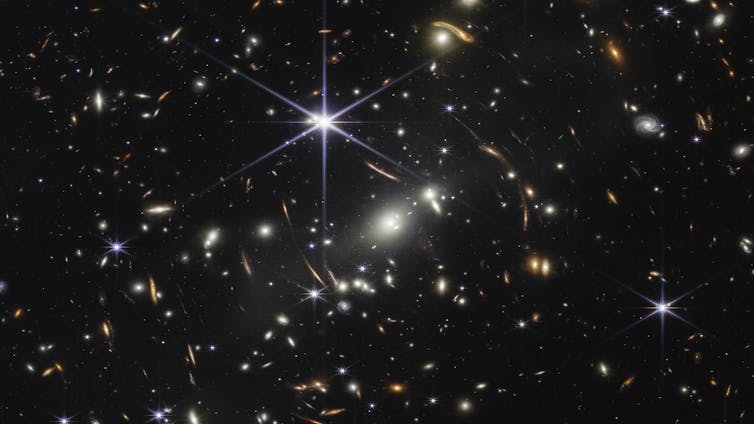
NASA’s James Webb Space Telescope has spotted some potential dark star candidates. NASA, ESA, CSA, and STScIAlexey A. Petrov, University of South Carolina Scientists working with the James Webb Space Telescope discovered three unusual astronomical objects in early 2025, which may be examples of dark stars. The concept of dark stars has existed for some time and could alter scientists’ understanding of how ordinary stars form. However, their name is somewhat misleading. “Dark stars” is one of those unfortunate names that, on the surface, does not accurately describe the objects it represents. Dark stars are not exactly stars, and they are certainly not dark. Still, the name captures the essence of this phenomenon. The “dark” in the name refers not to how bright these objects are, but to the process that makes them shine — driven by a mysterious substance called dark matter. The sheer size of these objects makes it difficult to classify them as stars. As a physicist, I’ve been fascinated by dark matter, and I’ve been trying to find a way to see its traces using particle accelerators. I’m curious whether dark stars could provide an alternative method to find dark matter.
What makes dark matter dark?
Dark matter, which makes up approximately 27% of the universe but cannot be directly observed, is a key idea behind the phenomenon of dark stars. Astrophysicists have studied this mysterious substance for nearly a century, yet we haven’t seen any direct evidence of it besides its gravitational effects. So, what makes dark matter dark?Despite physicists not knowing much about it, dark matter makes up around 27% of the universe.Visual Capitalist/Science Photo Library via Getty Images Humans primarily observe the universe by detecting electromagnetic waves emitted by or reflected off various objects. For instance, the Moon is visible to the naked eye because it reflects sunlight. Atoms on the Moon’s surface absorb photons – the particles of light – sent from the Sun, causing electrons within atoms to move and send some of that light toward us. More advanced telescopes detect electromagnetic waves beyond the visible spectrum, such as ultraviolet, infrared or radio waves. They use the same principle: Electrically charged components of atoms react to these electromagnetic waves. But how can they detect a substance – dark matter – that not only has no electric charge but also has no electrically charged components? Although scientists don’t know the exact nature of dark matter, many models suggest that it is made up of electrically neutral particles – those without an electric charge. This trait makes it impossible to observe dark matter in the same way that we observe ordinary matter. Dark matter is thought to be made of particles that are their own antiparticles. Antiparticles are the “mirror” versions of particles. They have the same mass but opposite electric charge and other properties. When a particle encounters its antiparticle, the two annihilate each other in a burst of energy. If dark matter particles are their own antiparticles, they would annihilate upon colliding with each other, potentially releasing large amounts of energy. Scientists predict that this process plays a key role in the formation of dark stars, as long as the density of dark matter particles inside these stars is sufficiently high. The dark matter density determines how often dark matter particles encounter, and annihilate, each other. If the dark matter density inside dark stars is high, they would annihilate frequently.
What makes a dark star shine?
The concept of dark stars stems from a fundamental yet unresolved question in astrophysics: How do stars form? In the widely accepted view, clouds of primordial hydrogen and helium — the chemical elements formed in the first minutes after the Big Bang, approximately 13.8 billion years ago — collapsed under gravity. They heated up and initiated nuclear fusion, which formed heavier elements from the hydrogen and helium. This process led to the formation of the first generation of stars.Stars form when clouds of dust collapse inward and condense around a small, bright, dense core.NASA, ESA, CSA, and STScI, J. DePasquale (STScI), CC BY-ND In the standard view of star formation, dark matter is seen as a passive element that merely exerts a gravitational pull on everything around it, including primordial hydrogen and helium. But what if dark matter had a more active role in the process? That’s exactly the question a group of astrophysicists raised in 2008. In the dense environment of the early universe, dark matter particles would collide with, and annihilate, each other, releasing energy in the process. This energy could heat the hydrogen and helium gas, preventing it from further collapse and delaying, or even preventing, the typical ignition of nuclear fusion. The outcome would be a starlike object — but one powered by dark matter heating instead of fusion. Unlike regular stars, these dark stars might live much longer because they would continue to shine as long as they attracted dark matter. This trait would make them distinct from ordinary stars, as their cooler temperature would result in lower emissions of various particles.
Can we observe dark stars?
Several unique characteristics help astronomers identify potential dark stars. First, these objects must be very old. As the universe expands, the frequency of light coming from objects far away from Earth decreases, shifting toward the infrared end of the electromagnetic spectrum, meaning it gets “redshifted.” The oldest objects appear the most redshifted to observers. Since dark stars form from primordial hydrogen and helium, they are expected to contain little to no heavier elements, such as oxygen. They would be very large and cooler on the surface, yet highly luminous because their size — and the surface area emitting light — compensates for their lower surface brightness. They are also expected to be enormous, with radii of about tens of astronomical units — a cosmic distance measurement equal to the average distance between Earth and the Sun. Some supermassive dark stars are theorized to reach masses of roughly 10,000 to 10 million times that of the Sun, depending on how much dark matter and hydrogen or helium gas they can accumulate during their growth. So, have astronomers observed dark stars? Possibly. Data from the James Webb Space Telescope has revealed some very high-redshift objects that seem brighter — and possibly more massive — than what scientists expect of typical early galaxies or stars. These results have led some researchers to propose that dark stars might explain these objects.The James Webb Space Telescope, shown in this illustration, detects light coming from objects in the universe.Northrup Grumman/NASA In particular, a recent study analyzing James Webb Space Telescope data identified three candidates consistent with supermassive dark star models. Researchers looked at how much helium these objects contained to identify them. Since it is dark matter annihilation that heats up those dark stars, rather than nuclear fusion turning helium into heavier elements, dark stars should have more helium. The researchers highlight that one of these objects indeed exhibited a potential “smoking gun” helium absorption signature: a far higher helium abundance than one would expect in typical early galaxies.
Dark stars may explain early black holes
What happens when a dark star runs out of dark matter? It depends on the size of the dark star. For the lightest dark stars, the depletion of dark matter would mean gravity compresses the remaining hydrogen, igniting nuclear fusion. In this case, the dark star would eventually become an ordinary star, so some stars may have begun as dark stars. Supermassive dark stars are even more intriguing. At the end of their lifespan, a dead supermassive dark star would collapse directly into a black hole. This black hole could start the formation of a supermassive black hole, like the kind astronomers observe at the centers of galaxies, including our own Milky Way. Dark stars might also explain how supermassive black holes formed in the early universe. They could shed light on some unique black holes observed by astronomers. For example, a black hole in the galaxy UHZ-1 has a mass approaching 10 million solar masses, and is very old – it formed just 500 million years after the Big Bang. Traditional models struggle to explain how such massive black holes could form so quickly. The idea of dark stars is not universally accepted. These dark star candidates might still turn out just to be unusual galaxies. Some astrophysicists argue that matter accretion — a process in which massive objects pull in surrounding matter — alone can produce massive stars, and that studies using observations from the James Webb telescope cannot distinguish between massive ordinary stars and less dense, cooler dark stars. Researchers emphasize that they will need more observational data and theoretical advancements to solve this mystery. Alexey A. Petrov, Professor of physics and astronomy, University of South Carolina This article is republished from The Conversation under a Creative Commons license. Read the original article.
NASA goes on an ESCAPADE – twin small, low-cost orbiters will examine Mars’ atmosphere
NASA’s ESCAPADE mission launched two small, affordable orbiters to Mars on Blue Origin’s New Glenn rocket. Discover how these twin spacecraft will study Mars’ atmosphere, test new trajectories, and usher in a new era of rapid, low-cost space exploration.
NASA goes on an ESCAPADE – twin small, low-cost orbiters will examine Mars’ atmosphere
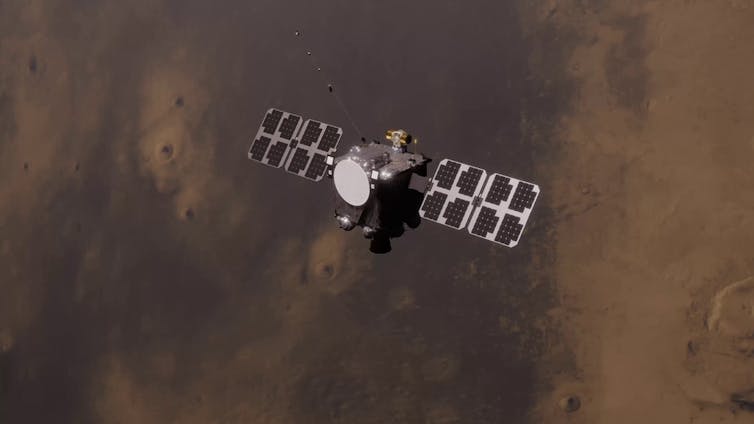
Christopher Carr, Georgia Institute of Technology and Glenn Lightsey, Georgia Institute of Technology Envision a time when hundreds of spacecraft are exploring the solar system and beyond. That’s the future that NASA’s ESCAPADE, or Escape and Plasma Acceleration and Dynamics Explorers, mission will help unleash: one where small, low-cost spacecraft enable researchers to learn rapidly, iterate, and advance technology and science. The ESCAPADE mission launched on Nov. 13, 2025 on a Blue Origin New Glenn rocket, sending two small orbiters to Mars to study its atmosphere. As aerospace engineers, we’re excited about this mission because not only will it do great science while advancing the deep space capabilities of small spacecraft, but it also will travel to the red planet on an innovative new trajectory. The ESCAPADE mission is actually two spacecraft instead of one. Two identical spacecraft will take simultaneous measurements, resulting in better science. These spacecraft are smaller than those used in the past, each about the size of a copy machine, partly enabled by an ongoing miniaturization trend in the space industry. Doing more with less is very important for space exploration, because it typically takes most of the mass of a spacecraft simply to transport it where you want it to go.The ESCAPADE mission logo shows the twin orbiters.TRAX International/Kristen Perrin Having two spacecraft also acts as an insurance policy in case one of them doesn’t work as planned. Even if one completely fails, researchers can still do science with a single working spacecraft. This redundancy enables each spacecraft to be built more affordably than in the past, because the copies allow for more acceptance of risk.
Space is not a friendly place. Most of it is a vacuum – that is, mostly empty, without the gas molecules that create pressure and allow you to breathe or transfer heat. These molecules keep things from getting too hot or too cold. In space, with no pressure, a spacecraft can easily get too hot or too cold, depending on whether it is in sunlight or in shadow. In addition, the Sun and other, farther astronomical objects emit radiation that living things do not experience on Earth. Earth’s magnetic field protects you from the worst of this radiation. So when humans or our robotic representatives leave the Earth, our spacecraft must survive in this extreme environment not present on Earth. ESCAPADE will overcome these challenges with a shoestring budget totaling US$80 million. That is a lot of money, but for a mission to another planet it is inexpensive. It has kept costs low by leveraging commercial technologies for deep space exploration, which is now possible because of prior investments in fundamental research. For example, the GRAIL mission, launched in 2011, previously used two spacecraft, Ebb and Flow, to map the Moon’s gravity fields. ESCAPADE takes this concept to another world, Mars, and costs a fraction as much as GRAIL. Led by Rob Lillis of UC Berkeley’s Space Sciences Laboratory, this collaboration between spacecraft builders Rocket Lab, trajectory specialists Advanced Space LLC and launch provider Blue Origin – all commercial partners funded by NASA – aims to show that deep space exploration is now faster, more agile and more affordable than ever before.NASA’s ESCAPADE represents a partnership between a university, commercial companies and the government.
How will ESCAPADE get to Mars?
ESCAPADE will also use a new trajectory to get to Mars. Imagine being an archer in the Olympics. To hit a bull’s-eye, you have to shoot an arrow through a 15-inch – 40-centimeter – circle from a distance of 300 feet, or 90 meters. Now imagine the bull’s-eye represents Mars. To hit it from Earth, you would have to shoot an arrow through the same 15-inch bull’s-eye at a distance of over 13 miles, or 22 kilometers. You would also have to shoot the arrow in a curved path so that it goes around the Sun. Not only that, but Mars won’t be at the bull’s-eye at the time you shoot the arrow. You must shoot for the spot that Mars will be in 10 months from now. This is the problem that the ESCAPADE mission designers faced. What is amazing is that the physical laws and forces of nature are so predictable that this was not even the hardest problem to solve for the ESCAPADE mission. It takes energy to get from one place to another. To go from Earth to Mars, a spacecraft has to carry the energy it needs, in the form of rocket fuel, much like gasoline in a car. As a result, a high percentage of the total launch mass has to be fuel for the trip. When going to Mars orbit from Earth orbit, as much as 80% to 85% of the spacecraft mass has to be propellant, which means not much mass is dedicated to the part of the spacecraft that does all the experiments. This issue makes it important to pack as much capability into the rest of the spacecraft as possible. For ESCAPADE, the propellant is only about 65% of the spacecraft’s mass. ESCAPADE’s route is particularly fuel-efficient. First, Blue and Gold will go to the L2 Lagrange point, one of five places where gravitational forces of the Sun and Earth cancel out. Then, after about a year, during which they will collect data monitoring the Sun, they will fly by the Earth, using its gravitational field to get a boost. This way, they will arrive at Mars in about 10 more months. This new approach has another advantage beyond needing to carry less fuel: Trips from Earth to Mars are typically favorable to save fuel about every 26 months due to the two planets’ relative positions. However, this new trajectory makes the departure time more flexible. Future cargo and human missions could use a similar trajectory to have more frequent and less time-constrained trips to Mars. ESCAPADE is a testament to a new era in spaceflight. For a new generation of scientists and engineers, ESCAPADE is not just a mission – it is a blueprint for a new collaborative era of exploration and discovery. This article was updated on Nov. 13, 2025 to reflect the ESCAPADE launch’s date and success.Christopher Carr, Assistant Professor of Aerospace Engineering, Georgia Institute of Technology and Glenn Lightsey, Professor of Space Systems Technology, Georgia Institute of Technology This article is republished from The Conversation under a Creative Commons license. Read the original article.
Where Is Most Normal Matter in the Universe? Astronomers Map the Invisible
Most normal matter in the universe isn’t found in stars or planets. Discover how astronomers traced it to the cosmic web between galaxies using fast radio bursts and what this means for our understanding of the cosmos.
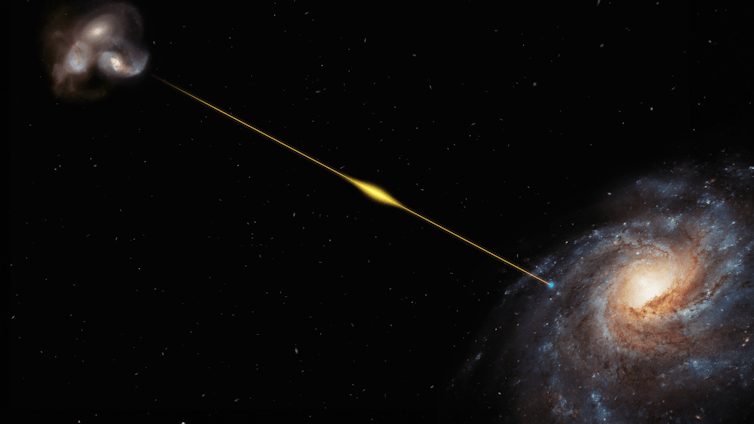
Mysterious blasts of radio waves from across the universe called fast radio bursts help astronomers catalog matter. ESO/M. Kornmesser, CC BY-SA
Most normal matter in the universe isn’t found in planets, stars or galaxies – an astronomer explains where it’s distributed
Chris Impey, University of Arizona If you look across space with a telescope, you’ll see countless galaxies, most of which host large central black holes, billions of stars and their attendant planets. The universe teems with huge, spectacular objects, and it might seem like these massive objects should hold most of the universe’s matter. But the Big Bang theory predicts that about 5% of the universe’s contents should be atoms made of protons, neutrons and electrons. Most of those atoms cannot be found in stars and galaxies – a discrepancy that has puzzled astronomers. If not in visible stars and galaxies, the most likely hiding place for the matter is in the dark space between galaxies. While space is often referred to as a vacuum, it isn’t completely empty. Individual particles and atoms are dispersed throughout the space between stars and galaxies, forming a dark, filamentary network called the “cosmic web.” Throughout my career as an astronomer, I’ve studied this cosmic web, and I know how difficult it is to account for the matter spread throughout space. In a study published in June 2025, a team of scientists used a unique radio technique to complete the census of normal matter in the universe.
The census of normal matter
The most obvious place to look for normal matter is in the form of stars. Gravity gathers stars together into galaxies, and astronomers can count galaxies throughout the observable universe. The census comes to several hundred billion galaxies, each made of several hundred billion stars. The numbers are uncertain because many stars lurk outside of galaxies. That’s an estimated 1023 stars in the universe, or hundreds of times more than the number of sand grains on all of Earth’s beaches. There are an estimated 1082 atoms in the universe. However, this prodigious number falls far short of accounting for all the matter predicted by the Big Bang. Careful accounting indicates that stars contain only 0.5% of the matter in the universe. Ten times more atoms are presumably floating freely in space. Just 0.03% of the matter is elements other than hydrogen and helium, including carbon and all the building blocks of life.
Looking between galaxies
The intergalactic medium – the space between galaxies – is near-total vacuum, with a density of one atom per cubic meter, or one atom every 35 cubic feet. That’s less than a billionth of a billionth of the density of air on Earth. Even at this very low density, this diffuse medium adds up to a lot of matter, given the enormous, 92-billion-light-year diameter of the universe. The intergalactic medium is very hot, with a temperature of millions of degrees. That makes it difficult to observe except with X-ray telescopes, since very hot gas radiates out through the universe at very short X-ray wavelengths. X-ray telescopes have limited sensitivity because they are smaller than most optical telescopes.
Deploying a new tool
Astronomers recently used a new tool to solve this missing matter problem. Fast radio bursts are intense blasts of radio waves that can put out as much energy in a millisecond as the Sun puts out in three days. First discovered in 2007, scientists found that the bursts are caused by compact stellar remnants in distant galaxies. Their energy peters out as the bursts travel through space, and by the time that energy reaches the Earth, it is a thousand times weaker than a mobile phone signal would be if emitted on the Moon, then detected on Earth. Research from early 2025 suggests the source of the bursts is the highly magnetic region around an ultra-compact neutron star. Neutron stars are incredibly dense remnants of massive stars that have collapsed under their own gravity after a supernova explosion. The particular type of neutron star that emits radio bursts is called a magnetar, with a magnetic field a thousand trillion times stronger than the Earth’s.A magnetar is a rare type of neutron star with an extremely strong magnetic field.ESO/L. Calçada, CC BY-ND Even though astronomers don’t fully understand fast radio bursts, they can use them to probe the spaces between galaxies. As the bursts travel through space, interactions with electrons in the hot intergalactic gas preferentially slow down longer wavelengths. The radio signal is spread out, analogous to the way a prism turns sunlight into a rainbow. Astronomers use the amount of spreading to calculate how much gas the burst has passed through on its way to Earth.
Puzzle solved
In the new study, published in June 2025, a team of astronomers from Caltech and the Harvard Center for Astrophysics studied 69 fast radio bursts using an array of 110 radio telescopes in California. The team found that 76% of the universe’s normal matter lies in the space between galaxies, with another 15% in galaxy halos – the area surrounding the visible stars in a galaxy – and the remaining 9% in stars and cold gas within galaxies. The complete accounting of normal matter in the universe provides a strong affirmation of the Big Bang theory. The theory predicts the abundance of normal matter formed in the first few minutes of the universe, so by recovering the predicted 5%, the theory passes a critical test. Several thousand fast radio bursts have already been observed, and an upcoming array of radio telescopes will likely increase the discovery rate to 10,000 per year. Such a large sample will let fast radio bursts become powerful tools for cosmology. Cosmology is the study of the size, shape and evolution of the universe. Radio bursts could go beyond counting atoms to mapping the three-dimensional structure of the cosmic web.
Pie chart of the universe
Scientists may now have the complete picture of where normal matter is distributed, but most of the universe is still made up of stuff they don’t fully understand. The most abundant ingredients in the universe are dark matter and dark energy, both of which are poorly understood. Dark energy is causing the accelerating expansion of the universe, and dark matter is the invisible glue that holds galaxies and the universe together.Despite physicists not knowing much about it, dark matter makes up around 27% of the universe.Visual Capitalist/Science Photo Library via Getty Images Dark matter is probably a previously unstudied type of fundamental particle that is not part of the standard model of particle physics. Physicists haven’t been able to detect this novel particle yet, but we know it exists because, according to general relativity, mass bends light, and far more gravitational lensing is seen than can be explained by visible matter. With gravitational lensing, a cluster of galaxies bends and magnifies light in a way that’s analogous to an optical lens. Dark matter outweighs conventional matter by more than a factor of five. One mystery may be solved, but a larger mystery remains. While dark matter is still enigmatic, we now know a lot about the normal atoms making up us as humans, and the world around us.
Most normal matter in the universe isn’t found in planets, stars or galaxies – an astronomer explains where it’s distributed
The science section of our news blog STM Daily News provides readers with captivating and up-to-date information on the latest scientific discoveries, breakthroughs, and innovations across various fields. We offer engaging and accessible content, ensuring that readers with different levels of scientific knowledge can stay informed. Whether it’s exploring advancements in medicine, astronomy, technology, or environmental sciences, our science section strives to shed light on the intriguing world of scientific exploration and its profound impact on our daily lives. From thought-provoking articles to informative interviews with experts in the field, STM Daily News Science offers a harmonious blend of factual reporting, analysis, and exploration, making it a go-to source for science enthusiasts and curious minds alike. https://stmdailynews.com/category/science/