Connect with us

astronomy

NASA goes on an ESCAPADE – twin small, low-cost orbiters will examine Mars’ atmosphere

NASA’s ESCAPADE mission launched two small, affordable orbiters to Mars on Blue Origin’s New Glenn rocket. Discover how these twin spacecraft will study Mars’ atmosphere, test new trajectories, and usher in a new era of rapid, low-cost space exploration.

Published

on

NASA’s ESCAPADE mission launched two small, affordable orbiters to Mars on Blue Origin’s New Glenn rocket. Discover how these twin spacecraft will study Mars’ atmosphere, test new trajectories, and usher in a new era of rapid, low-cost space exploration.
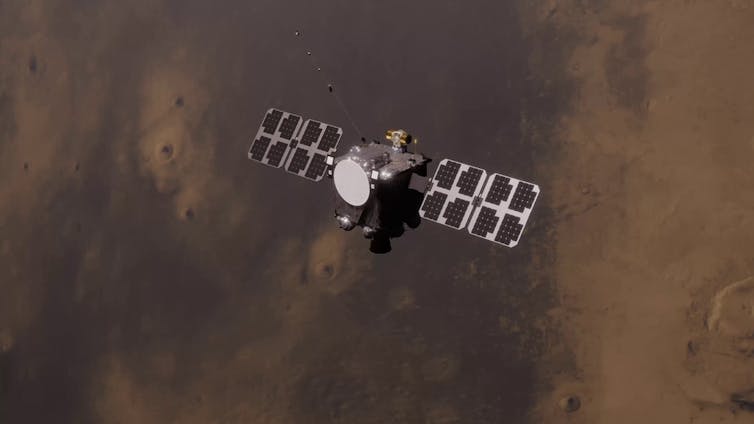
This close-up illustration shows what one of the twin ESCAPADE spacecraft will look like conducting its science operations.
James Rattray/Rocket Lab USA/Goddard Space Flight Center

NASA goes on an ESCAPADE – twin small, low-cost orbiters will examine Mars’ atmosphere

Christopher Carr, Georgia Institute of Technology and Glenn Lightsey, Georgia Institute of Technology

Envision a time when hundreds of spacecraft are exploring the solar system and beyond. That’s the future that NASA’s ESCAPADE, or Escape and Plasma Acceleration and Dynamics Explorers, mission will help unleash: one where small, low-cost spacecraft enable researchers to learn rapidly, iterate, and advance technology and science.

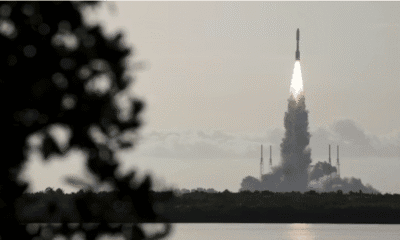
The ESCAPADE mission launched on Nov. 13, 2025 on a Blue Origin New Glenn rocket, sending two small orbiters to Mars to study its atmosphere. As aerospace engineers, we’re excited about this mission because not only will it do great science while advancing the deep space capabilities of small spacecraft, but it also will travel to the red planet on an innovative new trajectory.

The ESCAPADE mission is actually two spacecraft instead of one. Two identical spacecraft will take simultaneous measurements, resulting in better science. These spacecraft are smaller than those used in the past, each about the size of a copy machine, partly enabled by an ongoing miniaturization trend in the space industry. Doing more with less is very important for space exploration, because it typically takes most of the mass of a spacecraft simply to transport it where you want it to go.

A patch with a drawing of two spacecraft, one behind the other, on a red background and the ESCAPADE mission title.
The ESCAPADE mission logo shows the twin orbiters.
TRAX International/Kristen Perrin

Having two spacecraft also acts as an insurance policy in case one of them doesn’t work as planned. Even if one completely fails, researchers can still do science with a single working spacecraft. This redundancy enables each spacecraft to be built more affordably than in the past, because the copies allow for more acceptance of risk.

Studying Mars’ history

Long before the ESCAPADE twin spacecraft Blue and Gold were ready to go to space – billions of years ago, to be more precise – Mars had a much thicker atmosphere than it does now. This atmosphere would have enabled liquids to flow on its surface, creating the channels and gullies that scientists can still observe today.

But where did the bulk of this atmosphere go? Its loss turned Mars into the cold and dry world it is today, with a surface air pressure less than 1% of Earth’s.

Mars also once had a magnetic field, like Earth’s, that helped to shield its atmosphere. That atmosphere and magnetic field would have been critical to any life that might have existed on early Mars.

A view of Mars' crater-flecked surface from above.
Today, Mars’ atmosphere is very thin. Billions of years ago, it was much thicker.
©UAESA/MBRSC/HopeMarsMission/EXI/AndreaLuck, CC BY-ND

ESCAPADE will measure remnants of this magnetic field that have been preserved by ancient rock and study the flow and energy of Mars’ atmosphere and how it interacts with the solar wind, the stream of particles that the sun emits along with light. These measurements will help to reveal where the atmosphere went and how quickly Mars is still losing it today.

Weathering space on a budget

Space is not a friendly place. Most of it is a vacuum – that is, mostly empty, without the gas molecules that create pressure and allow you to breathe or transfer heat. These molecules keep things from getting too hot or too cold. In space, with no pressure, a spacecraft can easily get too hot or too cold, depending on whether it is in sunlight or in shadow.

In addition, the Sun and other, farther astronomical objects emit radiation that living things do not experience on Earth. Earth’s magnetic field protects you from the worst of this radiation. So when humans or our robotic representatives leave the Earth, our spacecraft must survive in this extreme environment not present on Earth.

ESCAPADE will overcome these challenges with a shoestring budget totaling US$80 million. That is a lot of money, but for a mission to another planet it is inexpensive. It has kept costs low by leveraging commercial technologies for deep space exploration, which is now possible because of prior investments in fundamental research.

For example, the GRAIL mission, launched in 2011, previously used two spacecraft, Ebb and Flow, to map the Moon’s gravity fields. ESCAPADE takes this concept to another world, Mars, and costs a fraction as much as GRAIL.

Advertisement
Get More From A Face Cleanser And Spa-like Massage

Led by Rob Lillis of UC Berkeley’s Space Sciences Laboratory, this collaboration between spacecraft builders Rocket Lab, trajectory specialists Advanced Space LLC and launch provider Blue Origin – all commercial partners funded by NASA – aims to show that deep space exploration is now faster, more agile and more affordable than ever before.

NASA’s ESCAPADE represents a partnership between a university, commercial companies and the government.

How will ESCAPADE get to Mars?

ESCAPADE will also use a new trajectory to get to Mars. Imagine being an archer in the Olympics. To hit a bull’s-eye, you have to shoot an arrow through a 15-inch – 40-centimeter – circle from a distance of 300 feet, or 90 meters. Now imagine the bull’s-eye represents Mars. To hit it from Earth, you would have to shoot an arrow through the same 15-inch bull’s-eye at a distance of over 13 miles, or 22 kilometers. You would also have to shoot the arrow in a curved path so that it goes around the Sun.

Not only that, but Mars won’t be at the bull’s-eye at the time you shoot the arrow. You must shoot for the spot that Mars will be in 10 months from now. This is the problem that the ESCAPADE mission designers faced. What is amazing is that the physical laws and forces of nature are so predictable that this was not even the hardest problem to solve for the ESCAPADE mission.

It takes energy to get from one place to another. To go from Earth to Mars, a spacecraft has to carry the energy it needs, in the form of rocket fuel, much like gasoline in a car. As a result, a high percentage of the total launch mass has to be fuel for the trip.

When going to Mars orbit from Earth orbit, as much as 80% to 85% of the spacecraft mass has to be propellant, which means not much mass is dedicated to the part of the spacecraft that does all the experiments. This issue makes it important to pack as much capability into the rest of the spacecraft as possible. For ESCAPADE, the propellant is only about 65% of the spacecraft’s mass.

ESCAPADE’s route is particularly fuel-efficient. First, Blue and Gold will go to the L2 Lagrange point, one of five places where gravitational forces of the Sun and Earth cancel out. Then, after about a year, during which they will collect data monitoring the Sun, they will fly by the Earth, using its gravitational field to get a boost. This way, they will arrive at Mars in about 10 more months.

This new approach has another advantage beyond needing to carry less fuel: Trips from Earth to Mars are typically favorable to save fuel about every 26 months due to the two planets’ relative positions. However, this new trajectory makes the departure time more flexible. Future cargo and human missions could use a similar trajectory to have more frequent and less time-constrained trips to Mars.

ESCAPADE is a testament to a new era in spaceflight. For a new generation of scientists and engineers, ESCAPADE is not just a mission – it is a blueprint for a new collaborative era of exploration and discovery.

This article was updated on Nov. 13, 2025 to reflect the ESCAPADE launch’s date and success.

Christopher Carr, Assistant Professor of Aerospace Engineering, Georgia Institute of Technology and Glenn Lightsey, Professor of Space Systems Technology, Georgia Institute of Technology

Advertisement
Get More From A Face Cleanser And Spa-like Massage

This article is republished from The Conversation under a Creative Commons license. Read the original article.


Space Force Faces New Challenge: Tracking Debris from Intelsat 33e Breakdown

Link: https://stmdailynews.com/space-force-faces-new-challenge-tracking-debris-from-intelsat-33e-breakdown/

Science

Seeing an eclipse from Earth is awe‑inspiring – for astronauts seeing one from space, the scene was even more grand

Discover the stunning eclipse seen by Artemis II astronauts during their 2026 Moon mission. A truly extraordinary spectacle awaits.

Published

on

Seeing an eclipse from Earth is awe‑inspiring – for astronauts seeing one from space, the scene was even more grand
During a total solar eclipse, the Sun is barely visible behind the Moon. Roger Sorensen

Deana L. Weibel, Grand Valley State University

The astronauts on Artemis II’s trip to the Moon in April 2026 didn’t just have an amazing journey through space. They also saw something extraordinary. They were the first humans to see a total solar eclipse from space.

A solar eclipse happens when the Moon moves in front of the Sun. In a total eclipse, the Sun’s central disc is covered completely.

From Earth, the circle of the Sun is about the same size as the circle of the Moon. With the bright circle blocked, you can see the undulating rays of the Sun’s corona, or outer atmosphere, that are normally too dim to be observed.

Moon covering most, then all, then most of the Sun
Composite image of moments before, during and after totality. NASA/Aubrey Gemignani

I’m a cultural anthropologist who studies awe-inspiring aspects of space exploration. I have been lucky enough to have seen two total solar eclipses. The first one was in Nebraska in 2017, the second in Indiana in 2024.

During my second total eclipse, the period of totality – that short span when you can remove your protective glasses and look directly at the eclipse – lasted close to 4 minutes. I saw waves of diffuse light snaking around an ink-black hole in the sky. It looked very wrong – almost alien.

On Aug. 12, 2026, there will be another total solar eclipse, visible only from Greenland, Iceland, Spain and the Balearic Islands of the Mediterranean. Some fortunate viewers in Spain and nearby islands may see the eclipse just before sunset, low on the horizon. The Moon illusion, a phenomenon where the Moon looks bigger when it’s near the horizon, might make this eclipse look unusually large.

Unusual eclipse perspectives

Astronauts will occasionally also have less common eclipse experiences. I interviewed one I call by the pseudonym “Jackie” in my research about astronauts’ experiences of awe. She was part of an astronaut training group that did a flight exercise during a total solar eclipse.

Jackie and her squad flew their jets in the shadow of the Moon. This lengthened their time in totality because they could follow and stay within the shadow. Jackie was most impressed with how the Sun’s corona seemed to shift and ripple.

“It’s not static … it’s alive,” she told me.

On April 6, 2026, the astronauts of NASA’s Artemis II mission saw another kind of unusual eclipse as they flew around the Moon. At one point during their flight, the Moon and the spacecraft aligned so that the Moon was directly between them and the Sun, blocking the Sun’s disk in a way that looks very different from what we see on Earth.

Astronaut Victor Glover said it felt like they “just went sci-fi.” https://www.youtube.com/embed/YLjPci5bo1k?wmode=transparent&start=0 ‘An impressive sight’: The Artemis II crew were the first humans to observe a solar eclipse from near the Moon.

Advertisement
Get More From A Face Cleanser And Spa-like Massage

The astronauts were so close to the Moon that the Moon looked bigger than the Sun and hid more of its bright circle. Earth was also in view, and sunlight reflected from the Earth onto the Moon in a phenomenon NASA calls “earthshine.” This dim light is very similar to the moonlight that shines on the Earth at night.

Imagine the Sun hidden behind the Moon, creating a hazy halo around the Moon’s edges. At the same time, faint light reflected from Earth softly illuminates the Moon, revealing mountains and craters in a dim twilight. Now imagine this striking scene lasting 54 minutes.

This sight was, without a doubt, one of the most unusual eclipses ever seen by human eyes.

Although Artemis’ astronauts are trained to think scientifically, this experience propelled them into a state of awe. They talked openly about how their brains were “not processing” what they observed. While NASA kept them busy with a variety of tasks, the sound of emotion and excitement in their voices as they broadcast live from their lunar flyby was unmistakable.

An eclipse visible from space - the Moon is shown shadowed with some sunlight visible behind it, and part of the Orion capsule shown off to the left.
The Moon during a solar eclipse on April 6, 2026, photographed by one of the Orion spacecraft’s cameras during Artemis II. Earth is reflecting sunlight at the left edge of the Moon, called ‘earthshine.’ NASA

The psychology of awe

Researchers have studied the effects of awe on the human brain, including awe felt during solar eclipses. Moments of wonder like these can transform how you feel and even how you think, making you more thoughtful and open-minded.

In my own work I’ve found these experiences can change how astronauts understand their own place in the universe.

One astronaut said she gained an awareness of the fragility of our planet that now shapes everything she does, while another described becoming more curious after returning to Earth. A third said the awe he experienced in lunar orbit changed his understanding of time and infinity.

Space travel creates many opportunities for awe, but a solar eclipse from behind the Moon, as Mission Commander Reid Wiseman put it, required “20 new superlatives.”

It’s an experience most of the earthbound eclipse-chasers heading to Greenland or Iceland or Spain this summer will only dream about. Whether eclipses happen in space or on Earth, though, close encounters with the grandeur of our universe can make you feel profoundly human.

Deana L. Weibel, Professor of Anthropology, Grand Valley State University

Advertisement
Get More From A Face Cleanser And Spa-like Massage

This article is republished from The Conversation under a Creative Commons license. Read the original article.

Dive into “The Knowledge,” where curiosity meets clarity. This playlist, in collaboration with STMDailyNews.com, is designed for viewers who value historical accuracy and insightful learning. Our short videos, ranging from 30 seconds to a minute and a half, make complex subjects easy to grasp in no time. Covering everything from historical events to contemporary processes and entertainment, “The Knowledge” bridges the past with the present. In a world where information is abundant yet often misused, our series aims to guide you through the noise, preserving vital knowledge and truths that shape our lives today. Perfect for curious minds eager to discover the ‘why’ and ‘how’ of everything around us. Subscribe and join in as we explore the facts that matter.  https://stmdailynews.com/the-knowledge/

View recent photos

Unlock fun facts & lost history—get The Knowledge in your inbox!

We don’t spam! Read our privacy policy for more info.

Continue Reading

Science

After the Blood Moon: Scientists and Skywatchers React to the March 3, 2026 Total Lunar Eclipse

The March 3, 2026 total lunar eclipse amazed skywatchers worldwide. Scientists and amateur astronomers share reactions and photos from the dramatic blood moon event.

Published

on

Last Updated on March 5, 2026 by Daily News Staff

Millions of people around the world looked to the sky in the early hours of March 3, 2026 to witness one of the most striking astronomical events of the year — a total lunar eclipse, often referred to as a “Blood Moon.” As the Moon passed completely into Earth’s shadow, it transformed from its familiar silver glow into a deep copper-red color, captivating observers from North America to Asia and across the Pacific.

AdobeStock 217349871


Blood Moon Aftermath: Scientists and Skywatchers React to the March 3, 2026 Total Lunar Eclipse

For viewers in the western United States, including Arizona and California, the eclipse occurred just before sunrise. The timing created a dramatic scene as the reddish Moon hovered low in the western sky while the eastern horizon began to brighten with dawn.

A Global Skywatching Event

Total lunar eclipses occur when the Sun, Earth, and Moon align so that Earth’s shadow completely covers the Moon. During the March 3 event, the Moon spent nearly an hour fully inside the darkest part of Earth’s shadow, known as the umbra. During this phase, sunlight filtered through Earth’s atmosphere projected reddish light onto the Moon’s surface, creating the dramatic “blood moon” effect.

Astronomers noted that the event was particularly significant because total lunar eclipses are relatively infrequent. While partial eclipses occur more often, a full eclipse visible across large portions of the globe remains a memorable experience for both scientists and casual observers.

Scientists Explain the Phenomenon

According to researchers at NASA, the reddish color seen during totality occurs because Earth’s atmosphere scatters shorter wavelengths of sunlight — such as blue — while allowing longer red wavelengths to pass through. This filtered light is then bent, or refracted, into Earth’s shadow and projected onto the Moon.

Planetary scientists say lunar eclipses provide a powerful visual demonstration of the geometry of the Earth–Moon–Sun system. The curved shadow moving across the Moon also historically served as one of the earliest pieces of evidence that Earth is spherical.

Researchers also point out that lunar eclipses offer opportunities to study Earth’s atmosphere. Variations in dust, volcanic particles, and atmospheric conditions can influence how dark or red the Moon appears during totality.

img 2221
Taken in North Phoenix around 5 AM MST March 3, 2026

Amateur Astronomers Share Their Views

While professional observatories monitored the eclipse with precision instruments, amateur astronomers and astrophotographers helped document the event from countless locations worldwide. Social media platforms and astronomy forums quickly filled with images showing the Moon’s color shifting from pale gray to orange and deep red.

Many skywatchers in the southwestern United States described the experience as particularly dramatic because the eclipse occurred just before moonset. Observers reported seeing the Moon glowing red above desert landscapes and city skylines before gradually fading into the brightening morning sky.

Astrophotographers also emphasized that lunar eclipses are among the easiest astronomical events to capture. Unlike solar eclipses, they can be photographed safely without special filters, making them accessible to beginners using smartphones as well as professionals using telescopes and high-end cameras.

Advertisement
Get More From A Face Cleanser And Spa-like Massage

A Rare Pre-Dawn Sight

In parts of the western United States, some observers were able to witness a rare atmospheric phenomenon known as a selenelion, when both the eclipsed Moon and the rising Sun appear in the sky at the same time due to atmospheric refraction. The effect added an unusual visual element to an already impressive celestial event.

The combination of a deep red Moon and the approaching dawn created striking photographic opportunities and memorable moments for early-morning skywatchers.

When Is the Next Total Lunar Eclipse?

Although partial eclipses occur periodically, the next widely visible total lunar eclipse will not occur until late 2028. That makes the March 2026 eclipse one of the most notable skywatching events of the decade.

For many observers, the event served as a reminder that some of the most spectacular astronomical experiences require nothing more than stepping outside, looking up, and taking a moment to appreciate the universe above.

References and Further Reading

Author

  • Rod Washington

    Rod: A creative force, blending words, images, and flavors. Blogger, writer, filmmaker, and photographer. Cooking enthusiast with a sci-fi vision. Passionate about his upcoming series and dedicated to TNC Network. Partnered with Rebecca Washington for a shared journey of love and art.

    View all posts
Continue Reading

Breaking News

🌕 Blood Moon Over Arizona: Total Lunar Eclipse Visible in Phoenix on March 3, 2026

Published

on

Last Updated on March 2, 2026 by Daily News Staff

Early risers in Arizona are in for a celestial show.

A total lunar eclipse will be visible in Phoenix on March 3, 2026. Here are exact viewing times, what to expect, and how to watch the Blood Moon in Arizona.

On Tuesday, March 3, 2026, a total lunar eclipse will be visible across much of North America — including Phoenixand the Valley. During this event, the Moon will pass completely into Earth’s shadow, turning a deep copper-red color often called a “Blood Moon.”

Here’s what you need to know.


Geometry of a Lunar Eclipse.svg
A schematic diagram of the shadow cast by Earth. Within the umbra, the central region, the planet totally shields direct sunlight. In contrast, within the penumbra, the outer portion, the sunlight is only partially blocked. SunMoon, and Earth sizes and distances between them not to scale.

🌍 What Is a Total Lunar Eclipse?

A total lunar eclipse happens when the Sun, Earth, and Moon align perfectly, with Earth positioned directly between the Sun and the Moon. As the Moon moves into Earth’s darkest shadow (the umbra), it doesn’t disappear — instead, it glows red.

That reddish color comes from sunlight filtering through Earth’s atmosphere — essentially, we’re seeing all the world’s sunrises and sunsets projected onto the Moon at once.


🕒 Phoenix Viewing Times (MST)

Arizona does not observe Daylight Saving Time in March, so these times are in Mountain Standard Time (MST).

  • 1:44 a.m. – Penumbral eclipse begins (subtle dimming begins)
  • 2:50 a.m. – Partial eclipse begins (Earth’s shadow becomes clearly visible)
  • 4:04 a.m. – Totality begins 🌕
  • 4:34 a.m. – Greatest eclipse
  • 5:03 a.m. – Totality ends
  • 6:18 a.m. – Partial eclipse ends
  • 7:20 a.m. – Penumbral eclipse ends
Lunar eclipse contact diagram.svg
Vectorised by User:Sushant savla from the work by Tomruen – File:Lunar eclipse contact diagram.png

The most dramatic portion — totality — lasts nearly one hour.


🌅 Where to Look in Phoenix

The eclipse happens in the pre-dawn hours, so the Moon will be low in the western sky as it sets.

For the best view:

  • Find a location with a clear western horizon
  • Avoid city light glare if possible
  • Consider desert viewpoints, parks, or elevated areas around the Valley

Because the Moon will be setting as the Sun begins to rise, the backdrop of early morning twilight could make for stunning photography.

AdobeStock 284042140

🔭 Do You Need Special Equipment?

No.

Unlike a solar eclipse, lunar eclipses are completely safe to view with the naked eye. However:

  • Binoculars enhance color detail
  • A small telescope reveals subtle shadow gradients
  • A tripod and DSLR or smartphone with night mode can capture impressive images

🌎 Why This Eclipse Matters

This will be one of the most accessible celestial events of 2026 for Arizona residents. Total lunar eclipses don’t happen every year in the same location, and the timing — just before sunrise — adds dramatic visual contrast.

If skies are clear, Phoenix could have a spectacular view.


📌 Quick Viewing Reminder for Phoenix

Set your alarm for around 3:45 a.m.

Advertisement
Get More From A Face Cleanser And Spa-like Massage

Step outside by 4:00 a.m.

Look west

Watch the Moon turn red

No tickets. No crowds. Just the sky putting on a show.


For more science, space, and Arizona skywatching coverage, visit STM Daily News.


Related Coverage

Author

Continue Reading

Trending