Connect with us

The Bridge

Harvard fights to keep enrolling international students – 4 essential reads about their broader impact

Published

on

Last Updated on June 2, 2025 by Rod Washington

international students
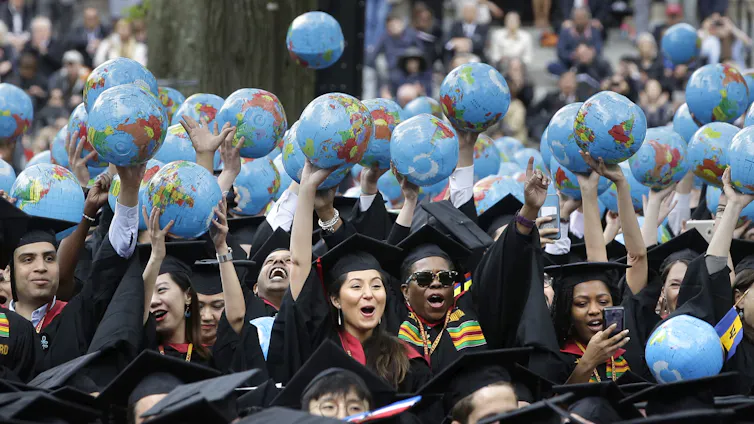
Graduates of Harvard’s John F. Kennedy School of Government celebrate during commencement exercises in Cambridge, Mass. AP Photo/Steven Senne, File
Corey Mitchell, The Conversation A federal judge in Boston on May 23, 2025, temporarily blocked a Trump administration order that would have revoked Harvard University’s authorization to enroll international students. The directive from the U.S. Department of Homeland Security and resulting lawsuit from Harvard have escalated the ongoing conflict between the Trump administration and the Ivy League institution. It’s also the latest step in a White House campaign to ramp up vetting and screening of foreign nationals, including students. Homeland Security officials accused Harvard of creating a hostile campus climate by accommodating “anti-American” and “pro-terrorist agitators.” The accusation stems from the university’s alleged support for certain political groups and their activities on campus. In early April, the Trump administration terminated the immigration statuses of thousands of international students listed in a government database, the Student and Exchange Visitor Information System. The database includes country of citizenship, which U.S. school they attend and what they study. Barring Harvard from enrolling international students could have significant implications for the campus’s climate and the local economy. International students account for 27% of the university’s enrollment. Here are four stories from The Conversation’s archive about the Trump administration’s battle with Harvard and the economic impact of international students.

1. A target on Harvard

This isn’t the first time the Trump administration has targeted the university. The White House has threatened to end the university’s tax-exempt status, and some media outlets have reported that the Internal Revenue Service is taking steps in that direction. But it is illegal to revoke an entity’s tax-emempt status “on a whim,” according to Philip Hackney, a University of Pittsburgh law professor, and Brian Mittendorf, an accounting professor at Ohio State University. “Before the IRS can do that, tax law requires that it first audit that charity,” they wrote. “And it’s illegal for U.S. presidents or other officials to force the IRS to conduct an audit or stop one that’s already begun.” Several U.S. senators, all Democrats, have urged the IRS inspector general to see whether the IRS has begun auditing Harvard or any nonprofits in response to the administration’s requests or whether Trump has violated any laws with his pressure campaign. Hackney and Mittendorf wrote that the Trump administration’s moves are part of a larger push to exert control over Harvard, including its efforts to increase its diversity and its response to claims of discrimination on campus.
Young people walk and bike along a paved road lined with red brick buildings on one side and trees on the other.
University of Michigan students on campus on April 3, 2025, in Ann Arbor, Mich. Bill Pugliano/Getty Images

2. International students help keep ‘America First’

The U.S. has long been the global leader in attracting international students. But competition for these students is increasing as other countries vie to attract the scholars. In a recent story for The Conversation, David L. Di Maria, vice provost for global engagement at the University of Maryland, Baltimore County, wrote that stepped-up screening and vetting of students could make the U.S. a less attractive study destination. Di Maria wrote that such efforts could hamper the Trump administration’s ability to achieve its “America First” priorities related to the economy, science and technology, and national security. Trump administration officials have emphasized the importance of recruiting top global talent. And Trump has said that international students who graduate from U.S. colleges should be awarded a green card with their degree. Research shows that international students launch successful startups at a rate that is eight to nine times higher than their U.S.-born peers. Roughly 25% of billion-dollar companies in the U.S. were founded by former international students, Di Maria noted.

3. A boost to local economies

Indeed, international students have a tremendous economic impact on local communities. If these global scholars stay home or go elsewhere, that’s bad economic news for cities and towns across the United States, wrote Barnet Sherman, a professor of multinational finance and trade at Boston University. With the money they spend on tuition, food, housing and other other items, international students pump money into the local economy, but there are additional benefits. On average, a new job is created for every three international students enrolled in a U.S. college or university. In the 2023-24 academic year, about 378,175 jobs were created, Sherman wrote. In Greater Boston, where Harvard is located, there are about 63,000 international students who contribute to the economy. The gains are huge – about US$3 billion.

4. Rising number of international students

The rising number of foreign students studying in the U.S. has long led to concerns about U.S. students being displaced by international peers. The unease is often fueled by the assumption that financial interests are driving the trend, Cynthia Miller-Idriss of American University and Bernhard Streitwieser of George Washington University wrote in a 2015 story for The Conversation. A common claim, they wrote, is the flawed assumption that “cash-strapped public universities” aggressively recruit more affluent students from abroad who can afford to pay rising tuition costs. The pair wrote that, historically, shifting demographics on college campuses result from social and economic changes. In today’s context, Miller-Idriss and Streitwieser maintain that the argument that colleges prioritize international students fails to account for the global role of U.S. universities, which help support national security, foster international development projects and accelerate the pace of globalization. This story is a roundup of articles from The Conversation’s archives. Corey Mitchell, Education Editor, The Conversation This article is republished from The Conversation under a Creative Commons license. Read the original article.

Discover more from Daily News

Subscribe to get the latest posts sent to your email.

Continue Reading
Advertisement Sports Research

STM Daily News

Chinamaxxing: The Viral Trend Turning Geopolitics Into Aesthetic Fantasy

A viral social media trend called “Chinamaxxing” is turning geopolitics into aesthetic comparison—revealing more about generational frustration than China itself.

Published

on

Chinamaxxing: Crowded subway station with train. A deep dive into “Chinamaxxing,” the viral social media trend blending aesthetics, politics, and generational disillusionment.

At first glance, the videos seem harmless enough.

Clean subways gliding into spotless stations. Neon skylines glowing at night. Clips of high-speed trains, cashless stores, orderly crowds. Overlaid text reads something like, “Meanwhile in China…” or “They figured it out.”

This is “Chinamaxxing,” a loosely defined but increasingly visible social media trend where mostly young users frame China as a model of efficiency, stability, and modernity—often in contrast to life in the West.

What makes the trend notable isn’t just its subject, but its tone. Chinamaxxing is rarely explicit political advocacy. It’s not a manifesto. It’s a mood. Aesthetic admiration blended with subtle critique, delivered through short, visually compelling clips that invite comparison without context.

And that’s precisely why it has sparked debate.

What Is “Chinamaxxing,” Really?

Despite the provocative name, Chinamaxxing isn’t a coordinated movement or ideology. It’s better understood as an algorithm-driven pattern—a recurring style of content that rewards certain visuals and emotional cues.

Most Chinamaxxing content emphasizes:

  • Infrastructure and urban design
  • Technology embedded in daily life
  • Perceived order and efficiency
  • Implicit contrast with Western dysfunction

What it typically omits:

  • Political repression and censorship
  • State surveillance
  • Limits on speech and dissent
  • The lived diversity of Chinese experiences

The result is a highly curated portrayal—less about China as a nation, and more about what viewers want to believe is possible somewhere else.

Why It’s Gaining Traction Now

The rise of Chinamaxxing says as much about the West as it does about China.

For many young users, particularly Gen Z, the backdrop is familiar: rising housing costs, student debt, healthcare anxiety, political polarization, and a growing sense that institutions no longer function as promised.

In that environment, visually persuasive content showing order and functionality carries emotional weight. It offers relief from chaos—real or perceived.

Social platforms amplify this effect. Short-form video rewards clarity, contrast, and immediacy. A clean subway platform communicates more in five seconds than a policy analysis ever could. Nuance does not trend well. Aesthetics do.

Advertisement
Get More From A Face Cleanser And Spa-like Massage

The Social and Political Criticism

Critics argue Chinamaxxing crosses a line from curiosity into distortion.

By focusing exclusively on infrastructure and surface-level efficiency, the trend risks:

  • Normalizing authoritarian governance through lifestyle framing
  • Reducing political systems to consumer experiences
  • Ignoring the tradeoffs that make such systems possible

Supporters counter that Western media has long flattened China into a single negative narrative, and that admiration for specific aspects of another society is not the same as endorsing its government.

Both perspectives, however, miss something important.

What the Trend Actually Reveals

Chinamaxxing isn’t primarily about China. It’s about disillusionment.

It reflects a generation that:

  • Feels let down by existing systems
  • Engages politics emotionally rather than institutionally
  • Uses visual culture to express dissatisfaction indirectly

In this context, China becomes a projection surface—not because it is perfect, but because it appears functional.

That distinction matters.

Why This Matters

Chinamaxxing highlights how political understanding is evolving in the digital age. Governance is increasingly consumed not through debate or civic participation, but through comparison clips, memes, and aesthetics.

The risk isn’t admiration. It’s oversimplification.

When complex societies are reduced to visuals alone, public discourse loses depth. But when those visuals resonate, they also signal real unmet needs: stability, competence, and trust in institutions.

Ignoring that signal would be a mistake.

Advertisement
Get More From A Face Cleanser And Spa-like Massage

The STM Daily News Perspective

Chinamaxxing is not an endorsement, a conspiracy, or a joke. It is a cultural artifact—one that reflects generational anxiety, algorithmic storytelling, and the widening gap between expectations and reality.

The question it raises isn’t whether China is better.

It’s why so many people feel their own systems are no longer working.

Related Reading


More on This Topic from STM Daily News

Stay tuned to STM Daily News for more stories exploring internet culture, social media trends, and how digital platforms shape public perception. We’ll be publishing in-depth pieces that break down the societal impact of viral phenomena like Chinamaxxing, the psychology behind online political trends, and the evolving language of Gen Z culture.

Want alerts? Be sure to subscribe to our newsletter for the latest insights and analysis.

Author

  • Rod Washington

    Rod: A creative force, blending words, images, and flavors. Blogger, writer, filmmaker, and photographer. Cooking enthusiast with a sci-fi vision. Passionate about his upcoming series and dedicated to TNC Network. Partnered with Rebecca Washington for a shared journey of love and art. View all posts

Want more stories 👋
“Your morning jolt of Inspiring & Interesting Stories!”

Sign up to receive awesome articles directly to your inbox.

STM Coffee Newsletter 1

We don’t spam! Read our privacy policy for more info.


Discover more from Daily News

Subscribe to get the latest posts sent to your email.

Continue Reading

Lifestyle

A Legacy of Service: How family stories shape service

Legacy of Service: Discover how military service creates lasting family legacies across generations. Explore powerful veteran stories from the Veterans History Project, including Pearl Harbor survivors and Code Talkers, and learn how to preserve your family’s service history.

Published

on

Last Updated on February 6, 2026 by Daily News Staff

A Legacy of Service: How family stories shape service

A Legacy of Service: How family stories shape service

(Family Features) Major historical events like war or military service make a lasting impact on family identity, values and traditions, often reverberating across multiple generations. Veterans frequently speak about their military units as if they were family, given the unbreakable bonds that develop between comrades. However, for some veterans, “brothers in arms” is more than a figurative turn of phrase. Throughout the 20th century, entire families felt the firsthand effects of war, with multiple generations serving. Brothers enlisted together. A father’s military legacy inspired his children to join up. Sweethearts met and married while in uniform. These stories not only illustrate the experiences of individual veterans but also provide an intimate glimpse into family legacies of military service. Consider the Veterans History Project, a program overseen by the Library of Congress, which collects and preserves the firsthand remembrances of U.S. military veterans and makes them accessible for future generations to better understand veterans’ service and sacrifice. These personal stories encompass original correspondence, memoirs, diaries, photographs and oral history interviews, all offering deeper insight into the long-term impact of military service. Veterans’ narratives are collected by volunteers, and anyone who served from World War I to today can submit their personal story, regardless of whether or not they saw combat. The collections frequently shed light on the importance of family in military experiences. Whether expressed through heartfelt letters home, enduring family legacies of service or the experience of serving alongside loved ones, these stories reflect profound connections. 17596 detail embed2Family Identity During the Cold War, Jennifer McNeill rose from Army Dental Assistant to Command Sergeant Major at the Army Eisenhower Medical Center in Fort Gordon, Georgia. Her collection includes a poignant photograph of her mother sharing images of her four military daughters in uniform, underscoring how family identity and military service are closely connected. Values Military service makes a lasting impression on veterans, shaping the experiences and the values that guide them through life. Ray Chavez is one such example. He was the oldest known Pearl Harbor survivor before his passing in 2018. For most of his life, he remained silent about his experiences, but in 1991, his daughter, Kathleen Chavez, who served in the U.S. Navy during Desert Storm, convinced him to return to Pearl Harbor. That trip marked the first time he spoke openly about his service. Kathleen shared their family’s deep military legacy in her oral history for the Veterans History Project. Traditions Across Generations Serving in the military is a deeply personal journey, but for many veterans, it’s an experience that transcends generations. Bill Toledo enlisted in the Marine Corps in October 1942 at the age of 18. Along with his uncle, Frank Toledo, and cousin, Preston Toledo, he served as a Code Talker transmitting military messages through secret codes. In his oral history, Bill vividly recalled both the challenges of combat during the invasion of Iwo Jima in February 1945, and the treasured moments spent with his uncle. These and many other family stories of military service and remembrance are available to the public at loc.gov/vets.   Photo courtesy of Shutterstock (men looking at scrapbook) Photo courtesy of the Library of Congress (man and woman on park bench) collect?v=1&tid=UA 482330 7&cid=1955551e 1975 5e52 0cdb 8516071094cd&sc=start&t=pageview&dl=http%3A%2F%2Ftrack.familyfeatures SOURCE: Library of Congress

Author


Discover more from Daily News

Subscribe to get the latest posts sent to your email.

Continue Reading

Daily News

Bad Bunny’s Super Bowl Halftime Show Fits the NFL’s Long Game to Win Latin America

The NFL aims to expand its reach into Latin America through strategic marketing and high-profile performers like Bad Bunny at the Super Bowl halftime show. While the choice has sparked controversy, particularly among conservatives, the league sees it as a business move to attract more fans, particularly in Mexico and Brazil.

Published

on

Bad Bunny: Concert crowd with illuminated stage
Bad Bunny performs on stage on Dec. 11, 2025, in Mexico City, Mexico. Emma McIntyre/Getty Images

Jared Bahir Browsh, University of Colorado Boulder

Bad Bunny’s Super Bowl show is part of long play drawn up by NFL to score with Latin America

Donald Trump, it is fair to assume, will be switching channels during this year’s Super Bowl halftime show.

The U.S. president has already said that he won’t be attending Super Bowl LX in person, suggesting that the venue, Levi’s Stadium in Santa Clara, California, was “just too far away.” But the choice of celebrity entertainment planned for the main break – Puerto Rican reggaeton star Bad Bunny and recently announced pregame addition Green Day – didn’t appeal. “I’m anti-them. I think it’s a terrible choice. All it does is sow hatred. Terrible,” Trump told the New York Post.

National Football League Commissioner Roger Goodell likely didn’t have the sensibilities of the U.S. president in mind when the choice of Bad Bunny was made.

One of the top artists in the world, Bad Bunny performs primarily in Spanish and has been critical of immigration enforcement, which factored into the backlash in some conservative circles to the choice. Bad Bunny’s anti-ICE comments at this year’s Grammy Awards will have only stoked the ire of some conservatives.

But for the NFL hierarchy, this was likely a business decision, not a political one. The league has its eyes on expansion into Latin America; Bad Bunny, they hope, will be a ratings-winning means to an end. It has made such bets in the past. In 2020, Shakira and Jennifer Lopez were chosen to perform, with Bad Bunny making an appearance. The choice then, too, was seen as controversial.

A man dressed in silver sings while crouched over a woman.
Shakira and Bad Bunny perform during the Pepsi Super Bowl LIV Halftime Show on Feb. 2, 2020, in Miami, Fla. Al Bello/Getty Images

Raising the flag overseas

As a teacher and scholar of critical sports studies, I study the global growth of U.S.-based sports leagues overseas.

Some, like the National Basketball Association, are at an advantage. The sport is played around the globe and has large support bases in Asia – notably in the Philippines and China – as well as in Europe, Australia and Canada.

The NFL, by contrast, is largely entering markets that have comparatively little knowledge and experience with football and its players.

The league has opted for a multiprong approach to attracting international fans, including lobbying to get flag football into the 2028 Olympics in Los Angeles.

Playing the field

When it comes to the traditional tackle game, the NFL has held global aspirations for over three-quarters of a century. Between 1950-1961, before they merged, the NFL and American Football League played seven games against teams in Canada’s CFL to strengthen the relationship between the two nations’ leagues.

Developing a fan base south of the border has long been part of the plan.

Advertisement
Get More From A Face Cleanser And Spa-like Massage

The first international exhibition game between two NFL teams was supposed to take place in Mexico City in 1968. But Mexican protest over the economy and cost of staging the Olympics that year led the game, between the Detroit Lions and Philadelphia Eagles, to be canceled.

Instead, it was Montreal that staged the first international exhibition match the following year.

In 1986, the NFL added an annual international preseason game, the “American Bowl,” to reach international fans, including several games in Mexico City and one in Monterrey.

But the more concerted effort was to grow football in the potentially lucrative, and familiar, European market.

After several attempts by the NFL and other entities in the 1970s and ’80s to establish an international football league, the NFL-backed World League of Football launched in 1991. Featuring six teams from the United States, one from Canada and three from Europe, the spring league lost money but provided evidence that there was a market for American football in Europe, leading to the establishment of NFL Europe.

But NFL bosses have long had wider ambitions. The league staged 13 games in Tokyo, beginning in 1976, and planned exhibitions for 2007 and 2009 in China that were ultimately canceled. These attempts did not have the same success as in Europe.

Beyond exhibitions

The NFL’s outreach in Latin America has been decades in the making. After six exhibition matches in Mexico between 1978 and 2001, the NFL chose Mexico City as the venue of its first regular season game outside the United States.

In 2005, it pitted the Arizona Cardinals against the San Francisco 49ers at Estadio Azteca in Mexico City. Marketed as “Fútbol Americano,” it drew the largest attendance in NFL history, with over 103,000 spectators.

The following year, Goodell was named commissioner and announced that the NFL would focus future international efforts on regular-season games.

The U.K. was a safe bet due to the established stadium infrastructure and the country’s small but passionate fan base. The NFL International Series was played exclusively in London between 2007 and 2016.

Advertisement
Get More From A Face Cleanser And Spa-like Massage

But in 2016, the NFL finally returned to Mexico City, staging a regular-season game between the Oakland – now Las Vegas – Raiders and Houston Texans.

And after the completion of upgrades to Latin America’s largest stadium, Estadio Azteca, the NFL will return to Mexico City in 2026, along with games in Munich, Berlin and London. Future plans include expanding the series to include Sydney, Australia, and Rio de Janeiro, Brazil, in 2026.

The International Player Pathway program also offers players from outside the United States an opportunity to train and earn a roster spot on an NFL team. The hope is that future Latin American players could help expand the sport in their home countries, similar to how Yao Ming expanded the NBA fan base in China after joining the Houston Rockets, and Shohei Ohtani did the same for baseball in Japan while playing in Los Angeles.

Heading south of the border

The NFL’s strategy has gained the league a foothold in Latin America.

Mexico and Brazil have become the two largest international markets for the NFL, with nearly 40 million fans in each of the nations.

Although this represents a fraction of the overall sports fans in each nation, the raw numbers match the overall Latino fan base in the United States. In recent years the NFL has celebrated Latino Heritage Month through its Por La Cultura campaign, highlighting Latino players past and present.

Latin America also offers practical advantages. Mexico has long had access to NFL games as the southern neighbor to the United States, with the Dallas Cowboys among the most popular teams in Mexico.

For broadcasters, Central and South America offer less disruption in regards to time zones. Games in Europe start as early as 6:30 a.m. for West Coast fans, whereas Mexico City follows Central time, and Brasilia time is only one to two hours ahead of Eastern time.

A man in a bowtie holds three trophies.
Bad Bunny poses with the Album of the Year, Best Música Urbana Album and Best Global Music Performance awards during the 68th Grammy Awards on Feb. 1, 2026, in Los Angeles. Matt Winkelmeyer/Getty Images for The Recording Academy

The NFL’s expansion plans are not without criticism. Domestically, fans have complained that teams playing outside the U.S. borders means one less home game for season-ticket holders. And some teams have embraced international games more than others.

Another criticism is the league, which has reported revenues of over US$23 billion during the 2024-25 season – nearly double any other U.S.-based league – is using its resources to displace local sports. There are also those who see expansion of the league as a form of cultural imperialism. These criticisms often intersect with long-held ideas around the league promoting militarism, nationalism and American exceptionalism.

Bad Bunny: No Hail Mary attempt

For sure, the choice of Bad Bunny as the halftime pick is controversial, given the current political climate around immigration. The artist removed tour dates on the U.S. mainland in 2025 due to concerns about ICE targeting fans at his concerts, a concern reinforced by threats from the Department of Homeland Security that they would do just that at the Super Bowl.

Advertisement
Get More From A Face Cleanser And Spa-like Massage

But in sticking with Bad Bunny, the NFL is showing it is willing to face down a section of its traditional support and bet instead on Latin American fans not just tuning in for the halftime show but for the whole game – and falling in love with football, too.

Jared Bahir Browsh, Assistant Teaching Professor of Critical Sports Studies, University of Colorado Boulder

This article is republished from The Conversation under a Creative Commons license. Read the original article.



Discover more from Daily News

Subscribe to get the latest posts sent to your email.

Continue Reading

Trending


