

Urbanism
Los Angeles is in a 4-year sprint to deliver a car-free 2028 Olympics

Last Updated on September 18, 2024 by Daily News Staff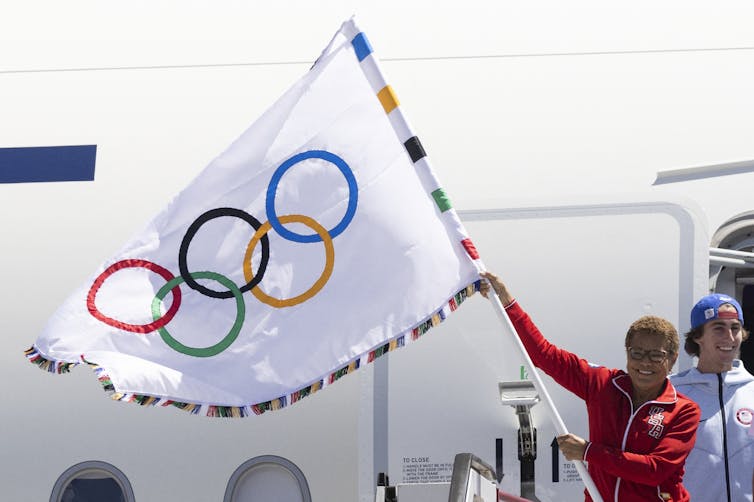
Jay L. Zagorsky, Boston University
With the Olympic torch extinguished in Paris, all eyes are turning to Los Angeles for the 2028 Olympics.
The host city has promised that the next Summer Games will be “car-free.”
For people who know Los Angeles, this seems overly optimistic. The car remains king in LA, despite growing public transit options.
When LA hosted the Games in 1932, it had an extensive public transportation system, with buses and an extensive network of electric streetcars. Today, the trolleys are long gone; riders say city buses don’t come on schedule, and bus stops are dirty. What happened?
This question fascinates me because I am a business professor who studies why society abandons and then sometimes returns to certain technologies, such as vinyl records, landline phones and metal coins. The demise of electric streetcars in Los Angeles and attempts to bring them back today vividly demonstrate the costs and challenges of such revivals. https://www.youtube.com/embed/9X78ZqGyc5o?wmode=transparent&start=0 The 2028 Olympic Games will be held in existing sports venues around Los Angeles and are expected to host 15,000 athletes and over 1 million spectators.
Riding the Red and Yellow Cars
Transportation is a critical priority in any city, but especially so in Los Angeles, which has been a sprawling metropolis from the start.
In the early 1900s, railroad magnate Henry Huntington, who owned vast tracts of land around LA, started subdividing his holdings into small plots and building homes. In order to attract buyers, he also built a trolley system that whisked residents from outlying areas to jobs and shopping downtown.
By the 1930s, Los Angeles had a vibrant public transportation network, with over 1,000 miles of electric streetcar routes, operated by two companies: Pacific Electric Railway, with its “Red Cars,” and Los Angeles Railway, with its “Yellow Cars.”
The system wasn’t perfect by any means. Many people felt that streetcars were inconvenient and also unhealthy when they were jammed with riders. Moreover, streetcars were slow because they had to share the road with automobiles. As auto usage climbed and roads became congested, travel times increased.
Nonetheless, many Angelenos rode the streetcars – especially during World War II, when gasoline was rationed and automobile plants shifted to producing military vehicles. https://www.youtube.com/embed/AwKv3_WwD4o?wmode=transparent&start=0 In 1910, Los Angeles had a widely used local rail network, with over 1,200 miles (1,930 kilometers) of track. What happened?
Demise of public transit
The end of the war marked the end of the line for streetcars. The war effort had transformed oil, tire and car companies into behemoths, and these industries needed new buyers for goods from the massive factories they had built for military production. Civilians and returning soldiers were tired of rationing and war privations, and they wanted to spend money on goods such as cars.
After years of heavy usage during the war, Los Angeles’ streetcar system needed an expensive capital upgrade. But in the mid-1940s, most of the system was sold to a company called National City Lines, which was partly owned by the carmaker General Motors, the oil companies Standard Oil of California and Phillips Petroleum, and the Firestone tire company.
These powerful forces had no incentive to maintain or improve the old electric streetcar system. National City ripped up tracks and replaced the streetcars with buses that were built by General Motors, used Firestone tires and ran on gasoline.
There is a long-running academic debate over whether self-serving corporate interests purposely killed LA’s streetcar system. Some researchers argue that the system would have died on its own, like many other streetcar networks around the world.
The controversy even spilled over into pop culture in the 1988 movie “Who Framed Roger Rabbit,” which came down firmly on the conspiracy side.
What’s undisputed is that, starting in the mid-1940s, powerful social forces transformed Los Angeles so that commuters had only two choices: drive or take a public bus. As a result, LA became so choked with traffic that it often took hours to cross the city.
In 1990, the Los Angeles Times reported that people were putting refrigerators, desks and televisions in their cars to cope with getting stuck in horrendous traffic. A swath of movies, from “Falling Down” to “Clueless” to “La La Land,” have featured the next-level challenge of driving in LA.
Traffic was also a concern when LA hosted the 1984 Summer Games, but the Games went off smoothly. Organizers convinced over 1 million people to ride buses, and they got many trucks to drive during off-peak hours. The 2028 games, however, will have roughly 50% more athletes competing, which means thousands more coaches, family, friends and spectators. So simply dusting off plans from 40 years ago won’t work.
Olympic transportation plans
Today, Los Angeles is slowly rebuilding a more robust public transportation system. In addition to buses, it now has four light-rail lines – the new name for electric streetcars – and two subways. Many follow the same routes that electric trolleys once traveled. Rebuilding this network is costing the public billions, since the old system was completely dismantled.
Three key improvements are planned for the Olympics. First, LA’s airport terminals will be connected to the rail system. Second, the Los Angeles organizing committee is planning heavily on using buses to move people. It will do this by reassigning some lanes away from cars and making them available for 3,000 more buses, which will be borrowed from other locales.
Finally, there are plans to permanently increase bicycle lanes around the city. However, one major initiative, a bike path along the Los Angeles River, is still under an environmental review that may not be completed by 2028.
Car-free for 17 days
I expect that organizers will pull off a car-free Olympics, simply by making driving and parking conditions so awful during the Games that people are forced to take public transportation to sports venues around the city. After the Games end, however, most of LA is likely to quickly revert to its car-centric ways.
As Casey Wasserman, chair of the LA 2028 organizing committee, recently put it: “The unique thing about Olympic Games is for 17 days you can fix a lot of problems when you can set the rules – for traffic, for fans, for commerce – than you do on a normal day in Los Angeles.”
This article has been updated to indicate that Los Angeles has four light-rail lines.
Jay L. Zagorsky, Associate Professor of Markets, Public Policy and Law, Boston University
This article is republished from The Conversation under a Creative Commons license. Read the original article.
The Bridge is a section of the STM Daily News Blog meant for diversity, offering real news stories about bona fide community efforts to perpetuate a greater good. The purpose of The Bridge is to connect the divides that separate us, fostering understanding and empathy among different groups. By highlighting positive initiatives and inspirational actions, The Bridge aims to create a sense of unity and shared purpose. This section brings to light stories of individuals and organizations working tirelessly to promote inclusivity, equality, and mutual respect. Through these narratives, readers are encouraged to appreciate the richness of diverse perspectives and to participate actively in building stronger, more cohesive communities.
https://stmdailynews.com/category/the-bridge
Discover more from Daily News
Subscribe to get the latest posts sent to your email.



Blog
The Dodger Gondola Project: A High-Flying Transit Idea Facing Heavy Headwinds
The Dodger Gondola Project, a proposed aerial transit line between Union Station and Dodger Stadium, faces major political, legal, and community opposition in 2025. Here’s where the controversial project stands now.


Dodger Gondola Project Faces Major Setbacks as L.A. Leaders and Residents Push Back
For years, the Los Angeles Aerial Rapid Transit (LA ART) — better known as the Dodger Gondola Project — has been pitched as a bold, futuristic connection between Union Station and Dodger Stadium, whisking riders above traffic in a six-minute aerial trip. Supporters call it L.A.’s chance to build a cleaner, faster, iconic transit link. But as 2025 winds toward its close, the project faces more turbulence than ever.
A Quick Refresher: What the Gondola Would Be
The proposed gondola line would travel about 1.2 miles, with stations at Union Station, a stop near L.A. State Historic Park, and Dodger Stadium. Private backers connected to former Dodgers owner Frank McCourt have promoted it as a zero-emission way to move more than 5,000 passengers per hour on game days — and potentially daily for tourists, residents, and park visitors.
Why the Dream Is Stalling
In November 2025, the Los Angeles City Council voted 12–1 to formally oppose the project, urging Metro to abandon it. While the vote isn’t legally binding, it signaled a major political shift. Councilmember Eunisses Hernandez, who introduced the resolution, cited environmental and community concerns — especially the impact on Chinatown, Solano Canyon, and L.A. State Historic Park.
A California Court of Appeals ruling earlier in the year also struck down Metro’s original environmental review, forcing a supplemental EIR that reopened debates about tree removal, tower placement, noise, and neighborhood impacts. The city has additionally ordered a comprehensive traffic study, pausing key permits until it’s complete.
Communities Speak Out
Local opposition has been strong and well-organized. Residents warn the gondola would remove mature trees, alter the character of the State Historic Park, and intrude over communities that have already shouldered decades of infrastructure burdens. Advocacy groups say the project favors private interests over public need, pointing to the lack of a clear long-term funding or maintenance plan.
Not Dead — But Deeply Uncertain
Despite mounting challenges, the gondola isn’t entirely grounded. Metro is still reviewing public comments on the supplemental environmental report, and state lawmakers are debating legislation that could streamline some project requirements. Whether those efforts succeed — or whether political pressure ultimately stalls the gondola indefinitely — remains to be seen.
The Big Picture
The Dodger Gondola Project sits at the intersection of transit innovation, environmental justice, and the future of Los Angeles mobility. For supporters, it represents a chance to modernize travel to one of the nation’s most visited stadiums. For opponents, it’s an unnecessary experiment that risks community space and public resources.
Either way, the next year will be pivotal — and L.A.’s debate over the gondola is far from over.
Sources and links for further information
Associated Press: “Los Angeles officials seek to halt proposed Dodger Stadium gondola” — apnews.com
Los Angeles Times: “Los Angeles City Council votes 12-1 to urge Metro to halt Dodgers gondola project” — latimes.com
NBC Los Angeles: “Dodger Stadium gondola should be a no-go, LA City Council says” — nbclosangeles.com
PR Newswire (project press release): “LA ART Gondola Project Takes Next Step Forward … with Release of Draft Supplemental Environmental Report” — prnewswire.com
LAist: “Controversial Dodger Stadium gondola project gets new environmental report. Here’s how you can weigh in” — laist.com
Official Metro page: “Los Angeles Aerial Rapid Transit (LA ART)” — metro.net
Site for public comment: “Stop The Gondola – Public Comment” — stopthegondola.org
CEQA Notice of Availability: “Draft Supplemental Environmental Impact Report – LA ART Project” — ceqanet.lci.ca.gov
Discover more from Daily News
Subscribe to get the latest posts sent to your email.
Urbanism
Celebrating World Urbanism Day: Building Livable Communities
World Urbanism Day: Celebrating livable communities and the role of urban planning. #WorldUrbanismDay Celebrating World Urbanism Day
Last Updated on November 7, 2025 by Rod Washington

Celebrating World Urbanism Day
On November 8th, we commemorate World Urbanism Day, a moment to acknowledge and advocate for the significance of urban planning in shaping livable communities. Also known as World Town Planning Day, this occasion highlights the interaction between inhabitants and their built environments in urban areas.
Urban planning focuses on creating healthy and vibrant communities that offer a high quality of life. By ensuring orderly development and preserving the economy and environment, planners strive to enhance the well-being of residents. The key elements of a livable city include plentiful opportunities for a high quality of life, diverse housing options, accessible public transportation, ample green spaces, and essential amenities like schools, grocery stores, and recreational facilities.
Cities such as Osaka, Tokyo, and Zurich exemplify healthy and livable communities, while Tripoli, Algiers, and Lagos face challenges in this regard. It is essential for us to engage in urban planning discussions, attend local council meetings, and explore ways to improve our communities. Let’s celebrate World Urbanism Day by spreading awareness, connecting with public health networks, and championing the creation of livable cities through #WorldUrbanismDay.
Check out our articles about urbanism: https://stmdailynews.com/category/the-bridge/urbanism/
Author

Discover more from Daily News
Subscribe to get the latest posts sent to your email.
Daily News
Watts Towers: A Landmark of Art, History, and Resilience in Los Angeles
Discover the Watts Towers in Los Angeles, a National Historic Landmark built by Sabato Rodia. Learn about their history, cultural impact, and significance in art, film, and literature.”
Last Updated on September 12, 2025 by Daily News Staff

Watts Towers. (2023, August 13). In Wikipedia. https://en.wikipedia.org/wiki/Watts_Towers
Watts Towers: A Landmark of Art, History, and Resilience in Los Angeles
The Watts Towers in Los Angeles are one of the most remarkable examples of outsider art in the United States. Built singlehandedly by Italian immigrant Sabato (Simon) Rodia over a span of 33 years (1921–1954), the towers stand as a testament to perseverance, creativity, and cultural expression.
Rodia, working without formal training or blueprints, constructed 17 interconnected towers and sculptural structures, the tallest reaching 99.5 feet. Using steel, mortar, and found objects such as glass, tile, pottery shards, and seashells, he created a visionary masterpiece that has since become an iconic symbol of Los Angeles art and heritage.
Recognition and Historic Significance
The Watts Towers are more than an architectural wonder—they are a recognized cultural landmark:
National Historic Landmark (1990)
California Historical Landmark
Los Angeles Historic-Cultural Monument
Listed in the National Register of Historic Places as one of only nine folk art sites in Los Angeles
Their enduring legacy highlights the resilience of both Rodia’s vision and the Watts community, which fought to preserve the towers when demolition was once proposed.
Influence on Culture, Film, and Literature
The influence of the Watts Towers extends far beyond architecture. They have been celebrated and referenced across multiple art forms:
In music, legendary jazz musician Charles Mingus mentioned them in his autobiography.
In literature, they appear in Don DeLillo’s novel Underworld.
On film, the towers have been featured in iconic movies such as La La Land and Ricochet.
These references reflect the towers’ place in both local identity and global culture.
Community and Public Space
The site is also home to the Watts Towers Crescent Greenway, a 0.2-mile rail-with-trail pedestrian and bike path. This space allows visitors to experience the towers while enjoying outdoor recreation, blending community engagement with cultural preservation.
Why the Watts Towers Matter
The Watts Towers are more than sculptures—they are a story of human determination, creativity, and cultural pride. They remind us that art can rise from unlikely places and stand the test of time, inspiring generations.

Watts Towers. (2023, August 13). In Wikipedia. https://en.wikipedia.org/wiki/Watts_Towers
Explore More About South Los Angeles
For those interested in learning more about the rich history of South Los Angeles, we recommend checking out The South LA Recap by Eric Craig on YouTube. The channel dives into fascinating hidden details of the region’s past and offers valuable insights into the cultural landscape surrounding the Watts Towers.
You can also visit Eric Craig’s website for additional resources: South LA Recap
Dive into “The Knowledge,” where curiosity meets clarity. This playlist, in collaboration with STMDailyNews.com, is designed for viewers who value historical accuracy and insightful learning. Our short videos, ranging from 30 seconds to a minute and a half, make complex subjects easy to grasp in no time. Covering everything from historical events to contemporary processes and entertainment, “The Knowledge” bridges the past with the present. In a world where information is abundant yet often misused, our series aims to guide you through the noise, preserving vital knowledge and truths that shape our lives today. Perfect for curious minds eager to discover the ‘why’ and ‘how’ of everything around us. Subscribe and join in as we explore the facts that matter. https://stmdailynews.com/the-knowledge/
At STM Daily News, we’re passionate about uncovering the stories that shaped Los Angeles. Visit our YouTube channelto explore more history, culture, and hidden gems of the city—from landmarks like the Watts Towers to the people and events that defined LA’s past. Subscribe today and discover the history of Los Angeles, one story at a time. https://www.youtube.com/playlist?list=PLEhXBupt8tVyhnfS344AWOC6s7sDNHHKG
Author
Discover more from Daily News
Subscribe to get the latest posts sent to your email.





