Connect with us

The Knowledge

Metro Board Advances Sepulveda Transit Corridor as C Line South Bay Extension Remains Under Review

The Los Angeles Metro Board meeting addressed progress on two key rail projects: the approved underground Sepulveda Transit Corridor, enhancing regional connectivity, and the debated extension of the Metro C Line into the South Bay, which remains undecided.


Published

on

The LA Metro Board approved the Sepulveda Transit Corridor’s underground rail plan while continuing debate over the C Line extension into the South Bay. Here’s what it means for LA transit’s future.
Image Credit: LA Metro

The future of Los Angeles transit was the focus of a recent Los Angeles County Metropolitan Transportation Authority (Metro) Board meeting, where directors considered progress on two major rail projects: the Sepulveda Transit Corridor and the long-planned extension of the Metro C Line into the South Bay.
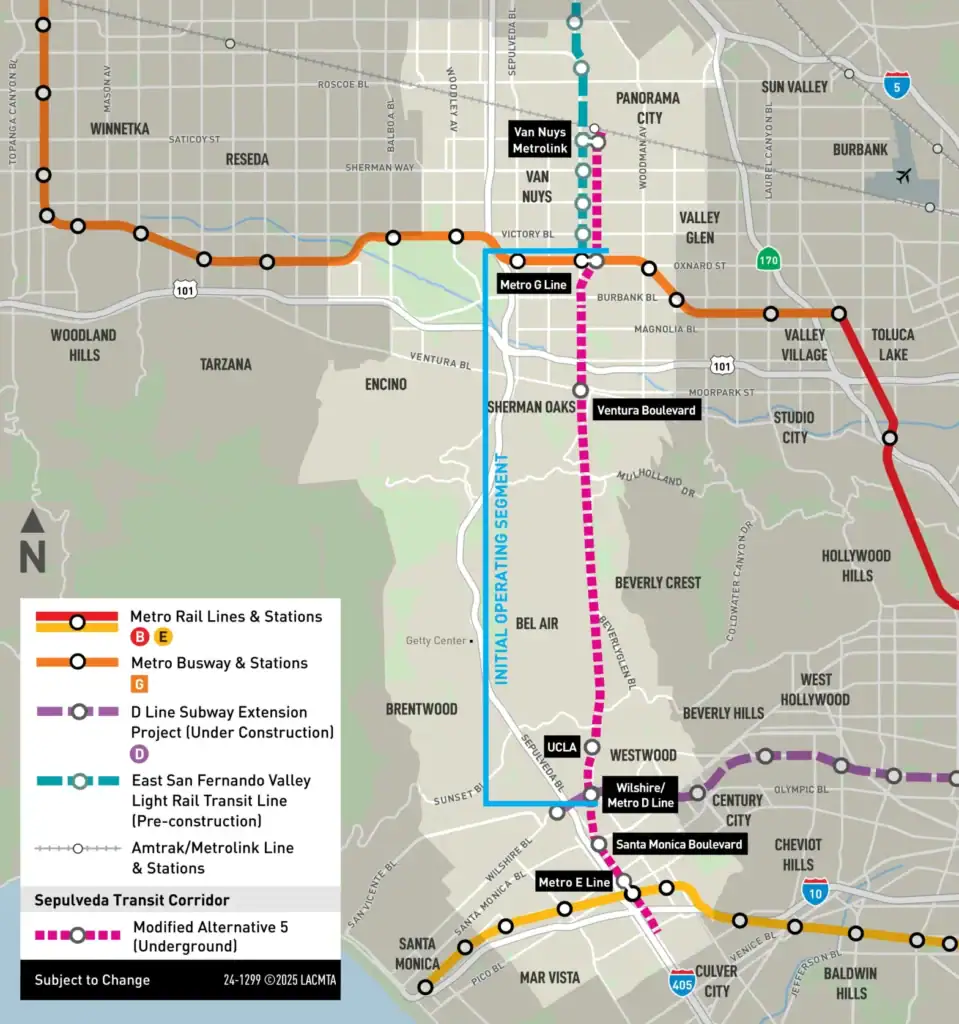
STC LPA scaled 1
Image Credit: LA Metro

While the meeting resulted in a decisive vote on one project, the other continues to generate debate among Metro officials, local cities, and residents.

Sepulveda Transit Corridor: Underground Heavy Rail Moves Forward

The Metro Board unanimously approved the Locally Preferred Alternative (LPA) for the Sepulveda Transit Corridor, marking a major milestone for a project that has been discussed for decades.

The approved alternative calls for a fully underground heavy rail subway connecting the San Fernando Valley to the Westside, running from the Van Nuys Metrolink Station to the Metro E Line’s Expo/Sepulveda Station. The line would pass beneath the Sepulveda Pass, UCLA, and other high-demand travel areas.

Metro officials emphasized that the underground alignment offers the fastest travel times, highest passenger capacity, and the fewest surface-level impacts when compared with earlier aerial or monorail alternatives. The project is expected to significantly reduce congestion along the 405 Freeway corridor and improve regional connectivity.

With the LPA now selected, the Sepulveda Transit Corridor advances toward final environmental clearance, engineering, and eventual construction — a process that will continue over the coming years.

Metro C Line Extension: South Bay Alignment Debate Continues

The Board also discussed the Metro C Line extension into the South Bay, a project intended to extend light rail service approximately 4.5 miles from the current Redondo Beach station to the Torrance Transit Center.

Metro has released the project’s Final Environmental Impact Report (FEIR), which incorporates years of technical analysis and public input. However, unlike the Sepulveda project, the Board did not take final action to certify the FEIR or formally adopt a locally preferred alignment at this meeting.

Hawthorne Boulevard vs. Metro Right-of-Way

At the center of the C Line discussion is the question of alignment.

Metro staff has identified a “hybrid” alignment using an existing Metro-owned rail right-of-way as the preferred option. This route would largely follow the historic Harbor Subdivision corridor, minimizing new street disruptions while blending at-grade, elevated, and below-grade segments.

Some South Bay cities, however, continue to advocate for a Hawthorne Boulevard alignment, which would place rail tracks within the median of the busy commercial corridor. Supporters argue it offers better street-level access, while Metro has cited higher costs, longer construction timelines, and greater traffic impacts as key concerns.

Metro officials indicated that additional coordination with local jurisdictions and further Board action will be needed before a final decision is made.

Advertisement
SodaStream USA, inc

What This Means for LA Transit

The contrast between the two projects was clear at the meeting: the Sepulveda Transit Corridor is now firmly on a defined path forward, while the C Line extension remains in a critical decision-making phase.

Together, the projects highlight both the ambition and complexity of expanding transit in Los Angeles County — balancing regional mobility goals, neighborhood impacts, and long-term funding realities.

Further Reading & Official Project Information


Metro Sepulveda Transit Corridor Project Page

– Official Metro overview of the Sepulveda Pass project, including alternatives, maps, timelines, and environmental documents.

Metro Board Considers Locally Preferred Alternative for Sepulveda Corridor

– Metro’s summary of the Board action and rationale behind selecting the underground heavy rail option.

Metro C Line Extension to Torrance Project Page

– Background, station concepts, and status updates for the South Bay light rail extension.

Final Environmental Impact Report: C Line Extension

– Details on the Final EIR, public comments, and next steps toward Board certification.

Metro Project Updates – The Source

– Ongoing Metro blog updates covering major transit projects, board actions, and construction milestones.

LA Metro Board of Directors

– Information on Metro Board members, meeting schedules, agendas, and voting records.

STM Daily News will continue to follow both projects closely, providing updates as Metro moves toward final approvals, construction timelines, and funding decisions that will shape how Angelenos travel for decades to come.

For ongoing coverage of Metro projects, transportation policy, and infrastructure across Southern California, visit STM Daily News.

View recent photos

Unlock fun facts & lost history—get The Knowledge in your inbox!

We don’t spam! Read our privacy policy for more info.

Rod: A creative force, blending words, images, and flavors. Blogger, writer, filmmaker, and photographer. Cooking enthusiast with a sci-fi vision. Passionate about his upcoming series and dedicated to TNC Network. Partnered with Rebecca Washington for a shared journey of love and art.

Continue Reading
Advertisement Simply Wholesale
Click to comment

Tell us what did you think about this article?

The Knowledge

Mosquitoes carrying malaria are evolving more quickly than insecticides can kill them – researchers pinpoint how

Published

on

file 20260319 57 o1tmci.JPG?ixlib=rb 4.1
Anopheles darlingi, a key carrier of malaria, is rapidly evolving resistance to insecticides. Romuald Carinci and Pascal Gaborit/Duchemin lab/Institut Pasteur de la Guyane, CC BY-SA

Jacob A Tennessen, Harvard University

The fight against infectious disease is a race against evolution. Bacteria become resistant to antibiotics. Viruses adapt to spread more quickly. Diseases transmitted by insects present another evolutionary front: Insects themselves can evolve resistance to the poisons that people use to kill them.

In particular, the mosquito-borne disease malaria kills over 600,000 people annually. Since World War II, people have battled malaria with insecticides – chemical weapons intended to kill Anopheles mosquitoes infected with the Plasmodium parasites that cause the disease.

However, mosquitoes are quickly evolving counterstrategies that make these insecticides ineffective, putting millions of people at greater risk of deadly infection. My colleagues and I have newly published research showing how.

Insecticide resistance threatens public health

As an evolutionary geneticist, I study natural selection – the basis for adaptive evolution. Genetic variants that best promote survival can replace less advantageous versions, causing species to change. Anopheles mosquitoes are frustratingly adept at evolving.

In the mid-1990s, most African Anopheles were susceptible to pyrethroids, a popular type of insecticide originally derived from chrysanthemums. Anopheles control relies on two pyrethroid-based methods: insecticide-treated bed nets to protect sleepers, and indoor residual spraying of insecticide against the walls of homes. These two methods alone likely prevented over a half-billion cases of malaria between 2000 and 2015.

However, mosquitoes today from Ghana to Malawi are often able to survive insecticide concentrations 10 times the previously lethal dose. Along with Anopheles control efforts, agriculture also inadvertently exposes mosquitoes to pyrethroids and contributes to insecticide resistance.

In some African locales, Anopheles is already showing resistance to all four main classes of insecticide used for malaria control.

Close-up of mosquito on human skin with abdomen engorged with blood, a droplet extruding at its end
Anopheles mosquitoes are found all over the world. Jim Gathany/CDC

Adaptation in Latin American mosquitoes

Anopheles mosquitoes and the malaria-causing Plasmodium also occur outside Africa, where insecticide resistance is less well-researched.

In much of South America, the main malaria vector is Anopheles darlingi. This mosquito species has diverged evolutionarily from the African vectors so extensively that it might be a different genus, Nyssorhynchus. Along with colleagues from eight countries, I analyzed over 1,000 Anopheles darlingi genomes to understand its genetic diversity, including any recent changes due to human activity. My collaborators collected these mosquitoes at 16 locations ranging from the Atlantic coast of Brazil to the Pacific side of the Andes in Colombia.

We found that, like its African counterparts, Anopheles darlingi shows extremely high genetic diversity – more than 20 times that of humans – indicating that very large populations of this insect exist. A species with such a vast gene pool is well poised to adapt to new challenges. The right mutation giving it the advantage it needs is more likely to pop up when there are so many individuals. And once that mutation starts to spread, it’s protected by numbers since it won’t be wiped out if a few mosquitoes die by chance.

In contrast, bald eagles in the contiguous U.S. were never able to evolve resistance against the insecticide DDT and approached extinction. Evolution is more efficient among millions of insects than mere thousands of birds. And indeed, we saw signals of adaptive evolution in the resistance-related genes of Anopheles darlingi occurring over the past few decades.

Advertisement
SodaStream USA, inc

Mosquitoes evolve to detoxify poisons

Insecticides like pyrethroids and DDT share the same molecular target: channels in nerve cells that can open and close. When open, the nerve cell stimulates other cells. These insecticides force the channels to remain open and continuously fire, causing paralysis and death. However, insects can evolve resistance by changing the shape of the channel itself.

Earlier genetic scans performed by other researchers had not detected this type of resistance in Anopheles darlingi, and neither did ours. Instead, we found that resistance is evolving in another way: a group of genes encoding enzymes that break down toxic compounds. High activity of these enzymes, called P450, frequently underlies resistance to insecticides in other mosquitoes. The same cluster of P450 genes has changed independently at least seven times across South America since insecticide use began in the mid-20th century.

In French Guiana, a different set of P450 genes exhibits a similar evolutionary pattern, cementing the clear connection between these enzymes and adaptation. Moreover, when we exposed mosquitoes to pyrethroids in sealed bottles, differences among the P450 genes of individual mosquitoes were linked to the length of time they stayed alive.

Insecticide-heavy campaigns against malaria have been only sporadic in South America and may not be the main driver behind this evolution. Instead, it’s possible that mosquitoes are being exposed indirectly to agricultural insecticides. Intriguingly, we saw the strongest signs of evolution in places where farming is prevalent.

Diagram comparing Mendelian inheritance (50% chance of inheritance leads to slower spread) with gene drive inheritance (nearly 100% inheritance leads to rapid spread)
Gene drives can help a malaria-fighting mutation spread more quickly through a mosquito population than it would by chance alone. Naidoo et al./Gene Therapy, CC BY-SA

Toward more sophisticated vector control

Despite new vaccines and other recent advances against malaria, mosquito control remains essential for reducing disease.

Some countries are launching trials of gene drives to control malaria, which involve forcing a genetic modification into a mosquito population to reduce their numbers or their tolerance for Plasmodium. Such prospects are exciting, though the relentless adaptability of mosquitoes could be an obstacle.

I and others are revising methods to efficiently test for emerging insecticide resistance. Genome-scale sequencing remains important to detect new or unexpected evolutionary responses. The risk of adaptation is highest under a continuous, strong selection pressure, so minimizing, switching and staggering pesticides can help thwart resistance.

Success in the fight against evolving resistance will require a coordinated effort of monitoring, and reacting accordingly. Unlike evolution, humans can think ahead.

Jacob A Tennessen, Research Scientist in Immunology and Infectious Diseases, Harvard University

This article is republished from The Conversation under a Creative Commons license. Read the original article.

Advertisement
SodaStream USA, inc

The science section of our news blog STM Daily News provides readers with captivating and up-to-date information on the latest scientific discoveries, breakthroughs, and innovations across various fields. We offer engaging and accessible content, ensuring that readers with different levels of scientific knowledge can stay informed. Whether it’s exploring advancements in medicine, astronomy, technology, or environmental sciences, our science section strives to shed light on the intriguing world of scientific exploration and its profound impact on our daily lives. From thought-provoking articles to informative interviews with experts in the field, STM Daily News Science offers a harmonious blend of factual reporting, analysis, and exploration, making it a go-to source for science enthusiasts and curious minds alike. https://stmdailynews.com/category/science/

Continue Reading

The Knowledge

How dolphins communicate – new discoveries from a long‑term study in Sarasota, Florida

Published

on

Brookfield Zoo Chicago's Sarasota Dolphin Research Program
Bottlenose dolphins are social creatures that use whistles and clicks to communicate with each other. Brookfield Zoo Chicago’s Sarasota Dolphin Research Program, taken under NMFS MMPA Scientific Research Permit

Laela Sayigh, Woods Hole Oceanographic Institution

Human fascination with bottlenose dolphins goes back thousands of years, at least as early as Greek mythology.

But it wasn’t until the 1960s that methodical research into dolphin communication began. Scientists like John Lilly and the husband-and-wife team of Melba and David Caldwell tried various experiments to decipher the sounds dolphins can make.

The Caldwells figured out a way to record isolated animals in human care. They discovered that each individual dolphin communicated mostly with one unique whistle, which they called the “signature whistle.” Researchers now know that these whistles convey identities much like human names do. Dolphins use them to stay in touch with each other in their murky habitat, where vision is limited. It’s like announcing “I’m over here!” when someone can’t see you.

This discovery is foundational to my own research. I’ve been studying communication in wild dolphins since the mid-1980s, when I joined my mentor Peter Tyack in documenting signature whistles in wild dolphins for the first time. Our team’s research focused on a resident community of free-ranging bottlenose dolphins in waters near Sarasota, Florida, where I continue to work today.

This collaborative study, led by Randall Wells of Brookfield Zoo Chicago’s Sarasota Dolphin Research Program, involves numerous researchers from a variety of institutions, who study different aspects of dolphin biology, health, ecology and behavior. Begun in 1970, this is the longest-running research project on a population of wild cetaceans – whales, dolphins and porpoises – in the world.

one dolphin surfaces next to another's dorsal fin, which has a jagged edge at the top
Each dolphin has distinctive markings on its dorsal fin. Experienced researchers can sometimes identify them by sight in the field, and they photograph them to confirm their identity in the lab. Photo by Brookfield Zoo Chicago’s Sarasota Dolphin Research Program, taken under NMFS MMPA Scientific Research Permit

Recording and observing

Researchers know the age, sex and maternal relatedness of almost all of the approximately 170 dolphins in the Sarasota community. This depth of knowledge provides an unprecedented opportunity to study communication in a wild cetacean species.

The dolphins in the Sarasota project are periodically subject to brief catch-and-release health assessments, during which researchers, including me, briefly handle individual dolphins.

Our team attaches suction-cup hydrophones directly onto each dolphin’s melon – that is, its forehead. We then record the dolphins continuously throughout the health assessments, taking notes on who is being recorded when, and what is happening at the time.

This is how my colleagues and I were able to confirm that wild dolphins, like captive animals, produced large numbers of individually distinctive signature whistles when briefly isolated from other dolphins. Through observations and recordings of known free-swimming dolphins, we were further able to confirm that they produced these same signature whistles in undisturbed contexts.

We have organized these recordings into the Sarasota Dolphin Whistle Database, which now contains nearly 1,000 recording sessions of 324 individual dolphins. More than half of the dolphins in the database have been recorded more than once.

We identify each dolphin’s signature whistle based on its prevalence: In the catch-and-release context, about 85% of the whistles that dolphins produced are signature whistles. We can identify these visually, by viewing plots of frequency vs. time called spectrograms.

Advertisement
SodaStream USA, inc
file 20260306 57 g5fjiz.jpg?ixlib=rb 4.1
Spectrograms of signature whistles of 269 individual bottlenose dolphins recorded in Sarasota. Figure created by Frants Jensen, with sound files from Laela Sayigh

Signature whistles and ‘motherese’

The Sarasota Dolphin Whistle Database has proved to be a rich resource for understanding dolphin communication. For instance, we have discovered that some calves develop signature whistles similar to those of their mothers, but many do not, raising questions about what factors influence signature whistle development.

We have also found that once developed, signature whistles are highly stable over an animal’s lifetime, especially for females. Males often form strong pair bonds with another adult male, and in some instances, their whistles become more similar to one another over time. We are still trying to understand when and why this occurs.

Dolphin mothers modify their signature whistles when communicating with their calves by increasing the maximum frequency, or pitch. This is similar to human caregivers using a higher-pitched voice when communicating with young children – a phenomenon known as “motherese.”

Slowed recording of a bottle-nosed dolphin without her calf, then with her calf. Courtesy of Laela Sayigh of Woods Hole Oceanographic Institution, and Brookfield Zoo Chicago’s Sarasota Dolphin Research Program. These sounds were obtained under a federal scientific research permit issued to R. Wells of SDRP.72 KB (download)

Also similar to humans is how dolphins will initiate contact with another dolphin by imitating their signature whistle – what we call a signature whistle copy. This is similar to how you would use someone’s name to call out to them.

Our team is interested in finding out if dolphins also copy whistles of others who aren’t present, potentially talking about them. We have seen evidence of this in our recordings of dolphins during health assessments, which provide a rare context to document this phenomenon convincingly. But we still have more work to do to confirm that these are more than chance similarities in whistles.

Shared whistle types

Another exciting development has been our recent discovery of shared whistle types — ones that are used by multiple animals and that are not signature whistles. We call these non-signature whistles.

I could hardly believe my ears when I first discovered a repeated, shared non-signature whistle type being produced by multiple dolphins in response to sounds we play back to them through an underwater speaker. We had previously believed that these non-signature whistles were somewhat random, but now I was hearing many different dolphins making a similar whistle type.

Our team originally had been using the playbacks to try to determine whether dolphins use “voice cues” to recognize each other – similar to how you can recognize the voice of someone you know. Although we found that dolphins did not use voice cues, our discovery of shared non-signature whistle types has led to an entirely new research direction.

A woman on a boat wearing headphones and looking at a laptop
The author listens to dolphin whistles on a boat in Sarasota. Jonathan Bird from the film ‘Call of the Dolphins’/Oceanic Research Group, Inc.

So far, I’ve identified at least 20 different shared non-signature whistle types, and I am continuing to build our catalog. We are hoping that artificial intelligence methods may help us categorize these whistle types in the future.

To understand how these shared non-signature whistle types function, we are carrying out more playback experiments, filming the dolphins’ responses with drones. We’ve found that one such whistle often leads the dolphins to swim away, suggesting a possible alarm-type function. We have also found that another type might be an expression of surprise, as we have seen animals produce it when they hear unexpected stimuli.

Advertisement
SodaStream USA, inc

More difficult, more interesting

So far, the main takeaway from our experiments has been that dolphin communication is complex and that there are not going to be one-size-fits-all responses to any non-signature whistle type. This isn’t surprising, given that, like us, these animals have complicated social relationships that could affect how they respond to different sound types.

For instance, when you hear someone call your name, you may respond differently if you are with a group of people or alone, or if you recently had an argument with someone, or if you’re hungry and on your way to eat.

Our team has a lot more work ahead to sample as many dolphins in as many contexts as possible, such as different ages, sexes, group compositions and activities.

This makes my job more difficult – and far more interesting. I feel lucky every day I am able to spend working on the seemingly infinite number of fascinating research questions about dolphin communication that await answers.

This article has been corrected to better describe how dolphins respond to playback whistles.

Read more stories from The Conversation about Florida.

Laela Sayigh, Senior Research Specialist, Cetacean Communication, Woods Hole Oceanographic Institution

This article is republished from The Conversation under a Creative Commons license. Read the original article.

Dive into “The Knowledge,” where curiosity meets clarity. This playlist, in collaboration with STMDailyNews.com, is designed for viewers who value historical accuracy and insightful learning. Our short videos, ranging from 30 seconds to a minute and a half, make complex subjects easy to grasp in no time. Covering everything from historical events to contemporary processes and entertainment, “The Knowledge” bridges the past with the present. In a world where information is abundant yet often misused, our series aims to guide you through the noise, preserving vital knowledge and truths that shape our lives today. Perfect for curious minds eager to discover the ‘why’ and ‘how’ of everything around us. Subscribe and join in as we explore the facts that matter.  https://stmdailynews.com/the-knowledge/

Advertisement
SodaStream USA, inc
Continue Reading

The Knowledge

Artemis II Astronauts Return to Earth After Record-Setting Moon Mission

Published

on

Last Updated on April 11, 2026 by Daily News Staff

April 10, 2026NASA’s Artemis II crew has safely returned to Earth, marking the successful completion of the first crewed mission to the Moon’s vicinity in more than 50 years.

NASA’s Artemis II astronauts return to Earth after a historic Moon mission, setting a record for the farthest distance traveled by humans in space.
NASA’s Orion spacecraft, with Artemis II crewmembers NASA astronauts Reid Wiseman, Victor Glover, Christina Koch, and CSA (Canadian Space Agency) astronaut Jeremy Hansen, was seen as it splashed down in the Pacific Ocean off the coast of California, at 5:07 p.m. PDT on Friday, April 10, 2026.
Credit: NASA/Joel Kowsky

The Orion spacecraft splashed down in the Pacific Ocean off the coast of California at 5:07 p.m. PDT, carrying NASA astronauts Reid Wiseman, Victor Glover, Christina Koch, and Canadian astronaut Jeremy Hansen back home after a nearly 10-day journey through deep space.

🚀 A Mission for the Record Books

During the mission, the crew traveled a total of 694,481 miles, reaching a maximum distance of 252,756 miles from Earth—farther than any humans have ever gone, surpassing the Apollo 13 record set in 1970.

Launched on April 1 aboard NASA’s powerful Space Launch System (SLS) rocket, Artemis II tested critical systems needed for future missions, including life support, navigation, and deep space communication.

🌕 Science, Exploration, and Stunning Views

While orbiting the Moon, the astronauts captured more than 7,000 images, including views of the lunar far side, a rare solar eclipse, and detailed observations of craters, lava flows, and surface features.

The mission also included scientific experiments to better understand how the human body responds to deep space conditions, helping prepare for longer missions to the Moon and Mars.

🛰️ Safe Return and Recovery

Following splashdown, recovery teams quickly reached the spacecraft and transported the crew by helicopter to the USS John P. Murtha for initial medical evaluations. The astronauts are expected to return to NASA’s Johnson Space Center for further assessments.

🌍 What Comes Next

With Artemis II complete, NASA is now turning its focus to Artemis III, the next mission aimed at landing astronauts on the Moon and establishing a long-term human presence.

The success of Artemis II marks a major step forward in humanity’s return to deep space—and the beginning of a new era of exploration.


For more information on NASA’s Artemis program, visit the official NASA website.

Advertisement
SodaStream USA, inc

🔗 Source & Further Reading

Dive into “The Knowledge,” where curiosity meets clarity. This playlist, in collaboration with STMDailyNews.com, is designed for viewers who value historical accuracy and insightful learning. Our short videos, ranging from 30 seconds to a minute and a half, make complex subjects easy to grasp in no time. Covering everything from historical events to contemporary processes and entertainment, “The Knowledge” bridges the past with the present. In a world where information is abundant yet often misused, our series aims to guide you through the noise, preserving vital knowledge and truths that shape our lives today. Perfect for curious minds eager to discover the ‘why’ and ‘how’ of everything around us. Subscribe and join in as we explore the facts that matter.  https://stmdailynews.com/the-knowledge/

Continue Reading

Trending


