

The Earth
Vancouver Aquarium and Aquarium du Québec Team Up to Expand Care for Rescued Sea Otters
Vancouver Aquarium will transfer rescued sea otters Hardy, Mak, Quatse and Taz to Aquarium du Québec in June, expanding Canada’s capacity for care.

A new partnership between two of Canada’s best-known aquariums is about to change what sea otter rescue and long-term care can look like nationwide.
On May 7, the Vancouver Aquarium announced it will transfer four rescued sea otters—Hardy, Mak, Quatse, and Taz—to the Aquarium du Québec in early June. The move supports the opening of Aquarium du Québec’s new sea otter habitat and creates much-needed capacity at the Vancouver Aquarium for future rescue cases.
Why this transfer matters
The Vancouver Aquarium works alongside the Vancouver Aquarium Marine Mammal Rescue Society (VAMMR) to rescue and rehabilitate hundreds of marine animals each year across the Pacific Northwest. The goal for every patient is release back into the ocean—but not every animal can return to the wild.
In this case, the aquarium says its sea otters were rescued as orphaned pups and later deemed non-releasable by Canadian and U.S. government agencies. Without the chance to develop key survival skills, many orphaned otters can’t safely hunt, avoid predators, or navigate the risks of coastal life on their own.
By expanding sea otter care to Eastern Canada, the collaboration increases the country’s overall ability to provide specialized, long-term support for rescued otters—especially those that cannot be released.
Creating space for the next rescue
The Vancouver Aquarium notes it is currently the only aquarium in Canada with a sea otter habitat, which means its capacity is limited even as rescue needs continue.
“Our aquarium’s otter habitat provides a safe and enriching home—but it also has limits,” said Mackenzie Neale, Animal Care Director at the Vancouver Aquarium. “This transfer creates much-needed space for when the next otter needs our help.”
That “next otter” is not hypothetical. VAMMR responds to more than 300 marine animal emergencies each year, including rescues of sick, injured, or orphaned animals and the disentanglement of sea lions trapped by marine debris.
A new educational opportunity in Québec
For the Aquarium du Québec, welcoming sea otters is both a conservation milestone and a major visitor experience upgrade—especially for families and students in Eastern Canada who may never have seen sea otters up close.
“The Aquarium du Quebec is thrilled to introduce sea otters to visitors in Eastern Canada,” said Nathalie Julien Boucher, director of Aquarium du Québec. She added that because the animals were rescued from the wild, the habitat will offer “a fantastic educational opportunity while continuing our conservation mission,” as part of the aquarium’s Louphoque project.
Catch them before they head east
The Vancouver Aquarium is inviting guests to visit Hardy, Mak, Quatse, and Taz before May 31. Throughout May, the four otters will be on public display during weekend (Saturday and Sunday) operating hours.
If you can’t make it to Stanley Park, the aquarium says viewers can still follow their journey on the Sea Otter Cam.
What to watch for
- Early June transfer: Four otters move from Vancouver to Québec City.
- Expanded national capacity: More space in Vancouver for future rescues; new habitat in Québec for long-term care.
- Conservation storytelling: Two aquariums amplifying public education about sea otters and coastal ecosystems.
About the rescue work behind the scenes
The Vancouver Aquarium opened in 1956 and has connected more than 50 million people to ocean life. It is accredited by major animal care and conservation organizations, and it’s also Humane Conservation Certified by American Humane.
The Vancouver Aquarium Marine Mammal Rescue Society (VAMMR) operates Canada’s only dedicated marine mammal rescue facility. It is an independent registered charity that works in partnership with the Vancouver Aquarium, and donations support rescue, rehabilitation, and release efforts. Learn more at www.vammr.org.
Source: Vancouver Aquarium press release via CNW (May 7, 2026).
Catch the latest in movies, TV, music, pop culture, and live events in STM Daily News’ Entertainment section.


Nature
What in the Heck Is a Sweat Bee? Turns Out, My Wife Wasn’t Making It Up
My wife Rebecca said she thought a sweat bee stung her. I thought she was making it up. Turns out, sweat bees are very real—and their strange name actually makes perfect sense.


It started with a conversation with my wife, Rebecca.
She mentioned that she thought she’d been stung by something called a “sweat bee.”
My immediate reaction was basically:
“What in the heck is a sweat bee?”
I’ll admit it. For a moment, I thought she was making the whole thing up. 😂
A sweat bee? Really?
It sounded like one of those names somebody invents when they don’t know what actually stung them.
“It wasn’t a regular bee. It was a… uh… sweat bee!”
So naturally, I asked ChatGPT the same question: What in the heck is a sweat bee?
Well, Rebecca gets this round.
Sweat bees are absolutely real.
And Yes, They’re Interested in Your Sweat
Sweat bees belong primarily to the Halictidae family, a large group of generally small bees found around the world.
Some are rather ordinary-looking little insects, while others are surprisingly flashy, sporting metallic shades of green, blue, bronze or gold.
But here’s where they earned that wonderfully unfortunate name.
Some sweat bees are attracted to human perspiration.
They’re not after you because they’re angry, and they’re certainly not tiny vampire bees. They’re interested in the salt and minerals in your sweat.
In other words, after you’ve been outside working, gardening, exercising or simply trying to survive a hot summer afternoon, a sweat bee may look at you and think:
“Hey! Free electrolytes!”
Wait…They Can Sting Too?
Unfortunately for Rebecca, there’s another part of her story that checks out.
Female sweat bees can sting.
They’re generally not aggressive and aren’t flying around looking for people to attack. But if one gets trapped against your skin, squeezed or swatted, it may defend itself.
Their sting is generally considered relatively mild compared with those of many other bees and wasps—but “relatively mild” probably isn’t much consolation when you’re the person who just got stung.
So, Rebecca, I officially withdraw my skepticism.
Mostly.
Don’t Declare War on Them
As annoying as having a tiny bee land on your sweaty arm might be, sweat bees are actually beneficial insects.
They’re important pollinators, visiting wildflowers, garden plants and agricultural crops and carrying pollen from flower to flower.
So if one lands on you, gently brushing or blowing it away is probably a better idea than swatting it against your skin.
And that’s today’s unexpected nature lesson.
Sweat bees are real.
They really are attracted to sweat.
The females really can sting.
And, perhaps most importantly…
My wife was right.
There. I said it.
I’m sure I’ll never hear the end of this one. 😂
Related Links
- University of Arizona Cooperative Extension — Arizona Bee Identification Guide — A useful Arizona-focused guide that includes sweat bees and explains their appearance, size, nesting behavior and attraction to salt in perspiration.
- USDA Natural Resources Conservation Service — Native Bees and Their Favorite Flowers — More information about native pollinators and the important role sweat bees play around wildflowers.
- USDA Forest Service — Bee Basics — A broader guide to North American bees, including the colorful metallic members of the sweat bee family.
- Smithsonian National Museum of Natural History — Sweat Bee — See an actual female sweat bee specimen (Augochlorella aurata) and its scientific classification.
📰 Enjoying STM Daily News? Join the conversation!
💬 Leave a comment, share your thoughts, and subscribe to our newsletter for the latest stories, updates, and “News You Can Use This Moment!” delivered to your inbox.
Stay connected with STM Daily News!

The Earth
Cement has a climate problem — here’s how geopolymers with add‑ins like cork could help fix it
Portland cement drives ~8% of global emissions. Learn how low-carbon geopolymers—enhanced with add-ins like cork—could cut concrete’s footprint.


Alcina Johnson Sudagar, Washington University in St. Louis
Concrete is all around you – in the foundation of your home, the bridges you drive over, the sidewalks and buildings of cities. It is often described as the second-most used material by volume on Earth after water.
But the way concrete is made today also makes it a major contributor to climate change.
Portland cement, the key component of concrete, is responsible for about 8% of global greenhouse gas emissions. That’s because it’s made by heating limestone to high temperatures, a process that burns a large amount of fossil fuels for energy and releases carbon dioxide from the limestone in the process.
The good news is that there are alternatives, and they are gaining attention.
Portland cement: A greenhouse gas problem
Cementlike substances have been used in construction for thousands of years. Architects have found evidence of their use in the pyramids of Egypt and the buildings and aqueducts of the Roman Empire.
The Portland cement commonly used in construction today was patented in 1824 by Joseph Aspdin, a British bricklayer.
Modern cement preparation starts with crushing the excavated raw materials limestone and clay and then heating them in a kiln at around 2,650 degrees Fahrenheit (about 1,450 degrees Celsius) to form clinker, a hard, rocklike residue. The clinker is then cooled and ground with gypsum into a fine powder, which is called cement.
About 40% of the carbon dioxide emissions from cement production come from burning fossil fuels to generate the high heat needed to run the kiln. The rest come as the heat converts limestone (calcium carbonate) to lime (calcium oxide), releasing carbon dioxide.
In all, between half a ton and 1 ton of greenhouse gas is released per ton of Portland cement. Cement is a binding agent that, mixed with water, holds aggregate together to create concrete. It makes up about 10% to 15% of the concrete mix by weight.
Alternative technologies can lower emissions
As populations, cities and the need for new infrastructure expand, the use of cement is growing, making it important to find alternatives with lower environmental costs.

Some techniques for reducing carbon dioxide emissions include substituting some of the clinker – the hard residue typically made from limestone – with supplementary materials such as clay, or fly ash and slag from industries. Other methods reduce the amount of cement by mixing in waste sawdust or recycled materials like plastics.
The long-term solution for reducing cement’s emissions, however, is to replace traditional cement completely with alternatives. One option is geopolymers made from earthen clay and industrial wastes.
Geopolymers: A more climate-friendly solution
Geopolymers can be made by mixing claylike materials that are rich in aluminum and silicon minerals with a chemical activator through a process called geopolymerization. The activator transforms the silicon and aluminum into a structure that will look like cement. All of this can happen at room temperature.
The major difference between cement and geopolymer is that cement is mainly made of calcium, whereas geopolymers are made of silicon and aluminum with some possible calcium in their structure.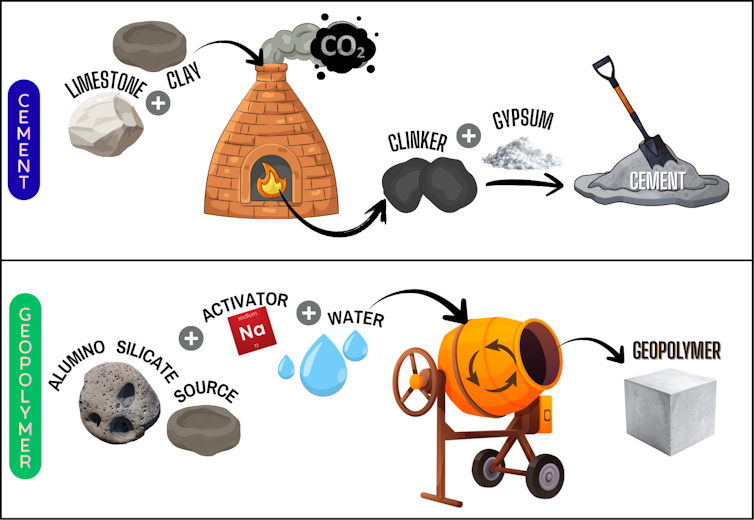
These geopolymers have been found to possess high strength and durability, including resilience in freeze-thaw cycles and resistance to heat and fire, which are important requirements in construction. Studies have found that some geopolymers can provide comparable if not better strength than traditional cement and, because they don’t require heat the way clinker does, they can be produced with significantly lower greenhouse gas emissions.
Geopolymers can also be produced from a variety of raw materials rich in aluminum and silicon, including earthen clays, fly ash, blast furnace slag, rice husk ash, iron ore wastes and recycled construction brick waste. Geopolymer technology can be adapted depending on the clay or industrial waste locally available in a region. https://www.youtube.com/embed/NOj3p6m9M7Q?wmode=transparent&start=0 A brief history of cement and geopolymers. Geopolymer International.
An added advantage of geopolymers is that changes to the mixture can produce a range of features.
For example, I and my co-researchers at the University of Aveiro in Portugal added a small amount of cork industry waste – the leftovers from creating bottle corks – to clay-based geopolymer and found it could improve the strength of the material by up to twofold. The cork particles filled the spaces in the geopolymer structure, making it denser, which increased the strength.
Similarly, additives such as sisal fibers from the agave plant, recycled plastic and steel fibers can change geopolymer properties. The additives do not participate in the geopolymerization process but act as fillers in the structure.
The structure of geopolymers can also be designed to act as adsorbents, attracting toxic metals in wastewater and capturing and storing radioactive wastes. Specifically, incorporating materials like zeolite that are natural adsorbents in the geopolymer structure can make them useful for such applications as well.
Where geopolymers are used now
Geopolymers have been used in many types of construction, including roads, coatings, 3D printing, coastal environmental protection, the steel and chemical industries, sewer rehabilitation and building radiation shielding and rocket launchpad and bunker infrastructure.
One of the earliest examples of a modern geopolymer concrete project was the Brisbane West Wellcamp airport in Australia.
It was built in 2014 with 70,000 metric tons of geopolymer concrete, which was estimated to have reduced the project’s carbon dioxide emissions by as much as 80%.
The geopolymer market is currently estimated to be between US$7 billion and $10 billion, with the largest growth in the Asia-Pacific region.
Analysts have estimated that the market could grow at a rate of 10% to 20% per year and reach about $62 billion by 2033.
In several countries, greenhouse gas regulations and green-building certifications are expected to support the continued growth of geopolymers in the construction industry.
Expanding the use of cement alternatives
The advantage of using industrial wastes in geopolymers is a double-edged sword, however. The composition of industrial wastes varies, so it can be difficult to standardize the processing methods. The geopolymer components need to be mixed in particular ratios to achieve desired properties.
Producing the activator for the geopolymer, typically done in chemical facilities, can raise the cost and contribute to the carbon footprint. And the long-term data about these materials’ stability is only now being developed given their newness. Also, these geopolymers can take longer to set than cement, though the setting time can be sped up by using raw materials that react quickly.
Developing cheaper, naturally available activators like agricultural waste rice husk with sustainable supply chains could help lower the costs and environmental impact. Also, printing the recipe on the raw material packaging could help simplify the job of determining the mixing ratio so geopolymers can be more widely used with confidence.
Even though geopolymer technology has some drawbacks, these low-carbon alternatives have great potential for reducing emissions from the construction sector.
Alcina Johnson Sudagar, Research Scientist in Chemistry, Washington University in St. Louis
This article is republished from The Conversation under a Creative Commons license. Read the original article.
📰 Enjoying STM Daily News? Join the conversation!
💬 Leave a comment, share your thoughts, and subscribe to our newsletter for the latest stories, updates, and “News You Can Use This Moment!” delivered to your inbox.
Stay connected with STM Daily News!

Science
Sonic booms from meteors can release the energy of hundreds of tons of TNT – here’s how they work

Shawn Laatsch, University of Maine
Sonic booms from meteors can release the energy of hundreds of tons of TNT – here’s how they work
As humans, we live out our lives on a planet that is constantly sweeping through a cosmic ocean littered with ancient debris from the formation of the solar system. For the most part, our world glides silently through space, shielded by Earth’s thin atmosphere.
Occasionally, however, the rest of the universe reminds us of its presence with stunning, visceral clarity.
Residents along the Massachusetts–New Hampshire border were startled by a sudden sonic boom on the afternoon of May 30, 2026. A large number of people up and down the Eastern Seaboard witnessed it.
After NASA analyzed imagery from weather satellites, they identified the culprit as a small meteor measuring roughly 3 to 5 feet (1 to 2 meters) across. It was screaming through space at an astonishing 42,000 miles per hour (68,000 kilometers per hour) when it plunged into Earth’s upper atmosphere.
Friction between the meteor and the increasingly dense air quickly turned the kinetic energy of the rock shooting through the sky into blistering heat. At an altitude of roughly 40 miles (60 kilometers), the immense heat and pressure overcame the structural integrity of the meteor, causing it to fragment in a brilliant flash.
The breakup released a staggering burst of energy equivalent to 300 tons of TNT. When an object travels through the air at speeds faster than sound, which is 761 mph (1,225 kph), it creates a shock wave creating a thunderous clap, or sonic boom. While the majority of the rock vaporized, the remaining fragments rained down harmlessly into the waters of Cape Cod Bay.
In the past, such an event might have passed as an unverified sighting in the daytime sky. Today, however, our planet is wired with an accidental network of planetary defense sensors: dashboard cameras, security systems and digital doorbells.
Because meteor entries like this one last only a few fleeting seconds, they were easily missed in the past. Now, our collective digital eyes capture these spontaneous cosmic intrusions almost instantly, bringing the universe directly into our daily news feeds. While dramatic, these events are more common than most people imagine.
As someone who has worked as a planetarium director and astronomy educator for over four decades, I often get emails, social media messages and phone calls about such objects and sightings. While hearing a sonic boom can be a bit unsettling or even shocking, it reminds us we live in an active universe and may want to occasionally look up instead of down at our devices.
A meteoric spring
The Cape Cod fireball was the latest sighting in an active season of meteoritic arrivals. Just months earlier, the solar system seemed to be sending a parade of rocky objects down to Earth.
From March 8-11, observers in Northern Europe witnessed large, slow-moving fireballs in their skies. Enthusiasts and scientists successfully recovered several fragments. Lab analysis of these specimens revealed their place in a fascinating lineage – scientists determined that they had originated from Vesta, a massive, pristine asteroid orbiting between Mars and Jupiter.
On March 17, a 7-ton asteroid measuring roughly 6 feet across entered the atmosphere directly over Lake Erie. Traveling at 45,000 mph (72,400 kph), it generated a brilliant daytime flash and a powerful sonic boom, unloading an energy equivalent to 250 tons of TNT. NASA scientists published data about its trajectory, allowing meteorite hunters to recover pristine fragments in Valley City, just a short drive from Cleveland, Ohio.
Only four days later, on March 21, another cosmic fragment blazed across the skies of Texas. This object was about 3 feet wide, and it traveled at 35,000 mph (56,300 kph), releasing the energy of roughly 26 tons of TNT.
Outside of Houston, homeowner Sherri James was startled by a sudden crash, only to discover a 6-inch (15-cm) hole in her roof and a small piece of the solar system resting on her floor.
Thank goodness for Earth’s atmospheric shield
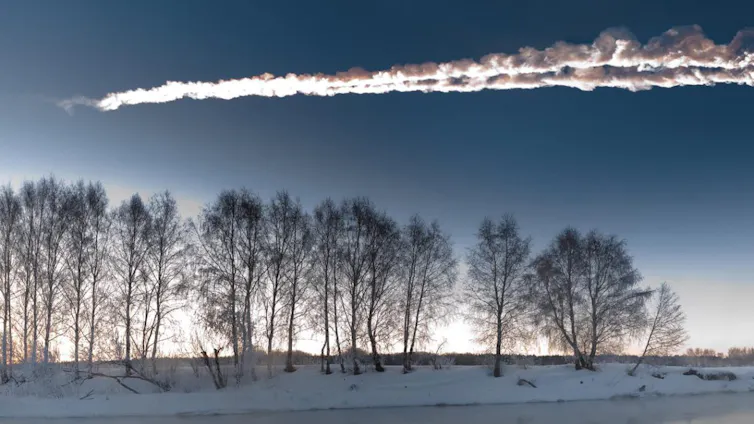
The benchmark for modern atmospheric impacts is the Chelyabinsk meteor, which exploded over Russia on Feb. 15, 2013.
That object was significantly larger than any of the meteors researchers have observed in 2026, measuring 60 feet (18 m) across and weighing roughly 10,000 tons. When it shattered 18 miles (29 km) above the ground, it produced an airburst with an explosive force 30 times greater than the Hiroshima atomic bomb.
The resulting shock wave shattered glass across hundreds of square miles, injuring nearly 1,500 people and registering as a seismic event between 2.7 and 3.7 on the Richter scale. The incident was a stark reminder that while Earth’s atmosphere is an incredibly effective shield, absorbing the lion’s share of cosmic impacts, a large enough kinetic punch can still reach the surface below.
Despite the dramatic stories around these meteor impacts, history shows that the cosmic lottery rarely targets humans directly. In all of recorded history, there is only one universally confirmed case of a person being directly struck by a space rock.
In 1954, an 8.5-pound (3.8 kg) meteorite crashed through the roof of a house in Sylacauga, Alabama, ricocheted off a heavy wooden radio and struck a sleeping woman named Ann Hodges. Though it left a severe bruise on her hip, the radio absorbed the brunt of the impact. Had it not been for the radio, there is a chance she could have been seriously injured or killed by this object.
Living with the cosmos
So, are you in any imminent danger from meteors? The mathematics of the cosmos provide profound reassurance. The statistical odds of being struck by a meteorite are vanishingly small. You stand a better chance of winning a multimillion-dollar lottery jackpot 10 times in a row than ever being hit by a meteorite.
The vast majority of the tons of space debris that bombard Earth daily arrive as harmless dust grains, burning up as elegant meteors or shooting stars. But when the larger pieces do break through and land on our planet, they offer a rare, tangible connection to the beginning of the solar system.
If you ever happen to witness one of these magnificent fireballs ripping open the sky, consider reporting your observation to the American Meteor Society. The organization keeps track of sightings and falls from around the globe. Recovered fragments provide a way for scientists to gain valuable information about the origin of our solar system, and of our home planet.
Shawn Laatsch, Director of the Versant Power Astronomy Center, University of Maine
This article is republished from The Conversation under a Creative Commons license. Read the original article.
📰 Thanks for reading STM Daily News – your source for News You Can Use This Moment!
We love hearing from our readers. Share your thoughts in the comments section and join the conversation with our growing community. Your feedback helps us create the stories and features that matter most to you.
Don’t miss the latest news, inspiring stories, lifestyle tips, food and drink features, and exclusive updates. Subscribe to the STM Daily News newsletter and get our top stories delivered directly to your inbox.
💬 Leave a comment.
📧 Subscribe to our newsletter.
📢 Share your favorite stories with friends and family.
Stay informed, stay connected, and be part of the STM Daily News community at STMDailyNews.com.





