Connect with us

music and concerts

‘The Eternal Queen of Asian Pop’ sings one last encore from beyond the grave

Published

on

The Eternal Queen of Asian Pop
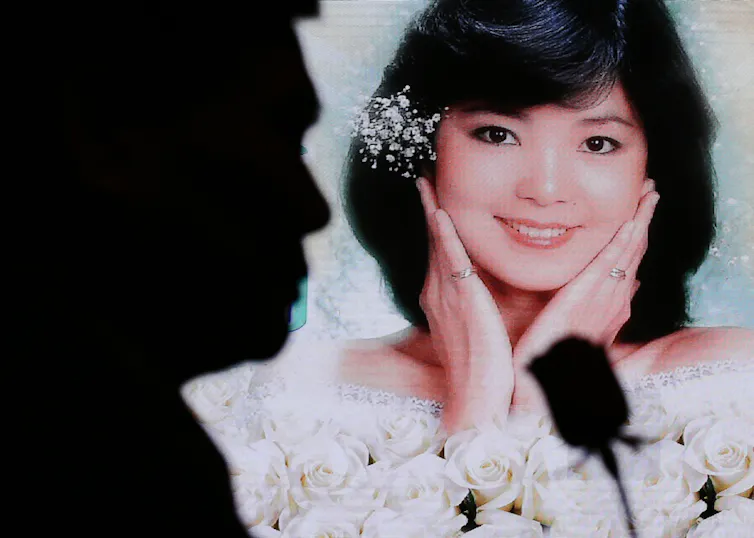
Teresa Teng, who died in 1995, still has legions of fans around the world.
Nora Tam/South China Morning Post via Getty Images

Xianda Huang, University of California, Los Angeles

Several years ago, an employee at Universal Music came across a cassette tape in a Tokyo warehouse while sorting through archival materials. On it was a recording by the late Taiwanese pop star Teresa Teng that had never been released; the pop ballad, likely recorded in the mid-1980s while Teng was living and performing in Japan, was a collaboration between composer Takashi Miki and lyricist Toyohisa Araki.

Now, to the delight of her millions of fans, the track titled “Love Songs Are Best in the Foggy Nightwill appear on an album set to be released on June 25, 2025.

Teng died 30 years ago. Most Americans know little about her life and her body of work. Yet the ballads of Teng, who could sing in Mandarin, Cantonese, Japanese and Indonesian, continue to echo through karaoke rooms, on Spotify playlists, at tribute concerts and at family gatherings across Asia and beyond.

I study how pop music has served as a tool of soft power, and I’ve spent the past several years researching Teng’s music and its legacy. I’ve found that Teng’s influence endures not just because of her voice, but also because her music transcends Asia’s political fault lines.

From local star to Asian icon

Born in 1953 in Yunlin, Taiwan, Teresa Teng grew up in one of the many villages that were built to house soldiers and their families who had fled mainland China in 1949 after the communists claimed victory in the Chinese civil war. Her early exposure to traditional Chinese music and opera laid the foundation for her singing career. By age 6, she was taking voice lessons. She soon began winning local singing competitions.

“It wasn’t adults who wanted me to sing,” Teng wrote in her memoir. “I wanted to sing. As long as I could sing, I was happy.”

At 14, Teng dropped out of high school to focus entirely on music, signing with the local label Yeu Jow Records. Soon thereafter, she released her first album, “Fengyang Flower Drum.” In the 1970s, she toured and recorded across Taiwan, Hong Kong, Japan and Southeast Asia, becoming one of Asia’s first truly transnational pop stars.

Teng’s career flourished in the late 1970s and 1980s. She released some of her most iconic tracks, such as her covers of Chinese singer Zhou Xuan’s 1937 hit “When Will You Return?” and Taiwanese singer Chen Fen-lan’s “The Moon Represents My Heart,” and toured widely across Asia, sparking what came to be known as “Teresa Teng Fever.”

In the early 1990s, Teng was forced to stop performing for health reasons. She died suddenly of an asthma attack on May 8, 1995, while on vacation in Chiang Mai, Thailand, at the age of 42.

China catches Teng Fever

Perhaps the most remarkable aspect of Teng’s story is that Teng Fever peaked in China.

Advertisement
Get More From A Face Cleanser And Spa-like Massage

Teng was ethnically Chinese, with ancestral roots in China’s Shandong province. But the political divide between China and Taiwan following the Chinese civil war had led to decades of hostility, with each side refusing to recognize the legitimacy of the other.

Black and white headshot of smiling young woman.
Teng speaks at a press conference in Hong Kong in 1980.
P.Y. Tang/South China Morning Post via Getty Images

During the late 1970s and 1980s, however, China began to relax its political control under Deng Xiaoping’s Reform and Opening Up policy. This sweeping initiative shifted China toward a market-oriented economy, encouraged foreign trade and investment, and cautiously reintroduced global cultural influences after decades of isolation.

Pop music from other parts of the world began trickling in, including Teng’s tender ballads. Her songs could be heard in coastal provinces such as Guangdong and Shanghai, inland cities such as Beijing and Tianjin, and even remote regions such as Tibet. Shanghai’s propaganda department wrote an internal memo in 1980 noting that her music had spread to the city’s public parks, restaurants, nursing homes and wedding halls.

Teng’s immense popularity in China was no accident; it reflected a time in the country’s history when its people were particularly eager for emotionally resonant art after decades of cultural propaganda and censorship.

For a society that had been awash in rote, revolutionary songs like “The East is Red” and “Union is Strength,” Teng’s music offered something entirely different. It was personal, tender and deeply human. Her gentle, approachable style – often described as “angelic” or like that of “a girl next door” – provided solace and a sense of intimacy that had long been absent from public life.

Teng performs ‘Fly Me to the Moon’ in Taipei in 1984.

Teng’s music was also admired for her ability to bridge eras. Her 1983 album “Light Exquisite Feeling” fused classical Chinese poetry with contemporary Western pop melodies, showcasing her gift for blending the traditional and the modern. It cemented her reputation not just as a pop star but as a cultural innovator.

It’s no secret why audiences across China and Asia were so deeply drawn to her and her music. She was fluent in multiple languages; she was elegant but humble, polite and relatable; she was involved in various charities; and she spoke out in support of democratic values.

A sound of home in distant lands

Throughout the 1990s and early 2000s, the Chinese immigrant population in the United States grew to over 1.1 million. Teng’s music has also deeply embedded itself within Chinese diasporic communities across the country. In cities such as Los Angeles, San Francisco and New York, Chinese immigrants played her music at family gatherings, during holidays and at community events. Walk through any Chinatown during Lunar New Year and you’re bound to hear her voice wafting through the streets.

Young woman wearing blue dresse smiles and poses on a sidewalk filled with pedestrians.
Teng visits New York City’s Chinatown during her 1980 concert tour in the U.S.
Wikimedia Commons

For younger Chinese Americans and even non-Chinese audiences, Teng’s music has become a window into Chinese culture.

When I was studying in the U.S., I often met Asian American students who belted out her songs at karaoke nights or during cultural festivals. Many had grown up hearing her music through their parents’ playlists or local community celebrations.

The release of her recently discovered song is a reminder that some voices do not fade – they evolve, migrate and live on in the hearts of people scattered across the world.

Teresa Teng’s music is still celebrated in Chinatowns across the U.S.

In an age when global politics drive different cultures apart, Teng’s enduring appeal reminds us of something quieter yet more lasting: the power of voice to transmit emotion across time and space, the way a melody can build a bridge between continents and generations.

Advertisement
Get More From A Face Cleanser And Spa-like Massage

I recently rewatched the YouTube video for Teng’s iconic 1977 ballad “The Moon Represents My Heart.” As I read the comments section, one perfectly encapsulated what I had discovered about Teresa Teng in my own research: “Teng’s music opened a window to a culture I never knew I needed.”

Xianda Huang, PhD student in Asian Languages and Cultures, University of California, Los Angeles

This article is republished from The Conversation under a Creative Commons license. Read the original article.

Continue Reading
Advertisement SodaStream USA, inc

Entertainment

30 years after ‘Reasonable Doubt,’ Jay‑Z’s career embodies hip‑hop’s biggest contradictions

Share article

Print article

“Reasonable Doubt” was not the first rap album I ever owned. But Jay-Z’s debut was the first hip-hop album I bought with my own money.

Published

on

file 20260622 57 yob62k.jpg?ixlib=rb 4.1
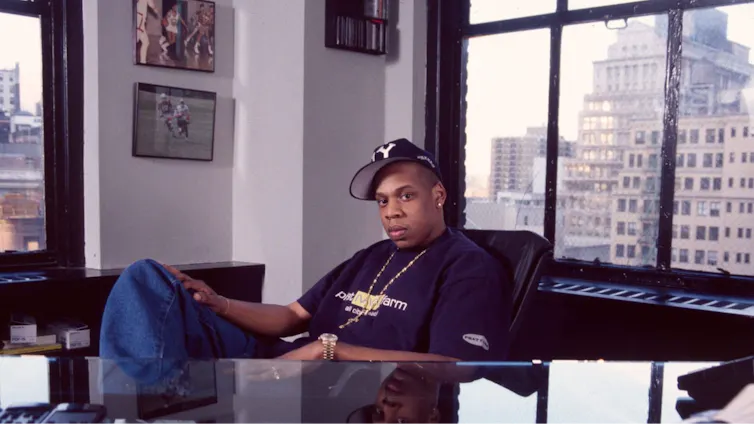
Rapper Jay-Z poses behind his desk in the New York offices of Roc-A-Fella Records in April 1996. Nitro/Getty Images

30 years after ‘Reasonable Doubt,’ Jay‑Z’s career embodies hip‑hop’s biggest contradictions

Jabari M. Evans, University of South Carolina

Reasonable Doubt” was not the first rap album I ever owned. But Jay-Z’s debut was the first hip-hop album I bought with my own money. More importantly, it was the first one I studied as a young writer who aspired to become a rapper, a dream that eventually came true.

Jay-Z sounded cool in a way that resembled a jazz musician more than a conventional rap star. He rapped with a quiet calm that also conveyed supreme confidence. His lyrics were layered, skillful and unorthodox.

Yes, the tracks often revolved around drug dealing. But the hustlers who populated “Reasonable Doubt” weren’t degenerates. They were refined and astute thinkers. And unlike other gangsta rappers, there was a moral quandary at the heart of his storytelling. In tracks like “D’Evils,” Jay-Z’s narrator turns crime, aspiration and paranoia into meditations on capitalism and the psychic cost of wealth:

We used to fight for building blocks

Now we fight for blocks with buildings that make a killing

The closest of friends when we first started

But grew apart as the money grew, and soon grew black-hearted

And later:

My soul is possessed by D’Evils in the form of diamonds and Lexuses

The cinematic complexity displayed in its tracks helps explain why “Reasonable Doubt” was inducted into the Grammy Hall of Fame, and why it still matters 30 years later.

But the album also launched the career of a rapper whose own trajectory has come to mirror hip-hop’s own transformation.

In 1996, hip-hop was still fighting for legitimacy. Three decades later, it had been folded into the mainstream. Kendrick Lamar can win a Pulitzer Prize, Nas can have an endowed fellowship at Harvard University, and Jay-Z, who once couldn’t get signed to a label, can create a label of his own and become a billionaire business mogul.

Advertisement
Get More From A Face Cleanser And Spa-like Massage

Is it even possible for hip-hop to be seen as countercultural in 2026? And what happens when hip-hop’s most successful outsider becomes central to the very institutions he once seemed to challenge?

From moral panic to corporate behemoth

When “Reasonable Doubt” was released, hip-hop was both ascendant and under siege.

In February 1996, Tupac Shakur came out with “All Eyez on Me,” which became one of the bestselling rap albums of all time; seven months later, he was shot and killed. His friend-turned-rival, The Notorious B.I.G., was shot and killed in a drive-by shooting the following year. The media often cast these high-profile deaths as proof that rap music was inseparable from street violence, and the moral panic around hip-hop’s influence on young listeners only intensified.

How times have changed. Today, hip-hop powers advertising campaigns, luxury branding and streaming platforms. According to Nielsen, rap surpassed rock music as the most popular music genre in the U.S. in 2018. Today, it accounts for roughly 1-in-4 on-demand audio streams.

Jay-Z has played an outsized role in that transformation.

Since 1998, he’s won 25 Grammys for his own music. In that time, he’s also built a business empire. There’s his talent agency, Roc Nation; his streaming platform, TIDAL; his venture capital firm, Marcy Venture Partners; and his luxury alcohol brands, Armand de Brignac and D’Ussé. Through Roc Nation, he’s also a strategic partner with the NFL, advising the football league on its entertainment programming.

Forbes currently pegs his net worth at US$2.8 billion.

An older blonde man wearing a polo shirt and a Black man wearing a black baseball cap laugh while sitting next to one another.
NFL Commissioner Roger Goodell meets with Jay-Z to announce a new partnership between Roc Nation and the NFL on Aug. 14, 2019, in New York. Kevin Mazur/Getty Images for Roc Nation

Confronted on capitalism

In April 2026, GQ published a long interview with Jay-Z.

This was a big deal: Jay-Z hadn’t interacted with the media like this since 2017, when he was promoting his 13th solo album, “4:44.”

How would one of hip-hop’s elder statesmen reflect on his career and his many successes?

In the interview, Jay-Z didn’t present his riches as a complicated outcome of capitalism’s contradictions. Instead, he talked about his wealth as if it were something his critics had failed to understand. When asked about the belief that there’s something inherently suspect about accumulating so much money, he pushed back:

Advertisement
Get More From A Face Cleanser And Spa-like Massage

“It’s almost like a cop-out. You get to demonize this group of folks without fixing the actual system that exists […] Your morality defines who you are. Your morality is not defined by a dollar amount.”

As for the notion that his career trajectory was somehow hypocritical:

“The only thing I heard coming up was the American dream. You could make it, if you pull yourself up by the bootstraps. I heard that my entire life – until we started being successful. Then it was like: You’re selling out because you’re making money.”

He then went on to insist that being handsomely paid is not some sort of betrayal to hip-hop, art or his community.

“I make art first and then I make sure that I’m compensated for my art. … That [capitalist] structure exists; I just see the world for what it is, not for what I want it to be. I’m a realist.”

To me, Jay-Z certainly sounded persuasive. He also sounded defensive. I think that’s because hip-hop has long been haunted by the idea that wealth compromises credibility, even as the tracks have always contained aspirational themes of luxury and entrepreneurship.

Don’t hate the player, hate the game

For my generation, Jay-Z sold aspiration in addition to albums.

I wore Rocawear denim suits in high school with a kind of conviction that now feels almost funny to admit. In college, drinking Belvedere vodka, which appeared in many a Jay-Z track in the early 2000s, felt like a rite of passage.

That’s because Jay made luxury seem urbane, sophisticated and distinctly Black. Even later in life, when I’d smoke Cohiba cigars, drink D’USSÉ or read about art collecting, I felt like I was living inside a script he had helped write.

Looking back, I can see that much of my admiration for him was cloaked in materialism. Now, I think about the work of political scientist Cedric Robinson, who wrote extensively about what he called “racial capitalism.”

He argued that capitalism has always been structured through race. It does not merely tolerate racial hierarchy; it depends on it. That means Black wealth – even spectacular Black wealth – does not automatically equal Black liberation. One Black billionaire can be held up as evidence of progress, while the broader system that continues to produce Black inequality remains intact.

In other words, if Jay-Z’s ascent becomes shorthand for Black progress, then the critique of the system that continues to oppress those at the margins starts to fade. The culture begins to confuse exceptional mobility with collective freedom.

At the same time, I don’t think Jay-Z can be simply understood as a sellout. Communication scholar A.J. Escoffery has written a lot about what he calls “reparative media.” Essentially, he calls for media institutions to do more than offer tokens of representation to marginalized communities. Media companies need to be built or owned by those communities.

Advertisement
Get More From A Face Cleanser And Spa-like Massage

Jay-Z’s defenders will sometimes describe him along these lines – as a Robin Hood-like figure who has taken capital from historically white-owned institutions and redirected some of it toward Black communities or Black entrepreneurs. Even if those gestures remain, at heart, capitalist – like his investments in cannabis brands – he’ll often use his positioning and clout to fund minority-owned businesses.

In the GQ interview, the rapper seemed to acknowledge the compromises he felt compelled to make, and he spoke of the limits Black artists face in industries they do not own:

“[There’s] nowhere you’re going to go that Black people control distribution and control media. At some point you’re going to have to partner with somebody.”

In that, Jay-Z highlights what hip-hop continues to grapple with. The genre no longer has to prove it belongs in the mainstream. But it has to figure out what it means to survive without being fully absorbed by it.

Jabari M. Evans, Assistant Professor of Race and Media, School of Journalism and Mass Communications, University of South Carolina

This article is republished from The Conversation under a Creative Commons license. Read the original article.

📰 Enjoying STM Daily News? Join the conversation!

💬 Leave a comment, share your thoughts, and subscribe to our newsletter for the latest stories, updates, and “News You Can Use This Moment!” delivered to your inbox.

Stay connected with STM Daily News!

Advertisement
Get More From A Face Cleanser And Spa-like Massage

Start Your Morning Informed

Get the STM Morning Brief delivered to your inbox every weekday with breaking news, transportation updates, technology, science, and trending stories.

STM News Brief Ad 2

We don’t spam! Read our privacy policy for more info.

Continue Reading

Entertainment

‘Jaws’ and the two musical notes that changed Hollywood forever

Published

on

Jaws
Many film historians see ‘Jaws’ as the first true summer blockbuster.
Steve Kagan/Getty Images

Jared Bahir Browsh, University of Colorado Boulder

“Da, duh.”

Two simple notes – E and F – have become synonymous with tension, fear and sharks, representing the primal dread of being stalked by a predator.

And they largely have “Jaws” to thank.

Fifty years ago, Steven Spielberg’s blockbuster film – along with its spooky score composed by John Williams – convinced generations of swimmers to think twice before going in the water.

As a scholar of media history and popular culture, I decided to take a deeper dive into the staying power of these two notes and learned about how they’re influenced by 19th-century classical music, Mickey Mouse and Alfred Hitchcock.

The first summer blockbuster

In 1964, fisherman Frank Mundus killed a 4,500-pound great white shark off Long Island.

After hearing the story, freelance journalist Peter Benchley began pitching a novel based on three men’s attempt to capture a man-eating shark, basing the character of Quint off of Mundus. Doubleday commissioned Benchley to write the novel, and in 1973, Universal Studios producers Richard D. Zanuck and David Brown purchased the film rights to the novel before it was published. The 26-year-old Spielberg was signed on to be the director.

Tapping into both mythical and real fears regarding great white sharks – including an infamous set of shark attacks along the Jersey Shore in 1916 – Benchley’s 1974 novel became a bestseller. The book was a key part of Universal’s marketing campaign, which began several months before the film’s release.

Starting in the fall of 1974, Zanuck, Brown and Benchley appeared on a number of radio and television programs to simultaneously promote the release of the paperback edition of the novel and the upcoming film. The marketing also included a national television advertising campaign that featured emerging composer Williams’ two-note theme. The plan was for a summer release, which, at the time, was reserved for films with less than stellar reviews.

TV ads promoting the film featured John Williams’ two-note theme.

Films at the time typically were released market by market, preceded by local reviews. However, Universal’s decision to release the film in hundreds of theaters across the country on June 20, 1975, led to huge up-front profits, sparking a 14-week run as the No. 1 film in the U.S.

Many consider “Jaws” the first true summer blockbuster. It catapulted Spielberg to fame and kicked off the director’s long collaboration with Williams, who would go on to earn the second-highest number of Academy Award nominations in history – 54 – behind only Walt Disney’s 59.

The film’s beating heart

Though it’s now considered one of the greatest scores in film history, when Williams proposed the two-note theme, Spielberg initially thought it was a joke.

But Williams had been inspired by 19th and 20th century composers, including Claude Debussy, Igor Stravinsky and especially Antonin Dvorak’s Symphony No. 9, “From the New World.” In the “Jaws” theme, you can hear echoes of the end of Dvorak’s symphony, as well as the sounds of another character-driven musical piece, Sergei Prokofiev’s “Peter and the Wolf.”

“Peter and the Wolf” and the score from “Jaws” are both prime examples of leitmotifs, or a musical piece that represents a place or character.

The varying pace of the ostinato – a musical motif that repeats itself – elicits intensifying degrees of emotion and fear. This became more integral as Spielberg and the technical team struggled with the malfunctioning pneumatic sharks that they’d nicknamed “Bruce,” after Spielberg’s lawyer.

As a result, the shark does not appear until the 81-minute mark of the 124-minute film. But its presence is felt through Williams’ theme, which some music scholars have theorized evoke the shark’s heartbeat.

A fake shark emerging and attacking an actor on the deck of a fishing boat.
Mechanical issues with ‘Bruce,’ the mechanical shark, during filming forced Steven Spielberg to rely more on mood and atmosphere.
Screen Archives/Moviepix via Getty Images

Sounds to manipulate emotions

Williams also has Disney to thank for revolutionizing character-driven music in film.

The two don’t just share a brimming trophy case. They also understood how music can heighten emotion and magnify action for audiences.

Although his career started in the silent film era, Disney became a titan of film, and later media, by leveraging sound to establish one of the greatest stars in media history, Mickey Mouse.

When Disney saw “The Jazz Singer” in 1927, he knew that sound would be the future of film.

On Nov. 18, 1928, “Steamboat Willie” premiered at Universal’s Colony Theater in New York City as Disney’s first animated film to incorporate synchronized sound.

Unlike previous attempts to bring sound to film by having record players concurrently play or deploying live musicians to perform in the theater, Disney used technology that recorded sound directly on the film reel.

It wasn’t the first animated film with synchronized sound, but it was a technical improvement to previous attempts at it, and “Steamboat Willie” became an international hit, launching Mickey’s – and Disney’s – career.

The use of music or sound to match the rhythm of the characters on screen became known as “Mickey Mousing.”

“King Kong” in 1933 would deftly deploy Mickey Mousing in a live action film, with music mimicking the giant gorilla’s movements. For example, in one scene, Kong carries away Ann Darrow, who’s played by actress Fay Wray. Composer Max Steiner uses lighter tones to convey Kong’s curiosity as he holds Ann, followed by ominous, faster, tones as Ann escapes and Kong chases after her. In doing so, Steiner encourages viewers to both fear and connect with the beast throughout the film, helping them suspend disbelief and enter a world of fantasy.

Mickey Mousing declined in popularity after World War II. Many filmmakers saw it as juvenile and too simplistic for the evolving and advancing film industry.

When less is more

In spite of this criticism, the technique was still used to score some iconic scenes, like the playing of violins in the shower as Marion Crane is stabbed in Alfred Hitchcock’s “Psycho.”

Spielberg idolized Hitchcock. A young Spielberg was even kicked off the Universal lot after sneaking on to watch the production of Hitchcock’s 1966 film “Torn Curtain.”

Although Hitchcock and Spielberg never met, “Jaws” clearly exhibits the influence of Hitchcock, the “Master of Suspense.” And maybe that’s why Spielberg initially overcame his doubts about using something so simple to represent tension in the thriller.

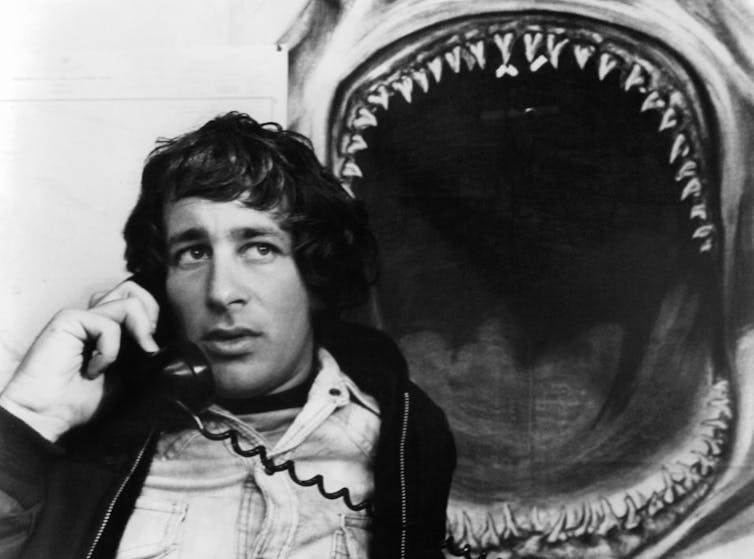
Young man with shoulder-length hair speaks on the phone in front of an image of a shark with its mouth open.
Steven Spielberg was just 26 years old when he signed on to direct ‘Jaws.’
Universal/Getty Images

The use of the two-note motif helped overcome the production issues Spielberg faced directing the first feature length movie to be filmed on the ocean. The malfunctioning animatronic shark forced Spielberg to leverage Williams’ minimalist theme to represent the shark’s ominous presence in spite of the limited appearances by the eponymous predatory star.

As Williams continued his legendary career, he would deploy a similar sonic motif for certain “Star Wars” characters. Each time Darth Vader appeared, the “Imperial March” was played to set the tone for the leader of the dark side.

As movie budgets creep closer to a half-billion dollars, the “Jaws” theme – and the way those two notes manipulate tension – is a reminder that in film, sometimes less can be more.

Jared Bahir Browsh, Assistant Teaching Professor of Critical Sports Studies, University of Colorado Boulder

This article is republished from The Conversation under a Creative Commons license. Read the original article.

Dive into “The Knowledge,” where curiosity meets clarity. This playlist, in collaboration with STMDailyNews.com, is designed for viewers who value historical accuracy and insightful learning. Our short videos, ranging from 30 seconds to a minute and a half, make complex subjects easy to grasp in no time. Covering everything from historical events to contemporary processes and entertainment, “The Knowledge” bridges the past with the present. In a world where information is abundant yet often misused, our series aims to guide you through the noise, preserving vital knowledge and truths that shape our lives today. Perfect for curious minds eager to discover the ‘why’ and ‘how’ of everything around us. Subscribe and join in as we explore the facts that matter.  https://stmdailynews.com/the-knowl

Continue Reading

music and concerts

Hillbilly Bible Film Relaunch Honors John Amos, Adds Voyage Air Guitar Giveaway

Hillbilly Bible, a Memphis-rooted faith-based dramedy dedicated to John Amos, is set to begin production in Fall 2026 and is launching a $30 fan campaign with a Voyage Air Guitar giveaway.

Published

on

MEMPHIS, Tenn. — Hillbilly Bible, a Memphis-rooted, music-driven faith-based dramedy, is being relaunched by Hillbilly Bible Movie LLC in association with MVP3 Foundation and MVP3 Network, with director KC Amos stepping in to honor the legacy of his father, actor John Amos.

acoustic guitar player in music studio. Hillbilly Bible
Photo by Caique Araujo on Pexels.com

The film is supported by Voyage Air Guitar as the leading product placement title sponsor and is scheduled to begin production in Fall 2026, with filming planned in Memphis and Nashville, Tennessee, and Clarksdale, Mississippi.

What the film is about

Written by Marie Pizano with co-writer Mark Selker and inspired by the book title Hillbilly Bible by Stevie Rey, the PG-13 story follows Billy Madden, a former foster kid whose early trauma shadows his adult life.

After a public fall tied to pride and addiction, Billy heads south searching for a legendary bluesman known as the “Cool Cat Jesus,” believing the musician can help restore his broken career.

Instead, he meets unexpected messengers who challenge him to face humility, inner-child wounds, and the cost of chasing applause over purpose.

The film tracks Billy’s road to repentance, healing, and restored identity, blending music, drama, and humor while carrying a dedication to John Amos.

The creative team

Pizano leads the project alongside director KC Amos and co-director Al Coronel, who makes his directorial debut. The producing team also includes Kent Wells, a longtime producer associated with Dolly Parton.

“This story carries the spirit of all of us,” Pizano said in the announcement. “We all stumble and fall, but we can get back up and find our ‘yes.’”

Fan campaign + giveaway

To bring supporters into the rollout, the film is launching a $30 fan supporter campaign and a Voyage Air Guitar giveaway. Organizers say the campaign is designed to give back to foster youth, ministries, and mental health advocacy.

Each supporter package includes an exclusive Hillbilly Bible T-shirt, entry into the Voyage Air Guitar giveaway, and access to a private screening before any wider public release.

More details and official rules are available at https://hillbillybiblemovie.com/. Fans can also follow the official Facebook page at https://www.facebook.com/share/1ApXMKqqA1/?mibextid=wwXIfr.

Advertisement
Get More From A Face Cleanser And Spa-like Massage

What to Watch For

  • Fall 2026 production start and location updates (Memphis, Nashville, Clarksdale)
  • News from press-only conferences set for March 25, 2026 (Memphis and Clarksdale), plus a later Nashville event
  • Casting, music partnerships, and additional sponsor announcements as the project ramps up

Sources: hillbillybiblemovie.com
Official Facebook page

STM Daily News’ Entertainment section delivers the latest on movies, television, music, pop culture, events, and industry buzz. From breaking news and trending stories to feature coverage and community-centered entertainment reporting, it keeps readers connected to what’s happening on screen, on stage, and beyond.

Continue Reading

Trending