The word “HAM” has an interesting origin story in the world of amateur radio. In 1908, a group of amateurs from the Harvard Radio Club, consisting of Albert S. Hyman, Bob Almy, and Poogie Murray, set up the first amateur wireless station. Initially, they called their station “Hyman-Almy-Murray,” which was quite a mouthful. They needed something shorter, snappier, and more memorable.
It was during a conversation with a fellow operator that the group stumbled upon the word “ham.” The operator in question had commented that their signals were “hammy,” which meant that they were distorted and hard to understand. The group embraced this word and decided to adopt it as their station call. And thus, the first amateur wireless station became known as “HAM.”
The word “ham” quickly caught on and became a popular term among amateur radio operators. It’s easy to see why. It’s short, catchy, and memorable. And it has a certain charm to it that just rolls off the tongue. But beyond its linguistic appeal, the word “ham” also had a deeper meaning for those early radio enthusiasts.
Amateur radio was a new and exciting technology at the time, and it was still largely unregulated. Operators were free to experiment and explore, and there was a sense of camaraderie and shared enthusiasm among those who were working with this new technology. The word “ham” embodied this spirit of experimentation and exploration. It was a nod to the fact that these operators were “amateurs” in the truest sense of the word – they were doing this for the love of the hobby, not for any financial gain or professional recognition.
Over time, the word “ham” became more than just a station call. It became a term of endearment for those who were part of the amateur radio community. It was a way of identifying oneself as a member of this exclusive group, and it was a source of pride and identity.
Today, the word “ham” is still widely used in the world of amateur radio. It’s a reminder of the early days of this technology – a time when radio was still a wild and uncharted frontier. And it’s a tribute to those early pioneers who paved the way for the hobby that we know and love today.
Amateur radio, affectionately called “ham radio,” has continued to evolve and adapt with the times. From its early experiments with spark-gap transmitters to today’s sophisticated digital modes, the spirit of innovation and exploration remains at its core. Modern hams can communicate using voice, text, and even images, bouncing signals off satellites or the moon. The International Space Station even has its own ham radio station, enabling astronauts to connect with amateur radio enthusiasts back on Earth.
The broader ham community also plays an invaluable role in public service. During natural disasters and emergencies, when conventional communication systems fail, amateur radio operators step in to provide critical communication links. Their dedication and skill have saved countless lives and helped communities recover from crises.
This vibrant global community is made up of enthusiasts from all walks of life, sharing their knowledge and fostering a mutual appreciation for the art and science of communication. Clubs and gatherings, both in-person and online, offer opportunities to grow and learn together, emphasizing the strong sense of camaraderie that has been a hallmark of ham radio since its inception.
As technology continues to advance, one thing remains certain: the spirit of “ham” will endure, inspiring future generations of amateur radio operators to push the boundaries of what’s possible, just as those enterprising young men from Harvard did over a century ago.
Advertisement
In conclusion, the word “ham” has a rich and fascinating history in the world of amateur radio. It’s a symbol of the spirit of exploration and experimentation that drove the early pioneers of this technology. And it’s a reminder of the camaraderie and sense of community that has always been at the heart of the amateur radio hobby. So the next time you hear the word “ham” in the context of amateur radio, remember the story behind it and the legacy that it represents.
More information on HAM and amateur radio origins and operations reveals a rich history dating back to the early 20th century. Initially used by hobbyists and experimenters, HAM radio quickly became a valuable tool for long-distance communication and emergency services. Operators, known as “hams,” often build their own equipment and communicate with others around the world using various frequency bands allocated for amateur use. The community thrives on a culture of learning and experimentation, with organizations like the American Radio Relay League (ARRL) providing support and advocacy for enthusiasts. Today, HAM radio remains a popular and vital means of communication, bridging gaps where modern technology may falter, and continues to attract new generations of operators dedicated to exploring the limits of radio science. https://en.wikipedia.org/wiki/Amateur_radio_operator
The science section of our news blog STM Daily News provides readers with captivating and up-to-date information on the latest scientific discoveries, breakthroughs, and innovations across various fields. We offer engaging and accessible content, ensuring that readers with different levels of scientific knowledge can stay informed. Whether it’s exploring advancements in medicine, astronomy, technology, or environmental sciences, our science section strives to shed light on the intriguing world of scientific exploration and its profound impact on our daily lives. From thought-provoking articles to informative interviews with experts in the field, STM Daily News Science offers a harmonious blend of factual reporting, analysis, and exploration, making it a go-to source for science enthusiasts and curious minds alike. https://stmdailynews.com/category/science/
Rod: A creative force, blending words, images, and flavors. Blogger, writer, filmmaker, and photographer. Cooking enthusiast with a sci-fi vision. Passionate about his upcoming series and dedicated to TNC Network. Partnered with Rebecca Washington for a shared journey of love and art.
Rod: A creative force, blending words, images, and flavors. Blogger, writer, filmmaker, and photographer. Cooking enthusiast with a sci-fi vision. Passionate about his upcoming series and dedicated to TNC Network. Partnered with Rebecca Washington for a shared journey of love and art.
Unlike other big tech companies, OpenAI is a nonprofit with a for-profit subsidiary that is overseen by a nonprofit board of directors. Since its founding in 2015, OpenAI’s official mission has been “to build artificial general intelligence (AGI) that is safe and benefits all of humanity.”
By late September 2024, The Associated Press, Reuters, The Wall Street Journal and many other media outlets were reporting that OpenAI plans to discard its nonprofit status and become a for-profit tech company managed by investors. These stories have all cited anonymous sources. The New York Times, referencing documents from the recent funding round, reported that unless this change happens within two years, the $6.6 billion in equity would become debt owed to the investors who provided that funding.
The Conversation U.S. asked Alnoor Ebrahim, a Tufts University management scholar, to explain why OpenAI’s leaders’ reported plans to change its structure would be significant and potentially problematic.
How have its top executives and board members responded?
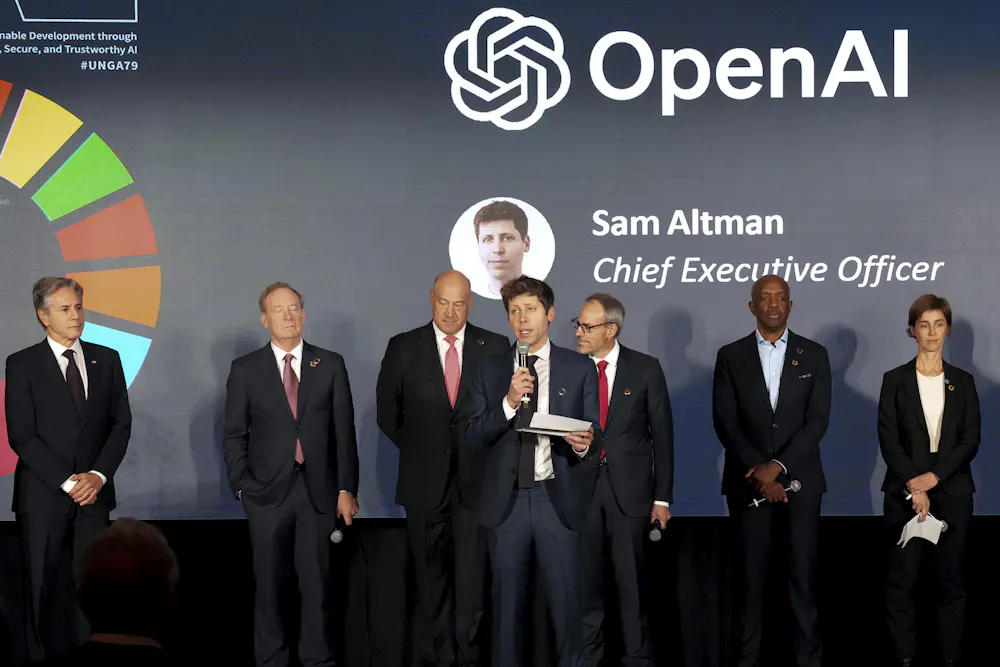
There has been a lot of leadership turmoil at OpenAI. The disagreements boiled over in November 2023, when its board briefly ousted Sam Altman, its CEO. He got his job back in less than a week, and then three board members resigned. The departing directors were advocates for building stronger guardrails and encouraging regulation to protect humanity from potential harms posed by AI.
OpenAI’s deep-pocketed investors cannot own shares in the organization under its existing nonprofit governance structure, nor can they get a seat on its board of directors. That’s because OpenAI is incorporated as a nonprofit whose purpose is to benefit society rather than private interests. Until now, all rounds of investments, including a reported total of $13 billion from Microsoft, have been channeled through a for-profit subsidiary that belongs to the nonprofit.
The current structure allows OpenAI to accept money from private investors in exchange for a future portion of its profits. But those investors do not get a voting seat on the board, and their profits are “capped.” According to information previously made public, OpenAI’s original investors can’t earn more than 100 times the money they provided. The goal of this hybrid governance model is to balance profits with OpenAI’s safety-focused mission.
Becoming a for-profit enterprise would make it possible for its investors to acquire ownership stakes in OpenAI and no longer have to face a cap on their potential profits. Down the road, OpenAI could also go public and raise capital on the stock market.
Advertisement
Altman reportedly seeks to personally acquire a 7% equity stake in OpenAI, according to a Bloomberg article that cited unnamed sources.
That arrangement is not allowed for nonprofit executives, according to BoardSource, an association of nonprofit board members and executives. Instead, the association explains, nonprofits “must reinvest surpluses back into the organization and its tax-exempt purpose.”
What kind of company might OpenAI become?
The Washington Post and other media outlets have reported, also citing unnamed sources, that OpenAI might become a “public benefit corporation” – a business that aims to benefit society and earn profits.
It’s more typical that a for-profit business – not a nonprofit – becomes a benefit corporation, according to the B Lab, a network that sets standards and offers certification for B Corps. It is unusual for a nonprofit to do this because nonprofit governance already requires those groups to benefit society.
Boards of companies with this legal status are free to consider the interests of society, the environment and people who aren’t its shareholders, but that is not required. The board may still choose to make profits a top priority and can drop its benefit status to satisfy its investors. That is what online craft marketplace Etsy did in 2017, two years after becoming a publicly traded company.
In my view, any attempt to convert a nonprofit into a public benefit corporation is a clear move away from focusing on the nonprofit’s mission. And there will be a risk that becoming a benefit corporation would just be a ploy to mask a shift toward focusing on revenue growth and investors’ profits.
But I think OpenAI has a possible workaround: It could try to dilute the nonprofit’s control by making it a minority shareholder in a new for-profit structure. This would effectively eliminate the nonprofit board’s power to hold the company accountable. Such a move could lead to an investigation by the office of the relevant state attorney general and potentially by the Internal Revenue Service.
What could happen if OpenAI turns into a for-profit company?
If OpenAI, an industry leader, begins to focus more on earning profits than ensuring AI’s safety, I believe that these dangers could get worse. Geoffrey Hinton, who won the 2024 Nobel Prize in physics for his artificial intelligence research, has cautioned that AI may exacerbate inequality by replacing “lots of mundane jobs.” He believes that there’s a 50% probability “that we’ll have to confront the problem of AI trying to take over” from humanity.
And even if OpenAI did retain board members for whom safety is a top concern, the only common denominator for the members of its new corporate board would be their obligation to protect the interests of the company’s shareholders, who would expect to earn a profit. While such expectations are common on a for-profit board, they constitute a conflict of interest on a nonprofit board where mission must come first and board members cannot benefit financially from the organization’s work.
The arrangement would, no doubt, please OpenAI’s investors. But would it be good for society? The purpose of nonprofit control over a for-profit subsidiary is to ensure that profit does not interfere with the nonprofit’s mission. Without guardrails to ensure that the board seeks to limit harm to humanity from AI, there would be little reason for it to prevent the company from maximizing profit, even if its chatbots and other AI products endanger society.
Regardless of what OpenAI does, most artificial intelligence companies are already for-profit businesses. So, in my view, the only way to manage the potential harms is through better industry standards and regulations that are starting to take shape.
California’s governor vetoed such a bill in September 2024 on the grounds it would slow innovation – but I believe slowing it down is exactly what is needed, given the dangers AI already poses to society.
Alnoor Ebrahim, Thomas Schmidheiny Professor of International Business, The Fletcher School & Tisch College of Civic Life, Tufts University
The science section of our news blog STM Daily News provides readers with captivating and up-to-date information on the latest scientific discoveries, breakthroughs, and innovations across various fields. We offer engaging and accessible content, ensuring that readers with different levels of scientific knowledge can stay informed. Whether it’s exploring advancements in medicine, astronomy, technology, or environmental sciences, our science section strives to shed light on the intriguing world of scientific exploration and its profound impact on our daily lives. From thought-provoking articles to informative interviews with experts in the field, STM Daily News Science offers a harmonious blend of factual reporting, analysis, and exploration, making it a go-to source for science enthusiasts and curious minds alike. https://stmdailynews.com/category/science/
Why do people get headaches? – Evie V., age 10, Corpus Christi, Texas
Whether sharp and stabbing or dull and throbbing, a headache can ruin your day. But your brain doesn’t actually feel pain. So what is going on when it feels like your head is in a vise or about to explode? I am a child neurologist – that is, a doctor who specializes in diseases of the brain in kids. Most of my patients are kids and adolescents who are struggling with headaches. Head pain is complicated, and there is still a lot to learn about what causes it and how it can be treated. But researchers know there are a few key players that take part in generating pain.
What are headaches?
Nerves communicate information like pain through electrical signals between the body and the brain. While the brain itself doesn’t have any nerve sensors to feel pain, blood vessels in the head and structures that protect and surround the brain do sense pain. When these tissues detect injury or damage, they release chemicals that trigger transmission of electrical signals through nerves to tell the brain the head is hurting. The brain will also use nerves to signal the body to respond to pain with symptoms like feeling tired, teary eyes, runny nose, upset stomach and discomfort in bright or loud environments. It’s not clear why humans evolved to feel these symptoms, but some scientists theorize that this can lead to healthier lifestyle choices to decrease the chance of future headache attacks.Weather changes are one of the most commonly reported migraine triggers. Danielle Wilhour, a neurologist and headache specialist at University of Colorado Anschutz Medical Campus, explains why shifts in weather can bring on migraines — and what you can do to ease the pain.
What causes headaches?
Often, headaches are a sign that the body is under some kind of stress. That stress triggers chemical and physical changes to the nerves and blood vessels around your brain, head and neck that can cause headaches. Many types of stresses can cause headaches, including an infection, allergies, hormone changes during puberty and menstrual cycles, not getting enough sleep, not drinking enough water, skipping meals or drinking too much caffeine or alcohol. Sometimes, headaches happen with emotional stress, like feeling anxious or depressed. Even pressure in your sinuses due to changes in the weather can cause your head to hurt. One in 11 kids have had a type of severe headache called a migraine. They feel like a pulsing and pounding pain in your head and come with other symptoms, including nausea or being sensitive to lights and sounds. During a migraine, it can be hard to do everyday activities because they can make the pain worse. It is also very common to feel unwell or irritable before the head pain starts and after the pain is gone.Migraines and chronic headaches can be debilitating.Viktoriya Skorikova/Moment via Getty Images Migraines occur when the nerves and other structures used in signaling and interpreting pain aren’t working properly, leading to pain and discomfort from stimulation that wouldn’t normally provoke this. There are many environmental and genetic factors that contribute to this dysfunction. Some people are born with a higher risk of developing migraines. Most people with migraines have someone in their family who also experiences them.
What can treat and prevent headaches?
Identifying what type of headache you’re experiencing is crucial to making sure it is treated properly. Because migraines can be severe, they’re the type of headache that most often leads to doctor’s visits for both kids and adults. There are several ways to reduce your chances of having headaches, such as drinking plenty of water and limiting caffeine. Eating, sleeping and exercising regularly are other ways you can help prevent headaches.Sleep deprivation can worsen headaches.DjelicS/iStock via Getty Images Plus While painkillers like ibuprofen are often enough to relieve a headache, prescription medications are sometimes necessary to make head pain more bearable. Some medications can also help control or prevent headache episodes. Physical therapy to exercise the body or behavioral therapy to work on the mind can also help you manage headache pain. There are even electronic devices to treat headaches by stimulating different parts of the nervous system. It is important to talk with a doctor about headaches, especially if it’s a new problem or you experience a change in how they usually feel. Sometimes, brain imaging or blood tests are needed to rule out another health issue. Recognizing a headache problem early will help your doctor get started on helping you figure out the best way to treat it.Hello, curious kids! Do you have a question you’d like an expert to answer? Ask an adult to send your question to CuriousKidsUS@theconversation.com. Please tell us your name, age and the city where you live.And since curiosity has no age limit – adults, let us know what you’re wondering, too. We won’t be able to answer every question, but we will do our best.Katherine Cobb-Pitstick, Assistant Professor of Child Neurology, University of Pittsburgh This article is republished from The Conversation under a Creative Commons license. Read the original article.
Unlikely Collaborators is bringing astrophysicist Dr. Lisa Kaltenegger to Santa Monica for a conversation centered on one of science’s most enduring questions: Are we alone in the universe? The event, part of the organization’s Spark Salon series, took place on March 17 at 7:00 p.m. PT and was offered both in person and via livestream.
Kaltenegger, founding director of the Carl Sagan Institute at Cornell University and a professor of astronomy, is widely recognized for her work on habitable exoplanets and the search for detectable signs of life beyond Earth. Her talk focused not only on the science of planet hunting, but also on the assumptions people bring to questions about life, habitability, and reality itself.
On March 17 at 7 PM PT, Unlikely Collaborators hosts Cornell astronomer and Carl Sagan Institute Founding Director Dr. Lisa Kaltenegger for Spark Salon: Are We Alone in the Universe? Explore the search for life on distant worlds and the deeper question of how our assumptions shape what we recognize as life, reality, and possibility. In person in Santa Monica + livestream.
According to the event announcement, the discussion examined how scientists interpret data from distant worlds and asked broader questions about what counts as life, what makes a planet habitable, and how human perspective can shape discovery. The program also highlighted how the search for life beyond Earth can challenge long-held ideas about what is normal, possible, and even alive.
The evening included a reception, the main program, and a book signing. In-person guests also received a complimentary copy of Kaltenegger’s book, Alien Earths: The New Science for Planet Hunting in the Cosmos.
Unlikely Collaborators, founded by Elizabeth R. Koch, describes itself as a nonprofit focused on helping people better understand themselves and the world through its Perception Box framework. The Spark Salon series regularly brings together researchers, artists, and thought leaders for conversations designed to challenge perspective and encourage reflection.
Dive into “The Knowledge,” where curiosity meets clarity. This playlist, in collaboration with STMDailyNews.com, is designed for viewers who value historical accuracy and insightful learning. Our short videos, ranging from 30 seconds to a minute and a half, make complex subjects easy to grasp in no time. Covering everything from historical events to contemporary processes and entertainment, “The Knowledge” bridges the past with the present. In a world where information is abundant yet often misused, our series aims to guide you through the noise, preserving vital knowledge and truths that shape our lives today. Perfect for curious minds eager to discover the ‘why’ and ‘how’ of everything around us. Subscribe and join in as we explore the facts that matter. https://stmdailynews.com/the-knowledge/