Connect with us

STM Blog

Meet Irene Curie, the Nobel-winning atomic physicist who changed the course of modern cancer treatment

Published

on

Last Updated on March 20, 2026 by Daily News Staff

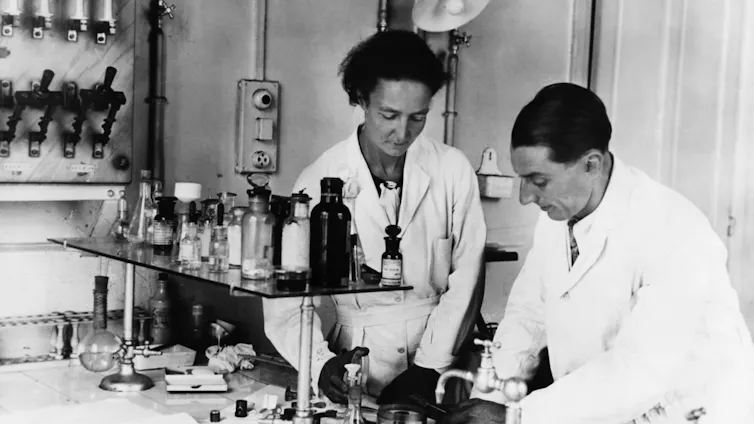
Irene Curie
Irene and Frederic Joliot-Curie shared the Nobel Prize in 1935.
Bettmann/Contributor via Getty Images

Meet Irene Curie, the Nobel-winning atomic physicist who changed the course of modern cancer treatment

Artemis Spyrou, Michigan State University and Andrea Richard, Ohio University

The adage goes “like mother like daughter,” and in the case of Irene Joliot-Curie, truer words were never spoken. She was the daughter of two Nobel Prize laureates, Marie Curie and Pierre Curie, and was herself awarded the Nobel Prize in chemistry in 1935 together with her husband, Frederic Joliot.

While her parents received the prize for the discovery of natural radioactivity, Irene’s prize was for the synthesis of artificial radioactivity. This discovery changed many fields of science and many aspects of our everyday lives. Artificial radioactivity is used today in medicine, agriculture, energy production, food sterilization, industrial quality control and more.

Two portraits, one on the left of a man with dark hair wearing a suit, Frederic Joliot, and on the right, of Irene Joliot-Curie, who has ear-length hair.
Frederic Joliot and Irene Joliot-Curie.
Wellcome Collection, CC BY

We are two nuclear physicists who perform experiments at different accelerator facilities around the world. Irene’s discovery laid the foundation for our experimental studies, which use artificial radioactivity to understand questions related to astrophysics, energy, medicine and more.

Early years and battlefield training

Irene Curie was born in Paris, France, in 1897. In an unusual schooling setup, Irene was one of a group of children taught by their academic parents, including her own by then famous mother, Marie Curie.

Marie Curie sits at a table with scientific equipment on it. Irene Curie stands next to her, fiddling with the equipment.
Marie Curie and her daughter Irene were both scientists studying radioactivity.
Wellcome Collection, CC BY

World War I started in 1914, when Irene was only 17, and she interrupted her studies to help her mother find fragments of bombs in wounded soldiers using portable X-ray machines. She soon became an expert in these wartime radiology techniques, and on top of performing the measurements herself, she also spent time training nurses to use the X-ray machines.

After the war, Irene went back to her studies in her mother’s lab at the Radium Institute. This is where she met fellow researcher Frederic Joliot, whom she later married. The two worked together on many projects, which led them to their major breakthrough in 1934.

A radioactive discovery

Isotopes are variations of a particular element that have the same number of protons – positively charged particles – and different numbers of neutrons, which are particles with no charge. While some isotopes are stable, the majority are radioactive and called radioisotopes. These radioisotopes spontaneously transform into different elements and release radiation – energetic particles or light – in a process called radioactive decay.

At the time of Irene and Frederic’s discovery, the only known radioactive isotopes came from natural ores, through a costly and extremely time-consuming process. Marie and Pierre Curie had spent years studying the natural radioactivity in tons of uranium ores.

In Irene and Frederic’s experiments, they bombarded aluminum samples with alpha particles, which consist of two protons and two neutrons bound together – they are atomic nuclei of the isotope helium-4.

In previous studies, they had observed the different types of radiation their samples emitted while being bombarded. The radiation would cease when they took away the source of alpha particles. In the aluminum experiment, however, they noticed that even after they removed the alpha source, they could still detect radiation.

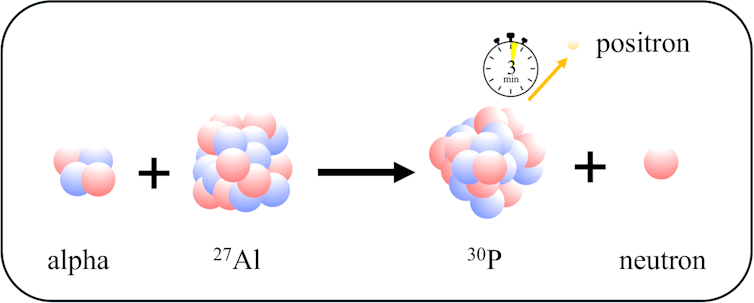
The amount of radiation decreased by half every three minutes, and they concluded that the radiation came from the decay of a radioisotope of the element phosphorus. Phosphorus has two additional protons compared to aluminum and was formed when the alpha particles fused with the aluminum nuclei. This was the first identification of an artificially made radioisotope, phosphorus-30. Because phosphorus-30 was created after bombarding aluminum with alpha particles – rather than occurring in its natural state – Irene and Frederic induced the radioactivity. So, it is called artificial radioactivity.
Advertisement
Get More From A Face Cleanser And Spa-like Massage
A diagram showing an atom of 27-aluminum next to an alpha which is made of two neutrons and two protons. Next to it is an arrow to a lone neutron and an atom of 30-phosphorus with an arrow labeled 'positron' coming off it.
In Irene and Frederic’s experiments, an isotope of aluminum was hit with an alpha particle (two neutrons and two protons bound together). The collision resulted in two protons and a neutron from the alpha particle binding to the aluminum, making it an isotope of phosphorus, which decayed, releasing a particle called a positron.
Artemis Spyrou

After her major discovery, Irene stayed active not only in research but in activism and politics as well. In 1936, almost a decade before women gained the right to vote in France, she was appointed under secretary of state for scientific research. In this position, she laid the foundations for what would become the National Centre for Scientific Research, which is the French equivalent of the U.S. National Science Foundation or National Institutes of Health.

She co-created the French Atomic Energy Commission in 1945 and held a six-year term, promoting nuclear research and development of the first French nuclear reactor. She later became director of the Curie Laboratory at the Radium Institute and a professor at the Faculty of Science in Paris.

Medical uses of artificial radioactivity

The Joliot-Curie discovery opened the road to the extensive use of radioisotopes in medical applications. Today, radioactive iodine is used regularly to treat thyroid diseases. Radioisotopes that emit positrons – the positive equivalent of the electron – are used in medical PET scans to image and diagnose cancer, and others are used for cancer therapy.

To diagnose cancer, practitioners can inject a small amount of the radioisotope into the body, where it accumulates at specific organs. Specialized devices such as a PET scanner can then detect the radioactivity from the outside. This way, doctors can visualize how these organs are working without the need for surgery.

To then treat cancer, practitioners use large amounts of radiation to kill the cancer cells. They try to localize the application of the radioisotope to just where the cancer is so that they’re only minimally affecting healthy tissue.

An enduring legacy

In the 90 years since the Joliot-Curie discovery of the first artificial radioisotope, the field of nuclear science has expanded its reach to roughly 3,000 artificial radioisotopes, from hydrogen to the heaviest known element, oganesson. However, nuclear theories predict that up to 7,000 artificial radioisotopes are possible.

As physicists, we work with data from a new facility at Michigan State University, the Facility for Rare Isotope Beams, which is expected to discover up to 1,000 new radioisotopes.

A graph showing protons on the Y axis and neutrons on the X axis, with an upwards trend line labeled 'stable isotopes' and a cloud of data points surrounding it labeled 'radioisotopes produced in experiments' and 'radioisotopes predicted to exist'
Scientists graph the known isotopes in the chart of nuclei. They have discovered roughly 3,000 radioisotopes (shown with cyan boxes) and predict the existence of another 4,000 radioisotopes (shown with gray boxes).
Facility for Rare Isotope Beams

While the Joliot-Curies were bombarding their samples with alpha particles at relatively low speeds, the Michigan State facility can accelerate stable isotopes up to half the speed of light and smash them on a target to produce new radioisotopes. Scientists using the facility have already discovered five new radioisotopes since it began operating in 2022, and the search continues.

Each of the thousands of available radioisotopes has a different set of properties. They live for different amounts of time and emit different types of radiation and amounts of energy. This variability allows scientists to choose the right isotope for the right application.

Iodine, for example, has more than 40 known radioisotopes. A main characteristic of radioisotopes is their half-life, meaning the amount of time it takes for half of the isotopes in the sample to transform into a new element. Iodine radioisotopes have half-lives that span from a tenth of a second to 16 million years. But not all of them are useful, practical or safe for thyroid treatment.

A diagram showing an atom of 131-Iodine, with an arrow to an atom of 131-Xenon, representing decay. Coming off the Xenon is an arrow denoting an electron, and a wavy arrow denoting radiation.
The iodine radioisotope used in cancer therapy has a half-life of eight days. Eight days is long enough to kill cancer cells in the body, but not so long that the radioactivity poses a long-term threat to the patient and those around them.
Artemis Spyrou

Radioisotopes that live for a few seconds don’t exist long enough to perform medical procedures, and radioisotopes that live for years would harm the patient and their family. Because it lives for a few days, iodine-131 is the preferred medical radioisotope.

Artificial radioactivity can also help scientists study the universe’s mysteries. For example, stars are fueled by nuclear reactions and radioactive decay in their cores. In violent stellar events, such as when a star explodes at the end of its life, they produce thousands of different radioisotopes that can drive the explosion. For this reason, scientists, including the two of us. produce and study in the lab the radioisotopes found in stars.

With the advent of the Facility for Rare Isotope Beams and other accelerator facilities, the search for new radioisotopes will continue opening doors to a world of possibilities.

Advertisement
Get More From A Face Cleanser And Spa-like Massage

Artemis Spyrou, Professor of Nuclear Physics, Michigan State University and Andrea Richard, Assistant Professor of Physics and Astronomy, Ohio University

This article is republished from The Conversation under a Creative Commons license. Read the original article.

Forgotten Genius Fridays

https://stmdailynews.com/the-knowledge-2/forgotten-genius-fridays/

🧠 Forgotten Genius Fridays

A Short-Form Series from The Knowledge by STM Daily News

Every Friday, STM Daily News shines a light on brilliant minds history overlooked.

Forgotten Genius Fridays is a weekly collection of short videos and articles dedicated to inventors, innovators, scientists, and creators whose impact changed the world—but whose names were often left out of the textbooks.

From life-saving inventions and cultural breakthroughs to game-changing ideas buried by bias, our series digs up the truth behind the minds that mattered.

Each episode of The Knowledge runs 30–90 seconds, designed for curious minds on the go—perfect for YouTube Shorts, TikTok, Reels, and quick reads.

Because remembering these stories isn’t just about the past—it’s about restoring credit where it’s long overdue.

Advertisement
Get More From A Face Cleanser And Spa-like Massage

🔔 New episodes every Friday

📺 Watch now at: stmdailynews.com/the-knowledge

🧠 Now you know.


Continue Reading
Advertisement SodaStream USA, inc

The Knowledge

Metrolink Offers Fare-Free Rides for Earth Day 2026 Across Southern California

Metrolink offers fare-free rides for Earth Day 2026 across Southern California, encouraging sustainable travel and reduced emissions.

Published

on

Last Updated on April 21, 2026 by Daily News Staff

Metrolink Offers Fare-Free Rides for Earth Day 2026
Image Credit: Metrolink

Metrolink Offers Fare-Free Rides for Earth Day 2026

LOS ANGELES — April 22, 2026 — In a continued push toward sustainable transportation, Metrolink will once again offer systemwide free rides on Earth Day, inviting commuters and travelers to leave their cars behind and explore a cleaner way to move across the region.

A One-Day Opportunity to Ride Free

On Wednesday, April 22, passengers can board any Metrolink train — including the Arrow service — without purchasing a ticket. The initiative is part of the broader celebration of Earth Day, encouraging environmentally conscious travel choices.

The fare-free program is designed to appeal to both regular riders and first-time users, particularly those navigating Southern California’s persistent traffic congestion and rising fuel costs.

ml earth emailheader eng.jpg
Image Credit: Metrolink

Encouraging Sustainable Travel Habits

“Earth Day is a reminder that small changes, like choosing public transit over driving one day a week, can have a meaningful impact on our environment,” said Doug Chaffee, chair of the Metrolink Board.

With gas prices continuing to strain household budgets, the agency hopes the initiative will inspire more residents to consider rail as part of their regular commute.

Regional Connections Expand Access

Metrolink’s Earth Day promotion aligns with similar efforts by other Southern California transit providers. Riders can seamlessly connect to services operated by: LA Metro and the Orange County Transportation AuthorityRiverside County Transportation CommissionSan Bernardino County Transportation Authority and Ventura County Transportation Commission.

These partnerships extend the reach of fare-free travel across a six-county region, making it easier for riders to explore destinations without relying on personal vehicles.

Service Adjustments and Rider Tips

Passengers should note that trains will operate on a reduced weekday schedule, implemented earlier this spring. Despite the adjustment, all Metrolink lines and station cities remain in service.

For those planning a trip:

  • No ticket is required — simply board the train
  • Bikes are welcome, with capacity ranging from three bikes per standard car to nine in designated bike cars
  • A curated destination guide highlights attractions within walking or biking distance of stations

Environmental and Economic Impact

Metrolink is also promoting its Personal Impact Calculator, a digital tool that allows riders to estimate how switching from driving to rail can reduce greenhouse gas emissions and lower fuel expenses.

A Broader Trend in Public Transit

Fare-free transit days have gained traction nationwide as agencies look to boost ridership and promote sustainability. Southern California’s expansive commuter rail network makes it particularly well-suited for such initiatives, offering a viable alternative to one of the country’s most car-dependent regions.


Bottom Line

Metrolink’s Earth Day promotion is more than a one-day free ride — it’s a strategic effort to shift commuter behavior, reduce environmental impact, and showcase the convenience of regional rail. For Southern Californians, April 22 presents a low-risk opportunity to rethink how they travel.

Advertisement
Get More From A Face Cleanser And Spa-like Massage

Source: Metrolink

https://metrolinktrains.com/news/metrolink-goes-fare-free-for-earth-day-on-april-22

Dive into “The Knowledge,” where curiosity meets clarity. This playlist, in collaboration with STMDailyNews.com, is designed for viewers who value historical accuracy and insightful learning. Our short videos, ranging from 30 seconds to a minute and a half, make complex subjects easy to grasp in no time. Covering everything from historical events to contemporary processes and entertainment, “The Knowledge” bridges the past with the present. In a world where information is abundant yet often misused, our series aims to guide you through the noise, preserving vital knowledge and truths that shape our lives today. Perfect for curious minds eager to discover the ‘why’ and ‘how’ of everything around us. Subscribe and join in as we explore the facts that matter.  https://stmdailynews.com/the-knowledge/

Continue Reading

Science

New Glenn’s Third Mission Set for April 19 as Blue Origin Advances Commercial Space Capabilities

Published

on

CAPE CANAVERAL, Fla. — Blue Origin has confirmed the launch window for the third mission of its heavy-lift New Glenn rocket, marking another step forward in the company’s expanding role in commercial spaceflight.

New Glenn’s Third Mission
Image Credit: Blue Origin

New Glenn’s Third Mission

Launch Details and Timeline

The mission is scheduled to lift off no earlier than Sunday, April 19, 2026, from Launch Complex 36 at Cape Canaveral Space Force Station. The two-hour launch window opens at 6:45 a.m. EDT (10:45 UTC) and closes at 8:45 a.m. EDT (12:45 UTC).

Viewers can follow the mission through a live webcast hosted by Blue Origin, beginning approximately 30 minutes before liftoff.

Mission Payload: Expanding Space-Based Connectivity

At the heart of the mission is the deployment of the BlueBird 7 satellite, developed by AST SpaceMobile. The satellite is designed to enhance a growing direct-to-smartphone broadband network, an emerging technology aimed at delivering connectivity to standard mobile devices without the need for ground-based towers.

BlueBird 7 will contribute to expanding network capacity and is expected to support initial service rollout plans targeted for 2026. The broader initiative reflects a significant shift in how satellite infrastructure could complement terrestrial telecom systems, particularly in underserved or remote regions.

Reusability Milestone: Booster Returns Again

A key feature of this mission is the planned reuse of New Glenn’s first-stage booster, “Never Tell Me The Odds.” The booster previously demonstrated a successful launch and landing during the rocket’s second mission in November, underscoring Blue Origin’s commitment to reusable rocket technology—a cornerstone of cost reduction and operational efficiency in modern spaceflight.

If successful, this mission will further validate the reliability of the New Glenn system and strengthen its competitiveness in a market increasingly shaped by reusable launch vehicles.

Industry Context: Competing in a Rapidly Evolving Market

The New Glenn program represents Blue Origin’s answer to heavy-lift launch demands, positioning the company alongside major players such as SpaceX. As satellite constellations grow in scale and ambition, reliable and cost-effective launch services have become a critical component of the global space economy.

The inclusion of commercial payloads like BlueBird 7 highlights the increasing collaboration between aerospace firms and telecommunications providers, signaling a future where space-based infrastructure plays a central role in everyday connectivity.

Looking Ahead

With its third mission, New Glenn continues to build momentum as a next-generation launch platform. The combination of reusable hardware, commercial partnerships, and advanced payload capabilities places this launch among the most closely watched developments in the 2026 spaceflight calendar.

For ongoing updates, mission tracking, and live coverage, audiences can follow Blue Origin across its digital platforms or visit its official website.

Advertisement
Get More From A Face Cleanser And Spa-like Massage

Source

Blue Origin Official Announcement – New Glenn Third Mission

Related External Links


Explore the latest in innovation, AI, gadgets, startups, and digital trends in STM Daily News’ Techsection.

Continue Reading

Tech

Drones paired with AI could help search‑and‑rescue teams find missing persons faster

AI-powered drones equipped with thermal and infrared imaging are transforming search-and-rescue operations, enabling teams to locate missing persons faster and assess their condition—including signs of injury, consciousness, or life-threatening temperature changes—in real time.

Published

on

Drones: An AI system can analyze data from a drone to detect people in a forest – and determine what condition they’re in. Adeel Khalid
An AI system can analyze data from a drone to detect people in a forest – and determine what condition they’re in. Adeel Khalid

Adeel Khalid, Kennesaw State University

A combination of infrared imaging, thermal imaging and color cameras on an uncrewed drone, along with an AI system to interpret the data, can help emergency responders and search-and-rescue teams locate, identify and track people who have gone missing in the wilderness. The experimental system helps responders pinpoint where a missing person is and determine whether they are hurt or even alive.

People who get lost or hurt while exploring nature can become stranded for days. Rescue teams often use drones to look for the person or signs of their whereabouts. The small drone my colleagues and I built at my lab at Kennesaw State University flies autonomously using a grid search pattern. It sends live video and images to a ground station operated by the rescue team.

When the AI system finds a person, it analyzes images to determine whether the individual is upright or lying on the ground. It segments parts of the person’s body, identifying the person’s head and the body’s position. It then zeroes in on the forehead. It extracts forehead temperature readings, pixel by pixel, from the imaging data to estimate forehead temperature. We have two papers detailing these findings accepted for the American Institute of Aeronautics and Astronautics Aviation Forum 2026 conference.

https://cdn.theconversation.com/infographics/1381/8e55acef0075dfeebe10e7de53e7f0cbf5223831/site/index.html

Our AI model then assesses whether the person is conscious or unconscious and identifies abnormal temperatures that could indicate heat stress, hypothermia or other physical complications, or death – all vital information for a search-and-rescue team.

In field trials we have conducted, the system has provided consistent temperature readings of the heads of volunteers from our research team who have walked out into a variety of environments, under different conditions.

https://cdn.theconversation.com/infographics/1380/7fe5f8cf79d68c8907da060b27accb7b2051d60c/site/index.html

Why it matters

It is critical to get accurate and timely information on the whereabouts of a missing person. The likelihood that the person will survive decreases steeply as time passes.

An AI-enhanced drone can make search-and-rescue operations significantly more efficient than sending teams of people out into the environment to search on foot, especially in poor weather conditions or under thick foliage. Rescuers who know whether a person is conscious or unconscious can also better gear up for what they need to do to retrieve the person and administer aid. Our technology could save lives.

What other research is being done

Search-and-rescue personnel use various kinds of drones, but the machines often lack the ability to positively identify humans, especially under thick foliage, in bad weather or when the person is lying down or unconscious. The AI-based technology we have developed overcomes those challenges.

Advertisement
Get More From A Face Cleanser And Spa-like Massage

Better sensors that are very lightweight, that can function at night or in rain, and can see more clearly through thick foliage could further improve our drone and drones used by others. Researchers are devising AI-powered sound recognition for detecting screams for help, advanced thermal imaging for better nighttime vision and autonomous drones that could act as first responders.

Also under development are drones that can carry heavy payloads, such as flotation devices, fly for up to 14 hours or perform real-time mapping of the ground below.

What’s next

One of our next steps is to have multiple drones fly together and autonomously coordinate search-and-rescue operations among themselves. This will allow the technology to cover a much larger area, perhaps hundreds of square miles.

We are also designing a large drone that can carry up to 110 pounds (50 kilograms) of payload and stay aloft for an hour.

The Research Brief is a short take on interesting academic work.

Adeel Khalid, Professor of Industrial & Systems Engineering, Kennesaw State University

This article is republished from The Conversation under a Creative Commons license. Read the original article.

Looking for an entertainment experience that transcends the ordinary? Look no further than STM Daily News Blog’s vibrant Entertainment section. Immerse yourself in the captivating world of indie films, streaming and podcasts, movie reviews, music, expos, venues, and theme and amusement parks. Discover hidden cinematic gems, binge-worthy series and addictive podcasts, gain insights into the latest releases with our movie reviews, explore the latest trends in music, dive into the vibrant atmosphere of expos, and embark on thrilling adventures in breathtaking venues and theme parks. Join us at STM Entertainment and let your entertainment journey begin! https://stmdailynews.com/category/entertainment/

and let your entertainment journey begin!

Advertisement
Get More From A Face Cleanser And Spa-like Massage

Author

Continue Reading

Trending


