

STM Daily News
The United States’ human rights practices are taking a nosedive
New human rights data shows the United States’ civil and political rights record deteriorated sharply in 2025, with major declines involving detention, free expression, religious freedom and political participation.

K. Chad Clay, University of Georgia
In the lead-up to the 2026 midterm elections, how is the U.S. government performing in terms of human rights? Listening to politicians, it can be difficult to know.
On one hand, some have pointed to a number of potential human rights abuses committed by the U.S. government inside and outside its borders in the past two years.
On the other hand, while marking the United States’ 250th anniversary this year, President Donald Trump called the country “the home of freedom,” “the land of liberty” and “the most extraordinary, most exceptional, most incredible nation ever to exist on the face of the earth.”
“We’re doing better now than we’ve ever done before,” he said.
So which is it?
According to many of the human rights data sources available, the U.S. lags behind most other high-income democracies – countries that are both members of the Organisation for Economic Co-operation and Development and classified as high income by the World Bank. The U.S.’s poor performance spans civil and political rights, such as the right to be free from torture and the right to political participation, as well as economic and social rights, including the rights to health and food.
In fact, the U.S. has been a relatively poor performer across many of these rights for quite some time, regardless of the political party in power.
Even accounting for the U.S.’s prior poor practices, however, new data from the Human Rights Measurement Initiative shows that in 2025 the country’s civil and political rights performance deteriorated even further.
As a human rights scholar who has been measuring human rights practices for 20 years – and as one of HRMI’s co-founders – I believe this data raises serious questions about the United States’ commitment to human rights.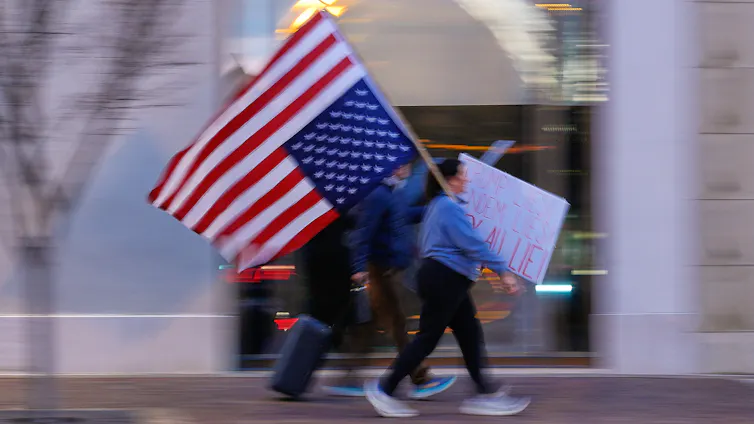
How are rights practices measured?
Governments rarely publish accurate information on their own human rights abuses, so the task of measuring them typically falls to advocates and scholars.
Historically, most international measures of civil and political rights have depended on public reports from the U.S. State Department, Amnesty International, Human Rights Watch or news organizations.
However, these reports cannot cover every human rights violation that experts know about, especially in countries with low government transparency or high levels of repression.
Thus, data produced using those sources will show fewer abuses than those that have actually occurred and will be more accurate about some places than others. Further, the Trump administration has changed one of the most important sources of human rights information, the U.S. State Department’s Country Reports on Human Rights Practices, to contain more bias in favor of the administration’s foreign allies and less information on human rights abuse overall.
Since 2017, HRMI has used a different approach. Recognizing the problems with public reports, we collect information directly from researchers for human rights organizations, human rights lawyers and others, asking them about governments’ practices across several rights and using a statistical model to assess their information and ensure that the resulting metrics are comparable across countries. The result is a robust dataset that includes information previously missing from public reports.
Today, HRMI’s civil and political rights dataset covers 62 countries, with more added every year.
How does the US compare?
According to the Human Rights Scores dataset, which uses publicly available information to score more than 190 countries on physical integrity rights – such as the rights to be free from torture, killing, forced disappearance and political imprisonment – the U.S. never ranked higher than 81st from 2001 to 2021 or higher than 109th from 2010 to 2021.
Indeed, from 2003 to 2021, the United States’ score was either the worst or the second-worst every year among high-income OECD member states, which include the United Kingdom, Japan and New Zealand.
The Human Rights Scores dataset has not been updated past 2021, but HRMI’s data collected since that time suggests that the pattern has continued.
Among the six high-income OECD countries on which HRMI currently collects data, the U.S. has been the worst performer for physical integrity rights since 2017.
It has also frequently been rated as the worst performer on “empowerment rights,” or the rights to assembly, association, opinion, expression, political participation, religion and belief.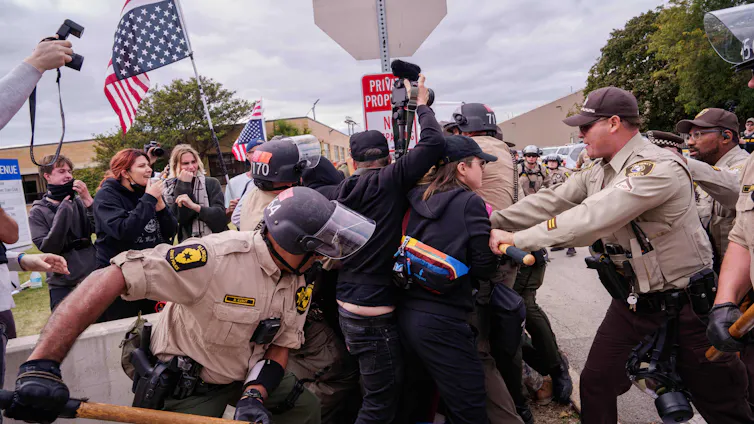
What changed in 2025?
Even starting from this poor position, the U.S.’s civil and political rights practices dramatically worsened in 2025. HRMI measures nine civil and political rights, and the U.S. significantly worsened on eight of them.
These were not small changes. Measured against every significant change HRMI has recorded since 2017, the U.S. showed the largest decline ever observed for the right to be free from forced disappearance and for the right to freedom of religion and belief.
The U.S. showed the second-largest decline ever observed for the right to be free from arbitrary or political arrest and for the right to opinion and expression.
The U.S. also showed major declines in the rights to be free from torture and extrajudicial killing, and the right to political participation – that is, the right to participate in one’s government via free and fair elections, to take part in public affairs and to have access to public service. U.S. scores likewise fell in the right to assembly and association, which are, respectively, the rights to peacefully gather in public or private and to form or join groups and organizations.
What caused the scores to fall?
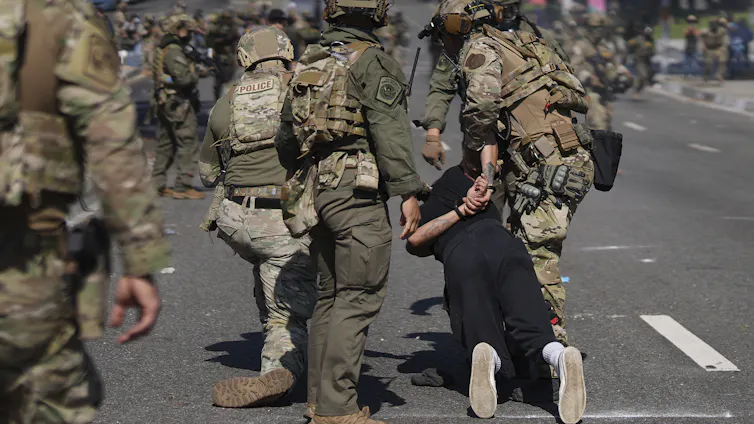
Human rights experts raised several issues that led to these declines. For instance, the U.S.’s worsened scores for the rights to be free from arbitrary detention, disappearance and torture were tied to the expanded use of practices such as incommunicado detention and warrantless arrest by ICE and other immigration-related agencies.
While several killings occurred during ICE operations in 2025, the worsened extrajudicial killing score was also tied to the country’s use of airstrikes against boats in the Pacific and Caribbean, which caused the deaths of at least 123 people in 2025 alone.
Other changes enacted in 2025 contributed to large declines in the U.S.’s rights scores, including crackdowns on anti-ICE demonstrations and government pressure on universities, including limits on free speech and class subjects.
Last year also saw threats to television networks over political expression, restrictions on mail-in voting, state measures targeting American Islamic organizations by labeling them “foreign terrorist organizations” and an executive order focused on eradicating “anti-Christian bias.”
While current HRMI data does not yet cover 2026, early indicators are not promising, with continued abuses by ICE, further killings in international waters and allegations of attempts to use government powers to punish critics.
K. Chad Clay, Director, Center for the Study of Global Issues (GLOBIS); Associate Professor of International Affairs, University of Georgia
This article is republished from The Conversation under a Creative Commons license. Read the original article.
📰 Enjoying STM Daily News? Join the conversation!
💬 Leave a comment, share your thoughts, and subscribe to our newsletter for the latest stories, updates, and “News You Can Use This Moment!” delivered to your inbox.
Stay connected with STM Daily News!


Transportation
FAA Nationwide Ground Stop Disrupts Thousands of Flights, Exposes Aging Air Traffic Control Infrastructure
FAA nationwide ground stop on November 13, 2026, disrupts U.S. flights and raises concerns about aging air traffic control infrastructure.

Last Updated on November 14, 2026 by Daily News Staff
Major communications and radar disruptions temporarily halted departures across the United States on Friday, raising fresh concerns about the reliability of the nation’s aviation infrastructure.
A major technical failure involving the Federal Aviation Administration’s (FAA) air traffic control systems triggered a nationwide ground stop on Friday, November 13, 2026, disrupting thousands of flights and leaving travelers stranded at airports across the United States.
The FAA temporarily suspended aircraft departures as technicians worked to address communications and radar system problems that threatened the reliability of air traffic control operations.
The nationwide ground stop reportedly began at approximately 3:54 p.m. Eastern Time and was lifted around 8:15 p.m., lasting more than four hours.
Aging Technology Raises Safety Concerns
According to reports, the disruption involved aging telecommunications equipment within the nation’s air traffic control infrastructure.
Transportation Secretary Sean Duffy indicated that older equipment experienced problems as newer technology was integrated into the network, resulting in intermittent communications and radar information failures.
Officials reported no evidence that the outage resulted from a cyberattack.
The incident highlights ongoing concerns about the FAA’s aging infrastructure and the challenges of modernizing critical aviation systems while maintaining safe and reliable operations.
Phoenix Airports Among Those Affected
The disruption also affected air travel throughout Arizona, including Phoenix Sky Harbor International Airport, Phoenix Deer Valley Airport, Phoenix-Mesa Gateway Airport, and Scottsdale Airport.
At Phoenix Sky Harbor, local reports indicated approximately 338 flight delays and 155 cancellations by Friday evening.
Nationwide, early reports indicated more than 10,000 delayed flights and over 4,000 cancellations, with an estimated 1.5 million passengers affected.
Airlines continued working to restore normal schedules after the FAA lifted the ground stop.
Questions Remain About System Reliability
The incident has renewed attention on efforts to replace outdated air traffic control equipment and strengthen the resilience of the national aviation network.
Although departures resumed Friday evening, the disruption raised important questions about whether the FAA’s existing infrastructure can adequately support growing air traffic demands.
Federal aviation officials are expected to continue evaluating the failure and measures needed to prevent similar nationwide disruptions.
For travelers, the incident serves as a reminder that a technical problem affecting the nation’s aviation network can quickly create widespread delays, cancellations, and travel uncertainty.
STM Daily News — News You Can Use This Moment!
Sources and Further Information

Last Updated on November 13, 2026 by Daily News Staff
STM Daily News | November 12, 2026
Graffiti Cleanup Transforms Oceanwide Plaza
LOS ANGELES — The unfinished skyscrapers known as downtown Los Angeles’ “Graffiti Towers” have reached a visible milestone: most of the exterior tagging has been removed, although completing the long-stalled Oceanwide Plaza development remains a separate challenge.
City officials celebrated the cleanup November 12. According to the mayor’s office, crews cleared graffiti from roughly 250 balconies across the three-tower complex opposite Crypto.com Arena and near the Los Angeles Convention Center. Remaining work has included touch-ups on windows and other exterior areas.
Oceanwide Plaza was envisioned as a mixed-use destination with residences, a luxury hotel, shops and restaurants. Construction stopped in 2019 after Beijing-based developer Oceanwide Holdings could no longer finance the project.
In early 2024, trespassers covered the unfinished towers with graffiti, turning them into an internationally recognized sight. The property also attracted dangerous stunts and heightened concerns about security.
The development entered bankruptcy in February 2024. This July, a bankruptcy court approved a purchase arrangement involving KPC Square, a joint venture between KPC Group and Lendlease. Graffiti removal began while the acquisition was still pending.
What Comes Next for LA’s Graffiti Towers?
The partnership is targeting a January 2027 closing, according to the Los Angeles Business Journal. Financing, a construction contract and required approvals remain important steps before the development can be completed.
For downtown residents and businesses, the cleanup marks tangible progress at a prominent property. However, it does not mean the towers are ready to open, and no firm opening date has been announced.
Sources
- Los Angeles Mayor’s Office, November 12, 2026: https://mayor.lacity.gov/news/mayor-bass-celebrates-graffiti-removal-oceanwide-plaza-clearing-way-full-restoration-and
- Los Angeles Business Journal, November 9, 2026: https://labusinessjournal.com/real-estate/cleaning-up-oceanwide/
- City News Service / MyNewsLA, November 12, 2026: https://mynewsla.com/life/2026/11/12/graffiti-cleanup-milestone-marked-at-oceanwide-plaza-in-downtown-la/


Local News
Maricopa Boil Water Advisory Lifted After Negative E. Coli Tests
Maricopa boil water advisory lifted: Global Water–Santa Cruz Water Company customers in Maricopa can resume normal tap water use after follow-up testing found no E. coli.
MARICOPA, Ariz. — A precautionary boil water advisory for Global Water–Santa Cruz Water Company customers in the city of Maricopa was lifted Thursday, October 8, after repeat testing found no E. coli in water samples. The utility announced the cancellation at approximately 2 p.m. Arizona time.

The advisory was issued October 7 after two preliminary tests indicated possible contamination. Customers were temporarily instructed to use bottled water or boil tap water for at least one minute before drinking it or using it for food preparation.
With follow-up results negative, affected customers no longer need to boil water for drinking, cooking, making ice, brushing teeth or washing dishes, according to the utility.
The advisory affected the utility’s customers in the city of Maricopa, located in Pinal County. It was not a countywide warning for Maricopa County or Phoenix.
Residents can visit Global Water Resources’ official notice page for updates or call 866-940-1102 with questions.




