Connect with us

Blog

Why Jimmy Kimmel’s First Amendment rights weren’t violated – but ABC’s would be protected if it stood up to the FCC and Trump

Published

on

Last Updated on September 22, 2025 by Daily News Staff

Jimmy Kimmel
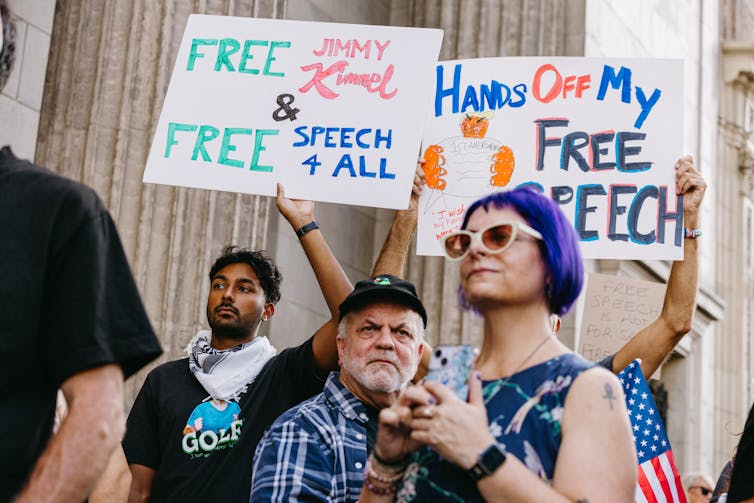
A crowd protests in Hollywood, Calif., on Sept. 18, 2025, after the suspension of the ‘Jimmy Kimmel Live!’ taping earlier in the day.
David Pashaee / Middle East Images via AFP, Getty Images

Why Jimmy Kimmel’s First Amendment rights weren’t violated – but ABC’s would be protected if it stood up to the FCC and Trump

Wayne Unger, Quinnipiac University

The assassination of conservative activist Charlie Kirk has sparked a wave of political commentary.

There were the respectful and sincere comments condemning the killing. Former President Barack Obama said, “What happened was a tragedy and … I mourn for him and his family.” And former Vice President Mike Pence said, “I’m heartsick about what happened to him.”

But Kirk’s killing also elicited what many saw as inappropriate comments. MSNBC terminated commentator Matthew Dowd after he said, “Hateful thoughts lead to hateful words, which then lead to hateful actions.” American Airlines grounded pilots accused of celebrating Kirk’s death.

Perhaps the most notable reaction to remarks seen as controversial about the Kirk killing hit ABC comedian Jimmy Kimmel. His network suspended him indefinitely after comments that he made about the alleged shooter in Kirk’s death.

Countless defenders of Kimmel quickly responded to his indefinite suspension as an attack on the First Amendment. MSNBC host Chris Hayes posted the following on X: “This is the most straightforward attack on free speech from state actors I’ve ever seen in my life and it’s not even close.”

But is it?

FCC Chairman Brendan Carr’s statement about how Jimmy Kimmel’s remarks could hurt ABC affiliate stations.

Free speech? It depends

The First Amendment limits government officials from infringing one’s right to free speech and expression.

For example, the government cannot force someone to recite the Pledge of Allegiance or salute the American flag, because the First Amendment, as one Supreme Court justice wrote, “includes both the right to speak freely and the right to refrain from speaking at all.”

And government cannot limit speech that it finds disagreeable while permitting other speech that it favors.

Advertisement
Get More From A Face Cleanser And Spa-like Massage

However, the First Amendment does not apply to private employers. With the exception of the 13th Amendment, which generally prohibits slavery, the Constitution applies only to government and those acting on its behalf.

So, as a general rule, employers are free to discipline employees for their speech – even the employees’ speech outside of the workplace. In this way, U.S. Sen. Lindsey Graham correctly said on X, “Free speech doesn’t prevent you from being fired if you’re stupid and have poor judgment.”

This is why Amy Cooper’s employer, an investment firm, was free to terminate her following her 2020 verbal dispute in New York’s Central Park with a bird-watcher over her unleashed dog. She called the police, falsely claiming that the bird-watcher, a Black man, was threatening her life. The incident, captured on video, went viral and Cooper was fired, with her employer saying, “We do not condone racism of any kind.”

This is also why ABC was able to fire Roseanne Barr from the revival of her show, “Roseanne,” after she posted a tweet about Valerie Jarrett, a Black woman who had been a top aide to President Obama, that many viewed as racist.

But as a scholar of constitutional law, I believe Kimmel’s situation is not as straightforward.
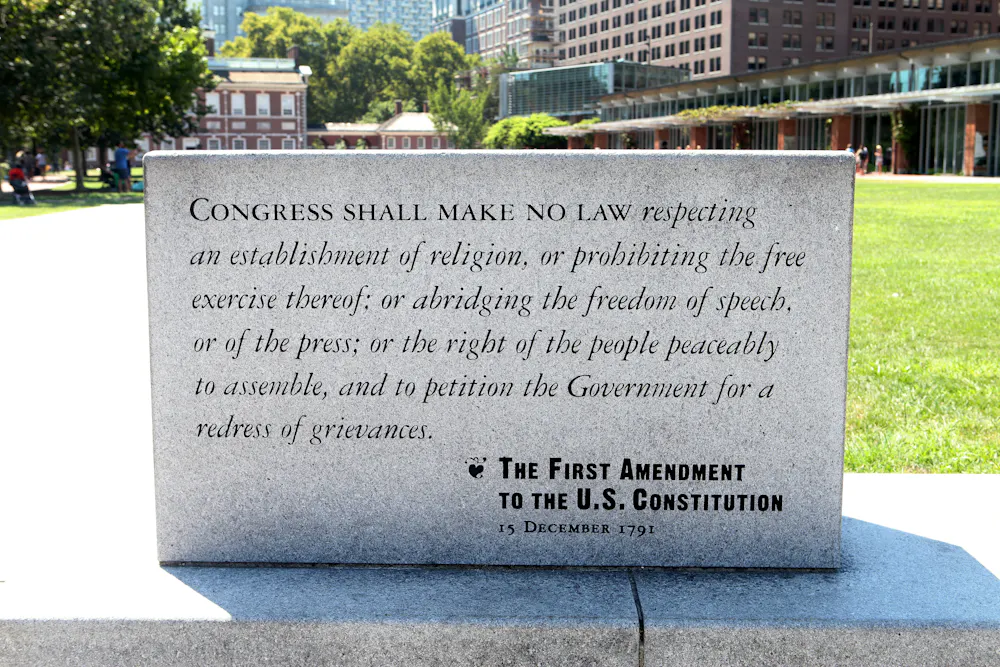
A small monument made out of marble has the First Amendment to the US Constitution printed on it.
A marble plaque inscribed with the First Amendment sits on Independence Mall in Philadelphia, Pa.
Raymond Boyd/Getty Images

Threat complicates things

Neither Cooper’s employer nor Barr’s employer faced any government pressure to terminate them.

Kimmel’s indefinite suspension followed a vague threat from the chairman of the Federal Communications Commission, Brendan Carr. As complaints about Kimmel’s statement exploded in conservative media, Carr suggested in a podcast interview that Kimmel’s statements could lead to the FCC revoking ABC affiliate stations’ licenses.

“We can do this the easy way or the hard way,” Carr said.

But the Supreme Court has been crystal clear. Government officials cannot attempt to coerce private parties in order to punish or suppress views that the government disfavors.

In a 2024 case, National Rifle Association v. Vullo, a unanimous Supreme Court plainly said that the government’s threat of invoking legal sanctions and other coercion to suppress speech it doesn’t like violates the First Amendment. That principle is so profound and fundamental that it got support from every member of an often bitterly divided court.

A threat to revoke broadcast licenses would almost certainly be seen in a court of law as a government action tantamount to coercion. And Carr’s public comments undoubtedly connect that threat to Kimmel’s disfavored comments.

Advertisement
Get More From A Face Cleanser And Spa-like Massage

If the FCC had indeed moved to strip ABC affiliates of their licenses to broadcast because of what Kimmel said, ABC and its parent company, Disney, could have sued the FCC to block the license revocations on First Amendment grounds, citing the NRA v. Vullo case.

But the network seemingly caved to the coercive threat instead of fighting for Kimmel. This is why so many are decrying the Kimmel suspension as an attack on free speech and the First Amendment – even though they might not fully understand the law they’re citing.

Wayne Unger, Associate Professor of Law, Quinnipiac University

This article is republished from The Conversation under a Creative Commons license. Read the original article.

Nourishing Our Heroes: Eight Years of Impact at Phoenix VA’s Veggies for Veterans

Link: https://stmdailynews.com/nourishing-our-heroes-eight-years-of-impact-at-phoenix-vas-veggies-for-veterans/

Blog

Terminal Island: The Untold Story of Los Angeles Harbor’s Forgotten Community and Industrial Giant

Discover the remarkable history of Terminal Island in Los Angeles Harbor—from its thriving Japanese American fishing village to World War II shipbuilding and today’s global shipping hub.

Published

on

Terminal Island in the background, and Mormon Island in the foreground, sometime before 1942. Image Credit: U.S. National Archives and Records Administration

Whenever I think about Terminal Island, my mind immediately goes back to childhood trips with my parents to San Pedro’s Fisherman’s Wharf. Those visits were some of my favorite family outings. We’d walk along the waterfront while my parents picked up fresh crab, shrimp, fish, and occasionally shellfish. The smells of the ocean, the sound of fishing boats, and the towering presence of the Vincent Thomas Bridge left a lasting impression on me long before I understood the incredible history hidden just beyond the docks.

As a child, I simply saw ships, cranes, and bridges. It wasn’t until years later that I learned Terminal Island had once been home to one of Southern California’s most vibrant immigrant communities—and that much of it disappeared almost overnight during World War II.

Today, Terminal Island stands at the crossroads of history, commerce, and remembrance.

From Sandbar to Strategic Harbor

Terminal Island wasn’t always an island as we know it today. Originally a marshy stretch of land in San Pedro Bay, it was reshaped through decades of dredging and engineering projects that transformed Los Angeles Harbor into one of the world’s busiest ports.

As railroads arrived in the late 1800s, the island became a gateway for commerce. Warehouses, rail terminals, and docks expanded rapidly, laying the foundation for the economic powerhouse that would eventually emerge.

The Village That Built an Industry

In the early 1900s, Japanese immigrants established a thriving fishing village along Fish Harbor.

Families built homes, schools, churches, markets, and businesses while creating a close-knit community unlike any other in Southern California. Many residents came from Japan’s Wakayama Prefecture, bringing generations of fishing knowledge with them.

Their expertise helped build California’s tuna fishing industry into one of the largest in the nation. Long before canned tuna became a pantry staple across America, many of the fishermen of Terminal Island were helping shape the industry that made it possible.

The community even developed its own distinctive blend of Japanese and English known as “Terminal Island lingo,” reflecting the unique culture that flourished there.

A Community Lost

Everything changed after the attack on Pearl Harbor on December 7, 1941.

Within weeks, Terminal Island became the first Japanese American community in the United States to be forcibly removed.

Advertisement
Get More From A Face Cleanser And Spa-like Massage

Residents were given little time to leave their homes.

Many men were arrested first under suspicion simply because of their ancestry. Families were separated. Businesses were abandoned. Eventually, nearly every house in the village was demolished.

For many residents, there was nothing to return to after the war.

Today, the story of Terminal Island serves as a powerful reminder of how fear and prejudice can overwhelm constitutional rights during times of national crisis.

Building Victory

As one community disappeared, another chapter began.

Terminal Island became one of America’s great wartime industrial centers.

Shipyards worked around the clock constructing destroyers, cargo ships, and support vessels for the Allied war effort. Thousands of workers—including many African Americans who had migrated west seeking defense jobs—helped build and repair ships that crossed the Pacific.

The island became a symbol of American industrial strength, contributing directly to victory during World War II.

The Bridge That Became an Icon

In 1963, the opening of the Vincent Thomas Bridge forever changed the harbor skyline.

The graceful green suspension bridge connected San Pedro with Terminal Island, replacing ferry service and improving access to the growing port.

Advertisement
Get More From A Face Cleanser And Spa-like Massage

For many Southern Californians—including myself—the bridge became more than just a transportation link. It was a landmark that signaled you were entering one of the hardest-working waterfronts in America.

Every crossing offered sweeping views of ships arriving from around the world, reminding visitors that Los Angeles Harbor is one of the nation’s most important economic engines.

Terminal Island Today

Modern Terminal Island bears little resemblance to the fishing village that once stood there.

Today it is home to massive container terminals, rail yards, ship repair facilities, Coast Guard operations, federal facilities, and the Federal Correctional Institution. Together with the neighboring Port of Long Beach, the Port of Los Angeles moves millions of cargo containers every year, supporting jobs and businesses across the United States.

The island remains essential to global trade while quietly preserving memories of the people who first called it home.

Remembering the Whole Story

Terminal Island is more than an industrial center.

It represents the American dream of immigrants who built thriving businesses through hard work.

It reminds us of the injustice experienced by Japanese American families during World War II.

It showcases the extraordinary industrial effort that helped win a global conflict.

And it demonstrates how one small piece of land helped shape the economy of Southern California and the nation.

Advertisement
Get More From A Face Cleanser And Spa-like Massage

The next time you cross the Vincent Thomas Bridge or see the towering cranes along the harbor, remember that beneath today’s shipping terminals lies a story of resilience, sacrifice, innovation, and hope.

Sometimes the most important history isn’t found in famous landmarks—it lives in the places we pass every day without realizing what came before.

Further Reading & Related Links

🧠 Discover the remarkable innovators, inventors, and trailblazers who helped shape our world but rarely receive the recognition they deserve. Share your thoughts in the comments and subscribe to the STM Daily News newsletter to catch every new Forgotten Genius Friday feature and more inspiring stories delivered to your inbox.

View recent photos

Unlock fun facts & lost history—get The Knowledge in your inbox!

We don’t spam! Read our privacy policy for more info.

Continue Reading

STM Blog

From Hand Signals to Smart Crosswalks: The Evolution of the Modern Pedestrian Signal

Discover the history of the modern pedestrian signal, from Garrett A. Morgan’s groundbreaking traffic signal to today’s smart, accessible crosswalks.

Published

on

The Evolution of the Modern Pedestrian Signal

Every day, millions of people rely on pedestrian signals to cross busy street safely. A glowing white walking figure, an orange-red hand, and a countdown timer have become familiar sights around the world. While these signals may seem like simple pieces of infrastructure, they are the result of more than a century of innovation, engineering, and public safety improvements.

The modern pedestrian signal did not appear overnight. Instead, it evolved through the contributions of inventors, engineers, city planners, and transportation officials who continually refined traffic control systems as cities grew and automobiles became more common.

The Early Days of Traffic Control

Before electric traffic signals, intersections were controlled by police officers, railway-style semaphores, or even hand signals. As horse-drawn wagons gave way to automobiles in the early 1900s, traffic congestion and accidents increased dramatically, creating an urgent need for better traffic management.

One of the earliest electric traffic lights was installed in Cleveland, Ohio, in 1914. It used red and green lights and was manually operated. While it improved vehicle movement, pedestrians still had to judge for themselves when it was safe to cross.

Garrett A. Morgan’s Breakthrough

One of the most important milestones came in 1923 when inventor and entrepreneur Garrett Augustus Morgan received U.S. Patent No. 1,475,024 for an improved traffic signal.

Morgan’s design introduced a third position in addition to “Stop” and “Go.” This intermediate phase temporarily stopped traffic in every direction before allowing vehicles to proceed. The brief pause reduced confusion at intersections and provided additional time for pedestrians to cross safely.

Morgan reportedly developed his design after witnessing a serious traffic accident. His invention demonstrated how thoughtful engineering could improve public safety while making increasingly busy streets more efficient.

Although Morgan did not invent the illuminated “WALK” and “DON’T WALK” pedestrian signal used today, his three-position signal became a foundational step in the evolution of modern traffic control.

The Birth of Dedicated Pedestrian Signals

As cities expanded after World War II, pedestrian safety became an even greater concern. More people were walking in increasingly crowded downtown districts, and separating pedestrian movements from vehicle traffic became a priority.

During the early 1950s, several American cities began experimenting with dedicated pedestrian signals. New York City became one of the first major municipalities to install illuminated “WALK” and “DON’T WALK” signs at busy intersections.

Advertisement
Get More From A Face Cleanser And Spa-like Massage

These early systems gave pedestrians their own designated crossing phase, reducing conflicts with turning vehicles and improving safety at some of the nation’s busiest intersections.

Standardization Across America

By the 1960s and 1970s, traffic engineers recognized the importance of creating consistent traffic control devices nationwide.

The Manual on Uniform Traffic Control Devices (MUTCD) established national standards for traffic signs, pavement markings, and pedestrian signals. Standardized designs helped ensure that pedestrians could understand crossing signals regardless of where they traveled in the United States.

Eventually, words gave way to internationally recognized symbols—a walking person to indicate it was safe to cross and an upraised hand to indicate pedestrians should wait. These symbols transcended language barriers and improved accessibility for visitors and non-English speakers.

The Countdown Era

One of the most significant modern improvements arrived with pedestrian countdown timers.

Rather than simply flashing a warning, countdown displays show exactly how many seconds remain before the crossing phase ends. Research has shown that countdown timers help pedestrians make better crossing decisions and improve compliance with traffic signals.

Today, countdown timers have become standard equipment at intersections across much of the United States.

Accessibility Takes Center Stage

Modern pedestrian signals are designed to serve everyone.

Accessible Pedestrian Signals (APS) now provide audible tones, spoken messages, vibrating push buttons, and locator sounds that assist pedestrians who are blind or have low vision. These features allow more people to navigate intersections independently and safely.

The continued development of accessible technology reflects a broader commitment to making transportation systems inclusive for all users.

Advertisement
Get More From A Face Cleanser And Spa-like Massage

The Future of Pedestrian Safety

Pedestrian signals continue to evolve.

Many cities now use smart traffic systems that detect pedestrians waiting to cross, automatically adjust signal timing based on traffic conditions, and prioritize people walking during busy periods.

Researchers are exploring artificial intelligence, connected vehicle technology, and sensor-based systems capable of communicating directly with autonomous vehicles. Future pedestrian crossings may adapt in real time to weather conditions, crowd sizes, emergency vehicles, and even the needs of older adults or individuals with disabilities.

A Legacy Built by Many Innovators

The pedestrian signal we know today is the product of more than a century of collaboration and innovation.

Early traffic engineers created the first electric traffic lights. Garrett A. Morgan improved intersection safety with his groundbreaking three-position traffic signal. Transportation agencies standardized traffic control devices, while engineers continued refining pedestrian technology through countdown timers, accessible features, and intelligent traffic systems.

Every safe crossing today reflects the work of countless inventors, planners, researchers, and public officials dedicated to protecting lives.

As cities continue to grow and transportation technology advances, the humble pedestrian signal remains one of the most effective—and often overlooked—public safety innovations ever developed.

At STM Daily News, we celebrate the inventors, engineers, and visionaries whose everyday innovations quietly improve life for millions of people. Sometimes the most important inventions aren’t the ones that grab headlines—they’re the ones we depend on every single day without giving them a second thought.

Related Reading

🧠 Discover the remarkable innovators, inventors, and trailblazers who helped shape our world but rarely receive the recognition they deserve. Share your thoughts in the comments and subscribe to the STM Daily News newsletter to catch every new Forgotten Genius Friday feature and more inspiring stories delivered to your inbox.

Advertisement
Get More From A Face Cleanser And Spa-like Massage
Continue Reading

STM Blog

What is Nude Recreation Week?

Nude Recreation Week is a real event that promotes the idea of enjoying the outdoors without clothing.

Published

on


Nude Recreation Week is a real event that promotes the idea of enjoying the outdoors without clothing. It is a week-long celebration of the human body and its natural state. The history of Nude Recreation Week is a fascinating one, with its origins dating back to the early 1970s.

The idea of Nude Recreation Week came from a group of naturists who wanted to promote the benefits of nudity in the outdoors. They believed that nudity was a natural and healthy way to enjoy the outdoors, and that it allowed people to connect with nature in a more meaningful way. The first Nude Recreation Week was held in 1976, and it has been celebrated every year since then.

There are many ways to celebrate Nude Recreation Week legally. Many naturist organizations offer events and activities that are open to the public, such as nude hikes, beach cleanups, and other outdoor activities. There are also many private resorts and campsites that cater to naturists, and they offer a variety of activities and amenities for those who want to enjoy the outdoors in the nude.

Nude Recreation Week – July 6–12

Nude Recreation Week celebrates naturism, body positivity, and the freedom to enjoy outdoor activities in a clothing-free environment. Observed at nudist resorts, beaches, and private spaces, it encourages self-acceptance and connection with nature. The week culminates in International Skinny Dip Day. Learn more about the history and celebration: National TodayNational Day CalendarAmerican Association for Nude Recreation.

The opinions about Nude Recreation Week are divided. Some people believe that it is a healthy and natural way to enjoy the outdoors, and that it promotes body positivity and self-confidence. Others believe that it is inappropriate and offensive, and that it should not be allowed in public spaces.

On one hand, some people argue that nudity is a natural state for humans and that it should be celebrated. They believe that nudity is not inherently sexual or offensive, and that it is a healthy way to connect with nature and with other people. They also argue that nudity promotes body positivity and self-confidence, and that it can help people overcome body shame and negative self-image.

On the other hand, some people argue that nudity is inappropriate and offensive, especially in public spaces. They believe that nudity is a private matter and that it should not be displayed in public. They also argue that nudity can be sexualized and that it can lead to inappropriate behavior and harassment.

Nude Recreation

In conclusion, Nude Recreation Week is a real event that promotes the idea of enjoying the outdoors without clothing. It has a fascinating history, and it is celebrated by many people around the world. While opinions about nudity are divided, it is clear that there are many ways to celebrate Nude Recreation Week legally, and that it is a healthy and natural way to enjoy the outdoors.

https://stmdailynews.com/category/lifestyle/travel-lifestyle/travel-staycations-and-vacations/travel/outdoor-activities/naturism

https://nationaltoday.com/nude-recreation-week/

Advertisement
Get More From A Face Cleanser And Spa-like Massage

National Nude Day – July

National Nude Day celebrates body positivity, personal freedom, and self-acceptance—not sex. Observed by nudist and naturist communities, the day encourages people to embrace their natural form and challenge societal body shaming. Participants may visit naturist beaches or resorts or enjoy private time at home to connect with their body and nature. Learn more about the celebration and its history here: National Day CalendarNational TodayThe Guardian on Naturism.

🌿 Enjoying Naturist News? Explore more stories celebrating naturism, body positivity, and the naturist lifestyle. Subscribe to the STM Daily News newsletter to stay informed with the latest articles, community news, and exclusive updates delivered right to your inbox.

Continue Reading

Trending

