

The Knowledge
📺 From Cable to Clicks: How Public Access TV Paved the Way for Social Media

Last Updated on March 11, 2026 by Daily News Staff

“From Public Access to Social Media.” Image: AI
Before there were influencers, viral videos, and billion-view platforms, there was something raw, real, and radically democratic: public access television.
Born in the 1970s, public access TV was one of the first true experiments in community-driven media. And while it may seem like a relic of the analog past, its legacy is alive and well every time someone hits “post” on YouTube, TikTok, or Instagram.
🎤 What Was Public Access Television?
Public access television was part of the “PEG” system—Public, Educational, and Government access channels—mandated by the FCC and local cable providers to serve community needs. The public access arm gave everyday people a platform to create and share their own content, often with free or low-cost equipment provided by local studios.
There were no ads, no executives, and no creative restrictions (aside from legal limitations). Programming ranged from the bizarre to the brilliant—local news, activist messages, drag performances, punk rock shows, religious rants, DIY cooking series, and more. If you had something to say and the courage to get in front of a camera, you could be on the air.
Scrappy, campy and unabashedly queer, public access TV series of the 1980s and 1990s offered a rare glimpse into LGBTQ+ life
🧪 Experimental, Inclusive, and Sometimes Outrageous
Public access TV wasn’t polished. It wasn’t corporate. It wasn’t predictable. And that was exactly the point.
It empowered:
Marginalized voices who couldn’t get airtime elsewhere. Aspiring creatives looking to test out new formats. Communities wanting to share local culture, ideas, and events.
In many ways, it was an open sandbox where media could be weird, wild, and wonderfully honest.
🌐 The Bridge to Social Media
Today, anyone with a smartphone can start a channel, build an audience, or go viral. But the foundation was laid decades earlier by public access.
Public Access TV
Modern Social Media
Community studios
Smartphones, apps, home setups
Broadcast on local cable channels
Global reach via internet
No advertising
Monetized, ad-supported
Free expression, limited censorship
Still a battleground for free speech
Niche, quirky content
Same—just with algorithms
The spirit of user-generated content—amateur, authentic, and accessible—is deeply rooted in the public access ethos. Creators like early YouTubers and digital activists have often cited public access as an inspiration.
🔄 A Full Circle Moment
Today’s digital platforms have expanded the reach and speed of content creation, but they also reintroduce challenges public access once bypassed—like algorithmic bias, platform censorship, and commercialization.
Ironically, as tech giants dominate digital communication, the original values of public access—local control, equal access, and creative freedom—are more relevant than ever.
🧠 Final Thought
Public access television may have existed before likes, shares, or subscribers—but it’s the ancestor of everything we now take for granted in social media. It showed us that the best stories don’t always come from studios, and the most important voices don’t always have a microphone—until they make one.
So next time you scroll through a creator’s feed or stumble on a strange but delightful video, remember:
📼 Public access walked so the internet could run
Related Links:
Public Access Television (Wikipedia): https://en.wikipedia.org/wiki/Public-access_television
Cable Communications Policy Act of 1984 (Wikipedia) https://en.wikipedia.org/wiki/Cable_Communications_Policy_Act_of_1984
Dive into “The Knowledge,” where curiosity meets clarity. This playlist, in collaboration with STMDailyNews.com, is designed for viewers who value historical accuracy and insightful learning. Our short videos, ranging from 30 seconds to a minute and a half, make complex subjects easy to grasp in no time. Covering everything from historical events to contemporary processes and entertainment, “The Knowledge” bridges the past with the present. In a world where information is abundant yet often misused, our series aims to guide you through the noise, preserving vital knowledge and truths that shape our lives today. Perfect for curious minds eager to discover the ‘why’ and ‘how’ of everything around us. Subscribe and join in as we explore the facts that matter. https://stmdailynews.com/the-knowledge/
Discover more from Daily News
Subscribe to get the latest posts sent to your email.




News
Jay Leno Test Drives the Slate Truck as Startup Pushes Toward 2026 Launch
The affordable electric pickup from Slate Auto is gaining attention after Jay Leno test drove the prototype on Jay Leno’s Garage. Here’s the latest update on pricing, features, reservations, and the planned 2026 production launch.

Testing the Slate Truck
The affordable electric pickup from Slate Auto is continuing to gain attention as the startup moves closer to production. One of the most visible recent developments came when legendary car collector and TV host Jay Leno featured the truck on his popular YouTube series Jay Leno’s Garage.
The episode offered one of the most detailed looks yet at the upcoming Slate Truck, including a real-world test drive, design insights, and a closer look at the company’s philosophy behind building what could become one of America’s most affordable electric vehicles.
Watch the Jay Leno Test Drive
What Jay Leno Revealed About the Slate Truck
During the episode, Leno drove a pre-production prototype of the truck while engineers from Slate Auto explained the design approach.
Unlike many modern EVs packed with luxury features, the Slate Truck is intentionally simple.
Key highlights from the test drive include:
A Focus on Simplicity and Repairability
One of the most notable ideas behind the truck is that it is designed to be easy to repair and modify. Instead of relying on proprietary parts or complex electronics, the vehicle uses a more straightforward architecture that could allow owners or independent mechanics to work on it.
This approach contrasts with many EVs that require dealership service or specialized tools.
Modular Body Panels and Customization
The Slate Truck is built around a modular platform with removable exterior panels and optional accessory kits.
According to the company, owners will be able to customize the vehicle with:
Different body panel styles Accessory racks and cargo options A potential conversion kit that can transform the pickup into a small SUV
The idea is to allow the vehicle to evolve with the owner’s needs over time.
Minimalist Interior
Inside the prototype shown to Leno, the truck features a very basic interior layout.
Instead of a large infotainment system, the vehicle relies heavily on smartphone integration and simpler controls to keep costs down. This minimalist philosophy is part of the company’s effort to build a lower-cost EV.
Pricing and the “Affordable EV” Promise
When the truck was first revealed in 2025, Slate Auto suggested the vehicle could cost under $20,000 after incentives.
However, with changes to federal EV incentives and updated pricing expectations, analysts now estimate the truck will likely start around the mid-$20,000 range.
Even at that price, the vehicle could still become one of the most affordable electric trucks available in the United States.
Production Plans in Indiana
The company plans to manufacture the truck in Warsaw, Indiana, where a large former industrial facility is being converted into an EV factory.
Production targets include:
Production start: Late 2026 Early deliveries: Possibly 2027 Potential capacity: Up to about 150,000 vehicles per year once fully ramped
Strong early interest has also been reported, with more than 100,000 reservations placed for the truck shortly after its reveal.
A Different Kind of Electric Truck
The Slate Truck is entering a market where most electric pickups—such as the Ford F-150 Lightning and Rivian R1T—sit at much higher price points.
Rather than competing on luxury or performance, the Slate Truck is aiming to fill a different niche: a practical, customizable, and relatively affordable electric work vehicle.
If the company can deliver on its promises, it could open the door to a new category of budget-friendly EVs.
For now, the test drive on Jay Leno’s Garage provides one of the clearest glimpses yet at how the truck might perform in the real world.
Related Coverage on STM Daily News
- Automotive News and Innovation – STM Daily News
- Boom Supersonic and the Overture: The Return of Commercial Supersonic Travel
- The Evolution of Public Transportation in Los Angeles
- Technology News and Emerging Innovations
Further Reading and Information
- Slate Auto Official Website
- Watch the Slate Truck Test Drive on Jay Leno’s Garage
- Car and Driver: First Look at the Slate Truck
- TechCrunch: Slate Auto Leadership Changes Ahead of Launch
- InsideEVs: Latest Electric Vehicle News
Welcome to the Consumer Corner section of STM Daily News, your ultimate destination for savvy shopping and informed decision-making! Dive into a treasure trove of insights and reviews covering everything from the hottest toys that spark joy in your little ones to the latest electronic gadgets that simplify your life. Explore our comprehensive guides on stylish home furnishings, discover smart tips for buying a home or enhancing your living space with creative improvement ideas, and get the lowdown on the best cars through our detailed auto reviews. Whether you’re making a major purchase or simply seeking inspiration, the Consumer Corner is here to empower you every step of the way—unlock the keys to becoming a smarter consumer today!
https://stmdailynews.com/category/consumer-corner
Author

Discover more from Daily News
Subscribe to get the latest posts sent to your email.
News
Children can be systematic problem-solvers at younger ages than psychologists had thought – new research
Child psychologists: Celeste Kidd’s research challenges long-standing ideas from Jean Piaget about children’s problem-solving abilities. Her findings show that children as young as four can independently utilize algorithmic strategies to solve complex tasks, contradicting the belief that systematic logical thinking develops only after age seven. This insight highlights the importance of nurturing algorithmic thinking in early education.

Last Updated on March 16, 2026 by Daily News Staff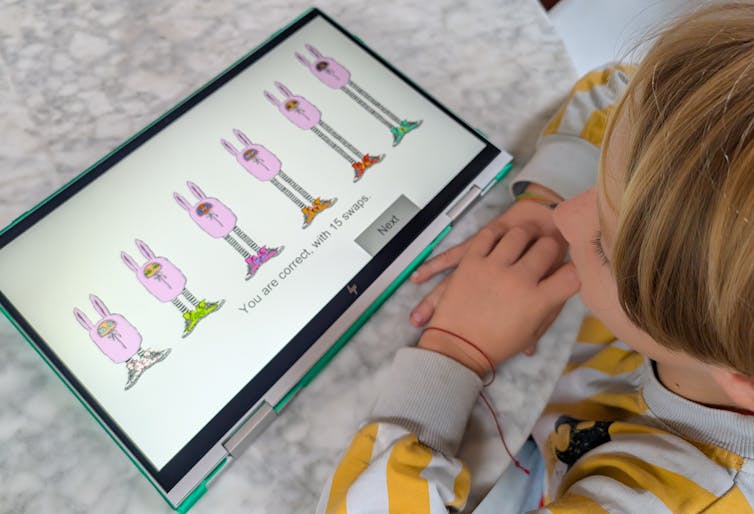
Celeste Kidd, University of California, Berkeley
I’m in a coffee shop when a young child dumps out his mother’s bag in search of fruit snacks. The contents spill onto the table, bench and floor. It’s a chaotic – but functional – solution to the problem.
Children have a penchant for unconventional thinking that, at first glance, can look disordered. This kind of apparently chaotic behavior served as the inspiration for developmental psychologist Jean Piaget’s best-known theory: that children construct their knowledge through experience and must pass through four sequential stages, the first two of which lack the ability to use structured logic.
Piaget remains the GOAT of developmental psychology. He fundamentally and forever changed the world’s view of children by showing that kids do not enter the world with the same conceptual building blocks as adults, but must construct them through experience. No one before or since has amassed such a catalog of quirky child behaviors that researchers even today can replicate within individual children.
While Piaget was certainly correct in observing that children engage in a host of unusual behaviors, my lab recently uncovered evidence that upends some long-standing assumptions about the limits of children’s logical capabilities that originated with his work. Our new paper in the journal Nature Human Behaviour describes how young children are capable of finding systematic solutions to complex problems without any instruction. https://www.youtube.com/embed/Qb4TPj1pxzQ?wmode=transparent&start=0 Jean Piaget describes how children of different ages tackle a sorting task, with varying success.
Putting things in order
Throughout the 1960s, Piaget observed that young children rely on clunky trial-and-error methods rather than systematic strategies when attempting to order objects according to some continuous quantitative dimension, like length. For instance, a 4-year-old child asked to organize sticks from shortest to longest will move them around randomly and usually not achieve the desired final order.
Psychologists have interpreted young children’s inefficient behavior in this kind of ordering task – what we call a seriation task – as an indicator that kids can’t use systematic strategies in problem-solving until at least age 7.
Somewhat counterintuitively, my colleagues and I found that increasing the difficulty and cognitive demands of the seriation task actually prompted young children to discover and use algorithmic solutions to solve it.
Piaget’s classic study asked children to put some visible items like wooden sticks in order by height. Huiwen Alex Yang, a psychology Ph.D. candidate who works on computational models of learning in my lab, cranked up the difficulty for our version of the task. With advice from our collaborator Bill Thompson, Yang designed a computer game that required children to use feedback clues to infer the height order of items hidden behind a wall, .
The game asked children to order bunnylike creatures from shortest to tallest by clicking on their sneakers to swap their places. The creatures only changed places if they were in the wrong order; otherwise they stayed put. Because they could only see the bunnies’ shoes and not their heights, children had to rely on logical inference rather than direct observation to solve the task. Yang tested 123 children between the ages of 4 and 10. https://www.youtube.com/embed/GlsbcE6nOxk?wmode=transparent&start=0 Researcher Huiwen Alex Yang tests 8-year-old Miro on the bunny sorting task. The bunnies are hidden behind a wall with only their sneakers visible. Miro’s selections exemplify use of selection sort, a classic efficient sorting algorithm from computer science. Kidd Lab at UC Berkeley.
Figuring out a strategy
We found that children independently discovered and applied at least two well-known sorting algorithms. These strategies – called selection sort and shaker sort – are typically studied in computer science.
More than half the children we tested demonstrated evidence of structured algorithmic thinking, and at ages as young as 4 years old. While older kids were more likely to use algorithmic strategies, our finding contrasts with Piaget’s belief that children were incapable of this kind of systematic strategizing before 7 years of age. He thought kids needed to reach what he called the concrete operational stage of development first.
Our results suggest that children are actually capable of spontaneous logical strategy discovery much earlier when circumstances require it. In our task, a trial-and-error strategy could not work because the objects to be ordered were not directly observable; children could not rely on perceptual feedback.
Explaining our results requires a more nuanced interpretation of Piaget’s original data. While children may still favor apparently less logical solutions to problems during the first two Piagetian stages, it’s not because they are incapable of doing otherwise if the situation requires it.
A systematic approach to life
Algorithmic thinking is crucial not only in high-level math classes, but also in everyday life. Imagine that you need to bake two dozen cookies, but your go-to recipe yields only one. You could go through all the steps of making the recipe twice, washing the bowl in between, but you’d never do that because you know that would be inefficient. Instead, you’d double the ingredients and perform each step only once. Algorithmic thinking allows you to identify a systematic way of approaching the need for twice as many cookies that improves the efficiency of your baking.
Algorithmic thinking is an important capacity that’s useful to children as they learn to move and operate in the world – and we now know they have access to these abilities far earlier than psychologists had believed.
That children can engage with algorithmic thinking before formal instruction has important implications for STEM – science, technology, engineering and math –education. Caregivers and educators now need to reconsider when and how they give children the opportunity to tackle more abstract problems and concepts. Knowing that children’s minds are ready for structured problems as early as preschool means we can nurture these abilities earlier in support of stronger math and computational skills.
And have some patience next time you encounter children interacting with the world in ways that are perhaps not super convenient. As you pick up your belongings from a café floor, remember that it’s all part of how children construct their knowledge. Those seemingly chaotic kids are on their way to more obviously logical behavior soon.
Celeste Kidd, Professor of Psychology, University of California, Berkeley
This article is republished from The Conversation under a Creative Commons license. Read the original article.
Dive into “The Knowledge,” where curiosity meets clarity. This playlist, in collaboration with STMDailyNews.com, is designed for viewers who value historical accuracy and insightful learning. Our short videos, ranging from 30 seconds to a minute and a half, make complex subjects easy to grasp in no time. Covering everything from historical events to contemporary processes and entertainment, “The Knowledge” bridges the past with the present. In a world where information is abundant yet often misused, our series aims to guide you through the noise, preserving vital knowledge and truths that shape our lives today. Perfect for curious minds eager to discover the ‘why’ and ‘how’ of everything around us. Subscribe and join in as we explore the facts that matter. https://stmdailynews.com/the-knowledge/
Discover more from Daily News
Subscribe to get the latest posts sent to your email.
The Bridge
Hard Rock International and Coca-Cola Launch ‘Women Empower’ Series for International Women’s Month

Last Updated on March 15, 2026 by Daily News Staff

Hard Rock International is teaming up with long-time partner Coca-Cola to spotlight women shaping the music business with a new content initiative and a month-long slate of events.
Announced Feb. 26, 2026, the collaboration introduces “Women Empower,” a micro-documentary series rolling out throughout March as part of Hard Rock’s annual International Women’s Month celebrations. Alongside the video series, Hard Rock says it’s aiming to host 1,000 live music and special events globally across its Cafes, Hotels, Casinos and Live venues.
A micro-documentary series focused on women across the industry
Rather than focusing only on performers, “Women Empower” highlights women working in a range of roles across music and media. Hard Rock notes that less than 5% of music and media creators are women, and the series is designed to put more faces—and job titles—into the public conversation.
The six featured women include:
- Janelle Abraham — Director/Film Producer
- Kat Luna — Singer/Songwriter
- Minami Minami — Composer/Dancer/Singer
- Claire Murphy — Guitar Tech
- Mayna Nevarez — CEO & Founder, Nevarez Communications
- Wendy Ong — Co-President/CMO, TaP Music
Elena Alvarez, Senior Vice President of Marketing and Brand Partnerships at Seminole Gaming and Hard Rock International, said the brand is using International Women’s Month to “lift the curtain” on the series while tying the celebration back to Hard Rock’s music-first identity and philanthropic work.
$100,000 donation to Women in Music
Hard Rock Heals Foundation®, Hard Rock’s charitable arm, is donating $100,000 to Women in Music, supporting the nonprofit’s education and empowerment efforts.
Nicole Barsalona, President of Women in Music, said the campaign highlights diversity on stage and “the wide range of roles across the music business—and the women behind the scenes whose work drives our industry forward.”
Limited-time Coca-Cola menu items at participating Hard Rock Cafes
Throughout March, participating Hard Rock Cafes will offer a limited-time Coca-Cola-inspired menu tied to the regions represented in the series.
Specialty drinks include:
- Passionfruit Splash — passionfruit beverage with Minute Maid Lemonade, Sprite and cranberry juice
- Mango Guava Chiller — mango and guava-flavored drink with Sprite, pineapple and lime juice
- Spiced Yuzu Soda — spiced brown sugar, yuzu and Coca-Cola blend
Food items include:
- Fattoush Chicken Caesar Salad — romaine with grilled chicken, mint, vegetables, fried naan and red wine Caesar dressing
- Mahi Sandwich — mahi filet with remoulade, lettuce, tomato and shoestring onions, served with seasoned fries
- Dulce de Leche Brownie — brownie with chocolate sauce, vanilla ice cream, dulce de leche and whipped cream
Hard Rock Hotels: curated listening experiences honoring female artists
Hard Rock Hotels will also highlight women in music through live performances, curated playlists and themed listening experiences using the brand’s Sound of Your Stay® program. Hard Rock says guests can expect music-themed amenities such as limited-edition vinyl, memorabilia highlights and playlists centered on female artists—both iconic names and emerging talent.
Events worldwide + Rock Shop merch
Hard Rock says it will host women-led performances, networking events, brunches and other community-driven experiences across its global footprint throughout March.
Hard Rock’s official International Women’s Month T-shirts are available at Rock Shop® retail locations and online.
For the full list of International Women’s Month activations, visit https://www.hardrock.com/women.
The Bridge is a section of the STM Daily News Blog meant for diversity, offering real news stories about bona fide community efforts to perpetuate a greater good. The purpose of The Bridge is to connect the divides that separate us, fostering understanding and empathy among different groups. By highlighting positive initiatives and inspirational actions, The Bridge aims to create a sense of unity and shared purpose. This section brings to light stories of individuals and organizations working tirelessly to promote inclusivity, equality, and mutual respect. Through these narratives, readers are encouraged to appreciate the richness of diverse perspectives and to participate actively in building stronger, more cohesive communities.
https://stmdailynews.com/the-bridge
Authors


Discover more from Daily News
Subscribe to get the latest posts sent to your email.





