

unknown
Why people tend to believe UFOs are extraterrestrial

Last Updated on March 13, 2026 by Daily News Staff
Barry Markovsky, University of South Carolina
Most of us still call them UFOs – unidentified flying objects. NASA recently adopted the term “unidentified anomalous phenomena,” or UAP. Either way, every few years popular claims resurface that these things are not of our world, or that the U.S. government has some stored away.
I’m a sociologist who focuses on the interplay between individuals and groups, especially concerning shared beliefs and misconceptions. As for why UFOs and their alleged occupants enthrall the public, I’ve found that normal human perceptual and social processes explain UFO buzz as much as anything up in the sky.
Historical context
Like political scandals and high-waisted jeans, UFOs trend in and out of collective awareness but never fully disappear. Thirty years of polling find that 25%-50% of surveyed Americans believe at least some UFOs are alien spacecraft. Today in the U.S., over 100 million adults think our galactic neighbors pay us visits.
It wasn’t always so. Linking objects in the sky with visiting extraterrestrials has risen in popularity only in the past 75 years. Some of this is probably market-driven. Early UFO stories boosted newspaper and magazine sales, and today they are reliable clickbait online.
In 1980, a popular book called “The Roswell Incident” by Charles Berlitz and William L. Moore described an alleged flying saucer crash and government cover-up 33 years prior near Roswell, New Mexico. The only evidence ever to emerge from this story was a small string of downed weather balloons. Nevertheless, the book coincided with a resurgence of interest in UFOs. From there, a steady stream of UFO-themed TV shows, films, and pseudo-documentaries has fueled public interest. Perhaps inevitably, conspiracy theories about government cover-ups have risen in parallel.
Some UFO cases inevitably remain unresolved. But despite the growing interest, multiple investigations have found no evidence that UFOs are of extraterrestrial origin – other than the occasional meteor or misidentification of Venus.
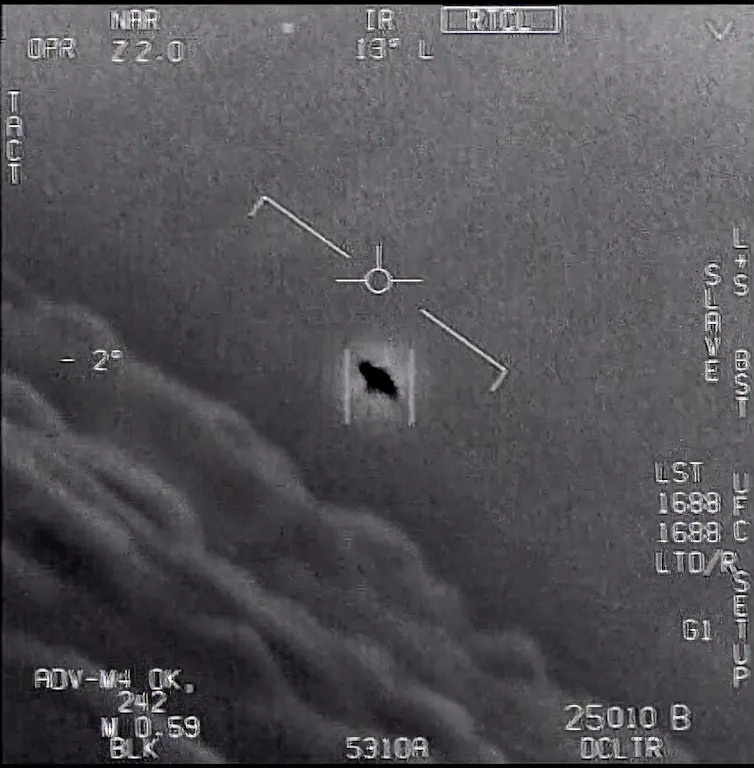
But the U.S. Navy’s 2017 Gimbal video continues to appear in the media. It shows strange objects filmed by fighter jets, often interpreted as evidence of alien spacecraft. And in June 2023, an otherwise credible Air Force veteran and former intelligence officer made the stunning claim that the U.S. government is storing numerous downed alien spacecraft and their dead occupants. https://www.youtube.com/embed/2TumprpOwHY?wmode=transparent&start=0 UFO videos released by the U.S. Navy, often taken as evidence of alien spaceships.
Human factors contributing to UFO beliefs
Only a small percentage of UFO believers are eyewitnesses. The rest base their opinions on eerie images and videos strewn across both social media and traditional mass media. There are astronomical and biological reasons to be skeptical of UFO claims. But less often discussed are the psychological and social factors that bring them to the popular forefront.
Many people would love to know whether or not we’re alone in the universe. But so far, the evidence on UFO origins is ambiguous at best. Being averse to ambiguity, people want answers. However, being highly motivated to find those answers can bias judgments. People are more likely to accept weak evidence or fall prey to optical illusions if they support preexisting beliefs.
For example, in the 2017 Navy video, the UFO appears as a cylindrical aircraft moving rapidly over the background, rotating and darting in a manner unlike any terrestrial machine. Science writer Mick West’s analysis challenged this interpretation using data displayed on the tracking screen and some basic geometry. He explained how the movements attributed to the blurry UFO are an illusion. They stem from the plane’s trajectory relative to the object, the quick adjustments of the belly-mounted camera, and misperceptions based on our tendency to assume cameras and backgrounds are stationary.
West found the UFO’s flight characteristics were more like a bird’s or a weather balloon’s than an acrobatic interstellar spacecraft. But the illusion is compelling, especially with the Navy’s still deeming the object unidentified.
West also addressed the former intelligence officer’s claim that the U.S. government possesses crashed UFOs and dead aliens. He emphasized caution, given the whistleblower’s only evidence was that people he trusted told him they’d seen the alien artifacts. West noted we’ve heard this sort of thing before, along with promises that the proof will soon be revealed. But it never comes.
Anyone, including pilots and intelligence officers, can be socially influenced to see things that aren’t there. Research shows that hearing from others who claim to have seen something extraordinary is enough to induce similar judgments. The effect is heightened when the influencers are numerous or higher in status. Even recognized experts aren’t immune from misjudging unfamiliar images obtained under unusual conditions.
Group factors contributing to UFO beliefs
“Pics or it didn’t happen” is a popular expression on social media. True to form, users are posting countless shaky images and videos of UFOs. Usually they’re nondescript lights in the sky captured on cellphone cameras. But they can go viral on social media and reach millions of users. With no higher authority or organization propelling the content, social scientists call this a bottom-up social diffusion process.
In contrast, top-down diffusion occurs when information emanates from centralized agents or organizations. In the case of UFOs, sources have included social institutions like the military, individuals with large public platforms like U.S. senators, and major media outlets like CBS.
Amateur organizations also promote active personal involvement for many thousands of members, the Mutual UFO Network being among the oldest and largest. But as Sharon A. Hill points out in her book “Scientifical Americans,” these groups apply questionable standards, spread misinformation and garner little respect within mainstream scientific communities.
Top-down and bottom-up diffusion processes can combine into self-reinforcing loops. Mass media spreads UFO content and piques worldwide interest in UFOs. More people aim their cameras at the skies, creating more opportunities to capture and share odd-looking content. Poorly documented UFO pics and videos spread on social media, leading media outlets to grab and republish the most intriguing. Whistleblowers emerge periodically, fanning the flames with claims of secret evidence.
Despite the hoopla, nothing ever comes of it.
For a scientist familiar with the issues, skepticism that UFOs carry alien beings is wholly separate from the prospect of intelligent life elsewhere in the universe. Scientists engaged in the search for extraterrestrial intelligence have a number of ongoing research projects designed to detect signs of extraterrestrial life. If intelligent life is out there, they’ll likely be the first to know.
As astronomer Carl Sagan wrote, “The universe is a pretty big place. If it’s just us, seems like an awful waste of space.”
Barry Markovsky, Distinguished Professor Emeritus of Sociology, University of South Carolina
This article is republished from The Conversation under a Creative Commons license. Read the original article.
The science section of our news blog STM Daily News provides readers with captivating and up-to-date information on the latest scientific discoveries, breakthroughs, and innovations across various fields. We offer engaging and accessible content, ensuring that readers with different levels of scientific knowledge can stay informed. Whether it’s exploring advancements in medicine, astronomy, technology, or environmental sciences, our science section strives to shed light on the intriguing world of scientific exploration and its profound impact on our daily lives. From thought-provoking articles to informative interviews with experts in the field, STM Daily News Science offers a harmonious blend of factual reporting, analysis, and exploration, making it a go-to source for science enthusiasts and curious minds alike. https://stmdailynews.com/category/science/


unknown
Did Jackie Gleason See Aliens? Inside the Strange Nixon–UFO Legend
Jackie Gleason reportedly told his wife that President Richard Nixon arranged for him to view preserved extraterrestrial bodies at a Florida Air Force base. Here is what we know—and why the remarkable story remains unverified.

The beloved comedian reportedly told his wife that President Richard Nixon arranged for him to view preserved extraterrestrial bodies at a Florida Air Force base. Decades later, the extraordinary story remains fascinating—but unverified.
Jackie Gleason is remembered as “The Great One,” the larger-than-life entertainer who turned bus driver Ralph Kramden into one of television’s most enduring characters on The Honeymooners. Away from the cameras, however, Gleason had another consuming interest: UFOs, psychic phenomena and the possibility of extraterrestrial life.
That interest eventually became the foundation of one of the strangest stories ever associated with an American president and a Hollywood celebrity. According to Gleason’s second wife, Beverly McKittrick, her husband came home late one night in 1973 and claimed that President Richard Nixon had helped him see the preserved bodies of extraterrestrial beings at Homestead Air Force Base in Florida.
Did Jackie Gleason really see aliens?
The honest answer is that we do not know. The allegation is remarkable, but the available evidence never rises above an uncorroborated story attributed to Gleason years after the supposed event.
Gleason’s fascination with UFOs was real
There is little question that Gleason took the UFO subject seriously. He reportedly assembled a substantial personal library devoted to UFOs, the paranormal and related mysteries. His unusual circular home in New York—often nicknamed “The Mothership”—only strengthened his public association with flying saucers, although its distinctive architecture is not evidence of an extraterrestrial encounter.
Gleason also had a genuine social connection with Nixon. The two men shared an interest in golf and spent time together in Florida. That documented friendship is the factual starting point from which the more sensational story grew.
The alleged trip to Homestead Air Force Base
McKittrick said that Gleason returned to their Florida home at about 11:30 one evening looking disturbed. According to her account, he told her that Nixon had arrived without the usual presidential entourage and taken him to Homestead Air Force Base, south of Miami.
Once there, Gleason allegedly entered a secured building where he saw small humanoid bodies preserved inside glass-topped containers. Published versions differ over the number of bodies and some physical details, but they generally describe child-sized beings with oversized heads.
Importantly, McKittrick did not claim to have accompanied the men or witnessed anything at the base. Her account was based entirely on what she said Gleason told her after returning home.
The story became public in 1983, years after the alleged visit and after the couple had divorced. It circulated widely through tabloid reporting, UFO publications and later books, gradually becoming part of UFO folklore.
Why the story remains unverified
No authenticated photograph, visitor record, military document or firsthand statement from Nixon has emerged to confirm the alleged trip. Gleason also never provided investigators with a signed affidavit describing the experience.
UFO researcher Larry Bryant reportedly sought records from Homestead and tried to obtain a statement from Gleason, but those efforts produced no confirming documentation. Gleason’s refusal to address the account publicly has sometimes been portrayed as suspicious, but silence is not proof that an event occurred.
There is another important complication: McKittrick later expressed uncertainty about her former husband’s story.
During telephone interviews conducted by researcher Kenny Young in 2003, she stood by her recollection that Gleason told her he had seen “dead aliens.” She also acknowledged that, as the years passed, she wondered whether he might have invented the explanation because he had been out late. She declined to appear on camera and said the story should be authenticated first.
Her later comments do not establish that the account was false, but they considerably weaken any attempt to treat it as verified history.
Could a president have slipped away unnoticed?
Some versions of the legend emphasize that Nixon supposedly drove to Gleason’s house alone and then entered a military installation without his Secret Service detail. Presidents have occasionally sought privacy or slipped away from tightly managed schedules, but a secret nighttime excursion of this nature would have involved serious security and logistical obstacles.
The claim becomes even more difficult to accept when we consider what Nixon allegedly revealed. If the United States possessed extraterrestrial bodies, granting a comedian personal access to them would have represented an extraordinary breach of national security—with no apparent official purpose and no surviving documentation.
None of that makes the episode logically impossible. It does, however, mean that the story requires exceptionally strong evidence. That evidence has never appeared.
A compelling legend, not a confirmed encounter
The Jackie Gleason story endures because it combines three irresistible ingredients: a famous comedian fascinated by UFOs, a secretive American president and a nighttime visit to a military base containing an alleged government secret.
What can be established is that Gleason was deeply interested in UFOs, knew Nixon and was said by his former wife to have made an extraordinary claim. What cannot be established is that Nixon took him to Homestead Air Force Base or that preserved extraterrestrial bodies were ever stored there.
So, did Jackie Gleason see aliens?
Perhaps he believed that he did—or perhaps he simply told an unforgettable story. Until corroborating evidence emerges, the alleged encounter belongs in the intriguing borderland between celebrity history and American UFO mythology.
Sources and further reading
- The Black Vault: Jackie Gleason and the Pickled Alien
- University of Miami Libraries: The Jackie Gleason Collection
- U.S. Department of Defense: All-domain Anomaly Resolution Office
Step into The Unknown, where STM Daily News explores the strange phenomena, unexplained encounters and enduring mysteries that continue to challenge what we think we know. From UFO sightings and paranormal events to historical mysteries and unusual scientific discoveries, we examine the stories, evidence and competing explanations—without losing our sense of wonder. https://stmdailynews.com/science/unknown/
unknown
Pentagon Releases Second Batch of UFO Files: New Videos, Testimony, and Unexplained Encounters
The Pentagon has released a second batch of UFO and UAP files, including military videos, witness testimony, Apollo mission records, and unexplained aerial encounters.
Last Updated on May 30, 2026 by Rod Washington
Public fascination with UFOs and UAPs continues to grow after the Pentagon released a second batch of declassified files tied to unexplained aerial phenomena. The new release expands upon the first wave of disclosures issued earlier this month and includes additional military videos, eyewitness testimony, audio recordings, and historical government documents.
While officials continue to stress that there is no confirmed evidence of extraterrestrial life, the latest tranche of files has intensified debate surrounding unexplained sightings involving military personnel, radar systems, and infrared tracking technology.
What Was Included in the Second Release?
The second batch was published through the government’s Presidential Unsealing and Reporting System for UAP Encounters (PURSUE).
According to the Pentagon, the latest release includes:
- More than 220 additional files
- Over 40 newly released videos
- Dozens of audio recordings
- Intelligence reports
- First-hand accounts from military and civilian witnesses
The Pentagon says these cases remain unresolved because investigators lacked sufficient data to make definitive conclusions. Officials also stated that additional releases are expected in the coming weeks.
New Military Videos Draw Attention
Among the most discussed materials are infrared military videos showing unusual formations and unidentified objects moving across restricted airspace.
One widely discussed video reportedly shows four unidentified objects flying in formation near Iran in 2022, captured using U.S. military infrared systems.
Another newly released report describes “orange orbs” that allegedly maneuvered near military aircraft during a mission connected to a sensitive government facility. Witnesses claimed the objects:
- Changed formation rapidly
- Approached aircraft at close range
- Appeared to pursue fighter jets before disappearing
According to one intelligence officer’s testimony, personnel were left “virtually speechless” following the encounter.
Apollo Mission Audio and Historical Records
The release also contains historical NASA-era materials involving Apollo missions and Cold War-era sightings.
One document includes audio from the Apollo 12 mission in which astronauts discussed mysterious “streaks of light” seen during their journey. NASA previously suggested the phenomenon may have been caused by internal visual effects experienced in spaceflight conditions.
The second release also includes reports from Sandia, New Mexico, where military personnel documented more than 200 sightings involving green fireballs, discs, and glowing objects between 1948 and 1950.
Pentagon Response Remains Cautious
Despite the excitement surrounding the files, the Pentagon maintains its position that:
- There is no verified evidence of extraterrestrial technology
- Many cases may eventually receive conventional explanations
Investigators say possible explanations can include:
- Drones
- Atmospheric phenomena
- Classified technology
- Sensor anomalies
- Insufficient data
Officials emphasized that unresolved does not automatically mean extraterrestrial.
Public Reaction and Skepticism
Reaction to the latest disclosure has been mixed.
Some UFO researchers believe the releases represent unprecedented government transparency and could encourage deeper scientific investigation. Others argue that many videos remain blurry, incomplete, or lacking critical technical context needed for meaningful analysis.
Skeptics also note that some materials in the first release had already circulated publicly for years, while others may involve ordinary objects captured under unusual conditions.
Still, public interest remains intense because the U.S. government is now openly acknowledging that some military encounters cannot currently be explained with available evidence.
Why the UAP Story Continues to Grow
The modern UAP discussion has evolved far beyond traditional UFO folklore.
Today the issue is increasingly viewed as:
- A national security concern
- An aviation safety issue
- A scientific mystery requiring improved data collection
Organizations now involved include:
- NASA
- All-domain Anomaly Resolution Office (AARO)
- Intelligence agencies
- Congressional oversight committees
The Pentagon has stated that additional batches of declassified files will continue to be released on a rolling basis as records are reviewed and approved for public disclosure.
The Bottom Line
The second release of Pentagon UAP files does not confirm alien visitation or extraterrestrial spacecraft. However, it does represent one of the most extensive public disclosures of unexplained aerial incident records in modern history.
Whether future investigations reveal advanced technology, misidentified phenomena, or something entirely unexpected, the UAP debate is no longer confined to the fringes of popular culture. It has become an ongoing subject of government transparency, scientific curiosity, and public fascination.
Related External Links
Stay updated with the latest UAP and breaking news coverage at STM Daily News.

unknown
Why U.S. Universities Still Avoid UAP Research Despite Growing Government Disclosure
As government disclosure around UAPs expands, universities still lag behind. This article examines academic stigma, funding gaps and the case for UAP research as a legitimate field of study.
Darrell Evans, Purdue University
Why U.S. Universities Still Avoid UAP Research Despite Growing Government Disclosure
President Donald Trump directed the Pentagon and other federal agencies to begin releasing government files related to UFOs and unidentified anomalous phenomena – called UAP – in February 2026, following years of pressure from Congress, military whistleblowers and the public.
Congress formally mandated UAP investigations through the National Defense Authorization Act in December 2022. The Pentagon’s official UAP investigative body, the All-domain Anomaly Resolution Office, AARO, now carries a caseload exceeding 2,000 reports dating back to 1945. Defense Secretary Pete Hegseth confirmed this figure earlier this year.
The cases were submitted by military personnel, pilots and government employees describing aerial objects that could not be explained as known aircraft, drones or weather phenomena. Governments in Japan, France, Brazil and Canada also have their own formal UAP investigation programs.
Yet modern research universities remain almost entirely absent from this conversation. No major university has established a dedicated UAP research center. No federal science agency offers competitive grants for UAP inquiry. No doctoral programs train researchers in UAP methodology. The gap between what governments openly acknowledge and what universities are willing to study is, at this point, difficult to explain on purely intellectual grounds.
I have navigated this gap while conducting my own UAP research. My work developing the temporal aerospace correlation tool, a standardized framework for correlating civilian UAP sighting reports with documented rocket launch activity from Cape Canaveral, is currently under peer review at Limina: The Journal of UAP Studies.
Designing that framework meant making methodological decisions without community standards, without institutional funding and without the professional infrastructure many researchers in established fields take for granted. What is missing is not interest or data – it is the shared scaffolding that turns isolated curiosity into cumulative science.
Stigma is measurable
The most rigorous evidence for the gap between faculty interest in UAP and faculty willingness to study it comes from peer-reviewed studies by Marissa Yingling, Charlton Yingling and Bethany Bell, published in the scholarly journal Humanities and Social Sciences Communications.
Across 14 disciplines at 144 major U.S. research universities, 1,460 faculty responded to their 2023 national survey. Most surveyed believed UAP research was important. Curiosity outweighed skepticism in every discipline that was part of the study. Nearly one-fifth had personally observed something aerial they could not identify. Yet fewer than 1% had ever conducted UAP-related research.
The gap was not explained by intellectual dismissal, but it was in part explained by fear. Researchers were not primarily deterred by intellectual skepticism because they doubted the topic’s merits. Instead, they feared they might lose funding, face ridicule from colleagues or find their careers quietly derailed. Faculty reported being told to “be careful.”
A 2024 follow-up study found that roughly 28% said they might vote against a colleague’s tenure case for conducting UAP research, even when they personally believed the topic warranted study.
Historian and philosopher of science Thomas Kuhn argued that scientific communities suppress anomalous questions not because those questions are unanswerable, but because they fall outside the boundaries the community has collectively decided are worth investigating.
Sociologist Thomas Gieryn called this suppression “boundary work,” referring to the active process by which scientists police what counts as legitimate science.
For UAP researchers, the data and tools to study the phenomenon exist. What may not exist is social permission to use them without professional consequence.
Creating an academic discipline
Academic disciplines do not emerge spontaneously. They require dedicated journals, agreed-upon methods, graduate programs and professional societies.
The history of cognitive neuroscience demonstrates how disciplines emerge. Before the 1980s, researchers at the intersection of neuroscience and cognitive psychology faced resistance from both parent disciplines.
These fields achieved mainstream acceptance only after targeted funding from the Alfred P. Sloan Foundation, new brain-imaging tools and the gradual formation of academic programs that created career pathways for researchers. Researchers at the nexus of these fields did not wait for central questions to be resolved. They built infrastructure, and the infrastructure made progress possible.
UAP studies as a discipline is developing some of these elements, but largely outside universities. The Society for UAP Studies, a nonprofit of scholars and researchers, operates Limina as a double-blind, peer-reviewed journal and has convened international symposia drawing researchers from physics, philosophy of science and the social sciences. But a nonprofit scholarly society without tenured faculty does not constitute a discipline.
To turn UAP studies into a recognized academic field would require three things.
First, funding. The Yingling studies found that competitive research grants would do more to unlock faculty participation than any other single factor. Without grants, researchers cannot hire students to assist them, maintain instruments or sustain the multiyear projects that produce meaningful results.
Second, shared methodological standards – these would entail agreed-upon procedures for collecting, recording and evaluating UAP reports – would mean findings from one research group can be compared and built upon by others.
Third, institutions could publicly affirm that they will evaluate appropriately rigorous UAP scholarship on its scientific merits during tenure reviews. Several universities have already done this for gun violence research and psychedelic-assisted therapy studies.
These are not isolated examples. Research into near-death experiences and adverse childhood experiences followed similar trajectories, moving from being a professional liability to mainstream legitimacy after the removal of institutional barriers.
The international comparison
This gap in UAP scholarship is unique to the United States. France’s GEIPAN, a dedicated investigation unit within its national space agency, has operated since 1977. It has publicly archived approximately 5,300 French UAP cases, of which about 2% to 3% remain unexplained after rigorous analysis.
In 2020, Japan formalized UAP reporting protocols for its Self-Defense Forces, the branch of the Japanese military responsible for national defense. By June 2024, more than 80 lawmakers had formed a parliamentary UAP investigation group that by May 2025 had formally proposed a dedicated UAP research office to the defense minister. Canada launched its own multiagency UAP investigation survey in 2023.
None of these actions has produced a corresponding response from American research universities. Universities provide independent, peer-reviewed analyses that government programs structurally cannot.
The University of Würzburg in Germany became the first Western university to officially recognize UAP as a legitimate object of academic research in 2022, when it formally added UAP investigation to its research canon. Researchers at Stockholm University and the Nordic Institute for Theoretical Physics in Sweden have been actively publishing peer-reviewed UAP research since 2017, most recently in Scientific Reports in October 2025.
Congress has passed legislation, the Pentagon is reporting on its investigations, and the president has directed federal agencies to begin releasing records. So the question no longer is whether governments take UAP seriously – it is whether universities will follow, and which ones will get there first.
Darrell Evans, Professor of Environmental Science and Sustainability, Purdue University
This article is republished from The Conversation under a Creative Commons license. Read the original article.
Dive into “The Knowledge,” where curiosity meets clarity. This playlist, in collaboration with STMDailyNews.com, is designed for viewers who value historical accuracy and insightful learning. Our short videos, ranging from 30 seconds to a minute and a half, make complex subjects easy to grasp in no time. Covering everything from historical events to contemporary processes and entertainment, “The Knowledge” bridges the past with the present. In a world where information is abundant yet often misused, our series aims to guide you through the noise, preserving vital knowledge and truths that shape our lives today. Perfect for curious minds eager to discover the ‘why’ and ‘how’ of everything around us. Subscribe and join in as we explore the facts that matter. https://stmdailynews.com/the-knowledge/




