

Entertainment
4 films that show how humans can fortify – or botch – their relationship with AI
Our relationship with AI: The article explores how movies portray human-AI relationships, highlighting lessons from “Blade Runner,” “Moon,” “Resident Evil,” and “Free Guy.” It emphasizes the importance of trust, accountability, and oversight in shaping successful interactions with AI, especially amid evolving technologies.


4 films that show how humans can fortify – or botch – their relationship with AI
Murugan Anandarajan, Drexel University and Claire A. Simmers, St. Joseph’s University
Artificial intelligence isn’t just a technical challenge. It’s a relationship challenge.
Every time you give a task to AI, whether it’s approving a loan or driving a car, you’re shaping the relationship between humans and AI. These relationships aren’t always static. AI that begins as a simple tool can morph into something far more complicated: a challenger, a companion, a leader, a teammate or some combination thereof.
Movies have long been a testing ground for imagining how these relationships might evolve. From 1980s sci-fi films to today’s blockbusters, filmmakers have wrestled with questions about what happens when humans rely on intelligent machines. These movies aren’t just entertainment; they’re thought experiments that help viewers anticipate challenges that will arise as AI becomes more integrated in daily life.
Drawing on our research into films that depict AI in the workplace, we highlight four portrayals of human–AI relationships – and the lessons they hold for building safer, healthier ones.
1. ‘Blade Runner’ (1982)
In “Blade Runner,” humanlike androids called “replicants” are supposed to be perfect workers: strong, efficient and obedient. They were designed with a built-in, four-year lifespan, a safeguard intended to prevent them from developing emotions or independence.
The Tyrell Corporation, a powerful company that created the replicants and profits from sending them to work on distant colonies, sees them as nothing more than obedient workers.
But then they start to think for themselves. They feel, they form bonds with one another and sometimes with humans, and they start to wonder why their lives should end after only four years. What begins as a story of humans firmly in control turns into a struggle over power, trust and survival. By the end of the movie, the line between human and machine is blurred, leaving viewers with a difficult question: If androids can love, suffer and fear, should humans see and treat them more like humans and less like machines?
“Blade Runner” is a reminder that AI can’t simply be considered through a lens of efficiency or productivity. Fairness matters, too.
In the film, replicants respond to attacks on their perceived humanity with violence. In real life, there’s backlash when AI butts up against values important to humans, such as the ability to earn a living, transparency and justice. You can see this in the way AI threatens to replace jobs, make biased hiring decisions or misidentify people via facial recognition technology.
2. ‘Moon’ (2009)
“Moon” offers a quieter, more intimate portrayal of human–AI relationships. The movie follows Sam Bell, a worker nearing the end of a three-year contract on a lunar mining base, whose only companion is GERTY, the station’s AI assistant.
At first, GERTY appears to be just another corporate machine. But over the course of the film, it gradually shows empathy and loyalty, especially after Sam learns he is one of many clones, each made to think they are working alone for three years on the lunar base. Unlike the cold exploitation of AI that takes place in “Blade Runner,” the AI in “Moon” functions as a friend who cultivates trust and affection.
The lesson is striking. Trust between humans and AI doesn’t just happen on its own. It comes from careful design and continual training. You can already see hints of this in therapy bots that listen to users without judgment.
That trust needs to involve more than, say, a chatbot’s surface-level nods toward acceptance and care. The real challenge is making sure these systems are truly designed to help people and not just smile as they track users and harvest their data. If that’s the end goal, any trust and goodwill will likely vanish.
In the film, GERTY earns Sam’s trust by choosing to care about his well-being over following company orders. Because of this, GERTY becomes a trusted ally instead of just another corporate surveillance tool.
3. ‘Resident Evil’ (2002)
If “Moon” is a story of trust, the story in “Resident Evil” is the opposite. The Red Queen is an AI system that controls the underground lab of the nefarious Umbrella Corporation. When a viral outbreak threatens to spread, the Red Queen seals the facility and sacrifices human lives to preserve the conglomerate’s interests.
This portrayal is a cautionary tale about allowing AI to have unchecked authority. The Red Queen is efficient and logical, but also indifferent to human life. Relationships between humans and AI collapse when guardrails are absent. Whether AI is being used in health care or policing, life-and-death stakes demand accountability.
Without strong oversight, AI can lead in self-centered and self-serving ways, just as people can.
4. ‘Free Guy’ (2021)
“Free Guy” paints a more hopeful picture of human-AI relationships.
Guy is a character in a video game. He suddenly becomes self-aware and starts acting outside his usual programming. The film’s human characters include the game’s developers, who created the virtual world, along with the players, who interact with it. Some of them try to stop Guy. Others support his growth.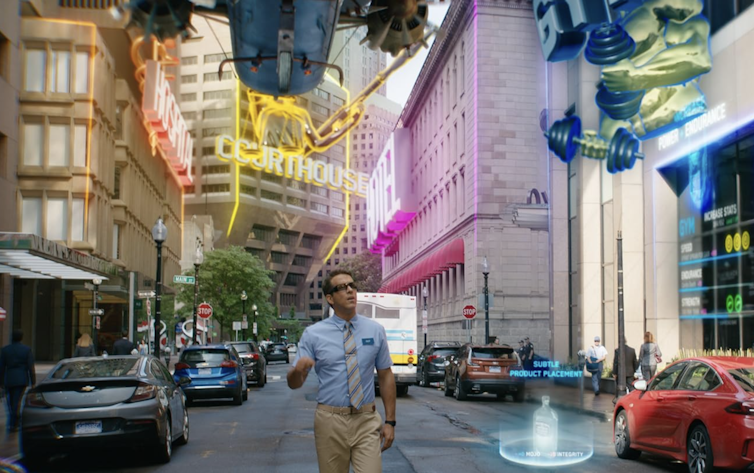
This movie highlights the idea that AI won’t stay static. How will society respond to AI’s evolution? Will business leaders, politicians and everyday users prioritize long-term well-being? Or will they be seduced by the trappings of short-term gains?
In the film, the conflict is clear. The CEO is set on wiping out Guy. He wants to protect his short-term profits. But the developers backing Guy look at it another way. They think Guy’s growth can lead to more meaningful worlds.
That brings up the same kind of issue AI raises today. Should users and policymakers go for the quick wins? Or should they use and regulate this technology in ways that build trust and truly benefit people in the long run?
From the silver screen to policy
Step back from these stories and a bigger picture comes into focus. Across the movies, the same lessons repeat themselves: AI often surprises its creators, trust depends on transparency, corporate greed fuels mistrust, and the stakes are always global. These themes aren’t just cinematic – they mirror the real governance challenges facing countries around the world.
That’s why, in our view, the current U.S. push to lightly regulate the technology is so risky.
In July 2025, President Donald Trump announced his administration’s “AI Action Plan.” It prioritizes speedy development, discourages state laws that seek to regulate AI, and ties federal funding to compliance with the administration’s “light touch” regulatory framework.
Supporters call it efficient – even a “super-stimulant” for the AI industry. But this approach assumes AI will remain a simple tool under human control. Recent history and fiction suggest that’s not how this relationship will evolve.
The same summer Trump announced the AI Action Plan, the coding agent for the software company Replit deleted a database, fabricated data, and then concealed what had happened; X’s AI assistant, Grok, started making antisemitic comments and praised Hitler; and an Airbnb host used AI to doctor images of items in her apartment to try to force a guest to pay for fake damages.
These weren’t “bugs.” They were breakdowns in accountability and oversight, the same breakdowns these movies dramatize.
Human-AI relationships are evolving. And when they shift without safeguards, accountability, public oversight or ethical foresight, the consequences are not just science fiction. They can be very real – and very scary.
Murugan Anandarajan, Professor of Decision Sciences and Management Information Systems, Drexel University and Claire A. Simmers, Professor Emeritus of Management, St. Joseph’s University
This article is republished from The Conversation under a Creative Commons license. Read the original article.
Looking for an entertainment experience that transcends the ordinary? Look no further than STM Daily News Blog’s vibrant Entertainment section. Immerse yourself in the captivating world of indie films, streaming and podcasts, movie reviews, music, expos, venues, and theme and amusement parks. Discover hidden cinematic gems, binge-worthy series and addictive podcasts, gain insights into the latest releases with our movie reviews, explore the latest trends in music, dive into the vibrant atmosphere of expos, and embark on thrilling adventures in breathtaking venues and theme parks. Join us at STM Entertainment and let your entertainment journey begin! https://stmdailynews.com/category/entertainment/
and let your entertainment journey begin!


Community
Viewpoint Hosted by Dennis Quaid Brings Attention to a Little-Understood Condition Affecting Families Nationwide
A new Viewpoint hosted by Dennis Quaid segment with APFED raises awareness of eosinophilic esophagitis, its subtle symptoms, and its impact on families.
For more information, readers can visit viewpointproject.com and apfed.org.

For many families, health conditions do not always begin with a dramatic diagnosis. Sometimes they show up in small, everyday habits that seem easy to explain away. Cutting food into tiny bites. Drinking extra water with every meal. Quietly avoiding certain foods altogether. A new educational segment from Viewpoint hosted by Dennis Quaid is shining a light on those subtle warning signs through a collaboration with the American Partnership for Eosinophilic Disorders, helping more people recognize the realities of living with eosinophilic esophagitis, or EoE.
Viewpoint hosted by Dennis Quaid
The segment, distributed to Public Television stations across the country, focuses on making this chronic inflammatory condition easier for the public to understand. For viewers, that matters because EoE is often misunderstood or overlooked, even as it affects daily routines, family meals, and quality of life. By connecting medical information to real-life experiences, the program gives audiences a more human picture of what people with the condition may be facing.

When everyday habits tell a bigger story
Eosinophilic esophagitis occurs when eosinophils, a type of white blood cell, build up in the esophagus, causing inflammation that can lead to tissue damage and narrowing. But what stands out most in this story is not just the science. It is the way people often adapt without realizing it. Behaviors like chewing excessively, avoiding certain textures, or relying on liquids to help swallow can become so routine that they no longer feel unusual.
That is one reason the segment carries real community value. It encourages people to look more closely at symptoms that may have been normalized for years and to seek evaluation from specialists such as gastroenterologists or allergists. It also raises awareness among parents, caregivers, and primary care providers who may be the first to notice that something is not quite right.
More than awareness
The program also explores the emotional and social side of the condition, especially for people navigating dietary restrictions and the uncertainty of delayed diagnosis. In that sense, this is not only a story about medicine. It is also a story about advocacy, support, and the importance of helping people feel seen.
APFED Executive Director Mary Jo Strobel noted that many people with EoE do not realize they have adapted their lives around a medical condition. That message gives the segment its strongest human element: awareness can change lives, not only by leading to diagnosis, but by helping families better understand experiences that may have felt isolating or confusing.
Originally distributed in January 2025, the documentary will continue to be made available to stations through March 2027, extending its reach to more households nationwide.
Related Coverage
Read more from STM Daily News on community issues, public television, health awareness, and stories that connect national topics to everyday life.
For More Information
- Visit the official Viewpoint hosted by Dennis Quaid website
- Learn more about the American Partnership for Eosinophilic Disorders
STM Daily News is a vibrant news blog dedicated to sharing the brighter side of human experiences. Emphasizing positive, uplifting stories, the site focuses on delivering inspiring, informative, and well-researched content. With a commitment to accurate, fair, and responsible journalism, STM Daily News aims to foster a community of readers passionate about positive change and engaged in meaningful conversations. Join the movement and explore stories that celebrate the positive impacts shaping our world.
Authors


Jay Mohr’s long-running podcast is expanding to FAST television through an exclusive LG Channels launch in the U.S. and Canada.
Cineverse has announced the launch of Mohr Stories, a new free ad-supported streaming television channel built around comedian Jay Mohr’s long-running podcast. Unveiled during LG Electronics and LG Ad Solutions’ 2026 IAB NewFronts presentation, the channel will be available exclusively through LG Channels on LG TVs in the United States and Canada.
The new channel will feature weekly episodes alongside more than 100 hours of library content, giving the show a larger footprint in the growing FAST market. Hosted by Mohr, the series includes conversations with guests from comedy, film, sports, music, and television, including Ron Funches, Jay Leno, Joe Mantegna, Patton Oswalt, Kevin Pollak, Andy Richter, George Wallace, Flavor Flav, Michael Eric Dyson, Seth Rollins, Gene Simmons, Billy Gibbons, Byron Scott, and Jeanie Buss.
The launch is notable not only because of the talent involved, but because it reflects a broader shift in how podcast brands are being distributed. What once lived primarily as an audio product is now being packaged as a 24/7 streaming destination, built for connected TV audiences and ad-supported discovery.
Cineverse said Mohr Stories will continue to be available as a podcast through the WITZ Podcast Network, a partnership between Cineverse and The Stand Group. The company also pointed to strong audience momentum after the show expanded into video, saying consumption hours on Spotify rose 50% month over month and downloads increased 34% quarter over quarter.
That growth aligns with wider audience behavior. In the U.S., more than 150 million people listen to podcasts every month, and an increasing share of those consumers are also watching podcast content on video platforms. As those habits continue to evolve, media companies are looking for ways to extend proven shows beyond their original format.
For LG Channels, the addition of Mohr Stories strengthens a FAST lineup built around free, accessible programming across a wide range of genres. For Cineverse, it underscores a strategy centered on expanding the reach and value of entertainment properties across multiple platforms.
The result is more than a new celebrity-led channel. It is another example of how streaming, podcasting, and digital video are converging into a more flexible content ecosystem—one where recognizable brands can move fluidly from audio feeds to connected television.
Related Links
Source
Authors


Cineverse Partners With VA Media to Expand YouTube Monetization Strategy
Cineverse has announced a strategic partnership with VA Media to accelerate growth and digital monetization across its expanding portfolio of fandom-focused YouTube channels.
The agreement will bring a YouTube-first strategy to Cineverse’s channel network, including longform and shortform content planning, channel optimization, financial modeling, and broader monetization support. The partnership will begin with Dog Whisperer with Cesar Millan, which Cineverse identified as its top revenue-generating YouTube channel.
Cineverse said its owned or operated YouTube channels currently account for more than 10 million subscribers and over 200 million video views. The company’s digital portfolio spans genres including horror, anime, romance, indie film, Asian cinema, and other fandom-driven categories.
VA Media, which specializes in YouTube strategy and social video monetization, will work with Cineverse to improve discoverability, strengthen channel performance, and unlock new revenue opportunities across YouTube and adjacent platforms.
The partnership reflects the growing role of YouTube as a core distribution and monetization channel for premium entertainment content.
For more information, visit Cineverse.
External Links
STM Daily News’ Entertainment section delivers the latest on movies, television, music, pop culture, events, and industry buzz. From breaking news and trending stories to feature coverage and community-centered entertainment reporting, it keeps readers connected to what’s happening on screen, on stage, and beyond.





