

News
After he reached the Super Bowl, Colin Kaepernick’s racial justice protests helped expose US views toward sports activism


Betina Cutaia Wilkinson, Wake Forest University
Back in 2012, quarterback Colin Kaepernick was one of the NFL’s most popular stars. He led the San Francisco 49ers to the Super Bowl and was just a few plays away from winning the title and lifting the Lombardi Trophy.
But America’s focus on Kaepernick’s athletic success waned in 2016. That’s when he began to kneel before games during the playing of “The Star-Spangled Banner” to protest the deaths of young Black men at the hands of white police officers.
They included Alton Sterling and Philando Castile, two unarmed Black men killed by police in the summer of 2016.
“To me, this is bigger than football, and it would be selfish on my part to look the other way,” Kaepernick said in The Guardian newspaper. “There are bodies in the street and people getting paid leave and getting away with murder.”
Kaepernick’s activism, coinciding with the reemergence of the Black Lives Matter movement, received varied responses.
Some NFL players, like Kaepernick’s then-teammate Eric Reid, imitated Kaepernick’s actions, generating a wave of anti-racist activism – not just in football but in other sports, too, like women’s basketball. Others, including several NFL executives, responded with vitriol and hate.
A recent study I conducted with colleagues Lisa Kiang and Elizabeth Seagroves examines American attitudes toward sports activism, providing insight into the stark responses to Kaepernick’s advocacy and those of other athletes.
Making sense of the varied responses
We surveyed 207 college students and 33 residents in Winston-Salem, North Carolina, where I teach, to examine their views on racial justice activism among professional athletes.
We found there were three general perspectives.
One group supported the sports activism and tied it to changing the status quo. People in this group back athletes’ ability to serve as activists and role models, and they hope the protests generate meaningful sociopolitical change.
“I thought it was very necessary and good,” said one participant in the study, referring to athletes’ activism. “I think that if they can use their platform for something good, they should.”
When we asked about Kaepernick’s activism in 2016, these participants lauded him for his courage.
They felt Kaepernick’s protests, along with the Black Lives Matter movement, helped raise awareness of racial injustices in the United States.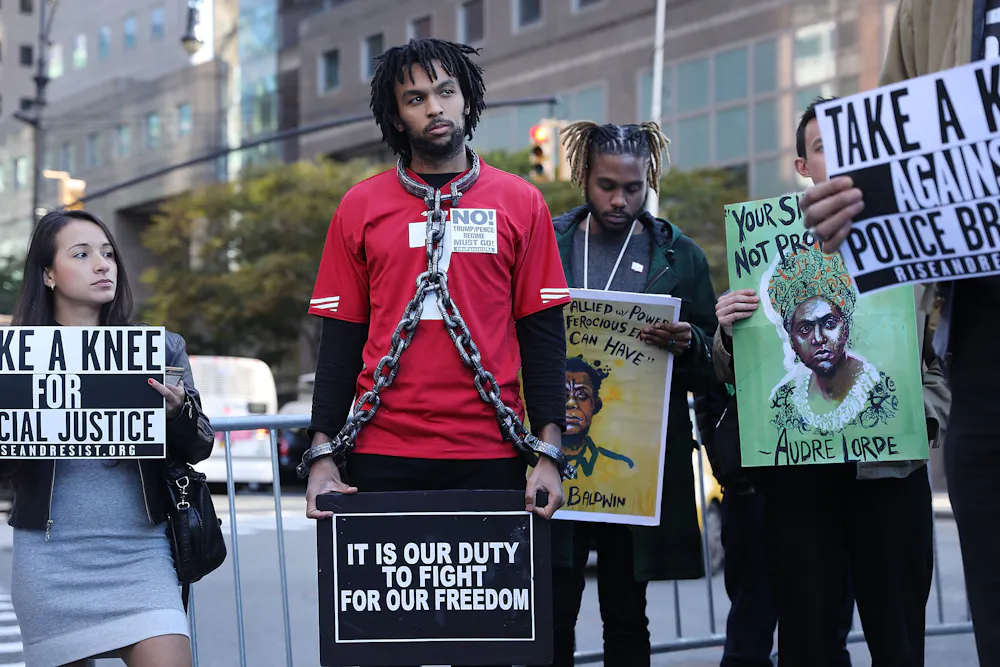
Participants reject racial justice advocacy
Other participants in our study expressed support for athletes’ right to protest, but they rejected their racial justice advocacy.
They said athletes have the freedom to say what they think. And they tied the protests to the United States’ commitment to freedom of speech. But they disapproved of kneeling during the playing of the national anthem, labeling it as disrespectful.
“I think most of it is good. If you have a platform, you should use it,” one participant told us. “However, when misinformation is spread, it becomes bad.”
Several participants felt the conflation of the national anthem with protesting racial injustices was misleading and wrong, and this participant considered Kaepernick’s protest “misinformation.”
Kaepernick’s activism elicited similarly mixed feelings at the time. A majority of the public viewed Kaepernick’s refusal to stand as unpatriotic. Most, however, also supported his right to free speech.
In May 2018, NFL Commissioner Roger Goodell barred athletes from protesting on the sidelines during the national anthem, but he gave them the option to remain in the locker room during the playing of “The Star-Spangled Banner” if they preferred. The move came after players had protested racial inequality and police brutality for two seasons.
“We want people to be respectful of the national anthem,” Goodell said, according to ESPN. “We want people to stand – that’s all personnel – and make sure they treat this moment in a respectful fashion. That’s something we think we owe. But we were also very sensitive to give players choices.”
In June 2020, in the wake of George Floyd’s death and years into Kaepernick’s activism, Goodell apologized to players and reversed the policy, saying, “We were wrong for not listening to NFL players earlier.”

But team protests varied throughout the league.
Some teams such as the Green Bay Packers and Jacksonville Jaguars, at least on one occasion, remained in their locker rooms during the playing of “The Star-Spangled Banner.”
Some teams acted uniformly with the exception of one or two players. Dallas Cowboys player Dontari Poe was the only person on his team to kneel during the playing of the national anthem.
The fact that not all players protested, and that teams had distinct approaches to protesting, is not surprising given the public’s varied responses to athlete activism.
Complete disapproval
A third group of participants in our study disapproved of sports activism entirely. And these participants often accompanied their criticism by saying that athletes strayed from their role as entertainers.
“I don’t think it’s good because it’s giving people a reason not to like a professional athlete when their job is to play a sport. They are not politicians and haven’t been able to prove they can make a change,” said one participant.
For example, when responding to WNBA player Skylar Diggins-Smith’s call for the imprisonment of the police officers in Louisville, Kentucky, involved in the 2020 shooting death of Breonna Taylor during a nighttime apartment raid, one participant said: “It’s not for the average citizen to call for police officers to be investigated. It’s just not OK for a professional athlete to push their agenda like that.”
Our study, much like other studies, found that people who are white, older and politically conservative are more opposed to racial justice activism in sports than their counterparts.
What does this mean?
As seen in our study, U.S. views toward sports protests are tied to the role people believe athletes should play in society.
For some, athletes can and should be role models; that includes by raising awareness of racial injustices. For others, athletes should only express their perspectives under certain conditions.
And yet other Americans believe athletes are performers whose only role should be to entertain.
Still, there’s no doubt Kaepernick’s activism changed the playing field, even if his NFL career suffered. After the 2016 season, he was never picked up by another team.
Kaepernick’s activism inspired people to attend protests and donate to political causes.
The NAACP has asked college athletes to avoid attending schools that are dismantling their diversity, equity and inclusion, or DEI, initiatives.
Coach Steve Kerr and All- Star Steph Curry of the Golden State Warriors regularly voice their political views and draw attention to injustices.
Several sports associations – the NFL, NBA, WNBA and NWSL – have implemented social justice initiatives and councils that strive to mobilize voters and educate the electorate on political issues.
Colin Kaepernick’s activism may have ended his Super Bowl dreams, but his legacy extends far beyond the game of football.
Betina Cutaia Wilkinson, Associate Professor & Associate Chair of Political Science, Wake Forest University
This article is republished from The Conversation under a Creative Commons license. Read the original article.

STM Daily News
Woman Charged With Felony Animal Cruelty in Santa Ana Puppy Killing
Santa Ana Puppy Killing: Prosecutors have filed felony charges against a 75-year-old Anaheim woman accused of deliberately running over and killing her puppy, Blackey, in Santa Ana.

Last Updated on October 3, 2026 by Daily News Staff
SANTA ANA, Calif. — A 75-year-old Anaheim woman accused of deliberately running over and killing her puppy on a Santa Ana street has now been formally charged with felony animal cruelty, marking a major development in a case that drew widespread attention after surveillance video was released by police.
The Orange County District Attorney’s Office announced Friday, October 2, that Hanh Minh Nguyen, 75, of Anaheim, has been charged with one felony count of animal cruelty, one felony count of animal abuse by a caretaker, and a felony enhancement alleging the personal use of a weapon — a vehicle — to kill the animal.
Nguyen was arrested by Santa Ana police on Thursday, October 1, after investigators used automated license plate reader technology to identify the green Honda Odyssey seen in surveillance footage from the September 8 incident. Police subsequently located Nguyen and found the minivan at her Anaheim residence.
According to the District Attorney’s Office, Nguyen was released from custody after posting $20,000 bail. She is scheduled to appear at the Central Justice Center in Santa Ana on November 2, 2026, in Department C55.
Surveillance video led to investigation
The case began on September 8 at approximately 9:15 a.m., when Santa Ana Animal Services officers responded to a report of a dead black-and-white male pit bull-mix puppy on West Park Lane.

Surveillance footage obtained during the investigation showed a woman removing the puppy from a minivan and placing food near the driver’s side of the vehicle. Authorities allege the woman then slowly drove forward as the puppy approached the food, running over the animal with the vehicle’s rear tire before leaving the scene.
The puppy, identified by authorities as Blackey, died.
The District Attorney’s Office describes Blackey as a 9-week-old puppy. Earlier statements and local news reports described him as approximately 9 months old.
Santa Ana police released surveillance footage of the incident on September 30 and appealed to the public for help identifying the driver.
Within a day, investigators said automated license plate reader technology helped them trace the Honda Odyssey to Nguyen. Police found the vehicle in her garage and took her into custody.
Police previously said Nguyen acknowledged owning and abandoning Blackey. According to the Los Angeles Times, a Santa Ana Police Department spokesperson said Nguyen told detectives she had left the puppy because he had been annoying her boyfriend by biting his shoes and belongings. Police said she acknowledged abandoning the dog but did not admit to intentionally running him over.
Prosecutors file felony charges
The filing of felony charges moves the case beyond the initial police investigation and into the Orange County court system.
Orange County District Attorney Todd Spitzer condemned the alleged killing in announcing the charges and said his office intends to prosecute acts of violence against animals.
Deputy District Attorney Danica Drotman of the Orange County District Attorney’s Animal Cruelty Unit is prosecuting the case.
Nguyen is accused of the offenses and has not been convicted. The allegations against her will now be addressed through the court process.
Her next scheduled court appearance is November 2.
STM Daily News will continue following the case and provide updates as additional information becomes available.
Source and Related Links
- Orange County District Attorney — October 2 charging announcement
- The DA’s release is the strongest source for this update. It provides case number 26CF4923, the exact charges, $20,000 bail, November 2 court date and the prosecutor assigned to the case. Orange County District Attorney
- For corroborating coverage, CBS Los Angeles reports the arrest, use of automated license-plate readers and the subsequent felony charges. CBS News
- CBS Los Angeles — arrest and charges update
- NBC Los Angeles — felony charges update
College Life
Is College Worth It? New U.S. News Rankings Put More Weight on What Graduates Earn
Is college worth it? MIT has taken the No. 1 spot in the 2027 U.S. News Best Colleges rankings, ending Princeton’s 15-year run. But a new Earnings by Major metric could be even more important for families asking whether college is worth the investment.

For millions of students and families, choosing a college increasingly comes down to a basic question: Is college worth it?
The latest U.S. News & World Report Best Colleges rankings are attempting to provide another piece of information to help answer that question.
The 2027 rankings place the Massachusetts Institute of Technology (MIT) at No. 1 among National Universities, ending Princeton University’s 15-year run at the top. But perhaps the bigger story for prospective students isn’t which university occupies the No. 1 position.
It’s a significant change in how U.S. News measures the value of attending college.
For the first time, the rankings include an Earnings by Major factor designed to examine what graduates earn after leaving school — and to compare those earnings with graduates who studied the same subjects elsewhere.
Is College Worth It? U.S. News Looks Beyond Graduation
College has traditionally been promoted as an investment in a person’s future. But as families confront tuition, housing expenses and the possibility of student debt, simply earning a degree may no longer be enough information when deciding where — or whether — to attend.
Students increasingly want to know what happens after graduation.
The new U.S. News Earnings by Major metric examines graduate earnings four years after graduation using data from the U.S. Department of Education’s College Scorecard.
Importantly, the system doesn’t simply compare the average salary of graduates from one university with another.
Instead, earnings are compared within specific academic disciplines.
That distinction matters.
A university graduating large numbers of engineers, computer scientists or students entering other relatively high-paying occupations could otherwise appear to produce stronger financial outcomes simply because of the subjects its students choose to study.
Comparing graduates within similar fields is intended to provide a clearer picture of how graduates from different institutions fare financially.
From Student Debt to Graduate Earnings
The new Earnings by Major metric replaces the Graduate Indebtedness factor previously used by U.S. News.
That represents an important shift in perspective.
Instead of focusing primarily on how much debt students accumulate, the new measure looks at one aspect of what students may receive financially from their education after entering the workforce.
The metric examines employed federal financial aid recipients whose highest degree is a bachelor’s degree.
According to U.S. News, the approach is intended to reduce the influence of family financial advantages and provide a better indication of the economic value institutions may contribute to graduates.
That doesn’t mean earnings alone determine whether a college education is worthwhile.
But for a student potentially investing tens of thousands of dollars — and several years of their life — knowing how graduates in a particular major perform economically can be an important part of the decision.
MIT Takes the No. 1 Spot
Against that changing methodology, MIT moved into the No. 1 position among National Universities in the 2027 rankings.
The top three are:
- Massachusetts Institute of Technology
- Princeton University
- Harvard University
Princeton’s move to second place ends a run at No. 1 that began with the 2012 edition of the rankings.
Among National Liberal Arts Colleges, Williams College remained No. 1, followed by Amherst College at No. 2. Bowdoin College, Claremont McKenna College, Pomona College and Swarthmore College tied for third.
Nearly 1,700 institutions were evaluated in the 2027 edition.
Outcomes Are Becoming a Bigger Part of the Equation
The addition of graduate earnings is part of a broader emphasis on student outcomes in the U.S. News methodology.
U.S. News says outcomes now account for more than half of a school’s total score.
Institutions can be evaluated using as many as 17 weighted measures, including graduation and retention rates, social mobility for lower-income students, post-graduate earnings, faculty resources and academic peer assessments.
The shift reflects a changing conversation surrounding higher education.
For generations, students were often encouraged to focus heavily on getting into the most prestigious college possible. Today’s students may also be asking more practical questions:
How much will it cost?
How much financial aid will I receive?
How much debt might I have when I graduate?
What do graduates in my intended major earn?
And perhaps most importantly:
Will the investment pay off for me?
College Value Isn’t Just About Salary
Graduate earnings can provide useful information, but salary shouldn’t be treated as the sole measurement of the value of higher education.
Different careers have dramatically different compensation structures.
A graduate pursuing teaching, public service, social work, the arts or nonprofit work may earn less than someone entering engineering, finance or technology while still considering their education worthwhile.
There are also benefits of higher education that are difficult to capture in a salary statistic.
That’s why students comparing schools may want to look beyond an institution’s overall ranking and examine factors such as net price after financial aid, scholarships, graduation rates, student debt, internship opportunities, career placement, location and the strength of the program they actually intend to study.
The best-known university isn’t automatically the best financial or educational choice for every student.
Economic Diversity Also Gets Attention
The 2027 rankings also highlight economic diversity among highly ranked institutions.
According to U.S. News, MIT and Princeton rank third and fourth, respectively, among the top 25 National Universities in the percentage of students receiving federal Pell Grants.
Pell Grants generally assist undergraduate students with significant financial need and typically do not have to be repaid.
Among the top 25 National Liberal Arts Colleges, Amherst College ranked highest for economic diversity under the U.S. News measure.
A New Ranking Looks at In-State Value
U.S. News is also placing additional attention on affordability for students considering public universities.
The 2027 edition introduces a Best Value Schools for In-State Students ranking, which evaluates public universities based on academic quality and affordability for residents.
The University of North Carolina at Chapel Hill took the No. 1 position in the inaugural ranking.
That category could be particularly relevant to families deciding whether the prestige associated with attending a private or out-of-state university justifies potentially higher costs compared with attending a public institution in their home state.
The Rankings Look Different This Year
There is another important caveat when comparing the 2027 results with previous years.
Changes to the Carnegie Classification framework resulted in approximately 20% of previously ranked institutions moving into different U.S. News categories.
Because some colleges are now being compared against different groups of institutions, their 2027 rankings may not be directly comparable with previous years.
The changes also expanded eligibility, allowing additional institutions specializing in areas such as engineering, business and health to enter the rankings.
U.S. News also introduced an undergraduate economics specialty ranking while continuing rankings covering areas such as social mobility, innovation, historically Black colleges and universities, artificial intelligence programs, internships, undergraduate research and study-abroad opportunities.
Public Universities, HBCUs and Social Mobility
Among public National Universities, the University of California, Berkeley and UCLA tied for the No. 1 position, followed by the University of Michigan–Ann Arbor.
The top three Historically Black Colleges and Universities were:
- Spelman College
- Howard University
- Tuskegee University
For social mobility among National Universities, Florida International University and the University of California, Riverside tied for No. 1, with Oakland City University ranked third.
These categories illustrate another reason students may want to look deeper than a school’s overall national position. Different rankings can reveal institutions performing particularly well in areas that may matter more to an individual student.
So, Is College Worth It?
There isn’t one answer that applies to every student.
The cost of attending, financial aid, chosen major, career goals, likelihood of graduating and potential debt can dramatically change the financial equation.
A college with a famous name and high national ranking could be a poor financial choice for one student while a less prominent public university with generous financial aid could be an excellent investment for another.
That’s what makes the addition of Earnings by Major noteworthy.
Instead of asking only “Which college ranks highest?”, prospective students now have another reason to ask a much more personal question:
“What am I paying for — and what could I realistically get in return?”
MIT replacing Princeton at No. 1 makes the headline.
But for students and parents trying to decide whether college is worth the cost, the growing emphasis on outcomes, affordability and post-graduation earnings may ultimately be the more important story.
Source: U.S. News & World Report, 2027 Best Colleges rankings, released September 22, 2026.
U.S. News & World Report press release:
MIT Claims No. 1 Spot in U.S. News 2027 Best Colleges Rankings PR Newswire
Stay Informed with STM Daily News
From education and personal finance to technology, lifestyle, transportation and the stories shaping our everyday lives, STM Daily News keeps you informed about what matters — and why it matters. Get more news, useful insights and the latest updates by visiting STM Daily News and subscribe to stay connected to the stories worth knowing.

Forgotten Genius Fridays
Sarah Boone Improved the Ironing Board by Thinking About the Sleeve
Sarah Boone didn’t invent the first ironing board. The New Haven dressmaker patented a clever improvement shaped for pressing sleeves and fitted clothing.

Forgotten Genius | STM Daily News
Try ironing a sleeve on a wide, flat board. The fabric bunches, the seams curve, and pressing one side can leave a crease on the other. For dressmaker Sarah Boone, that everyday frustration presented a problem she could solve.
Working in New Haven, Connecticut, Boone designed an ironing board shaped for sleeves and fitted garments. Her board was narrow enough for a sleeve to slip over it, allowing one side to be pressed without flattening the other. Its curved edges followed the lines of a sleeve’s seams, while its supports helped position the board for different uses.
Boone filed her patent application in 1891. On April 26, 1892, she received U.S. Patent No. 473,653 for her improvement.
Boone did not invent the first ironing board. What she patented was a thoughtful redesign for a particular task. That distinction makes her achievement more interesting: she understood how the tool was used, recognized where it fell short, and changed its shape to make the work easier.
The patent drawing brings her idea to life. Instead of the broad surface most people picture when they hear “ironing board,” Boone’s design looks almost like the part of a garment it was meant to support. It is a practical solution from someone who knew the job firsthand.
That is the heart of Sarah Boone’s story. Invention does not always begin with an entirely new machine. Sometimes it begins when a person doing familiar work asks a better question: What would this tool look like if it truly fit the task?
Boone answered with a design—and secured a place in the history of Black innovation.
References:
Sarah Boone’s Original Ironing Board Patent — U.S. Patent No. 473,653, granted April 26, 1892. Includes her description, construction details, and original drawings.
USPTO: Beyond Baker’s List—Black Innovation Then and Now — Identifies Boone as a New Haven dressmaker who patented an improved ironing board shaped for bodices and sleeves.
USPTO: Found on Baker’s List — Background on Henry Baker’s work documenting Black patent holders, providing historical context for the Forgotten Genius series.
Explore more inventors and innovators in STM Daily News’ Forgotten Genius series.
Sources: U.S. Patent and Trademark Office; Sarah Boone’s original 1892 patent, available through Google Patents.





