Connect with us

News

Trump administration aims to slash funds that preserve the nation’s rich architectural and cultural history

Published

on

Trump administration
The iconic ‘Walking Man’ Hawkes sign in Westbrook, Maine, was added to the National Register of Historic Places in 2019.
Ben McCanna/Portland Portland Press Herald via Getty Images

Michael R. Allen, West Virginia University

President Donald Trump’s proposed fiscal year 2026 discretionary budget is called a “skinny budget” because it’s short on line-by-line details.

But historic preservation efforts in the U.S. did get a mention – and they might as well be skinned to the bone.

Trump has proposed to slash funding for the federal Historic Preservation Fund to only $11 million, which is $158 million less than the fund’s previous reauthorization in 2024. The presidential discretionary budget, however, always heads to Congress for appropriation. And Congress always makes changes.

That said, the Trump administration hasn’t even released the $188 million that Congress appropriated for the fund for the 2025 fiscal year, essentially impounding the funding stream that Congress created in 1976 for historic preservation activities across the nation.

I’m a scholar of historic preservation who’s worked to secure historic designations for buildings and entire neighborhoods. I’ve worked on projects that range from making distressed neighborhoods in St. Louis eligible for historic tax credits to surveying Cold War-era hangars and buildings on seven U.S. Air Force bases.

I’ve seen the ways in which the Historic Preservation Fund helps local communities maintain and rehabilitate their rich architectural history, sparing it from deterioration, the wrecking ball or the pressures of the private market.

A rare, deficit-neutral funding model

Most Americans probably don’t realize that the task of historic preservation largely falls to individual states and Native American tribes.

The National Historic Preservation Act that President Lyndon B. Johnson signed into law in 1966 requires states and tribes to handle everything from identifying potential historic sites to reviewing the impact of interstate highway projects on archaeological sites and historic buildings. States and tribes are also responsible for reviewing nominations of sites in the National Register of Historic Places, the nation’s official list of properties deemed worthy of preservation.

However, many states and tribes didn’t have the capacity to adequately tackle the mandates of the 1966 act. So the Historic Preservation Fund was formed a decade later to alleviate these costs by funneling federal resources into these efforts.

The fund is actually the product of a conservative, limited-government approach.

Advertisement
SodaStream USA, inc

Created during Gerald Ford’s administration, it has a revenue-neutral model, meaning that no tax dollars pay for the program. Instead, it’s funded by private lease royalties from the Outer Continental Shelf oil and gas reserves.

Most of these reserves are located in federal waters in the Gulf of Mexico and off the coast of Alaska. Private companies that receive a permit to extract from them must agree to a lease with the federal government. Royalties from their oil and gas sales accrue in federally controlled accounts under the terms of these leases. The Office of Natural Resources Revenue then directs 1.5% of the total royalties to the Historic Preservation Fund.

Congress must continually reauthorize the amount of funding reserved for the Historic Preservation Fund, or it goes unfunded.

A plaque honoring Fenway Park is displayed on an easel on a baseball field.
Boston’s Fenway Park was added to the National Register of Historic Places in 2012, making it eligible for preservation grants and federal tax incentives.
Winslow Townson/Getty Images

Despite bipartisan support, the fund has been threatened in the past. President Ronald Reagan attempted to do exactly what Trump is doing now by making no request for funding at all in his 1983 budget. Yet the fund has nonetheless been reauthorized six times since its inception, with terms ranging from five to 10 years.

The program is a crucial source of funding, particularly in small towns and rural America, where privately raised cultural heritage funds are harder to come by. It provides grants for the preservation of buildings and geographical areas that hold historical, cultural or spiritual significance in underrepresented communities. And it’s even involved in projects tied to the nation’s 250th birthday in 2026, such as the rehabilitation of the home in New Jersey where George Washington was stationed during the winter of 1778-79 and the restoration of Rhode Island’s Old State House.

Filling financial gaps

I’ve witnessed the fund’s impact firsthand in small communities across the nation.

Edwardsville, Illinois, a suburb of St. Louis, is home to the Leclaire Historic District. In the 1970s, it was added to the National Register of Historic Places. The national designation recognized the historic significance of the district, protecting it against any adverse impacts from federal infrastructure funding. It also made tax credits available to the town. Edwardsville then designated LeClaire a local historic district so that it could legally protect the indelible architectural features of its homes, from original decorative details to the layouts of front porches.

Despite the designation, however, there was no clear inventory of the hundreds of houses in the district. A few paid staffers and a volunteer citizen commission not only had to review proposed renovations and demolitions, but they also had to figure out which buildings even contributed to LeClaire’s significance and which ones did not – and thus did not need to be tied up in red tape.

Black and white photo of family standing in front of their home.
The Allen House is one of approximately 415 single-family homes in the Leclaire neighborhood in Edwardsville, Ill.
Friends of Leclaire

Edwardsville was able to secure a grant through the Illinois State Historic Preservation Office thanks to a funding match enabled by money disbursed to Illinois via the Historic Preservation Fund.

In 2013, my team created an updated inventory of the historic district, making it easier for the local commission to determine which houses should be reviewed carefully and which ones don’t need to be reviewed at all.

Oil money better than no money

The historic preservation field, not surprisingly, has come out strongly against Trump’s proposal to defund the Historic Preservation Fund.

Nonetheless, there have been debates within the field over the fund’s dependence on the fossil fuel industry, which was the trade-off that preservationists made decades ago when they crafted the funding model.

Advertisement
SodaStream USA, inc

In the 1970s, amid the national energy crisis, conservation of existing buildings was seen as a worthy ecological goal, since demolition and new construction required fossil fuels. To preservationists, diverting federal carbon royalties seemed like a power play.

But with the effects of climate change becoming impossible to ignore, some preservationists are starting to more openly critique both the ethics and the wisdom of tapping into a pool of money created through the profits of the oil and gas industry. I’ve recently wondered myself if continued depletion of fossil fuels means that preservationists won’t be able to count on the Historic Preservation Fund as a long-term source of funding.

That said, you’d be hard-pressed to find a preservationist who thinks that destroying the Historic Preservation Fund would be a good first step in shaping a more visionary policy.

For now, Trump’s administration has only sown chaos in the field of historic preservation. Already, Ohio has laid off one-third of the staffers in its State Historic Preservation Office due to the impoundment of federal funds. More state preservation offices may follow suit. The National Council of State Historic Preservation Officers predicts that states soon could be unable to perform their federally mandated duties.

Unfortunately, many people advocating for places important to their towns and neighborhoods may end up learning the hard way just what the Historic Preservation Fund does.

Michael R. Allen, Visiting Assistant Professor of History, West Virginia University

This article is republished from The Conversation under a Creative Commons license. Read the original article.

The Knowledge

Mosquitoes carrying malaria are evolving more quickly than insecticides can kill them – researchers pinpoint how

Published

on

file 20260319 57 o1tmci.JPG?ixlib=rb 4.1
Anopheles darlingi, a key carrier of malaria, is rapidly evolving resistance to insecticides. Romuald Carinci and Pascal Gaborit/Duchemin lab/Institut Pasteur de la Guyane, CC BY-SA

Jacob A Tennessen, Harvard University

The fight against infectious disease is a race against evolution. Bacteria become resistant to antibiotics. Viruses adapt to spread more quickly. Diseases transmitted by insects present another evolutionary front: Insects themselves can evolve resistance to the poisons that people use to kill them.

In particular, the mosquito-borne disease malaria kills over 600,000 people annually. Since World War II, people have battled malaria with insecticides – chemical weapons intended to kill Anopheles mosquitoes infected with the Plasmodium parasites that cause the disease.

However, mosquitoes are quickly evolving counterstrategies that make these insecticides ineffective, putting millions of people at greater risk of deadly infection. My colleagues and I have newly published research showing how.

Insecticide resistance threatens public health

As an evolutionary geneticist, I study natural selection – the basis for adaptive evolution. Genetic variants that best promote survival can replace less advantageous versions, causing species to change. Anopheles mosquitoes are frustratingly adept at evolving.

In the mid-1990s, most African Anopheles were susceptible to pyrethroids, a popular type of insecticide originally derived from chrysanthemums. Anopheles control relies on two pyrethroid-based methods: insecticide-treated bed nets to protect sleepers, and indoor residual spraying of insecticide against the walls of homes. These two methods alone likely prevented over a half-billion cases of malaria between 2000 and 2015.

However, mosquitoes today from Ghana to Malawi are often able to survive insecticide concentrations 10 times the previously lethal dose. Along with Anopheles control efforts, agriculture also inadvertently exposes mosquitoes to pyrethroids and contributes to insecticide resistance.

In some African locales, Anopheles is already showing resistance to all four main classes of insecticide used for malaria control.

Close-up of mosquito on human skin with abdomen engorged with blood, a droplet extruding at its end
Anopheles mosquitoes are found all over the world. Jim Gathany/CDC

Adaptation in Latin American mosquitoes

Anopheles mosquitoes and the malaria-causing Plasmodium also occur outside Africa, where insecticide resistance is less well-researched.

In much of South America, the main malaria vector is Anopheles darlingi. This mosquito species has diverged evolutionarily from the African vectors so extensively that it might be a different genus, Nyssorhynchus. Along with colleagues from eight countries, I analyzed over 1,000 Anopheles darlingi genomes to understand its genetic diversity, including any recent changes due to human activity. My collaborators collected these mosquitoes at 16 locations ranging from the Atlantic coast of Brazil to the Pacific side of the Andes in Colombia.

We found that, like its African counterparts, Anopheles darlingi shows extremely high genetic diversity – more than 20 times that of humans – indicating that very large populations of this insect exist. A species with such a vast gene pool is well poised to adapt to new challenges. The right mutation giving it the advantage it needs is more likely to pop up when there are so many individuals. And once that mutation starts to spread, it’s protected by numbers since it won’t be wiped out if a few mosquitoes die by chance.

In contrast, bald eagles in the contiguous U.S. were never able to evolve resistance against the insecticide DDT and approached extinction. Evolution is more efficient among millions of insects than mere thousands of birds. And indeed, we saw signals of adaptive evolution in the resistance-related genes of Anopheles darlingi occurring over the past few decades.

Advertisement
SodaStream USA, inc

Mosquitoes evolve to detoxify poisons

Insecticides like pyrethroids and DDT share the same molecular target: channels in nerve cells that can open and close. When open, the nerve cell stimulates other cells. These insecticides force the channels to remain open and continuously fire, causing paralysis and death. However, insects can evolve resistance by changing the shape of the channel itself.

Earlier genetic scans performed by other researchers had not detected this type of resistance in Anopheles darlingi, and neither did ours. Instead, we found that resistance is evolving in another way: a group of genes encoding enzymes that break down toxic compounds. High activity of these enzymes, called P450, frequently underlies resistance to insecticides in other mosquitoes. The same cluster of P450 genes has changed independently at least seven times across South America since insecticide use began in the mid-20th century.

In French Guiana, a different set of P450 genes exhibits a similar evolutionary pattern, cementing the clear connection between these enzymes and adaptation. Moreover, when we exposed mosquitoes to pyrethroids in sealed bottles, differences among the P450 genes of individual mosquitoes were linked to the length of time they stayed alive.

Insecticide-heavy campaigns against malaria have been only sporadic in South America and may not be the main driver behind this evolution. Instead, it’s possible that mosquitoes are being exposed indirectly to agricultural insecticides. Intriguingly, we saw the strongest signs of evolution in places where farming is prevalent.

Diagram comparing Mendelian inheritance (50% chance of inheritance leads to slower spread) with gene drive inheritance (nearly 100% inheritance leads to rapid spread)
Gene drives can help a malaria-fighting mutation spread more quickly through a mosquito population than it would by chance alone. Naidoo et al./Gene Therapy, CC BY-SA

Toward more sophisticated vector control

Despite new vaccines and other recent advances against malaria, mosquito control remains essential for reducing disease.

Some countries are launching trials of gene drives to control malaria, which involve forcing a genetic modification into a mosquito population to reduce their numbers or their tolerance for Plasmodium. Such prospects are exciting, though the relentless adaptability of mosquitoes could be an obstacle.

I and others are revising methods to efficiently test for emerging insecticide resistance. Genome-scale sequencing remains important to detect new or unexpected evolutionary responses. The risk of adaptation is highest under a continuous, strong selection pressure, so minimizing, switching and staggering pesticides can help thwart resistance.

Success in the fight against evolving resistance will require a coordinated effort of monitoring, and reacting accordingly. Unlike evolution, humans can think ahead.

Jacob A Tennessen, Research Scientist in Immunology and Infectious Diseases, Harvard University

This article is republished from The Conversation under a Creative Commons license. Read the original article.

Advertisement
SodaStream USA, inc

The science section of our news blog STM Daily News provides readers with captivating and up-to-date information on the latest scientific discoveries, breakthroughs, and innovations across various fields. We offer engaging and accessible content, ensuring that readers with different levels of scientific knowledge can stay informed. Whether it’s exploring advancements in medicine, astronomy, technology, or environmental sciences, our science section strives to shed light on the intriguing world of scientific exploration and its profound impact on our daily lives. From thought-provoking articles to informative interviews with experts in the field, STM Daily News Science offers a harmonious blend of factual reporting, analysis, and exploration, making it a go-to source for science enthusiasts and curious minds alike. https://stmdailynews.com/category/science/

Continue Reading

News

Site Maintenance Update: Enhancing the Sleeves SPR Store & STM-STORE Merger

Published

on

Last Updated on April 12, 2026 by Daily News Staff

woman sitting in front of MacBook. Sleeves SPR Store maintenance
Photo by energepic.com on Pexels.com

Today, we’re undertaking important site maintenance to improve the performance and user experience of the Sleeves SPR Store while completing the merger with STM-STORE.

This transition marks a key step in streamlining our online shopping experience—bringing all merchandise under one unified platform. Our goal is to deliver a faster, more reliable, and more seamless store for our community.

What to Expect During Maintenance

As we work through this upgrade and integration process, visitors may notice:

  • Temporary downtime on both Sleeves SPR Store and STM-STORE
  • Intermittent access interruptions
  • Ongoing updates and improvements behind the scenes

We understand that downtime can be inconvenient, and we appreciate your patience as we complete these upgrades.

Staying Informed

We’ll continue to keep you updated on our progress and notify you as key milestones are reached. Our team is working to complete this transition as efficiently as possible while ensuring everything runs smoothly once fully launched.

Thank You for Your Support

We’re grateful for your continued support as we improve and grow. This merger represents an exciting step forward, and we look forward to delivering an enhanced shopping experience very soon.

Stay tuned for updates.

Source

Continue Reading

Space and Tech

Jupiter’s moons hide giant subsurface oceans − Europa Clipper is one of 2 missions on their way to see if these moons could support life

NASA’s Europa Clipper and ESA’s JUICE missions aim to explore Jupiter’s icy moons, focusing on the potential habitability of their underground oceans, particularly Europa’s, by gathering vital scientific data.

Published

on

Last Updated on April 11, 2026 by Daily News Staff

file 20230407 28 6r7tcb.jpg?ixlib=rb 4.1
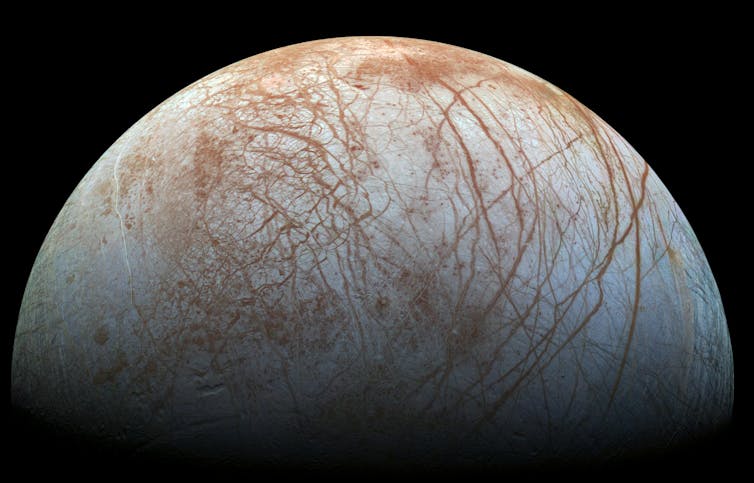
The surface of Europa – one of Jupiter’s moons – is a thick layer of solid ice. NASA/JPL-Caltech/SETI Institute, CC BY-SA

Mike Sori, Purdue University

On Oct. 14, 2024, NASA launched a robotic spacecraft named Europa Clipper to Jupiter’s moons. Clipper will reach the ice-covered Jovian moon Europa in 2030 and spend several years collecting and sending valuable data on the moon’s potential habitability back to Earth.

Clipper isn’t the only mission highlighting researchers’ interest in Jupiter and its moons.

On April 13, 2023, the European Space Agency launched a rocket carrying a spacecraft destined for Jupiter. The Jupiter Icy Moons Explorer – or JUICE – will spend at least three years on Jupiter’s moons after it arrives in 2031.

I’m a planetary scientist who studies the structure and evolution of solid planets and moons in the solar system.

There are many reasons my colleagues and I are looking forward to getting the data that Europa Clipper and JUICE will hopefully be sending back to Earth in the 2030s. But perhaps the most exciting information will have to do with water. Three of Jupiter’s moons – Europa, Ganymede and Callisto – are home to large, underground oceans of liquid water that could support life.

Four moons next to a large red spot on the surface of Jupiter.
This composite image shows, from top to bottom, Io, Europa, Ganymede and Callisto next to Jupiter. NASA, CC BY-ND

Meet Io, Europa, Ganymede and Callisto

Jupiter has dozens of moons. Four of them in particular are of interest to planetary scientists.

Io, Europa, Ganymede and Callisto are, like Earth’s Moon, relatively large, spherical complex worlds. Two previous NASA missions have sent spacecraft to orbit the Jupiter system and collected data on these moons. The Galileo mission orbited Jupiter from 1995 to 2003 and led to geological discoveries on all four large moons. The Juno mission is still orbiting Jupiter today and has provided scientists with an unprecedented view into Jupiter’s composition, structure and space environment.

These missions and other observations revealed that Io, the closest of the four to its host planet, is abuzz with geological activity, including lava lakes, volcanic eruptions and tectonically formed mountains. But it is not home to large amounts of water.

Europa, Ganymede and Callisto, in contrast, have icy landscapes. Europa’s surface is a frozen wonderland with a young but complex history, possibly including icy analogs of plate tectonics and volcanoes. Ganymede, the largest moon in the entire solar system, is bigger than Mercury and has its own magnetic field generated internally from a liquid metal core. Callisto appears somewhat inert compared to the others, but serves as a valuable time capsule of an ancient past that is no longer accessible on the youthful surfaces of Europa and Io.

Most exciting of all: Europa, Ganymede and Callisto all almost certainly possess underground oceans of liquid water.

Advertisement
SodaStream USA, inc
A diagram showing a cutaway of Europa.
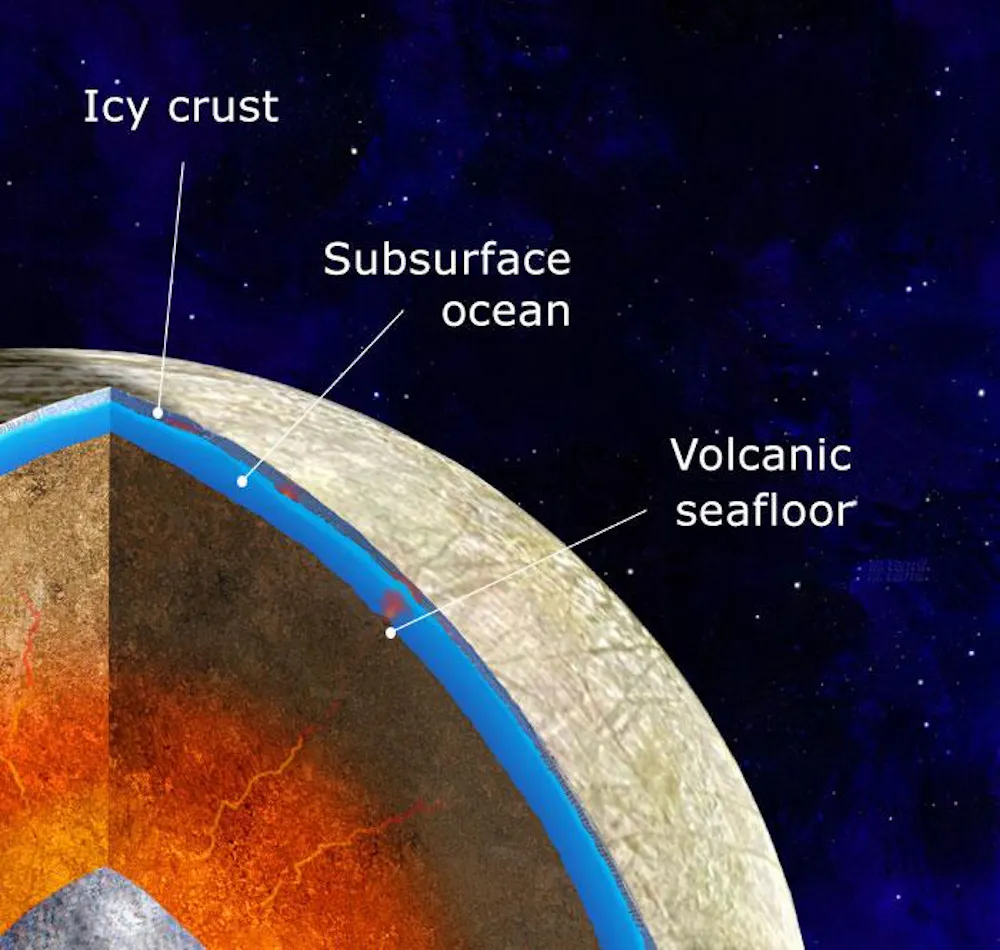
Warmth from Europa’s interior and tidal energy from Jupiter likely maintain a massive liquid ocean beneath the moon’s icy surface. NASA/JPL-Caltech/Michael Carroll

Ocean worlds

Europa, Ganymede and Callisto have chilly surfaces that are hundreds of degrees below zero. At these temperatures, ice behaves like solid rock.

But just like Earth, the deeper underground you go on these moons, the hotter it gets. Go down far enough and you eventually reach the temperature where ice melts into water. Exactly how far down this transition occurs on each of the moons is a subject of debate that scientists hope to resolve with JUICE and Europa Clipper. While the exact depths are still uncertain, scientists are confident that these oceans exist.

The best evidence of these oceans comes from Jupiter’s magnetic field. Saltwater is electrically conductive. So as these moons travel through Jupiter’s magnetic field, they generate a secondary, smaller magnetic field that signals to researchers the presence of an underground ocean. Using this technique, planetary scientists have been able to show that the three moons contain underground oceans. And these oceans are not small – Europa’s ocean alone might have more than double the water of all of Earth’s oceans combined.

An obvious and tantalizing next question is whether these oceans can support extraterrestrial life. Liquid water is an important piece of what makes for a habitable world, but far from the only requirement for life. Life also needs energy and certain chemical compounds in addition to water to flourish. Because these oceans are hidden beneath miles of solid ice, sunlight and photosynthesis are out. But it’s possible other sources could provide the needed ingredients.

On Europa, for example, the liquid water ocean overlays a rocky interior. That rocky seafloor could provide energy and chemicals through underwater volcanoes that could make Europa’s ocean habitable. But it is also possible that Europa’s ocean is a sterile, inhospitable place – scientists need more data to answer these questions.

Artist's impression of the JUICE spacecraft approaching Jupiter and the jovian moons.
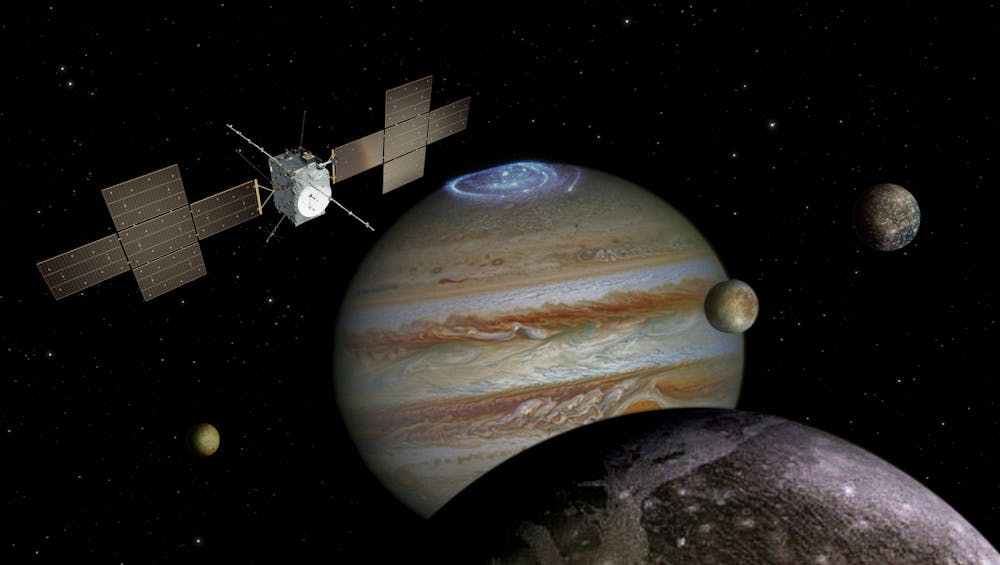
The Jupiter Icy Moons Explorer spacecraft will travel for eight years before reaching Jupiter. ESA/ATG medialab/NASA/JPL/University of Arizona/J. Nichols

Upcoming missions from ESA and NASA

Europa Clipper and JUICE are set up to give scientists game-changing information about the potential habitability of Jupiter’s moons. While both missions will gather data on multiple moons, JUICE will spend time orbiting and focusing on Ganymede, and Europa Clipper will make dozens of close flybys of Europa.

Both of the spacecraft will carry a suite of scientific instruments built specifically to investigate the oceans. Onboard radar will allow Europa Clipper and JUICE to probe into the moons’ outer layers of solid ice. Radar could reveal any small pockets of liquid water in the ice, or, in the case of Europa, which has a thinner outer ice layer than Ganymede and Callisto, hopefully detect the larger ocean.

Magnetometers will also be on both missions. These tools will give scientists the opportunity to study the secondary magnetic fields produced by the interaction of conductive oceans with Jupiter’s field in great detail and will hopefully give researchers clues to salinity and volumes of the oceans.

Scientists will also observe small variations in the moons’ gravitational pulls by tracking subtle movements in both spacecrafts’ orbits, which could help determine if Europa’s seafloor has volcanoes that provide the needed energy and chemistry for the ocean to support life.

Finally, both craft will carry a host of cameras and light sensors that will provide unprecedented images of the geology and composition of the moons’ icy surfaces.

Maybe one day, a spacecraft will be able to drill through the miles of solid ice on Europa, Ganymede or Callisto and explore oceans directly. Until then, observations from spacecraft like Europa Clipper and JUICE are scientists’ best bet for learning about these ocean worlds.

When Galileo discovered these moons in 1609, they were the first objects known to directly orbit another planet. Their discovery was the final nail in the coffin of the theory that Earth – and humanity – resides at the center of the universe. Maybe these worlds have another humbling surprise in store.

Advertisement
SodaStream USA, inc

This article, originally published April 10, 2023, has been updated with details about the Europa Clipper launch.

Mike Sori, Assistant Professor of Planetary Science, Purdue University

This article is republished from The Conversation under a Creative Commons license. Read the original article.

The science section of our news blog STM Daily News provides readers with captivating and up-to-date information on the latest scientific discoveries, breakthroughs, and innovations across various fields. We offer engaging and accessible content, ensuring that readers with different levels of scientific knowledge can stay informed. Whether it’s exploring advancements in medicine, astronomy, technology, or environmental sciences, our science section strives to shed light on the intriguing world of scientific exploration and its profound impact on our daily lives. From thought-provoking articles to informative interviews with experts in the field, STM Daily News Science offers a harmonious blend of factual reporting, analysis, and exploration, making it a go-to source for science enthusiasts and curious minds alike. https://stmdailynews.com/category/science/

Author

Continue Reading

Trending