

Local News
Why Arizona Republicans Are Pushing Back on Light Rail to the State Capitol — and What It Means for the West Valley
Arizona’s debate over a proposed light rail extension to the State Capitol has intensified. Supporters argue it promotes connectivity and equity, while Republicans oppose it due to cost concerns and a preference for car-centric infrastructure. The outcome will impact future west-side transit expansions and shape regional transportation priorities.


Arizona’s long-running debate over public transit has flared up again, this time over a proposed Valley Metro light rail extension that would bring rail service closer to the Arizona State Capitol complex. While Phoenix and Valley Metro leaders argue the project is a logical next step in regional mobility, Republican leaders at the state Capitol have mounted strong opposition — creating uncertainty not just for this segment, but for future west-side expansions.
The Case for the Capitol Light Rail Extension
Supporters of the project, including Valley Metro officials, Phoenix city leaders, transit advocates, and many west Phoenix residents, argue that extending light rail toward the Capitol area is both practical and symbolic.
From a planning standpoint, the Capitol is a major employment center that draws thousands of workers, visitors, and students. Transit planners say rail access would reduce congestion, improve air quality, and provide reliable transportation for residents who already depend heavily on public transit.
Proponents also emphasize equity. West Phoenix has historically received fewer infrastructure investments than other parts of the metro area, despite strong transit ridership. For supporters, extending rail service westward is about connecting communities to jobs, education, and government services — not politics.
There is also a broader regional argument: light rail lines function best as part of a connected network. Leaving a gap near a central civic destination, supporters say, undermines long-term system efficiency.
Why Republican Lawmakers Are Opposed
Republican leaders in the Arizona Legislature see the project very differently.
One major issue is cost. GOP lawmakers frequently point to the rising price of light rail construction, which has increased significantly over the past decade. They argue that rail projects deliver limited benefit compared to their expense and that bus service or roadway improvements could move more people at lower cost.
Usage is another concern. Critics note that light rail serves a relatively small percentage of total commuters in the Phoenix metro area and requires ongoing public subsidies to operate. From this perspective, expanding rail further — especially into politically sensitive areas like the Capitol — is viewed as fiscally irresponsible.
There is also a political and legal dimension. In recent years, Republican lawmakers passed legislation restricting light rail construction near the Capitol complex. While framed as a land-use and security issue, critics argue it reflects deeper ideological opposition to rail transit and urban-oriented infrastructure.
Finally, some GOP leaders simply prefer different transportation priorities. Arizona remains a car-centric state, and many Republican officials believe future investments should focus on highways, autonomous vehicle technology, or flexible transit options rather than fixed rail.
A Political Standoff with Real Transit Consequences
The dispute has become a high-stakes standoff between the Republican-controlled Legislature and Democratic leaders at the city and regional level. While lawmakers may not be able to directly cancel the project, they have significant leverage through funding approvals, oversight committees, and future legislation.
This uncertainty creates challenges for Valley Metro, which relies on long-term planning, federal funding commitments, and voter-approved local taxes. Transit systems work best with predictability — and political volatility can drive up costs or delay construction.
What This Means for West Valley Light Rail Expansion
The biggest question is what happens next for west Phoenix and the broader West Valley.
If the Capitol-area extension is altered or blocked, Valley Metro may be forced to redesign routes that avoid the restricted area, potentially making service less direct or less useful. That could weaken the case for future westward expansions toward areas like Maryvale or even farther west.
On the other hand, the controversy has also drawn renewed attention to west-side transit needs. Some advocates believe the political fight could energize local support, leading to stronger community backing and clearer messaging about why rail matters in west Phoenix.
Long term, the outcome may set a precedent. If state lawmakers successfully limit rail construction through legislative action, it could signal tighter constraints on future expansions. If cities push forward despite opposition, it may reaffirm local control over transportation planning.
The Bigger Picture
At its core, the debate over light rail to the Arizona State Capitol reflects a broader clash of visions for the region’s future: one focused on dense, transit-oriented growth, and another centered on fiscal restraint and automobile mobility.
For residents of the West Valley, the stakes are tangible. The decision will shape access to jobs, education, and public services for decades. Whether the project moves forward as planned, is rerouted, or delayed entirely, it will leave a lasting imprint on how — and for whom — the Valley’s transit system grows.
As Phoenix continues to expand westward, the question remains unresolved: will light rail be allowed to follow?
Further Reading & Context
- KJZZ Phoenix – State Politics & Transportation Coverage
In-depth reporting on Arizona legislative actions, Valley Metro planning, and Capitol-area transit disputes. - Valley Metro – Capitol / West Extension Project Page
Official project updates, maps, timelines, and explanations from the regional transit authority. - City of Phoenix Public Transit Department
City-level planning documents and policy perspectives on light rail expansion and transit equity. - Arizona State Legislature – Transportation & Infrastructure Bills
Primary source for legislation affecting light rail construction near the Capitol and statewide transit policy. - Cronkite News (Arizona PBS)
Nonpartisan reporting on Arizona infrastructure, urban growth, and political power dynamics. - Axios Phoenix
Concise breakdowns of Phoenix City Council decisions and regional transportation debates. - Federal Highway Administration – Public Transportation Planning
Federal perspective on transit funding, cost comparisons, and long-term mobility planning.


Economy
How new SNAP restrictions could hit Greater Pittsburgh’s food access and economy
New SNAP work requirements and retailer rules could reduce food assistance across Greater Pittsburgh, increasing food insecurity while hurting families, independent grocers and the regional economy.

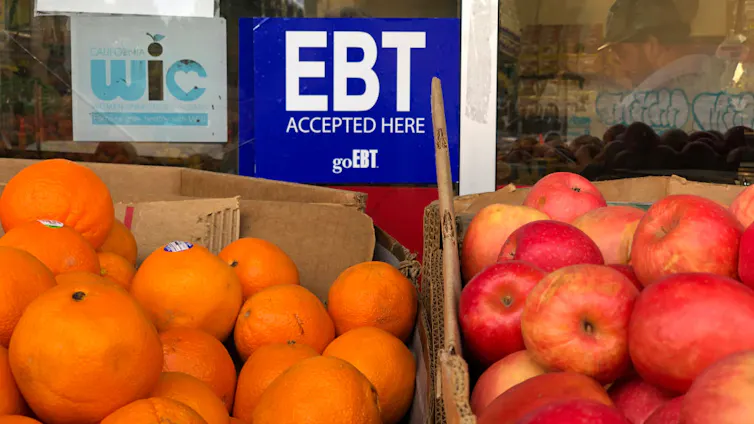
Amelia B. Finaret, Allegheny College
Food assistance is one of the most effective tools for fighting poverty in America. New federal rules are testing that reputation.
The Supplemental Nutrition Assistance Program, better known as SNAP, helps low-income people afford groceries. The program’s benefits reach far beyond the grocery bill, with research linking the program to better outcomes for K-12 students and improved overall health among participants.
However, new federal policy changes are making the program harder for many families to use, and participation is shrinking.
In Pennsylvania’s Allegheny County, the number of people who get SNAP benefits has decreased by about 12% since 2025. SNAP enrollment rates vary widely across the Greater Pittsburgh metropolitan area – from 31% of residents in Fayette County to just 13% in Butler County.
In Allegheny County, where Pittsburgh is located, approximately 17,000 people have already lost their benefits. That’s the second-highest total of any county in Pennsylvania. Roughly 162,000 Allegheny County residents receive SNAP, or about 14% of the county’s population.
Across the country, states like Arizona and Florida are seeing similar effects from these SNAP changes. The specifics vary by state, but the underlying pressures on food assistance are shared nationwide.
As a food economist and clinical dietition working in western Pennsylvania, I have seen how SNAP policy changes affect real people firsthand. Many of my patients are having more trouble making ends meet over the past few years, especially as grocery prices have risen roughly 25% in nominal terms since 2022 – a jump that has outpaced wage growth for many low-income households.
New SNAP work requirements
In November 2025, Pennsylvania began implementing the federal government’s expanded work requirements. The rules previously applied to adults ages 18 to 54 without a disability or dependent children, but they now reach up to age 64. Under these rules, these adults must work, volunteer or take part in education or training programs for at least 20 hours a week to keep receiving SNAP benefits.
Certain groups are especially likely to be affected by this rule change, including early retirees, first-time moms, children and people with disabilities who haven’t applied or been approved for disability benefits.
Stricter and more expansive work requirements increase SNAP benefit denials and reduce the number of people who get benefits, including among women who may become pregnant.
The new work requirements could also worsen food insecurity, which occurs when people cannot obtain enough safe and nutritionally adequate food for an active and healthy life.
Up to 5.4 million people nationwide could lose some or all of their SNAP benefits under the expanded work requirements, including 1.5 million children.
In Allegheny County, 43% of food-insecure children were likely ineligible for SNAP and similar benefits in 2025 because their household incomes exceeded 185% of the federal poverty line – US$61,050 for a family of four in 2026.
Stricter rules for SNAP retailers
Supermarkets and other stores that sell food must be certified to accept SNAP benefits for payment. Beyond helping individual households, SNAP spending boosts local economies, as those benefits get spent at grocery stores and other retailers.
Retailers that sell food are now required to offer seven varieties of foods in each of four staple food categories: grains, vegetables and fruits, dairy, and protein. Stores could meet the new requirements for grains, for example, by offering corn tortillas, whole wheat bread, white bread, brown rice, white rice, oats and infant cereal for sale.
In the 12th and 17th congressional districts that make up Allegheny County, 10.4% and 8.7% of people, respectively, live in areas where it is difficult to get healthy foods. According to data from the Institute for Local Self-Reliance, there are 191 grocery stores in these districts, about 28% of which are either small chains or independent stores that may have a harder time complying with the new requirements.
Between 2017 and 2023, the number of SNAP-authorized stores in Allegheny County increased by 13%, but this trend could reverse under the new rules.
While the stated goal of the new rules is to increase the availability of healthier foods, simply requiring stores to stock them doesn’t mean that customers will eat a better diet. Whether these new retailer policies ultimately improve diets is an open question.
Additional restrictions on purchases
Some states are placing additional restrictions on what people can buy with benefits. Purchasing hot prepared foods, alcohol, vitamins or diapers with SNAP benefits was already prohibited, but 23 states are now restricting the use of benefits to buy sugar-sweetened beverages and some other items that contribute to nutritionally inadequate diets.
While Pennsylvania has not adopted those additional restrictions, some of its neighboring states, such as Ohio and West Virginia, have.
SNAP helps people pay for groceries, but the benefit amount is typically less than what a household would spend on food. SNAP covers some of what a family would’ve spent on groceries anyway, leaving that money for other needs – rent, diapers, utility bills and the like. As a result, research shows the program doesn’t significantly change what or how much people eat, on average.
In my view, as food insecurity remains high in Allegheny County, policies that make it harder for local residents to get SNAP benefits risk weakening one of the nation’s most effective economic support programs.
Read more of our stories about Pittsburgh and Pennsylvania.
Amelia B. Finaret, Associate Professor of Business and Economics and Nutrition, Allegheny College
This article is republished from The Conversation under a Creative Commons license. Read the original article.
News
Black Los Angeles Is Shrinking—and Spreading Across the West
Black Los Angeles has changed dramatically over the past several decades. Explore why its population declined, where families moved, and which neighborhoods continue to anchor the region’s Black community.
Last Updated on August 21, 2026 by Daily News Staff
Black Los Angeles?
For much of the 20th century, South Los Angeles was the center of one of the most influential Black communities in the western United States. Neighborhoods such as Watts, West Adams, Crenshaw, Baldwin Hills and Leimert Park produced political leaders, musicians, entrepreneurs and cultural movements whose influence reached far beyond Southern California.
That community has not disappeared, but it has become smaller and considerably more dispersed.
Census figures show that Los Angeles has experienced a sustained decline in its Black population, particularly within the city and the older communities of South Los Angeles.
A decades-long population decline
In 1990, approximately 454,000 Los Angeles residents identified as non-Hispanic Black alone, representing about 13% of the city’s population. By the 2020 Census, that number had fallen to approximately 323,000—or about 8.3% of the population.
The same pattern is visible across Los Angeles County.
The county’s non-Hispanic Black population declined from approximately 935,000 in 1990 to about 761,000 in 2020. Between 2010 and 2020 alone, it fell by nearly 55,000 people, even as the county’s total population increased.
These numbers do not include everyone with partial Black ancestry or those identifying as multiracial. Nevertheless, the figures reveal a clear geographic and demographic shift.
Black Los Angeles has not simply vanished. It has spread outward.
Why have Black families left Los Angeles?
Housing costs are one of the most important factors.
As rents and home prices rose, many working- and middle-class families found it increasingly difficult to remain in neighborhoods where their families had lived for generations. Redevelopment and gentrification placed additional pressure on renters and homeowners, particularly in areas near downtown Los Angeles and new transit investments.
Older homeowners could sometimes benefit from rising property values, but their children often could not afford to purchase homes nearby. Selling a Los Angeles property also gave some families enough equity to buy larger or newer homes elsewhere.
Researchers at UC Berkeley’s Terner Center found that Black households were disproportionately represented among lower-income residents leaving the Los Angeles region.
Employment changes also contributed. Los Angeles lost many of the manufacturing, aerospace and industrial jobs that had helped support Black working-class families during the postwar period. Meanwhile, metropolitan areas in other states offered lower housing costs and growing professional communities.
Where did people go?
A significant portion of the movement remained within Southern California.
Lancaster and Palmdale in the Antelope Valley attracted families from South Los Angeles, Compton and Inglewood. Others moved east into Riverside and San Bernardino counties.
Between 1990 and 2021, Riverside County’s Black population grew from approximately 64,000 to more than 156,000. San Bernardino County’s Black population increased from approximately 115,000 to 174,000 during the same period.
The Urban Institute concluded that many Black residents leaving Los Angeles County likely settled in these neighboring Inland Empire counties.
Other families left California entirely. Las Vegas and Phoenix became important destinations for people seeking comparatively affordable housing while remaining relatively close to Southern California.
Farther away, Atlanta, Dallas–Fort Worth, Houston and Charlotte have attracted Black professionals and families as part of what researchers call the “New Great Migration”—a movement of Black Americans toward metropolitan areas in the South.
Where are the remaining Black population centers?
The strongest concentration within the city continues to run through the Crenshaw district and surrounding neighborhoods.
Leimert Park remains the symbolic and cultural heart of Black Los Angeles. Baldwin Hills, Baldwin Vista, Hyde Park, West Adams and Crenshaw also retain important Black institutions, churches, businesses and homeowners.
Immediately outside the city, View Park–Windsor Hills and Ladera Heights remain two of the county’s most prominent Black middle- and upper-middle-class communities. Recent American Community Survey estimates indicate that approximately 55% of Ladera Heights residents identify as Black.
Inglewood remains another major center of Black cultural and commercial life, despite its transition into a predominantly Latino city. Central and northern Inglewood, particularly areas near Morningside Park, View Park and Hyde Park, retain substantial Black populations.
Farther south, Black communities remain in Westmont, West Athens, Carson, Gardena, North Long Beach and portions of Compton. Most of these places are no longer majority-Black, but they continue to contain significant populations and long-established community institutions.
Lancaster and Palmdale now represent one of the county’s largest suburban concentrations of Black families. Unlike the compact neighborhoods of historic South Los Angeles, however, the Antelope Valley population is distributed across a much larger area.
Altadena was another important center of Black homeownership before the January 2025 Eaton Fire. The community’s Black population had already declined from its 1980 peak, but west Altadena still contained generations of Black homeowners. The fire destroyed or seriously damaged many of those homes, leaving the community’s future uncertain.
A community transformed, not erased
Today’s Black Los Angeles is more fragmented and suburban than the community that existed during the second half of the 20th century.
Leimert Park, Crenshaw and Baldwin Hills remain culturally significant, but they are now part of a much wider network extending from Inglewood and Carson to Lancaster, Palmdale and the Inland Empire.
This transformation presents a challenge for maintaining political representation, neighborhood institutions and cultural connections. A population that once lived within a relatively concentrated area is now spread across multiple cities, counties and states.
The story, therefore, is not simply that Black Los Angeles declined.
It is that rising housing costs, economic changes and suburban migration redrew the map of Black life in Southern California.
Sources: U.S. Census data compiled by Los Angeles Almanac, Urban Institute, UC Berkeley Terner Center and Brookings Institution.
📰 Enjoying STM Daily News? Join the conversation!
💬 Leave a comment, share your thoughts, and subscribe to our newsletter for the latest stories, updates, and “News You Can Use This Moment!” delivered to your inbox.
Stay connected with STM Daily News!
Consumer Corner
Deed fraud can cause vulnerable Detroiters to lose their homes – here’s why it’s hard to catch the thieves
Deed fraud is rising in Detroit, where forged deeds can strip vulnerable homeowners of their property. Here’s how title theft works, why it’s hard to catch, and what reforms could help.
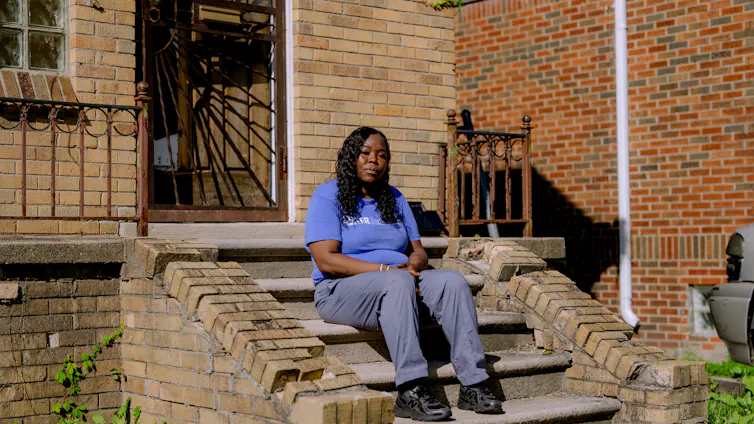
Donovan McCarty, Michigan State University
Buying her first home on Detroit’s far east side in 2021 was the moment when a lifelong dream finally came within reach for Kim Page.
“I accomplished something that I always wanted to do,” said Page, who grew up in the city. “I always wanted to buy my own home since I was like 18. I never wanted to rent from anyone.”
Page said she had saved US$15,000 and used $3,800 in cash to buy the single-family brick house on Britain Street. The house, owned by a friend planning to move out of Detroit, was “damaged pretty bad,” Page recalls. But the house was hers to care for, and she was determined to fix what was broken.
For the next several years, Page poured her sweat and paychecks into the property. Working first as a welder at automotive supplier Fisher Dynamics, and later as a phlebotomist, she paid for a dumpster, windows, a door, ceiling repair and an awning above her front porch. Page invested $27,000 in needed repairs and, in 2022, happily moved in.
But in August 2023, a storm damaged her roof. By March 2024, mold had grown inside the property, which made Page struggle to breathe; she moved in with family. She returned to the home in April 2024 for an appointment with a representative from the Federal Emergency Management Agency. That’s when Page noticed the locks had been changed. Perplexed but undeterred, she broke down the back door to get inside and purchased new locks, which she installed.
Then on a hot, summer day in July 2024, Page came home to discover all her locks had been changed again.
Searching for answers, Page called the Wayne County Register of Deeds’ Mortgage and Deed Fraud Unit. The staff confirmed she was a victim of deed fraud – a crime where scammers forge signatures to record a phony transfer of property ownership. Once criminals hijack the title, they can sell the property, rent it out or drain its equity with mortgages, potentially leaving the rightful owner to face the legal and financial fallout.
“I just was in shock,” Page said. “I can’t believe somebody really did this to me.”
A nationwide problem that’s hard to nail down

Page reached out to me for help in March 2025. I’m a housing attorney, assistant professor at Michigan State University College of Law and director of the Housing Justice Clinic. I have represented dozens of victims of deed fraud.
I have also studied how property recording systems respond – or, more accurately, fail to respond – to fraud. My work examines how procedural gaps in title systems disproportionately harm elderly, low-income and minority homeowners.
Nationwide, deed fraud – also called quit claim deed fraud or home title theft – is a growing problem, including in New York, Boston, Miami and Philadelphia.
Exactly how big a problem it is, is hard to know. The FBI does not track deed fraud specifically, instead grouping it into a larger category of real estate crimes.
From 2019 through 2023, 58,141 victims in the U.S. reported $1.3 billion in losses relating to real estate crime, the FBI says. However, that number is likely undercounted because many people don’t know where to report it, are embarrassed they were victims or don’t know yet they have been targeted.
In Detroit, deed fraud may be particularly prevalent because so many housing deals are made in cash and many properties owe back taxes. The Wayne County Mortgage and Deed Fraud Unit has tracked more than 13,000 inquiries regarding deed fraud and has opened over 2,300 cases throughout Wayne County since 2005.
Without oversight, the crime often goes undetected
Committing deed fraud is remarkably simple.
A deed is the legal document that transfers ownership of a home or other real property from one person to another. When a home is bought or sold, a deed is legally drawn up to reflect the transfer of ownership. That deed is then recorded with a county register of deeds, providing public notice of who legally owns the property.
A fraudster can forge the signature of the real owner – sometimes someone who is deceased. They can file a deed that appears valid on its face but isn’t.
They then record that false deed with a county register of deeds, the local government office that keeps public land records and other documents showing ownership, claiming title to property they do not actually own.
Fraudsters often target vulnerable people and properties, including elderly owners, families dealing with inherited homes, and houses that appear vacant or neglected, such as those behind on property taxes.
The incentive is clear: Once a fraudster appears to hold title, they can try to sell the property to an investor or an unsuspecting buyer looking for stable housing. I have seen fraudsters secure as much as $50,000 from one deal when they obtained a mortgage based on a fraudulent deed. One notable case of fraud targeted Elvis Presley’s former estate, Graceland.
In Michigan and most other states, recording offices do not have authority to substantively review a deed to determine whether it is fraudulent. If the document complies with technical formatting requirements, such as margin and font size, it must be recorded. Once stamped and indexed, the deed appears legitimate and can easily trick desperate buyers, investors, financial institutions and even police officers, lawyers and judges.
In other words, the recording process is largely administrative, not investigative. The government office accepts and files the document without first verifying that the person signing it actually had the legal right to transfer the property.
That means a fraudulent deed can enter the public record, look valid to the outside world and remain undiscovered for months or even years.
Detroit is vulnerable
The housing market helps explain why Detroiters are more vulnerable to deed fraud.
Homes in Black neighborhoods nationwide are systematically undervalued compared with similar homes in white neighborhoods. Black borrowers are also more likely to be denied conventional mortgage loans. Detroit is about 73% Black, with a median household income of roughly $39,000 and a poverty rate exceeding 30%.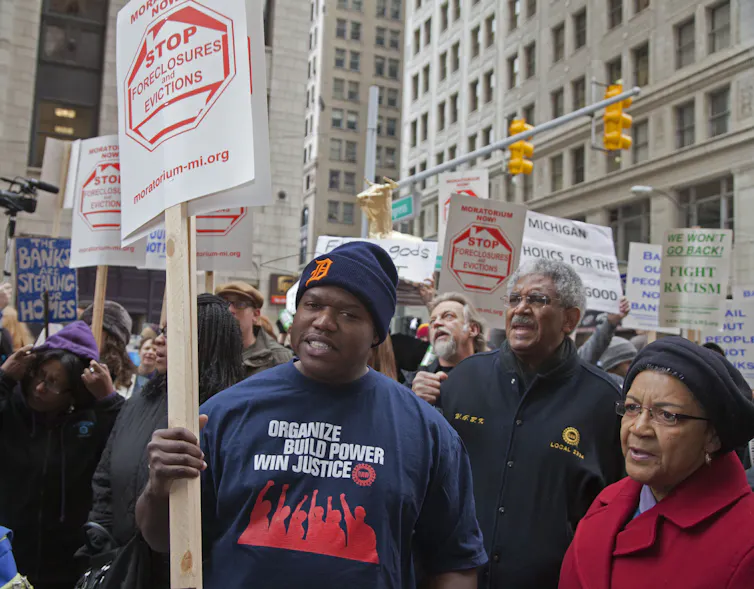
In a market where access to traditional financing is uneven and home prices are relatively low, cash sales accounted for 4 in 10 sales in February 2024.
Lenders, brokers and title companies act as informal gatekeepers when people purchase a home using a mortgage. In cash sales, those actors are absent, and there are fewer opportunities to detect irregularities in the documented history showing how title passed from one owner to the next over time.
Illegal tax practices led to thousands of foreclosed homes
Property tax distress attracts fraudsters. Fraudsters seem to rely on publicly available tax foreclosure lists to identify properties that appear abandoned. They then pay the past-due taxes to remove the property from foreclosure and attempt to sell or mortgage the property using their fraudulent deed.
The fraudsters may also assume that the owner lacks the resources to wage a prolonged legal fight to recover title if they do uncover their scheme. In many cases, that assumption proves correct.
Michigan’s Constitution caps assessments at 50% of market value, but researchers have found that from 2009 to 2015, a majority of Detroit homes were assessed above that limit. Once those inflated bills went unpaid, interest, penalties and fees accumulated, often ending in tax foreclosure.
More than 100,000 Detroit residents lost homes in that crisis, and homeowners were overtaxed by at least $600 million between 2010 and 2016.
In a city already destabilized by unlawful tax foreclosure, fraudsters found opportunity in homes burdened by vacancy and broken chains of ownership.
The burdens that deed fraud victims face
My first encounter with deed fraud came in July 2023. I received a request for legal assistance from a man who said he had been evicted from a home he claimed to own. Honestly, I didn’t believe him.
But when I pulled the court records and deeds, I learned he was right.
A fraudulent deed had been filed on his property, stripping him of title. The fraudsters then filed an eviction case against him.
The owner had no phone and no internet access to attend the virtual hearings. The court entered a judgment to evict him. A bailiff came, broke down his door and threw his belongings into a dumpster.
It took six months and two separate court cases before he was finally able to return to his home. He never recovered his belongings – and we never found the fraudster.
There are many other hardships for a legitimate owner. A fraudulent deed can prevent homeowners from selling their property, refinancing or accessing financial assistance programs.
To clear title, owners must file a quiet title lawsuit – a court action used to resolve disputes over who legally owns a property.
But quiet title cases are complex legal proceedings.
They require multiple filings, hearings and strict compliance with procedural rules. Even when fraud is obvious – for example, when a deed was signed by someone who was already deceased – courts generally require formal litigation to remove the cloud from the title.
Likewise, the legal process of notifying the defendant can be especially burdensome. Fraudsters often use fictitious names and addresses, making them difficult or impossible to locate. Even uncontested cases typically take months. If a defendant appears and disputes ownership, litigation can stretch for years.
Filing fees, service costs and other litigation expenses accumulate quickly. Hiring an attorney can cost several thousand dollars, and some victims have reported spending tens of thousands clearing title to their homes.
As for Kim Page, her case is still ongoing. After being locked out of her home, she had to move in with relatives for over a year, putting a strain on their relationship. She was eventually able to return to her home, but the legal dispute over ownership has not been resolved.
On top of that, she is facing a counter-lawsuit from the company that filed the fraudulent deed, requesting $50,000 for repairs the company made to the home while Page was locked out, along with property taxes and utility bills that the company says it paid to the county and utility companies on her behalf. The county opened an investigation, but it remains unresolved. As a result, she still has no idea who orchestrated the scheme.
While there are free legal services organizations to help, they have limited capacity, and income thresholds exclude some homeowners who still cannot afford private counsel.
Legal reforms likely won’t resolve systemic issues
Across the country, state legislatures have begun responding. Twenty-one have enacted deed fraud legislation, and 15 more have proposed it.
Another common intervention is fraud alert systems, which notify owners when any documents that impact the title of their property are recorded.
Other reforms increase notarial requirements or enhance criminal penalties.
These measures may deter some misconduct, but they do little to reduce the burden on victims once a fraudulent deed has been recorded.
In my assessment, meaningful reforms focus on empowering registers of deeds to substantively review suspicious documents before recording them; simplifying and expediting quiet title proceedings; and expanding civil remedies so victims can recover the costs associated with clearing their title.
Some jurisdictions like Texas and Florida have adopted streamlined procedures that allow victims to initiate quiet title actions using standardized forms with reduced fees. Others permit recorders, prosecutors or judges to act when fraud has already been established.
In Michigan, I am working with lawmakers and stakeholders to develop comprehensive legislation addressing these issues. Bills are expected to be introduced later this year.
At the same time, my clinic has begun exploring how technology can help identify fraudulent deeds already in the record. We are working with computer scientists to evaluate whether artificial intelligence tools could flag suspicious filings and potentially prevent fraudulent documents from being accepted in the future.
No property system can eliminate fraud entirely. Preventive and punitive measures may limit fraud, but they cannot eliminate the incentive to commit it. For fraudsters, the payoff can be substantial.
Conversations about the issue often begin and end with the mechanics of the crime or the procedural burdens victims face afterward. Far less attention is paid to the housing market conditions that make some communities especially vulnerable in the first place.
Page, now 42 and working as a transporter for Sinai-Grace Hospital, has been coping with the stress of legal proceedings for the past two years and living with a heart condition so serious that she got a defibrillator.
The longtime Detroiter is fed up – with the lack of police help to find the fraudster, as well as the court system. All she wants is to be the rightful owner of the home.
“Give me my house back,” Page said.
Detroit editor Eleanore Catolico contributed reporting.
Donovan McCarty, Director, Housing Justice Clinic at Michigan State University College of Law, Michigan State University
This article is republished from The Conversation under a Creative Commons license. Read the original article.
📰 Enjoying STM Daily News? Join the conversation!
💬 Leave a comment, share your thoughts, and subscribe to our newsletter for the latest stories, updates, and “News You Can Use This Moment!” delivered to your inbox.
Stay connected with STM Daily News!





