

Lifestyle
Building a Birdhouse: A Step-by-Step DIY Process

Last Updated on March 13, 2026 by Daily News Staff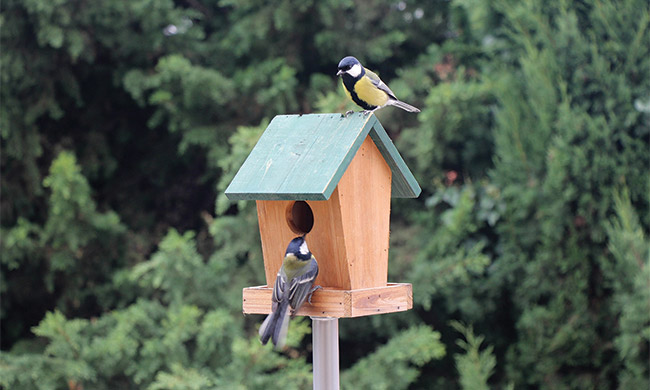
(Feature Impact) To add charm to your yard, encourage local wildlife and give you a front-row seat to nature, building a birdhouse is a simple weekend project that checks all of those boxes.
Building a Birdhouse
Seasoned DIYers and first-timers alike can follow this step-by-step guide to create a functional, welcoming birdhouse.
Step 1: Choose the Right Design
Start by deciding what type of birds you’d like to attract. Different birds prefer different house sizes and entrance types. A simple, classic birdhouse design makes the project beginner-friendly and works well for common backyard birds like wrens, chickadees and bluebirds. In general, plan for at least a 1-1 2/2-inch entrance hole, a 5-by-5-inch interior space and 2 inches or more of roof overhang.
Step 2: Gather Materials and Tools
Most DIY birdhouses can be built with basic materials and tools you may already have at home, including untreated cedar or pine wood, screws or nails, wood glue, sandpaper and exterior-safe paint as well as a measuring tape, pencil, saw and drill.
Step 3: Measure and Cut Wood
Measure and cut wood to make the front panel, back panel, two side panels, floor and roof. Then sand all edges for smooth assembly.
Step 4: Drill Holes
Using a hole-saw bit, drill the entrance hole into the front panel. Position it a few inches below the roofline to keep predators out. Next, drill 2-3 small drainage holes in the floor piece to prevent water buildup and help keep the birdhouse dry.
Step 5: Assemble the Birdhouse
Attach the side panels to the back panel using screws or nails. Add the front panel then secure the floor piece, slightly recessed, so rainwater can drain. Attach the roof last, making sure it slopes slightly to allow water to run off.
Step 6: Paint the Exterior
If you plan to paint your birdhouse, stick to neutral, nature-inspired colors. Light browns, soft greens or white help regulate temperature and blend into the environment.
Step 7: Mount Your Birdhouse
Once dry, place your birdhouse in a quiet, sheltered spot away from heavy foot traffic. Mount or hang it 5-10 feet off the ground, facing away from prevailing winds.
Visit eLivingtoday.com for more DIY project inspiration.
Photo courtesy of Shutterstock
SOURCE:

Our Lifestyle section on STM Daily News is a hub of inspiration and practical information, offering a range of articles that touch on various aspects of daily life. From tips on family finances to guides for maintaining health and wellness, we strive to empower our readers with knowledge and resources to enhance their lifestyles. Whether you’re seeking outdoor activity ideas, fashion trends, or travel recommendations, our lifestyle section has got you covered. Visit us today at https://stmdailynews.com/category/lifestyle/ and embark on a journey of discovery and self-improvement.


Festivals
Presqu’ile Winery Partners With LAND to Bring Contemporary Art to Santa Maria Valley
Presqu’ile Winery and LAND are partnering to bring free, site-responsive contemporary art to the Santa Maria Valley estate in Santa Barbara Wine Country.

Santa Barbara Wine Country is about to get a fresh reason to linger a little longer. Presqu’ile Winery has announced a new collaboration with Los Angeles Nomadic Division (LAND), the nationally recognized nonprofit known for taking contemporary art out of traditional museums and galleries and placing it directly into the environments that shape it. The result: curated, site-responsive works—some created specifically for the property—installed across Presqu’ile’s Santa Maria Valley estate.
A winery becomes an open-air gallery—at no cost
Under the partnership, Presqu’ile will serve as a host site for LAND programming, opening its estate to the public for free. Visitors can expect contemporary art integrated into the vineyard setting, with select installations shaped by the landscape itself. The goal is simple and ambitious at the same time: expand no-cost access to contemporary art along California’s Central Coast while creating a cultural experience that feels inseparable from the place it inhabits.
LAND’s approach is rooted in the belief that art should be experienced where people actually live, work, and gather. Rather than building exhibitions around white walls and controlled lighting, LAND supports projects driven by place—work that engages the environment, the community, and the lived experience of the artists creating it.
“Nourishing reciprocity” between art, landscape, and community
Laura Hyatt, Director of LAND, emphasized how the Central Coast setting opens new creative possibilities for artists.
Hyatt noted that collaborating with Presqu’ile gives artists the opportunity to engage with the region’s natural beauty and unique ecology—placing artworks in what she described as “nourishing reciprocity” with the landscape and the visitors moving through it. She also highlighted the long-term potential of the partnership, which allows for deeper exploration over time, expands LAND’s geographic reach, and strengthens connections between Southern and Central California.
For Hyatt, the collaboration is personal as well: her family has roots in the area going back five generations, adding another layer of community connection to the work LAND hopes to cultivate.
A shared mindset: tradition, experimentation, and a sense of place
Presqu’ile framed the partnership as a natural extension of what the winery already does—balancing tradition with experimentation. In the same way winemaking can honor time-tested methods while still pushing toward new expressions, contemporary art can offer new ways of seeing familiar processes and landscapes.
Matt Murphy, co-founder of Presqu’ile Winery, said the family’s appreciation for the visual arts made the collaboration an easy “yes.” He pointed to the opportunity to create “fun, compelling and unexpected” ways for the community to engage with both the installations and the estate itself—and to experience Presqu’ile through each artist’s creative lens.
What happens next
In the near term, LAND will install artworks developed through its programming on the Presqu’ile property, with public access remaining free. The collaboration is designed with community benefit at its center, positioning the estate as a cultural and agricultural destination—not just a tasting room.
Looking ahead, Presqu’ile has submitted plans for approval to develop expanded spaces intended to support free public art, cultural programming, and community gathering. If approved, those improvements would signal a long-term commitment to integrating arts and culture into the estate experience and welcoming future partners whose work aligns with Presqu’ile’s values of openness, creativity, and place-based expression.
Additional details—including participating artists and installation timelines—will be announced as the collaboration progresses.
About the partners
Presqu’ile Winery
Presqu’ile (pronounced press-keel) is a family-owned estate winery in Santa Maria Valley on California’s Central Coast. Founded in 2007, the winery produces cool-climate wines from its sustainably farmed estate vineyard and from a select group of growers across Santa Barbara County. The name—French Creole for “almost an island”—reflects the Murphy family’s Gulf Coast heritage and the winery’s deep emphasis on place.
Los Angeles Nomadic Division (LAND)
Founded in 2009, LAND is a nonprofit arts organization dedicated to connecting people and places through site-responsive public art and programs. Over 15 years, LAND has presented more than 500 artists across 300+ programs and exhibitions, ranging from large-scale sculptural commissions to billboards, roadside screenings, workshops, and city-wide video presentations—reaching millions of people.
Why it matters
This collaboration isn’t just about adding art to a winery—it’s about rethinking where art belongs, who gets to access it, and how landscape can become part of the creative process. For the Central Coast, Presqu’ile and LAND are setting the stage for a new kind of cultural destination: one where a walk through the vines can also be a walk through contemporary ideas, made visible in the open air.
Source: Presqu’ile Winery
Organization: Los Angeles Nomadic Division (LAND)
- Presqu’ile media contact: diana@solterrastrategies.com
- LAND media contact: kyle@hellothirdeye.com
Our Lifestyle section on STM Daily News is a hub of inspiration and practical information, offering a range of articles that touch on various aspects of daily life. From tips on family finances to guides for maintaining health and wellness, we strive to empower our readers with knowledge and resources to enhance their lifestyles. Whether you’re seeking outdoor activity ideas, fashion trends, or travel recommendations, our lifestyle section has got you covered. Visit us today at https://stmdailynews.com/category/lifestyle/ and embark on a journey of discovery and self-improvement.
Author

Lifestyle
Women are at a higher risk of dying from heart disease − in part because doctors don’t take major sex and gender differences into account
Heart disease impacts women differently than men due to genetic and gender biases in healthcare. Awareness and improved treatment approaches are essential for better outcomes.

Last Updated on April 20, 2026 by Daily News Staff
Amy Huebschmann, University of Colorado Anschutz Medical Campus and Judith Regensteiner, University of Colorado Anschutz Medical Campus
A simple difference in the genetic code – two X chromosomes versus one X chromosome and one Y chromosome – can lead to major differences in heart disease. It turns out that these genetic differences influence more than just sex organs and sex assigned at birth – they fundamentally alter the way cardiovascular disease develops and presents.
While sex influences the mechanisms behind how cardiovascular disease develops, gender plays a role in how healthcare providers recognize and manage it. Sex refers to biological characteristics such as genetics, hormones, anatomy and physiology, while gender refers to social, psychological, and cultural constructs. Women are more likely to die after a first heart attack or stroke than men. Women are also more likely to have additional or different heart attack symptoms that go beyond chest pain, such as nausea, jaw pain, dizziness and fatigue. It is often difficult to fully disentangle the influences of sex on cardiovascular disease outcomes versus the influences of gender.
While women who haven’t entered menopause have a lower risk of cardiovascular disease than men, their cardiovascular risk accelerates dramatically after menopause. In addition, if a woman has Type 2 diabetes, her risk of heart attack accelerates to be equivalent to that of men, even if the woman with diabetes has not yet gone through menopause. Further data is needed to better understand differences in cardiovascular disease risk among nonbinary and transgender patients.
Despite these differences, one key thing is the same: Heart attack, stroke and other forms of cardiovascular disease are the leading cause of death for all people, regardless of sex or gender.
We are researchers who study women’s health and the way cardiovascular disease develops and presents differently in women and men. Our work has identified a crucial need to update medical guidelines with more sex-specific approaches to diagnosis and treatment in order to improve health outcomes for all.
Gender differences in heart disease
The reasons behind sex and gender differences in cardiovascular disease are not completely known. Nor are the distinct biological effects of sex, such as hormonal and genetic factors, versus gender, such as social, cultural and psychological factors, clearly differentiated.
What researchers do know is that the accumulated evidence of what good heart care should look like for women compared with men has as many holes in it as Swiss cheese. Medical evidence for treating cardiovascular disease often comes from trials that excluded women, since women for the most part weren’t included in scientific research until the NIH Revitalization Act of 1993. For example, current guidelines to treat cardiovascular risk factors such as high blood pressure are based primarily on data from men. This is despite evidence that differences in the way that cardiovascular disease develops leads women to experience cardiovascular disease differently.
In addition to sex differences, implicit gender biases among providers and gendered social norms among patients lead clinicians to underestimate the risk of cardiac events in women compared with men. These biases play a role in why women are more likely than men to die from cardiac events. For example, for patients with symptoms that are borderline for cardiovascular disease, clinicians tend to be more aggressive in ordering artery imaging for men than for women. One study linked this tendency to order less aggressive tests for women partly to a gender bias that men are more open than women to taking risks.
In a study of about 3,000 patients with a recent heart attack, women were less likely than men to think that their heart attack symptoms were due to a heart condition. Additionally, most women do not know that cardiovascular disease is the No. 1 cause of death among women. Overall, women’s misperceptions of their own risk may hold them back from getting a doctor to check out possible symptoms of a heart attack or stroke.
These issues are further exacerbated for women of color. Lack of access to health care and additional challenges drive health disparities among underrepresented racial and ethnic minority populations.
Sex difference in heart disease
Cardiovascular disease physically looks different for women and men, specifically in the plaque buildup on artery walls that contributes to illness.
Women have fewer cholesterol crystals and fewer calcium deposits in their artery plaque than men do. Physiological differences in the smallest blood vessels feeding the heart also play a role in cardiovascular outcomes.
Women are more likely than men to have cardiovascular disease that presents as multiple narrowed arteries that are not fully “clogged,” resulting in chest pain because blood flow can’t ratchet up enough to meet higher oxygen demands with exercise, much like a low-flow showerhead. When chest pain presents in this way, doctors call this condition ischemia and no obstructive coronary arteries. In comparison, men are more likely to have a “clogged” artery in a concentrated area that can be opened up with a stent or with cardiac bypass surgery. Options for multiple narrowed arteries have lagged behind treatment options for typical “clogged” arteries, which puts women at a disadvantage.
In addition, in the early stages of a heart attack, the levels of blood markers that indicate damage to the heart are lower in women than in men. This can lead to more missed diagnoses of coronary artery disease in women compared with men.
The reasons for these differences are not fully clear. Some potential factors include differences in artery plaque composition that make men’s plaque more likely to rupture or burst and women’s plaque more likely to erode. Women also have lower heart mass and smaller arteries than men even after taking body size into consideration.
Reducing sex disparities
Too often, women with symptoms of cardiovascular disease are sent away from doctor’s offices because of gender biases that “women don’t get heart disease.”
Considering how symptoms of cardiovascular disease vary by sex and gender could help doctors better care for all patients.
One way that the rubber is meeting the road is with regard to better approaches to diagnosing heart attacks for women and men. Specifically, when diagnosing heart attacks, using sex-specific cutoffs for blood tests that measure heart damage – called high-sensitivity troponin tests – can improve their accuracy, decreasing missed diagnoses, or false negatives, in women while also decreasing overdiagnoses, or false positives, in men.
Our research laboratory’s leaders, collaborators and other internationally recognized research colleagues – some of whom partner with our Ludeman Family Center for Women’s Health Research on the University of Colorado Anschutz Medical Campus – will continue this important work to close this gap between the sexes in health care. Research in this field is critical to shine a light on ways clinicians can better address sex-specific symptoms and to bring forward more tailored treatments.
The Biden administration’s recent executive order to advance women’s health research is paving the way for research to go beyond just understanding what causes sex differences in cardiovascular disease. Developing and testing right-sized approaches to care for each patient can help achieve better health for all.
Amy Huebschmann, Professor of Medicine, University of Colorado Anschutz Medical Campus and Judith Regensteiner, Professor of Medicine, University of Colorado Anschutz Medical Campus
This article is republished from The Conversation under a Creative Commons license. Read the original article.
Our Lifestyle section on STM Daily News is a hub of inspiration and practical information, offering a range of articles that touch on various aspects of daily life. From tips on family finances to guides for maintaining health and wellness, we strive to empower our readers with knowledge and resources to enhance their lifestyles. Whether you’re seeking outdoor activity ideas, fashion trends, or travel recommendations, our lifestyle section has got you covered. Visit us today at https://stmdailynews.com/category/lifestyle/ and embark on a journey of discovery and self-improvement.

(Feature Impact) Shingles isn’t just a painful rash and nerve pain. It’s also linked with a higher risk of serious cardiovascular events, including heart attack and stroke, especially in the weeks to months after infection. However, shingles is largely preventable with vaccination.
The world’s leading nonprofit organization focused on changing the future of health for all, the American Heart Association, reminds eligible adults to protect themselves by getting vaccinated and staying on top of their heart health.
According to the Centers for Disease Control and Prevention (CDC), about 1 in 3 adults in the U.S. will get shingles in their lifetime. If you’ve had chickenpox, the virus that causes shingles, also known as herpes zoster, is already inside you. It can “wake up” years later, causing painful blisters and nerve pain that can last for months or longer.
After a shingles episode, one large study published in the “Journal of the American Heart Association” found the risk of heart attack and stroke was nearly 30% higher in the short term and may persist over time.
“Shingles can be very painful and knock you down for weeks,” said Eduardo Sanchez, M.D., FAHA, the American Heart Association’s chief medical officer for prevention. “It’s also associated with a higher chance of heart and stroke problems afterward. If you’re 50 or older, or have a weakened immune system, talk to your doctor or pharmacist about the shingles vaccine. It’s a simple step that can keep you healthier.”
Knowing your risk is the first step toward prevention. Age is the most important risk factor for developing shingles. As people age, their immune systems naturally weaken, making it easier for the virus to reactivate. People over 50, and especially those living with heart disease, diabetes or other chronic illnesses, are more likely to develop shingles.
The risk of serious complications from shingles increases:
- As you get older
- If you take drugs that keep your immune system from working properly, like steroids and drugs given after an organ transplant
- If you have medical conditions that keep your immune system from working properly such as certain cancers like leukemia and lymphoma, or HIV infection
Heart Health Made Simpler
 In addition to ensuring you’re up to date on your vaccines, talk to your health care professional about ways you can improve your overall heart health. According to the American Heart Association, heart disease remains the leading cause of death, taking more lives in the United States than any other cause.
Following healthy lifestyle guidance like Life’s Essential 8 can make inroads toward preventing heart disease and stroke, and improving brain health. The set of four health behaviors (eat better, be more active, quit tobacco and get healthy sleep) and four health factors (manage weight, control cholesterol, manage blood sugar and manage blood pressure) are key measures for improving and maintaining cardiovascular health.
How to Get the Shingles Vaccine
- Check eligibility: Recommended by the CDC for adults 50-plus and adults 19 and older with weakened immune systems.
- Find a location: Most national pharmacies, many primary care and specialty clinics and local health departments offer it. Search your pharmacy’s app or website, or call your clinician’s office.
- Book it: Make an appointment online or by phone. Same‑day or walk‑in options may be available at pharmacies.
- Bring what you need: Photo ID, insurance card and a list of medicines and allergies. Wear a short‑sleeve shirt, if you can.
- Plan for two doses, 2-6 months apart: When you schedule dose one, set a reminder or book dose two before you leave.
- Cost and coverage: Many health plans, including Medicare Part D, cover shingles vaccination at low or no cost. Check your benefits or ask the pharmacy to verify coverage.
- After your shot: A sore arm, fatigue, headache or mild fever are common and usually go away in 2-3 days. Call your clinician about severe or persistent symptoms.
- If you’ve had shingles before: You can still get vaccinated after you recover. Ask your health care provider about timing.
Learn more at heart.org/shingles.
Signs and Symptoms of Shingles
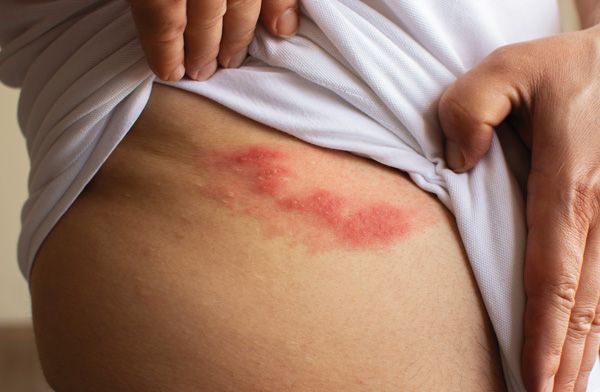
Symptoms to watch for: tingling, itching or burning on one side of the body or face; a stripe‑like rash that turns into fluid‑filled blisters; headache; fever; or chills.
Act fast: If you think you have shingles, contact your health care professional right away. Treatment works best within 72 hours of the rash appearing. If the rash is near your eye or you have eye pain or changes in vision, seek urgent care.
Lasting impact: The rash typically scabs over and clears within 2-4 weeks, but the pain in the rash area can last about a month. The duration of pain seems to increase with age.
Protect Yourself (and Others) from Shingles
If you have shingles, you can stop the spread by covering the rash and avoiding touching or scratching it. You should also wash your hands often, for at least 20 seconds, and avoid contact with people who may be at heightened risk until your rash scabs over, including:
- Pregnant women who never had chickenpox or the chickenpox vaccine
- Premature or low-birthweight infants
- People with weakened immune systems
Photos courtesy of Shutterstock


SOURCE:
Our Lifestyle section on STM Daily News is a hub of inspiration and practical information, offering a range of articles that touch on various aspects of daily life. From tips on family finances to guides for maintaining health and wellness, we strive to empower our readers with knowledge and resources to enhance their lifestyles. Whether you’re seeking outdoor activity ideas, fashion trends, or travel recommendations, our lifestyle section has got you covered. Visit us today at https://stmdailynews.com/category/lifestyle/ and embark on a journey of discovery and self-improvement.





