Connect with us

STM Blog

‘Big’ legislative package shifts more of SNAP’s costs to states, saving federal dollars but causing fewer Americans to get help paying for food

The legislative package signed into law on July 4, 2025, will shift more of SNAP’s costs to states, reducing federal spending while limiting assistance.

Published

on

SNAP
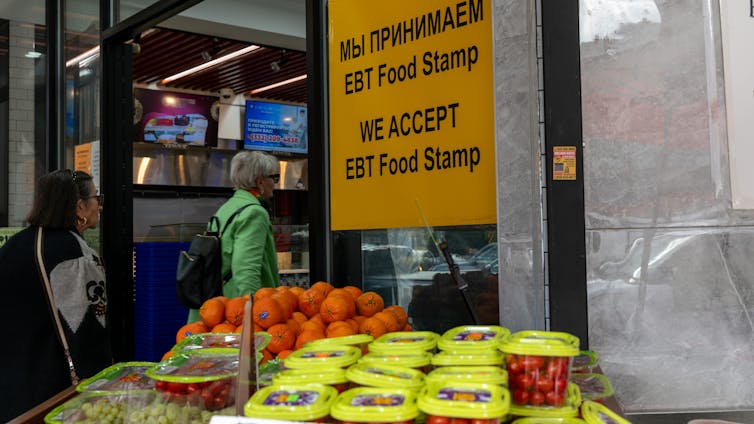
People shop for food in Brooklyn in 2023 at a store that makes sure that its customers know it accepts SNAP benefits, also known as food stamps and EBT.
Spencer Platt/Getty Images

Tracy Roof, University of Richmond

The legislative package that President Donald Trump signed into law on July 4, 2025, has several provisions that will shrink the safety net, including the Supplemental Nutrition Assistance Program, long known as food stamps. SNAP spending will decline by an estimated US$186 billion through 2034 as a result of several changes Congress made to the program that today helps roughly 42 million people buy groceries – an almost 20% reduction.

In my research on the history of food stamps, I’ve found that the program was meant to be widely available to most low-income people. The SNAP changes break that tradition in two ways.

The Congressional Budget Office estimates that about 3 million people are likely to be dropped from the program and lose their benefits. This decline will occur in part because more people will face time limits if they don’t meet work requirements. Even those who meet the requirements may lose benefits because of difficulty submitting the necessary documents.

And because states will soon have to take on more of the costs of the program, which totaled over $100 billion in 2024, they may eventually further restrict who gets help due to their own budgetary constraints.

Summing up SNAP’s origins

Inspired by the plight of unemployed coal miners whom John F. Kennedy met in Appalachia when he campaigned for the presidency in 1960, the early food stamps program was not limited to single parents with children, older people and people with disabilities, like many other safety net programs were at the time. It was supposed to help low-income people afford more and better food, regardless of their circumstances.

In response to national attention in the late 1960s to widespread hunger and malnutrition in other areas of the country, such as among tenant farmers in the rural South, a limited food stamps program was expanded. It reached every part of the country by 1974.

From the start, the states administered the program and covered some of its administrative costs and the federal government paid for the benefits in full. This arrangement encouraged states to enroll everyone who needed help without fearing the budgetary consequences.

Who could qualify and how much help they could get were set by uniform national standards, so that even the residents of the poorest states would be able to afford a budget-conscious but nutritionally adequate diet.

The federal government’s responsibility for the cost of benefits also allowed spending to automatically grow during economic downturns, when more people need assistance. These federal dollars helped families, retailers and local economies weather tough times.

The changes to the SNAP program included in the legislative package that Congress approved by narrow margins and Trump signed into law, however, will make it harder for the program to serve its original goals.

Advertisement
Reveal Your Skin's Youthful Radiance with FOREO's LUNA 2 Facial Massager. Shop Now For $199

Restricting benefits

Since the early 1970s, most so-called able-bodied adults who were not caring for a child or an adult with disabilities had to meet a work requirement to get food stamps. Welfare reform legislation in 1996 made that requirement stricter for such adults between the ages of 18 and 50 by imposing a three-month time limit if they didn’t log 20 hours or more of employment or another approved activity, such as verified volunteering.

Budget legislation passed in 2023 expanded this rule to adults up to age 54. The 2025 law will further expand the time limit to adults up to age 64 and parents of children age 14 or over.

States can currently get permission from the federal government to waive work requirements in areas with insufficient jobs or unemployment above the national average. This flexibility to waive work requirements will now be significantly limited and available only where at least 1 in 10 workers are unemployed.

Concerned senators secured an exemption from the work requirements for most Native Americans and Native Alaskans, who are more likely to live in areas with limited job opportunities.

A 2023 budget deal exempted veterans, the homeless and young adults exiting the foster care system from work requirements because they can experience special challenges getting jobs. The 2025 law does not exempt them.

The new changes to SNAP policies will also deny benefits to many immigrants with authorization to be in the U.S., such as people granted political asylum or official refugee status. Immigrants without authorization to reside in the U.S. will continue to be ineligible for SNAP benefits.

Tracking ‘error rates’

Critics of food stamps have long argued that states lack incentives to carefully administer the program because the federal government is on the hook for the cost of benefits.

In the 1970s, as the number of Americans on the food stamp rolls soared, the U.S. Department of Agriculture, which oversees the program, developed a system for assessing if states were accurately determining whether applicants were eligible for benefits and how much they could get.

A state’s “payment error rate” estimates the share of benefits paid out that were more or less than an applicant was actually eligible for. The error rate was not then and is not today a measure of fraud. Typically, it just indicates the share of families who get a higher – or lower – amount of benefits than they are eligible for because of mistakes or confusion on the part of the applicant or the case worker who handles the application.

Advertisement
Reveal Your Skin's Youthful Radiance with FOREO's LUNA 2 Facial Massager. Shop Now For $199

Congress tried to penalize states with error rates over 5% in the 1980s but ultimately suspended the effort under state pressure. After years of political wrangling, the USDA started to consistently enforce financial penalties on states with high error rates in the mid-1990s.

States responded by increasing their red tape. For example, they asked applicants to submit more documentation and made them go through more bureaucratic hoops, like having more frequent in-person interviews, to get – and continue receiving – SNAP benefits.

These demands hit low-wage workers hardest because their applications were more prone to mistakes. Low-income workers often don’t have consistent work hours and their pay can vary from week to week and month to month. The number of families getting benefits fell steeply.

The USDA tried to reverse this decline by offering states options to simplify the process for applying for and continuing to get SNAP benefits over the course of the presidencies of Bill Clinton, George W. Bush and Barack Obama. Enrollment grew steadily.

Penalizing high rates

Since 2008, states with error rates over 6% have had to develop a detailed plan to lower them.

Despite this requirement, the national average error rate jumped from 7.4% before the pandemic, to a record high of 11.7% in 2023. Rates rose as states struggled with a surge of people applying for benefits, a shortage of staff in state welfare agencies and procedural changes.

Republican leaders in Congress have responded to that increase by calling for more accountability.

Making states pay more

The big legislative package will increase states’ expenses in two ways.

It will reduce the federal government’s responsibility for half of the cost of administering the program to 25% beginning in the 2027 fiscal year.

Advertisement
Reveal Your Skin's Youthful Radiance with FOREO's LUNA 2 Facial Massager. Shop Now For $199

And some states will have to pay a share of benefit costs for the first time in the program’s history, depending on their payment error rates. Beginning in the 2028 fiscal year, states with an error rate between 6-8% would be responsible for 5% of the cost of benefits. Those with an error rate between 8-10% would have to pay 10%, and states with an error rate over 10% would have to pay 15%. The federal government would continue to pay all benefits in states with error rates below 6%.

Republicans argue the changes will give states more “skin in the game” and ensure better administration of the program.

While the national payment error rate fell from 11.68% in the 2023 fiscal year to 10.93% a year later, 42 states still had rates in excess of 6% in 2024. Twenty states plus the District of Columbia had rates of 10% or higher.

At nearly 25%, Alaska has the highest payment error rate in the country. But Alaska won’t be in trouble right away. To ease passage in the Senate, where the vote of Sen. Lisa Murkowski, an Alaska Republican, was in doubt, a provision was added to the bill allowing several states with the highest error rates to avoid cost sharing for up to two years after it begins.

Democrats argue this may encourage states to actually increase their error rates in the short term.

The effect of the new law on the amount of help an eligible household gets is expected to be limited.

About 600,000 individuals and families will lose an average of $100 a month in benefits because of a change in the way utility costs are treated. The law also prevents future administrations from increasing benefits beyond the cost of living, as the Biden Administration did.

States cannot cut benefits below the national standards set in federal law.

But the shift of costs to financially strapped states will force them to make tough choices. They will either have to cut back spending on other programs, increase taxes, discourage people from getting SNAP benefits or drop the program altogether.

Advertisement
Reveal Your Skin's Youthful Radiance with FOREO's LUNA 2 Facial Massager. Shop Now For $199

The changes will, in the end, make it even harder for Americans who can’t afford the bare necessities to get enough nutritious food to feed their families.

Tracy Roof, Associate Professor of Political Science, University of Richmond

This article is republished from The Conversation under a Creative Commons license. Read the original article.

Want more stories 👋
“Your morning jolt of Inspiring & Interesting Stories!”

Sign up to receive awesome articles directly to your inbox.

STM Coffee Newsletter 1

We don’t spam! Read our privacy policy for more info.


Discover more from Daily News

Subscribe to get the latest posts sent to your email.

The Knowledge

How Water Towers Work: The Simple System That Keeps Water Flowing in American Cities

Learn how water towers work in the United States, why they are so tall, and how gravity helps cities maintain water pressure and emergency water supplies.

Published

on

How Water Towers Work

How Water Towers Work

Water towers are one of the most recognizable pieces of infrastructure across the United States. Rising above towns, suburbs, and cities, these elevated tanks quietly perform a vital function every day: maintaining water pressure and storing emergency water for local communities.

Although they may look simple, water towers are an essential part of modern municipal water systems and remain one of the most reliable ways to deliver water to homes and businesses.

The Basic Science Behind Water Towers

Water towers work using a simple principle of physics: gravity.

Water from treatment plants or underground wells is pumped into a storage tank located high above the ground—typically between 100 and 200 feet tall. Because the tank is elevated, gravity naturally pushes the water downward through the city’s pipeline network.

This gravitational force creates the water pressure needed to supply homes, businesses, irrigation systems, and fire hydrants throughout the community.

Most residential plumbing systems in the United States operate best at 40 to 60 PSI (pounds per square inch), which water towers can easily provide through elevation alone.

@stmblog

Ever wondered why cities build giant water towers? 💧 It’s all about gravity. Water is pumped up into the tower and gravity pushes it through city pipes, creating the pressure that delivers water to homes, businesses, and fire hydrants. Simple engineering that keeps entire towns running. Now you know. Hashtags NowYouKnow WaterTower Infrastructure EngineeringExplained HowItWorks DidYouKnow CityInfrastructure UrbanEngineering STMDailyNews EducationalContent ♬ original sound – STMDailyNews – STMDailyNews

Why Water Towers Are Built So Tall

The height of a water tower determines how much pressure it can create. Engineers use a common rule:

For example, a water tower standing 120 feet tall can generate roughly 50 PSI of pressure—perfect for delivering water throughout a residential neighborhood.

Why Cities Still Use Water Towers

While modern pumping systems could theoretically move water through pipes continuously, water towers provide several major advantages that make them a preferred design in many municipal systems.

  • Stable Water Pressure – Water towers maintain consistent pressure even during peak usage times.
  • Energy Efficiency – Pumps can refill towers overnight when electricity demand is lower.
  • Emergency Water Supply – If power fails, gravity can continue delivering water.
  • Fire Protection – Fire hydrants depend on strong, immediate water pressure.

The Daily Fill-and-Use Cycle

Water towers typically operate on a daily cycle based on community demand.

  • Night: Pumps refill the tower while water demand is low.
  • Morning: Water levels drop as residents shower and prepare for the day.
  • Daytime: Businesses and homes continue drawing water from the tower.
  • Evening: The system begins refilling the tank for the next day.

How Much Water Can a Tower Store?

Water towers come in many sizes depending on the population they serve.

  • Small towns: 50,000–300,000 gallons
  • Suburban communities: 500,000–1 million gallons
  • Larger urban systems: up to 2 million gallons or more

Even a single tower holding one million gallons can supply thousands of homes for several hours during peak demand or emergencies.

Modern Technology Inside Water Towers

Today’s water towers are equipped with advanced monitoring systems that help utilities maintain safe and reliable water supplies.

Advertisement
Reveal Your Skin's Youthful Radiance with FOREO's LUNA 2 Facial Massager. Shop Now For $199
  • Digital water level sensors
  • Automated pump controls
  • Water quality monitoring
  • Protective interior coatings
  • Regular inspections and maintenance

Landmarks in the American Skyline

Many cities turn their water towers into local landmarks by painting them with city names, mascots, or community slogans. Some towns even design towers shaped like giant objects such as fruit, coffee cups, or sports balls.

Despite their distinctive appearance, water towers remain one of the simplest and most reliable engineering solutions for delivering clean water to millions of Americans every day.

Next time you see a water tower rising above a town skyline, remember: it’s not just a landmark—it’s the gravity-powered system that keeps water flowing.

Related External Coverage

For more information about how water towers and municipal water systems work, explore the following resources:

Dive into “The Knowledge,” where curiosity meets clarity. This playlist, in collaboration with STMDailyNews.com, is designed for viewers who value historical accuracy and insightful learning. Our short videos, ranging from 30 seconds to a minute and a half, make complex subjects easy to grasp in no time. Covering everything from historical events to contemporary processes and entertainment, “The Knowledge” bridges the past with the present. In a world where information is abundant yet often misused, our series aims to guide you through the noise, preserving vital knowledge and truths that shape our lives today. Perfect for curious minds eager to discover the ‘why’ and ‘how’ of everything around us. Subscribe and join in as we explore the facts that matter.  https://stmdailynews.com/the-knowledge/

Author

  • Rod Washington

    Rod: A creative force, blending words, images, and flavors. Blogger, writer, filmmaker, and photographer. Cooking enthusiast with a sci-fi vision. Passionate about his upcoming series and dedicated to TNC Network. Partnered with Rebecca Washington for a shared journey of love and art.

    View all posts

Discover more from Daily News

Subscribe to get the latest posts sent to your email.

Continue Reading

unknown

The Unfavorable Semicircle Mystery: The YouTube Channel That Uploaded Tens of Thousands of Cryptic Videos

In 2015, the YouTube channel Unfavorable Semicircle gained attention for its enigmatic and abundant video uploads, totaling over 70,000 before its deletion in 2016. Theories about its purpose vary, from automated content generation to digital art experimentation, leaving its intent unresolved.

Published

on

a man and woman with prosthetic hand sitting on the floor. Unfavorable Semicircle
Photo by Yaroslav Shuraev on Pexels.com

In the vast digital landscape of the internet, strange phenomena occasionally emerge that leave investigators, tech enthusiasts, and everyday viewers scratching their heads. One of the most puzzling cases appeared in 2015, when a mysterious YouTube channel called Unfavorable Semicircle began uploading an astonishing number of cryptic videos.

Within months, the channel had published tens of thousands of bizarre clips, many of which seemed random, incomprehensible, and visually chaotic. But as internet detectives began analyzing the content more closely, they discovered that these videos might not have been random at all.

The Sudden Appearance of an Internet Mystery

The Unfavorable Semicircle channel reportedly appeared in March 2015, with its first uploads arriving in early April.

Almost immediately, the channel began publishing videos at an incredible pace. Observers estimated that the account uploaded thousands of videos per week, sometimes multiple videos per minute. By the time the channel disappeared in early 2016, researchers believed it had uploaded well over 70,000 videos, possibly far more.

The scale alone made the project seem impossible for a human to manage manually.


Strange Visuals and Cryptic Titles

Most of the videos shared similar characteristics:

  • Extremely short or very long runtime
  • Abstract visuals such as flashing colors, static, or distorted imagery
  • Little or no audio, or heavily distorted sounds
  • Titles made of random characters, symbols, or numbers

To casual viewers, the videos looked like pure digital noise. However, online investigators suspected something more deliberate was happening.

Hidden Images Discovered

The mystery deepened when researchers began extracting individual frames from some videos.

When thousands of frames from certain clips were stitched together, the results sometimes formed coherent images. One of the most famous examples involved a video titled “LOCK.” While the footage appeared chaotic at first, combining the frames revealed a recognizable composite image.

This discovery suggested the videos were carefully constructed rather than random uploads.

Theories About the Channel’s Purpose

Because the creator never explained the project, several theories emerged across Reddit, YouTube, and internet forums.

Automated Experiment
Many believe the channel was created using automated software that generated and uploaded content at scale.

Alternate Reality Game (ARG)
Some viewers suspected the channel might be part of a hidden puzzle or digital scavenger hunt.

Advertisement
Reveal Your Skin's Youthful Radiance with FOREO's LUNA 2 Facial Massager. Shop Now For $199

Encrypted Communication
Others compared the channel to Cold War “numbers stations,” suggesting the videos could contain coded messages.

Digital Art Project
Another theory suggests the channel was an experimental art project exploring algorithms, data, and visual noise.

Despite years of investigation, no single explanation has been confirmed.

Why the Channel Disappeared

In February 2016, YouTube removed the channel, reportedly due to spam or automated activity violations.

By that time, the channel had already become a minor internet legend. Fortunately, some researchers managed to archive a large portion of the videos before they disappeared.

Even today, archived clips continue to circulate online as investigators attempt to decode them.

Unfavorable Semicircle: The Most Bizarre YouTube Mystery

Other Mysterious YouTube Channels

The Unfavorable Semicircle mystery is not the only strange case on YouTube.

One well-known example is Webdriver Torso, a channel that uploaded hundreds of thousands of videos showing red and blue rectangles with simple beeping sounds. Internet speculation ran wild before Google eventually confirmed it was an internal YouTube testing account.

Another example is AETBX, which posts distorted visuals and unusual audio that some viewers believe contain hidden patterns or encoded information.

These cases highlight how automation, experimentation, and creativity can sometimes blur the line between technology and mystery.

Advertisement
Reveal Your Skin's Youthful Radiance with FOREO's LUNA 2 Facial Massager. Shop Now For $199

A Digital Mystery That Remains Unsolved

Nearly a decade later, the true purpose behind Unfavorable Semicircle remains unknown.

Was it a sophisticated experiment? A piece of algorithmic art? Or simply an automated test that accidentally captured the internet’s imagination?

Whatever the explanation, the channel stands as a reminder that even in a world filled with billions of videos and endless information, the internet can still produce mysteries that challenge our understanding of technology.

Why Internet Mysteries Still Fascinate Us

Stories like Unfavorable Semicircle capture attention because they combine technology, creativity, and the unknown. They invite people from around the world to collaborate, analyze patterns, and search for meaning hidden in the noise.

And sometimes, the most intriguing part of the mystery is that the answer may never fully be known.

Related Coverage & Further Reading

Dive into “The Knowledge,” where curiosity meets clarity. This playlist, in collaboration with STMDailyNews.com, is designed for viewers who value historical accuracy and insightful learning. Our short videos, ranging from 30 seconds to a minute and a half, make complex subjects easy to grasp in no time. Covering everything from historical events to contemporary processes and entertainment, “The Knowledge” bridges the past with the present. In a world where information is abundant yet often misused, our series aims to guide you through the noise, preserving vital knowledge and truths that shape our lives today. Perfect for curious minds eager to discover the ‘why’ and ‘how’ of everything around us. Subscribe and join in as we explore the facts that matter.  https://stmdailynews.com/the-knowledge/


Discover more from Daily News

Subscribe to get the latest posts sent to your email.

Continue Reading

The Bridge

Celebrating International Women’s Day!

International Women’s Day is celebrated globally on March 8th to honor women’s achievements and promote gender equality, originating from a 1908 march in New York for better rights.

Published

on

Last Updated on March 7, 2026 by Daily News Staff

International Women’s Day is a global celebration that honors the achievements of women and highlights the progress still to be made in the fight for gender equality. On this day, people around the world come together to recognize the amazing contributions of women everywhere and to rally for greater gender equity in all areas of life.

#EmbraceEquity


The origins of International Women’s Day can be traced back to 1908, when 15,000 women marched through the streets of New York City to demand better working conditions and the right to vote. Since then, the celebration has grown to be an international event, with more than 100 countries recognizing the day. The United Nations even declared March 8th as International Women’s Day in 1975, to honor the struggles of women around the world.

This year’s International Women’s Day theme is #ChooseToChallenge, meaning that everyone is encouraged to call out gender bias and inequality when they see it. We’re also encouraged to celebrate women’s achievements, support each other, and take action for equality.

It’s important to recognize the progress we’ve made in terms of gender equality, but we still have a long way to go. International Women’s Day serves as a reminder that we must continue to fight for gender equality in all areas of life. Let’s use this day to honor the contributions of women around the world, and to continue the fight for a more equitable world.

https://www.internationalwomensday.com/

https://stmdailynews.com/category/science/

Author

  • IMG 2910 square e1726830094359

    Rebecca Jo is a mother of four and is a creative soul from Phoenix, Arizona, who also enjoys new adventures. Rebecca Jo has a passion for the outdoors and indulges in activities like camping, fishing, hunting and riding roller coasters. She is married to Rod Washington

    View all posts
Advertisement
Reveal Your Skin's Youthful Radiance with FOREO's LUNA 2 Facial Massager. Shop Now For $199

Discover more from Daily News

Subscribe to get the latest posts sent to your email.

Continue Reading

Trending


