

Space and Tech
Exploring New Frontiers: NASA Announces SpaceX Crew-10 Assignments for Space Station Mission
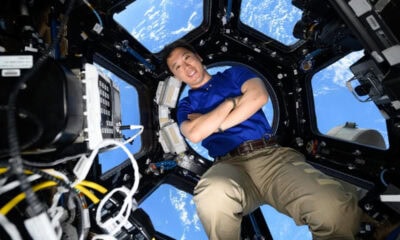
Meet NASA’s SpaceX Crew-10, set for a 2025 ISS mission to push the boundaries of space exploration.


Credit: NASA
In what marks a significant stride toward continued international collaboration in space, NASA has unveiled the crew lineup for its SpaceX Crew-10 mission scheduled for no earlier than February 2025. This mission demonstrates a compelling blend of experience and innovation, as four astronauts are set to embark on a long-duration stay at the International Space Station (ISS).
The crew consists of NASA astronauts Commander Anne McClain and Pilot Nichole Ayers, alongside JAXA astronaut Mission Specialist Takuya Onishi, and Roscosmos cosmonaut Mission Specialist Kirill Peskov. This diverse team will join other astronauts aboard the ISS to carry out a series of scientific investigations and technological demonstrations, crucial for both advancing our capabilities for future missions and enhancing life on Earth.
SpaceX Crew-10 Members at a Glance:
- Commander Anne McClain is no stranger to space. This mission represents her second journey to the ISS. McClain, a colonel in the U.S. Army, boasts an impressive resume that includes more than 2,300 flight hours across 24 different aircraft. Her previous spaceflight experience involved 204 days as a flight engineer during Expeditions 58 and 59, which included leading two spacewalks totaling over 13 hours. Her leadership and vast experience will undoubtedly be an asset to the Crew-10 mission.
- Pilot Nichole Ayers brings a mathematical mind and extensive pilot experience to the team. As a major in the U.S. Air Force and the inaugural member of NASA’s 2021 astronaut class to be named to a crew, Ayers has amassed over 1,400 flight hours, including more than 200 in combat. Her expertise in piloting the F-22 Raptor and other aircraft will be invaluable during the mission’s critical phases.
- Mission Specialist Takuya Onishi of JAXA has already spent 113 days in space and will be making his second visit to the ISS. His prior experience includes pivotal roles such as capturing the Cygnus spacecraft robotically, showcasing his technical prowess. As a seasoned astronaut, Onishi’s deep knowledge of space operations will enhance the crew’s ability to manage the station’s complex systems.
- Mission Specialist Kirill Peskov of Roscosmos will be experiencing his first spaceflight. Peskov’s background as a test-cosmonaut and his extensive training in diverse environments like scuba diving and wilderness survival will contribute a fresh perspective and resilience to the team dynamics.
Looking Toward the Future:
This upcoming mission is part of NASA’s larger goals within the Commercial Crew Program, which not only seeks to ensure constant human presence in space but also to expand commercial opportunities in low Earth orbit. Beyond the ISS, these missions also serve as groundwork for NASA’s ambitious Artemis campaign, which aims to return humans to the Moon and eventually push forward to Mars.
Undoubtedly, the data collected and the experiments conducted during the Crew-10 mission will provide invaluable information to help scientists and engineers understand the intricacies of long-duration space travel. This mission stands as a testament to international cooperation in space exploration — a collective endeavor that underscores the importance of working together to achieve extraordinary objectives.
Stay tuned as the Crew-10 astronauts prepare for their monumental journey into orbit, ready to contribute to our understanding of the cosmos and pave the way for future explorations. The sky is not the limit — indeed, it’s just the beginning!
Find more information on NASA’s SpaceX Crew-10 program at:
https://www.nasa.gov/commercialcrew
The science section of our news blog STM Daily News provides readers with captivating and up-to-date information on the latest scientific discoveries, breakthroughs, and innovations across various fields. We offer engaging and accessible content, ensuring that readers with different levels of scientific knowledge can stay informed. Whether it’s exploring advancements in medicine, astronomy, technology, or environmental sciences, our science section strives to shed light on the intriguing world of scientific exploration and its profound impact on our daily lives. From thought-provoking articles to informative interviews with experts in the field, STM Daily News Science offers a harmonious blend of factual reporting, analysis, and exploration, making it a go-to source for science enthusiasts and curious minds alike. https://stmdailynews.com/category/science/
Authors




Space and Tech
Jupiter’s moons hide giant subsurface oceans − Europa Clipper is one of 2 missions on their way to see if these moons could support life
NASA’s Europa Clipper and ESA’s JUICE missions aim to explore Jupiter’s icy moons, focusing on the potential habitability of their underground oceans, particularly Europa’s, by gathering vital scientific data.

Last Updated on April 11, 2026 by Daily News Staff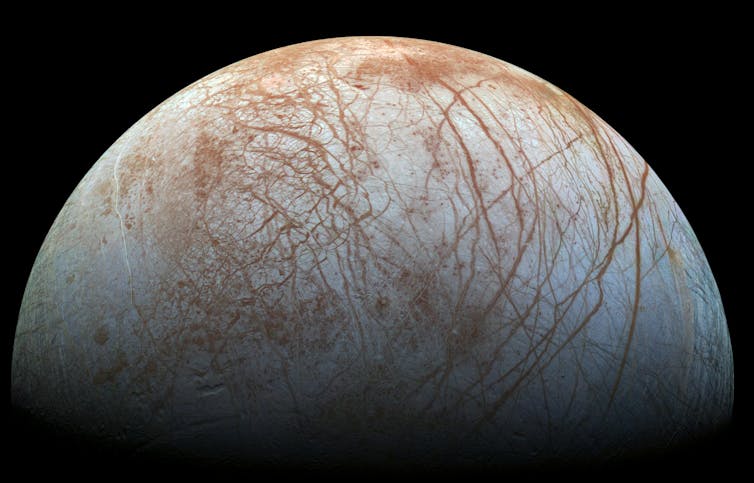
On Oct. 14, 2024, NASA launched a robotic spacecraft named Europa Clipper to Jupiter’s moons. Clipper will reach the ice-covered Jovian moon Europa in 2030 and spend several years collecting and sending valuable data on the moon’s potential habitability back to Earth.
Clipper isn’t the only mission highlighting researchers’ interest in Jupiter and its moons.
On April 13, 2023, the European Space Agency launched a rocket carrying a spacecraft destined for Jupiter. The Jupiter Icy Moons Explorer – or JUICE – will spend at least three years on Jupiter’s moons after it arrives in 2031.
I’m a planetary scientist who studies the structure and evolution of solid planets and moons in the solar system.
There are many reasons my colleagues and I are looking forward to getting the data that Europa Clipper and JUICE will hopefully be sending back to Earth in the 2030s. But perhaps the most exciting information will have to do with water. Three of Jupiter’s moons – Europa, Ganymede and Callisto – are home to large, underground oceans of liquid water that could support life.
Meet Io, Europa, Ganymede and Callisto
Jupiter has dozens of moons. Four of them in particular are of interest to planetary scientists.
Io, Europa, Ganymede and Callisto are, like Earth’s Moon, relatively large, spherical complex worlds. Two previous NASA missions have sent spacecraft to orbit the Jupiter system and collected data on these moons. The Galileo mission orbited Jupiter from 1995 to 2003 and led to geological discoveries on all four large moons. The Juno mission is still orbiting Jupiter today and has provided scientists with an unprecedented view into Jupiter’s composition, structure and space environment.
These missions and other observations revealed that Io, the closest of the four to its host planet, is abuzz with geological activity, including lava lakes, volcanic eruptions and tectonically formed mountains. But it is not home to large amounts of water.
Europa, Ganymede and Callisto, in contrast, have icy landscapes. Europa’s surface is a frozen wonderland with a young but complex history, possibly including icy analogs of plate tectonics and volcanoes. Ganymede, the largest moon in the entire solar system, is bigger than Mercury and has its own magnetic field generated internally from a liquid metal core. Callisto appears somewhat inert compared to the others, but serves as a valuable time capsule of an ancient past that is no longer accessible on the youthful surfaces of Europa and Io.
Most exciting of all: Europa, Ganymede and Callisto all almost certainly possess underground oceans of liquid water.
Ocean worlds
Europa, Ganymede and Callisto have chilly surfaces that are hundreds of degrees below zero. At these temperatures, ice behaves like solid rock.
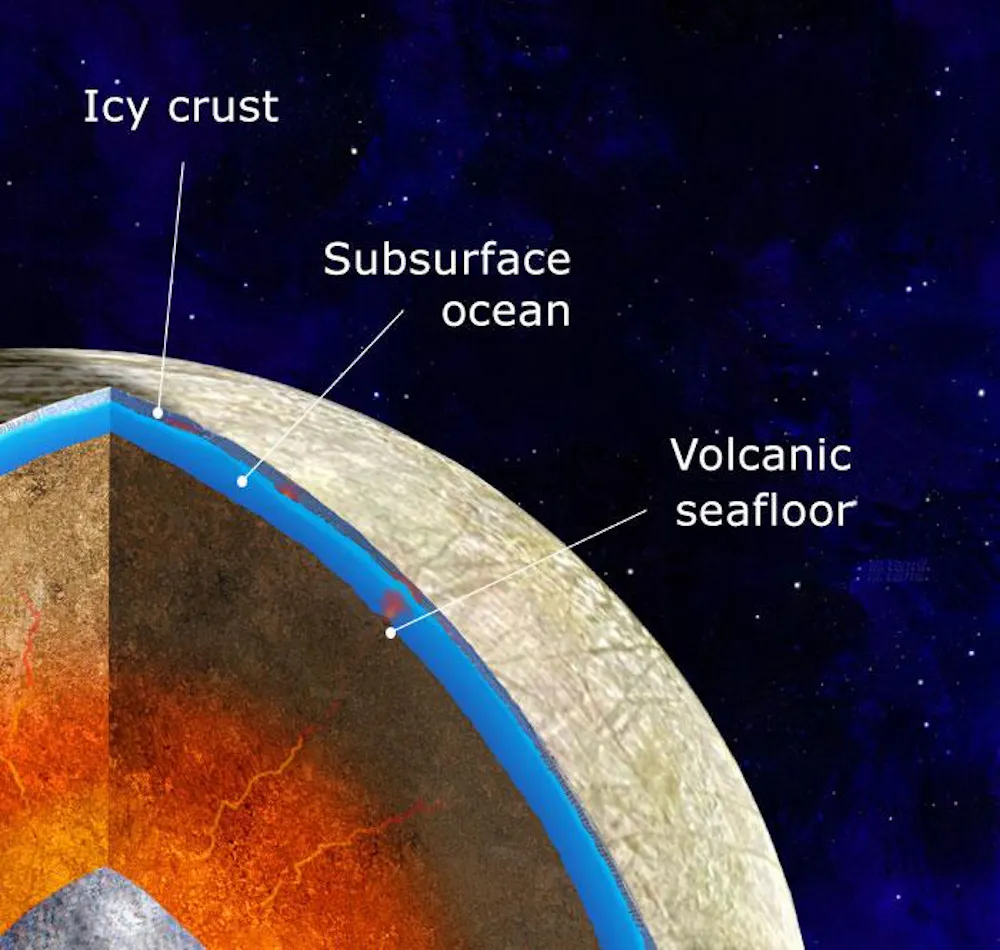
But just like Earth, the deeper underground you go on these moons, the hotter it gets. Go down far enough and you eventually reach the temperature where ice melts into water. Exactly how far down this transition occurs on each of the moons is a subject of debate that scientists hope to resolve with JUICE and Europa Clipper. While the exact depths are still uncertain, scientists are confident that these oceans exist.
The best evidence of these oceans comes from Jupiter’s magnetic field. Saltwater is electrically conductive. So as these moons travel through Jupiter’s magnetic field, they generate a secondary, smaller magnetic field that signals to researchers the presence of an underground ocean. Using this technique, planetary scientists have been able to show that the three moons contain underground oceans. And these oceans are not small – Europa’s ocean alone might have more than double the water of all of Earth’s oceans combined.
An obvious and tantalizing next question is whether these oceans can support extraterrestrial life. Liquid water is an important piece of what makes for a habitable world, but far from the only requirement for life. Life also needs energy and certain chemical compounds in addition to water to flourish. Because these oceans are hidden beneath miles of solid ice, sunlight and photosynthesis are out. But it’s possible other sources could provide the needed ingredients.
On Europa, for example, the liquid water ocean overlays a rocky interior. That rocky seafloor could provide energy and chemicals through underwater volcanoes that could make Europa’s ocean habitable. But it is also possible that Europa’s ocean is a sterile, inhospitable place – scientists need more data to answer these questions.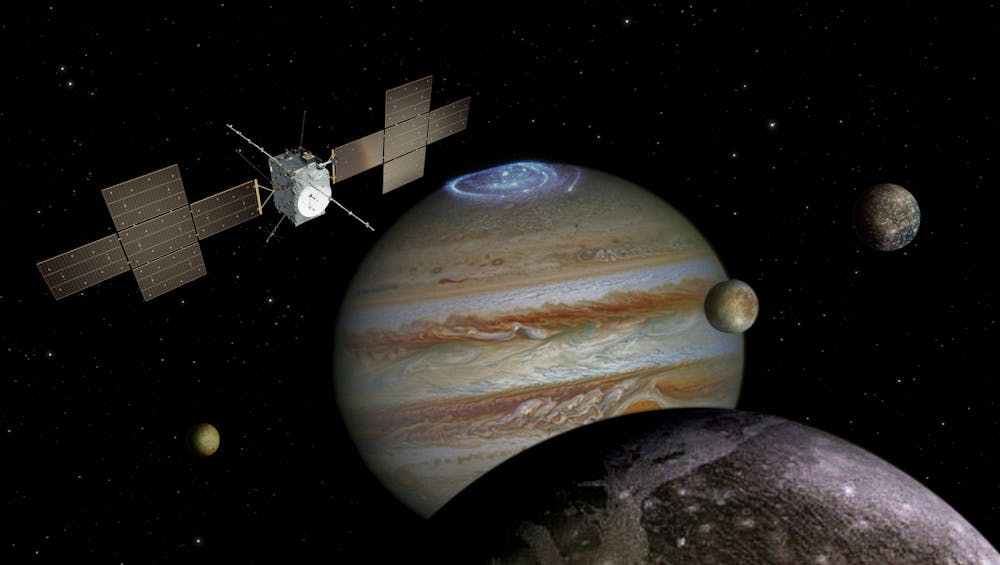
Upcoming missions from ESA and NASA
Europa Clipper and JUICE are set up to give scientists game-changing information about the potential habitability of Jupiter’s moons. While both missions will gather data on multiple moons, JUICE will spend time orbiting and focusing on Ganymede, and Europa Clipper will make dozens of close flybys of Europa.
Both of the spacecraft will carry a suite of scientific instruments built specifically to investigate the oceans. Onboard radar will allow Europa Clipper and JUICE to probe into the moons’ outer layers of solid ice. Radar could reveal any small pockets of liquid water in the ice, or, in the case of Europa, which has a thinner outer ice layer than Ganymede and Callisto, hopefully detect the larger ocean.
Magnetometers will also be on both missions. These tools will give scientists the opportunity to study the secondary magnetic fields produced by the interaction of conductive oceans with Jupiter’s field in great detail and will hopefully give researchers clues to salinity and volumes of the oceans.
Scientists will also observe small variations in the moons’ gravitational pulls by tracking subtle movements in both spacecrafts’ orbits, which could help determine if Europa’s seafloor has volcanoes that provide the needed energy and chemistry for the ocean to support life.
Finally, both craft will carry a host of cameras and light sensors that will provide unprecedented images of the geology and composition of the moons’ icy surfaces.
Maybe one day, a spacecraft will be able to drill through the miles of solid ice on Europa, Ganymede or Callisto and explore oceans directly. Until then, observations from spacecraft like Europa Clipper and JUICE are scientists’ best bet for learning about these ocean worlds.
When Galileo discovered these moons in 1609, they were the first objects known to directly orbit another planet. Their discovery was the final nail in the coffin of the theory that Earth – and humanity – resides at the center of the universe. Maybe these worlds have another humbling surprise in store.
This article, originally published April 10, 2023, has been updated with details about the Europa Clipper launch.
Mike Sori, Assistant Professor of Planetary Science, Purdue University
This article is republished from The Conversation under a Creative Commons license. Read the original article.
The science section of our news blog STM Daily News provides readers with captivating and up-to-date information on the latest scientific discoveries, breakthroughs, and innovations across various fields. We offer engaging and accessible content, ensuring that readers with different levels of scientific knowledge can stay informed. Whether it’s exploring advancements in medicine, astronomy, technology, or environmental sciences, our science section strives to shed light on the intriguing world of scientific exploration and its profound impact on our daily lives. From thought-provoking articles to informative interviews with experts in the field, STM Daily News Science offers a harmonious blend of factual reporting, analysis, and exploration, making it a go-to source for science enthusiasts and curious minds alike. https://stmdailynews.com/category/science/
Author

Last Updated on April 11, 2026 by Daily News Staff
April 10, 2026 — NASA’s Artemis II crew has safely returned to Earth, marking the successful completion of the first crewed mission to the Moon’s vicinity in more than 50 years.
Credit: NASA/Joel Kowsky
The Orion spacecraft splashed down in the Pacific Ocean off the coast of California at 5:07 p.m. PDT, carrying NASA astronauts Reid Wiseman, Victor Glover, Christina Koch, and Canadian astronaut Jeremy Hansen back home after a nearly 10-day journey through deep space.
🚀 A Mission for the Record Books
During the mission, the crew traveled a total of 694,481 miles, reaching a maximum distance of 252,756 miles from Earth—farther than any humans have ever gone, surpassing the Apollo 13 record set in 1970.
Launched on April 1 aboard NASA’s powerful Space Launch System (SLS) rocket, Artemis II tested critical systems needed for future missions, including life support, navigation, and deep space communication.
🌕 Science, Exploration, and Stunning Views
While orbiting the Moon, the astronauts captured more than 7,000 images, including views of the lunar far side, a rare solar eclipse, and detailed observations of craters, lava flows, and surface features.
The mission also included scientific experiments to better understand how the human body responds to deep space conditions, helping prepare for longer missions to the Moon and Mars.
🛰️ Safe Return and Recovery
Following splashdown, recovery teams quickly reached the spacecraft and transported the crew by helicopter to the USS John P. Murtha for initial medical evaluations. The astronauts are expected to return to NASA’s Johnson Space Center for further assessments.
🌍 What Comes Next
With Artemis II complete, NASA is now turning its focus to Artemis III, the next mission aimed at landing astronauts on the Moon and establishing a long-term human presence.
The success of Artemis II marks a major step forward in humanity’s return to deep space—and the beginning of a new era of exploration.
For more information on NASA’s Artemis program, visit the official NASA website.
🔗 Source & Further Reading
- NASA Blog: Artemis II Flight Day 10 – Re-entry Live Updates
- NASA Artemis II Mission Overview
- NASA Artemis Program – Return to the Moon
- Orion Spacecraft Details and Technology
- NASA Image and Video Library (Artemis II Photos & Media)
Dive into “The Knowledge,” where curiosity meets clarity. This playlist, in collaboration with STMDailyNews.com, is designed for viewers who value historical accuracy and insightful learning. Our short videos, ranging from 30 seconds to a minute and a half, make complex subjects easy to grasp in no time. Covering everything from historical events to contemporary processes and entertainment, “The Knowledge” bridges the past with the present. In a world where information is abundant yet often misused, our series aims to guide you through the noise, preserving vital knowledge and truths that shape our lives today. Perfect for curious minds eager to discover the ‘why’ and ‘how’ of everything around us. Subscribe and join in as we explore the facts that matter. https://stmdailynews.com/the-knowledge/
Space and Tech
Astronaut Victor Glover is the latest in a long line of Black American explorers − including York, the enslaved man who played a key role in the Lewis and Clark expedition
Last Updated on April 10, 2026 by Daily News Staff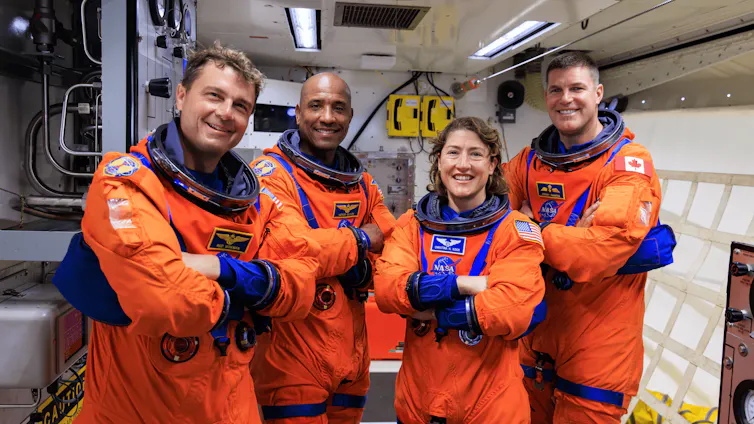
Craig Fehrman, Indiana University
Astronaut Victor Glover
In April 2026, four astronauts are scheduled to fly around the Moon. As part of NASA’s Artemis II mission, they will become the first humans to do so in half a century. One crew member, pilot Victor Glover, will become the first Black astronaut to ever orbit the Moon.
Glover’s achievement is worth celebrating. But it’s also worth remembering that he belongs to a long and underappreciated history. America’s first Black explorer didn’t fly an Apollo rocket or sail with the U.S. Exploring Expedition. He traveled with Lewis and Clark, and he was known by a single name: York.
I’m a historian who spent five years writing a book about Lewis and Clark, and I found new documents that show York was one of the most important people on their expedition. Even in a party that could number as many as 45 men, York stood out – for his courage, his skill and his sacrifices that helped the famous captains reach the Pacific Ocean.
York’s life as a slave

York was born in Virginia around 1770. Growing up, he was a creative and sociable child, unusually tall with dark hair and a dark complexion – “black as a bear,” a contemporary noted.
He was also enslaved by the Clarks. William Clark, who was around the same age, was also unusually tall, though his hair was a rusty red, and sometimes the boys played together. But the playing stopped once York turned 9 or 10. That’s when he joined the adult slaves in working full time. That’s also when he began to note the differences between his life and William’s – differences that became only clearer once William started ordering him around.
In the 1780s, the Clark household headed to Kentucky. York met a Black woman there and married her. He also became William’s “body servant.”
A body servant was a slave who stayed close to his owner and prioritized his comfort, laying out his clothes and serving his meals. When Meriwether Lewis asked Clark to join his expedition, in 1803, Clark ordered York to accompany him.
Perhaps York was excited for this adventure. Perhaps he was not – it would be punishing, and he would be separated from his wife.
Either way, York didn’t have a choice.
The Corps of Discovery
York proved his worth from the start. Once they reached St. Louis, the soldiers, later known as the Corps of Discovery, rushed to raise winter quarters. Working in hail and snow, York and the others built log huts. They needed rough planks for their tables and bunks, but the carpenters had only a single whipsaw to make them. They chose two men to operate this crucial tool. One of them was York.
On May 14, 1804, the corps began ascending the Missouri River. York helped row and tow the party’s barge, which was the size of a semi-truck trailer. He carried a rifle and hunted – according to the expedition’s journals, he was only the fifth named member to bring down a buffalo. York cooked for the captains. He collected scientific specimens. He nursed the sick, including several soldiers and, later on, Sacagawea, a Shoshone woman who would also prove essential to the expedition’s success.
The soldiers were not always kind in return. During this period, officers rarely brought along enslaved body servants. York’s race probably made some of the men angry or uncomfortable. One day, someone threw so much sand in his face that it nearly blinded him. Clark claimed it was “in fun,” but he also wrote that York was “very near losing his eyes,” and no one else got cruelly sprayed with sand.
That fall, during councils with Native leaders, York played a surprising and vital role. The Arikara, Mandan and Hidatsa all crowded in to see him and to touch his skin. They had never met a Black person before, and York showed off his strength and played with the Native children. Later, the Arikara said York was “the most marvelous” thing about the corps.
The next year, the expedition crossed the Rockies and the Continental Divide. York’s most important – and most overlooked – contributions came soon after. On the Columbia River and its tributaries, the party had to dig out five new canoes and then paddle them through treacherous rapids.
Lewis and Clark allowed only their best rivermen on these foaming, rock-riven waters. One of them was almost certainly York. During my research, I found an unpublished letter in which Clark praised York’s ability to “manage the boats.”
Just as important, York was a strong swimmer, a rare thing in an era when many people never learned to swim.
York’s life as an explorer
On the Columbia River, the corps survived a series of terrifying choke points – soggy hazards they referred to as the “Long Narrows” and the “Great Chute.” After that came the ocean. They had traveled together for more than 4,000 miles (6,400 kilometers), and when the captains asked the men to vote on where to put their final winter quarters, they made sure to ask York, too.
It was the latest sign that his role had changed during this epic journey. But those changes began with York. In the West, he found ways to make choices and assert himself. He sent a buffalo robe to his wife in Kentucky. When Clark told him to scale back his performances for Native people, York ignored him – because he wanted to, and because he could.
York’s vote was also evidence that, like Victor Glover today, he was an official American explorer, a key member of a sprawling, federally funded mission. From 1804 to 1806, the government devoted a larger percentage of its budget to the corps than it devotes to NASA today.
Part of that money was earmarked for York. The Army gave officers who brought along their slaves a monthly ration or its cash equivalent. When the corps made it home, the government paid US$274.57 for York’s labor, a sum similar to what the privates received. But that money didn’t go to York. It went to Clark.
The hidden history of Black explorers
There have been many Black explorers in American history. Thomas Jefferson launched other expeditions besides Lewis and Clark’s, and those expeditions also included enslaved people, though their names have not survived. Isaiah Brown served on the Wheeler Survey, which mapped the West in greater detail after the Civil War. Matthew Henson accompanied Robert Peary on his Arctic expeditions, which received some federal support. More recently, NASA has depended on Black astronauts such as Guy Bluford, Mae Jemison and Jeanette Epps, among others.
York and Victor Glover are, for now, the first and most recent examples of this inspiring tradition. But their contributions go beyond that. When the captains asked York to vote on the winter quarters, they were acknowledging in some small way that he’d proven he was more than a body servant.
Of course, York had always been more than that. It just took 4,000 miles for Lewis and Clark to see it.
Craig Fehrman, Adjunct instructor at the Media School, Indiana University
This article is republished from The Conversation under a Creative Commons license. Read the original article.
🧠 Forgotten Genius Fridays
A Short-Form Series from The Knowledge by STM Daily News
Every Friday, STM Daily News shines a light on brilliant minds history overlooked.
Forgotten Genius Fridays is a weekly collection of short videos and articles dedicated to inventors, innovators, scientists, and creators whose impact changed the world—but whose names were often left out of the textbooks.
From life-saving inventions and cultural breakthroughs to game-changing ideas buried by bias, our series digs up the truth behind the minds that mattered.
Each episode of The Knowledge runs 30–90 seconds, designed for curious minds on the go—perfect for YouTube Shorts, TikTok, Reels, and quick reads.
Because remembering these stories isn’t just about the past—it’s about restoring credit where it’s long overdue.
🔔 New episodes every Friday
📺 Watch now at: stmdailynews.com/the-knowledge
🧠 Now you know.





