U.S. forecasters with the National Oceanic and Atmospheric Administration are expecting an above-normal 2025 Atlantic hurricane season, with 13 to 19 named storms, and 6 to 10 of those becoming hurricanes. But, how do they know what’s likely to happen months in the future? I’m an atmospheric scientist who studies extreme weather. Let’s take a look at what Atlantic hurricane forecasts are based on and why those forecasts can shift during the season, which runs from June 1 to Nov. 30.
What goes into a seasonal forecast
Think of the preseason hurricane forecast as the 30,000-foot view: It can’t predict if or when a storm will hit a particular location, but it can offer insight into how many storms are likely to form throughout the entire Atlantic, and how active the season overall might be. These outlooks rely heavily on two large-scale climate factors. The first is the sea surface temperature in areas where tropical cyclones tend to form and grow. Hurricanes draw their energy from warm ocean water. So when the Atlantic is unusually warm, as it has been in recent years, it provides more fuel for storms to form and intensify.Once water temperatures are 79 degrees Fahrenheit (26 degrees Celsius), hurricanes can form. Most of the Gulf was above that by late May 2025.NOAA/NESDIS The second key ingredient that meteorologists have their eye on is the El Niño–Southern Oscillation, which forecasters refer to as ENSO. ENSO is a climate cycle that shifts every few years between three main phases: El Niño, La Niña, and a neutral space that lives somewhere in between. During El Niño, winds over the Atlantic high up in the troposphere – roughly 25,000 to 40,000 feet – strengthen and can disrupt storms and hurricanes. La Niña, on the other hand, tends to reduce these winds, making it easier for storms to form and grow. When you look over the historical hurricane record, La Niña years have tended to be busier than their El Niño counterparts, as we saw from 2020 through 2023. We’re in the neutral phase as the 2025 hurricane season begins, and probably will be for at least a few more months. That means upper-level winds aren’t particularly hostile to hurricanes, but they’re not exactly rolling out the red carpet either. At the same time, sea surface temperatures are running warmer than the 30-year average, but not quite at the record-breaking levels seen in some recent seasons. Taken together, these conditions point to a moderately above-average hurricane season. It’s important to emphasize that these factors merely load the dice, tilting the odds toward more or fewer storms, but not guaranteeing an outcome. A host of other variables influence whether a storm actually forms, how strong it becomes, and whether it ever threatens land.
The smaller influences forecasters can’t see yet
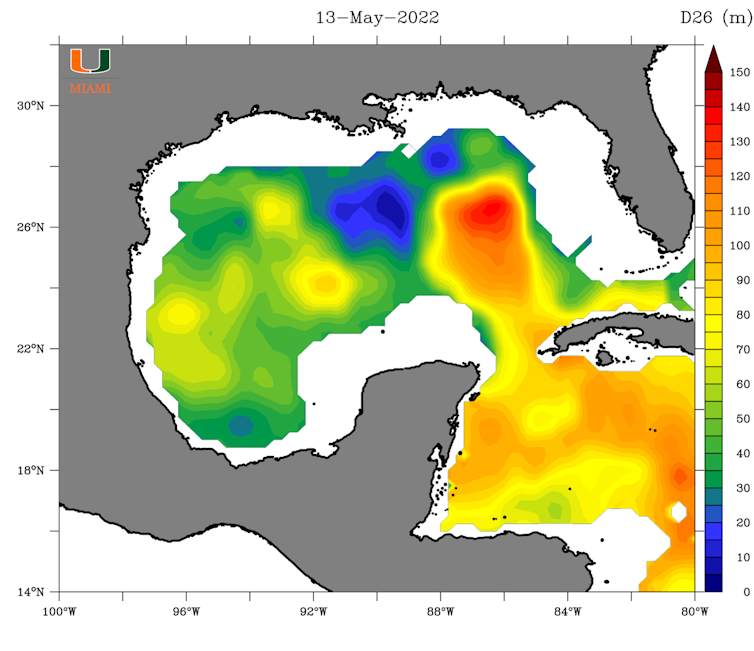
Once hurricane season is underway, forecasters start paying close attention to shorter-term influences. These subseasonal factors evolve quickly enough that they don’t shape the entire season. However, they can noticeably raise or lower the chances for storms developing in the coming two to four weeks. One factor is dust lofted from the Sahara Desert by strong winds and carried from east to west across the Atlantic. These dust plumes tend to suppress hurricanes by drying out the atmosphere and reducing sunlight that reaches the ocean surface. Dust outbreaks are next-to-impossible to predict months in advance, but satellite observations of growing plumes can give forecasters a heads-up a couple weeks before the dust reaches the primary hurricane development region off the coast of Africa.Dust blowing in from the Sahara Desert can tamp down hurricane activities by shading the ocean over the main development region for hurricanes and drying out the atmosphere, just off the African coast. This plume spread over 2,000 miles in June 2020.NASA Another key ingredient that doesn’t go into seasonal forecasts but becomes important during the season are African easterly waves. These “waves” are clusters of thunderstorms that roll off the West African coast, tracking from east to west across the ocean. Most major storms in the Atlantic basin, especially in the peak months of August and September, can trace their origins back to one of these waves. Forecasters monitor strong waves as they begin their westward journey across the Atlantic, knowing they can provide some insight about potential risks to U.S. interests one to two weeks in advance. Also in this subseasonal mix is the Madden–Julian Oscillation. The MJO is a wave-like pulse of atmospheric activity that moves slowly around the tropics every 30 to 60 days. When the MJO is active over the Atlantic, it enhances the formation of thunderstorms associated with hurricanes. In its suppressed phase, storm activity tends to die down. The MJO doesn’t guarantee storms – or a lack of them – but it turns up or down the odds. Its phase and position can be tracked two or three weeks in advance. Lastly, forecasters will talk about the Loop Current, a deep river of warm water that flows from the Caribbean into the Gulf of Mexico. When storms pass over the Loop Current or its warm eddies, they can rapidly intensify because they are drawing energy from not just the warm surface water but from warm water that’s tens of meters deep. The Loop Current has helped power several historic Gulf storms, including Hurricanes Katrina in 2005 and Ida in 2021.The Loop Current stretched well into the Gulf in May 2022. The scale, in meters, shows the maximum depth at which temperatures were 78 F (26 C) or greater.Nick Shay/University of Miami, CC BY-ND But the Loop Current is always shifting. Its strength and location in early summer may look very different by late August or September. Combined, these subseasonal signals help forecasters fine-tune their outlooks as the season unfolds.
Where hurricanes form shifts over the months
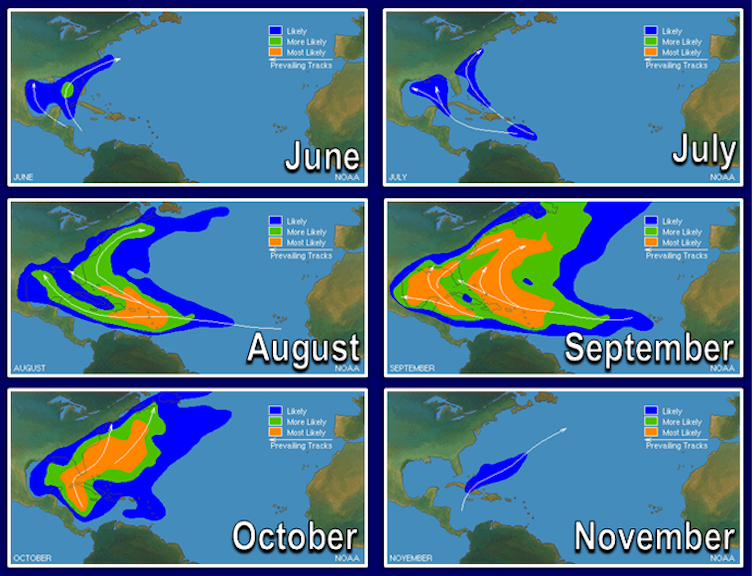
Where storms are most likely to form and make landfall also changes as the pages of the calendar turn. In early summer, the Gulf of Mexico warms up faster than the open Atlantic, making it a notable hotspot for early-season tropical storm development, especially in June and July. The Texas coast, Louisiana, and the Florida Panhandle often face a higher early-season risk than locations along the Eastern seaboard.These are generally the busiest areas during each month of hurricane season, but that doesn’t mean hurricanes won’t make landfall elsewhere.NOAA By August and September, the season reaches its peak. This is when those waves moving off the coast of Africa become a primary source of storm activity. These long-track storms are sometimes called “Cape Verde hurricanes” because they originate near the Cape Verde Islands off the African coast. While many stay over open water, others can gather steam and track toward the Caribbean, Florida or the Carolinas. Later in the hurricane season, storms are more likely to form in the western Atlantic or Caribbean, where waters are still warm and upper-level winds remain favorable. These late-season systems have a higher probability of following atypical paths, as Sandy did in 2012 when it struck the New York City region and Milton did in 2024 before making landfall in Florida. At the end of the day, the safest way to think about hurricane season is this: If you live along the coast, don’t let your guard down. Areas susceptible to hurricanes are never totally immune from hurricanes, and it only takes one to make it a dangerous – and unforgettable – season. Colin Zarzycki, Associate Professor of Meteorology and Climate Dynamics, Penn State This article is republished from The Conversation under a Creative Commons license. Read the original article.
Metro Board to Consider Locally Preferred Alternative for Sepulveda Transit Corridor Project
Metro Board will consider Modified Alternative 5 as the Locally Preferred Alternative for the Sepulveda Transit Corridor Project on January 22, 2026, a major step toward improving transit between the San Fernando Valley and LA’s Westside.
On Thursday, January 22, 2026, at 10:00 AM, the Metro Board will consider selecting a Locally Preferred Alternative (LPA) for the Sepulveda Transit Corridor Project. This milestone could significantly improve mobility options between the San Fernando Valley and the of Los Angeles.
Proposed Alternative
After a technical evaluation and reviewing more than 8,000 public comments from the Draft Environmental Impact Report (Draft EIR) period, Metro staff has proposed Modified Alternative 5 as the LPA. This underground heavy rail line would run between the Van Nuys Metrolink Station and the E Line Expo/Sepulveda Station with a key connection to the G Line at Van Nuys Boulevard.
Modified Alternative 5 combines the benefits of Alternative 5—high ridership, frequent service, and shorter station construction sites—while avoiding geographic challenges in the Santa Monica Mountains. It also incorporates connectivity advantages from Alternative 6 along Van Nuys Boulevard, reducing the overall project length and anticipated costs, and increasing direct connections to Metro’s growing transit network.
Next Steps
If approved, Metro would advance project development for the LPA, including:
Evaluating phasing and the Public/Private Partnership (P3) delivery model
Identifying value engineering opportunities
Refining designs to allow G Line connection at Van Nuys Boulevard
Continuing environmental review and community outreach
Public Participation
Residents, businesses, and institutions are encouraged to provide feedback:
Attend in person: Sign up on the tablets in the Metro Headquarters lobby before 9:45 AM.
Email comments:BoardClerk@metro.net (comments received before 5 PM on January 21, 2026, will be sent to the full Board)
The Sepulveda Transit Corridor Project will connect the San Fernando Valley to the Westside, addressing the natural barrier of the Santa Monica Mountains and relieving congestion on the I-405. It will provide a fast, safe, and reliable alternative to the freeway and strengthen LA’s regional transit network.
Disclaimer: Station locations and construction timelines are subject to change. Project availability may vary. Public input is encouraged before final decisions are made.
Continuing Coverage: STM Daily News will continue to follow developments surrounding the Sepulveda Transit Corridor Project, including Metro Board decisions, environmental review updates, community input opportunities, and the project’s long-term impact on transportation across Los Angeles.
For the latest updates, in-depth reporting, and transportation-focused coverage, visit STM Daily News.
Major Popeyes Franchisee Sailormen Files for Chapter 11 — What It Means for Restaurants and the Economy
Sailormen Inc., a major Popeyes franchisee operating 130+ locations in Florida and Georgia, filed for Chapter 11 on Jan. 15, 2026 amid rising costs and heavy debt. Many restaurants are expected to remain open as restructuring continues.
Sailormen Bankruptcy: What Chapter 11 Means for Popeyes Restaurants in FL and GA
A major Popeyes Louisiana Kitchen franchise operator is heading to bankruptcy court — but the headline does notmean Popeyes corporate is filing, or that every restaurant involved is about to close.
Sailormen Inc., a Miami-based Popeyes franchisee that has operated in the system since 1987, filed for Chapter 11 bankruptcy protection on Jan. 15, 2026. The company operates more than 130 Popeyes locations across Florida and Georgia (some industry coverage puts the count at 136), making it one of the chain’s largest franchise groups in the region.
Franchisee filing, not a Popeyes corporate bankruptcy
This case involves Sailormen (the operator) — not Popeyes corporate and not parent company Restaurant Brands International.
In a message referenced in industry reporting, Popeyes leadership said Sailormen’s filing does not reflect the overall health of the Popeyes brand, and that a large majority of Sailormen’s restaurants are expected to remain open while the company restructures.
What pushed Sailormen into Chapter 11
Court-related summaries and industry coverage point to a familiar mix of pressures hitting restaurant operators:
Inflation and higher operating costs (food, labor, and day-to-day expenses)
Higher borrowing costs as interest rates climbed
Liquidity strain, including reports of falling behind on rent and facing pressure from landlords and vendors
Legal disputes, including vendor-related claims tied to unpaid balances
The failed store sale that worsened the situation
One key detail: Sailormen reportedly tried to sell 16 Georgia restaurants to stabilize finances. That deal fell through, and the company remained responsible for lease guarantees tied to those locations — a liability that can linger even if other stores are performing.
The debt and the lender pressure
Industry reporting describes Sailormen as carrying a heavy debt load — cited at about $130 million overall.
More detailed figures cited in coverage include:
Over $112 million in unpaid principal loan balance
Over $17 million in accrued interest and fees
Reporting also points to pressure from BMO (BMO Bank), described as Sailormen’s largest lender. In December 2025, BMO reportedly sought to appoint a receiver, a move that can displace management and take control of a company’s assets. Sailormen’s Chapter 11 filing allows the company to continue operating as a debtor-in-possession while it attempts to reorganize.
Why this matters for “Food” and “Our Economy”
This isn’t just a Popeyes story — it’s a snapshot of what happens when restaurant operators face higher costs, value-conscious consumers, and more expensive debt at the same time.
Chapter 11 is designed to reorganize a business, not automatically liquidate it. For customers, the near-term impact may be limited if most locations stay open.
STM Daily News will follow this story as it develops, including any updates on store operations, restructuring plans, and potential sales of locations.
Hal Machina is a passionate writer, blogger, and self-proclaimed journalist who explores the intersection of science, tech, and futurism. Join him on a journey into innovative ideas and groundbreaking discoveries! View all postsjournalist
Diva Fam Inc. Announces Voluntary Recall of True Sea Moss “Sea Moss Gel Superfood” Products Due to Possible Health Risk
Diva Fam Inc. is recalling all True Sea Moss Sea Moss Gel Superfood flavors nationwide due to missing pH/temperature records and potential botulism risk.
Diva Fam Inc.. announced a voluntary recall of all lots and flavors of its True Sea Moss brand Sea Moss Gel Superfood due to a lack of required regulatory authorization and temperature monitoring records for pH-controlled food products, according to a company statement released January 9, 2026.
The company said the recall applies to products manufactured prior to January 9, 2026. The manufacture date (MFD) is indicated on the can lid in MM/YYYY format.
Why the products are being recalled
Diva Fam said the recall is related to missing required regulatory authorization and temperature monitoring records for certain pH-controlled food products. The company noted that pH-controlled foods that are not manufactured in accordance with applicable regulatory requirements may present a potential risk of microbial growth, including organisms that can produce toxins associated with botulism.
TrueSeaMoss Container
Botulism is a rare but serious illness that can affect the nervous system. Symptoms may include general weakness, dizziness, double vision, difficulty speaking or swallowing, and, in severe cases, difficulty breathing or muscle weakness.
Diva Fam said no illnesses or adverse health events have been reported in connection with the products subject to this recall to date.
Where the products were sold
The affected products were distributed nationwide through select retail locations, online via https://truеsеamоss.cоm/, and other distribution channels, according to the company.
Recalled products (all flavors, all lots)
The recall includes all flavors and sizes and batch numbers of True Sea Moss brand Sea Moss Gel Superfood packaged in 16 FL OZ (473 mL) glass jars, manufactured prior to January 9, 2026.True Sea Moss Packaging
Recalled flavors and UPCs
Flavor
UPC
Mango
5065006235875
Pineapple
5065006235288
Wildcrafted
5065006235073
Apple and Cinnamon
5065006235776
Elderberry
5065006235189
Passion Fruit
5061033691882
Blue Spirulina and Raspberry
5065006235813
Strawberry
5065006235271
Cherry
5061033691264
Mango and Pineapple
5065006235301
5 Blends in 1
5061033690052
Soursop
5061033691875
Lemon Pie
5061033691271
Orange
5061033692926
How the issue was identified
The company said the matter was identified during a California Department of Public Health inspection that raised questions regarding regulatory authorization and related production records for certain distributed products. Diva Fam said it is cooperating fully with regulatory authorities and initiated the voluntary recall to ensure regulatory alignment.
The company said the recall is being conducted with the knowledge of the U.S. Food and Drug Administration.
What consumers should do
Discontinue use of the affected product.
Follow the instructions provided by the place of purchase regarding product return or disposal.
Contact the company for additional information (details below).
Consumer and media contact
Consumers seeking additional information may contact:
Hal Machina is a passionate writer, blogger, and self-proclaimed journalist who explores the intersection of science, tech, and futurism. Join him on a journey into innovative ideas and groundbreaking discoveries! View all postsjournalist