U.S. forecasters with the National Oceanic and Atmospheric Administration are expecting an above-normal 2025 Atlantic hurricane season, with 13 to 19 named storms, and 6 to 10 of those becoming hurricanes. But, how do they know what’s likely to happen months in the future? I’m an atmospheric scientist who studies extreme weather. Let’s take a look at what Atlantic hurricane forecasts are based on and why those forecasts can shift during the season, which runs from June 1 to Nov. 30.
What goes into a seasonal forecast
Think of the preseason hurricane forecast as the 30,000-foot view: It can’t predict if or when a storm will hit a particular location, but it can offer insight into how many storms are likely to form throughout the entire Atlantic, and how active the season overall might be. These outlooks rely heavily on two large-scale climate factors. The first is the sea surface temperature in areas where tropical cyclones tend to form and grow. Hurricanes draw their energy from warm ocean water. So when the Atlantic is unusually warm, as it has been in recent years, it provides more fuel for storms to form and intensify.Once water temperatures are 79 degrees Fahrenheit (26 degrees Celsius), hurricanes can form. Most of the Gulf was above that by late May 2025.NOAA/NESDIS The second key ingredient that meteorologists have their eye on is the El Niño–Southern Oscillation, which forecasters refer to as ENSO. ENSO is a climate cycle that shifts every few years between three main phases: El Niño, La Niña, and a neutral space that lives somewhere in between. During El Niño, winds over the Atlantic high up in the troposphere – roughly 25,000 to 40,000 feet – strengthen and can disrupt storms and hurricanes. La Niña, on the other hand, tends to reduce these winds, making it easier for storms to form and grow. When you look over the historical hurricane record, La Niña years have tended to be busier than their El Niño counterparts, as we saw from 2020 through 2023. We’re in the neutral phase as the 2025 hurricane season begins, and probably will be for at least a few more months. That means upper-level winds aren’t particularly hostile to hurricanes, but they’re not exactly rolling out the red carpet either. At the same time, sea surface temperatures are running warmer than the 30-year average, but not quite at the record-breaking levels seen in some recent seasons. Taken together, these conditions point to a moderately above-average hurricane season. It’s important to emphasize that these factors merely load the dice, tilting the odds toward more or fewer storms, but not guaranteeing an outcome. A host of other variables influence whether a storm actually forms, how strong it becomes, and whether it ever threatens land.
The smaller influences forecasters can’t see yet
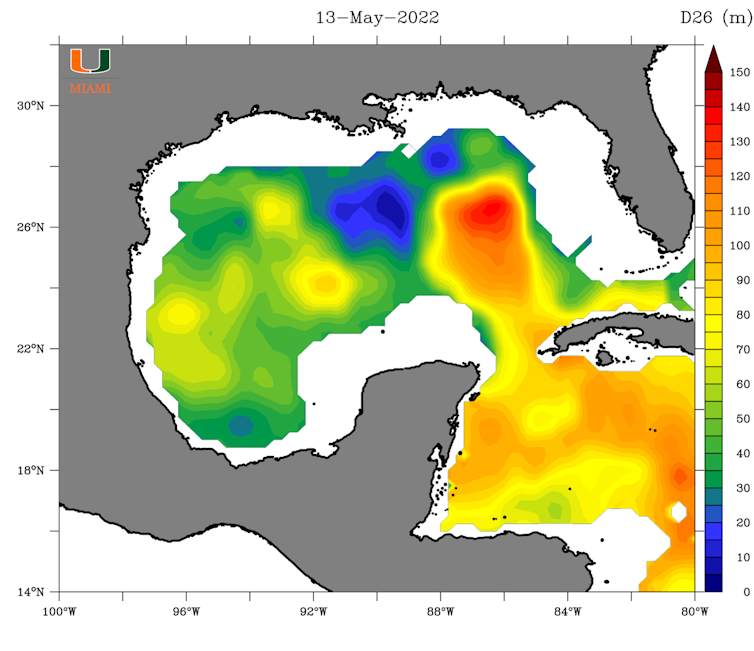
Once hurricane season is underway, forecasters start paying close attention to shorter-term influences. These subseasonal factors evolve quickly enough that they don’t shape the entire season. However, they can noticeably raise or lower the chances for storms developing in the coming two to four weeks. One factor is dust lofted from the Sahara Desert by strong winds and carried from east to west across the Atlantic. These dust plumes tend to suppress hurricanes by drying out the atmosphere and reducing sunlight that reaches the ocean surface. Dust outbreaks are next-to-impossible to predict months in advance, but satellite observations of growing plumes can give forecasters a heads-up a couple weeks before the dust reaches the primary hurricane development region off the coast of Africa.Dust blowing in from the Sahara Desert can tamp down hurricane activities by shading the ocean over the main development region for hurricanes and drying out the atmosphere, just off the African coast. This plume spread over 2,000 miles in June 2020.NASA Another key ingredient that doesn’t go into seasonal forecasts but becomes important during the season are African easterly waves. These “waves” are clusters of thunderstorms that roll off the West African coast, tracking from east to west across the ocean. Most major storms in the Atlantic basin, especially in the peak months of August and September, can trace their origins back to one of these waves. Forecasters monitor strong waves as they begin their westward journey across the Atlantic, knowing they can provide some insight about potential risks to U.S. interests one to two weeks in advance. Also in this subseasonal mix is the Madden–Julian Oscillation. The MJO is a wave-like pulse of atmospheric activity that moves slowly around the tropics every 30 to 60 days. When the MJO is active over the Atlantic, it enhances the formation of thunderstorms associated with hurricanes. In its suppressed phase, storm activity tends to die down. The MJO doesn’t guarantee storms – or a lack of them – but it turns up or down the odds. Its phase and position can be tracked two or three weeks in advance. Lastly, forecasters will talk about the Loop Current, a deep river of warm water that flows from the Caribbean into the Gulf of Mexico. When storms pass over the Loop Current or its warm eddies, they can rapidly intensify because they are drawing energy from not just the warm surface water but from warm water that’s tens of meters deep. The Loop Current has helped power several historic Gulf storms, including Hurricanes Katrina in 2005 and Ida in 2021.The Loop Current stretched well into the Gulf in May 2022. The scale, in meters, shows the maximum depth at which temperatures were 78 F (26 C) or greater.Nick Shay/University of Miami, CC BY-ND But the Loop Current is always shifting. Its strength and location in early summer may look very different by late August or September. Combined, these subseasonal signals help forecasters fine-tune their outlooks as the season unfolds.
Where hurricanes form shifts over the months
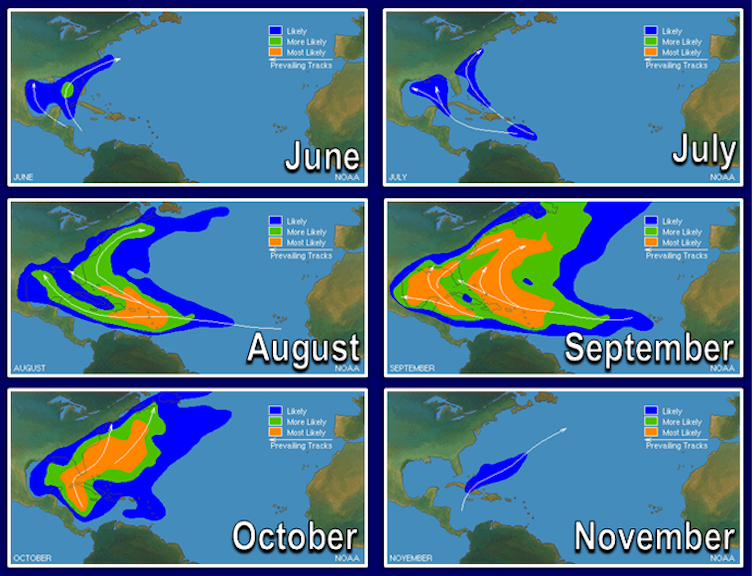
Where storms are most likely to form and make landfall also changes as the pages of the calendar turn. In early summer, the Gulf of Mexico warms up faster than the open Atlantic, making it a notable hotspot for early-season tropical storm development, especially in June and July. The Texas coast, Louisiana, and the Florida Panhandle often face a higher early-season risk than locations along the Eastern seaboard.These are generally the busiest areas during each month of hurricane season, but that doesn’t mean hurricanes won’t make landfall elsewhere.NOAA By August and September, the season reaches its peak. This is when those waves moving off the coast of Africa become a primary source of storm activity. These long-track storms are sometimes called “Cape Verde hurricanes” because they originate near the Cape Verde Islands off the African coast. While many stay over open water, others can gather steam and track toward the Caribbean, Florida or the Carolinas. Later in the hurricane season, storms are more likely to form in the western Atlantic or Caribbean, where waters are still warm and upper-level winds remain favorable. These late-season systems have a higher probability of following atypical paths, as Sandy did in 2012 when it struck the New York City region and Milton did in 2024 before making landfall in Florida. At the end of the day, the safest way to think about hurricane season is this: If you live along the coast, don’t let your guard down. Areas susceptible to hurricanes are never totally immune from hurricanes, and it only takes one to make it a dangerous – and unforgettable – season. Colin Zarzycki, Associate Professor of Meteorology and Climate Dynamics, Penn State This article is republished from The Conversation under a Creative Commons license. Read the original article.
3 Ways You Can Help Tackle Hunger and Strengthen Communities This Holiday Season
(Family Features) The holiday season is often a time of joy, connection and celebration. For millions of families across the country, however, it is also a season of uncertainty, wondering how to put food on the table or meet other essential needs. According to the USDA, more than 47.4 million people in the United States experience food insecurity each year. That’s why, each holiday season, thousands of Charles Schwab employees come together to fight hunger and strengthen the communities where they live and work. Through employee meal-packing events and nonprofit grants, volunteers and partners help families access nutritious meals and vital support during the holidays and beyond. “As we gather with loved ones this season, it’s important to remember that not all of our neighbors have that security,” said Kristine Dixon, managing director of Charles Schwab Community Affairs. “By working side-by-side with local hunger relief organizations, we’re helping ensure more families can share in the joy of a holiday meal and the peace of knowing they are supported.” As you prepare for the holidays, here are a few ways you can help address hunger relief and support your neighbors. Donate to a Local Food Bank Food banks and pantries are at the heart of efforts to make nutritious food accessible for all. Inflation and rising costs of living have stretched budgets thin, making it harder for families to afford groceries. Nonperishable donations such as canned goods, pasta and rice are always in high demand. Monetary donations often go even further, giving food banks the ability to purchase exactly what is needed most. Volunteer Your Time The gift of time is just as valuable as food donations. Food banks and hunger relief nonprofits rely on volunteers to sort, pack and distribute meals. Even a few hours can make a meaningful difference, adding up to thousands of volunteer hours to help nonprofits meet urgent needs during the holiday season and year-round. Support Community Partnerships No single organization can solve hunger alone. Collective action from neighbors, companies, nonprofits and others is what creates lasting impact. This year, Schwab employees will join forces with partners like Harvest Pack to pack more than 1 million nutritious meals for families across the country. Supporting these types of efforts, whether through donations, volunteering or spreading awareness, can expand the impact. Hunger is about more than food; it’s about stability and opportunity. By giving, volunteering and partnering with organizations that serve families in need, you can make the holiday season brighter for millions of Americans. Learn more at aboutschwab.com/season-of-giving. Photo courtesy of Shutterstock SOURCE:Charles Schwab
Stories of Change: People Making a Difference
Discover inspiring stories of changemakers making a positive impact. Explore videos and articles of people tackling today’s biggest challenges with action and hope. Visit: https://stmdailynews.com/stories-of-change/
A student looks at different images, as eye-tracking technology monitors how she is visualizing the objects. Chris Necuze/FIU, CC BY
Even before they can read, young children are visualizing letters and other objects with the same strategies adults use
Shannon Pruden, Florida International University and Karinna Rodriguez, Florida International University What do puzzles, gymnastics, writing and using maps all have in common? They all rely on people’s ability to visualize objects as they spin, flip or turn in space, without physically moving them. This is a spatial skill that developmental psychologists call mental rotation. Whether a person is navigating a new city or doing a cartwheel, they must use mental rotation skills to move shapes or objects in their mind and make sense of where their bodies are going and what surrounds them. When children play with puzzles, building blocks or pattern games, they are also practicing mental rotation. Over time, these skills support learning in math, science and reading. This can look like visualizing pulley systems in physics or seeing the differences between similar-looking letters such as b and d, which young children often confuse. Strong mental rotation skills also lay the foundation for doing well in school and developing interest in careers in science, technology, engineering and math. Most preschool-age children are not yet learning to read – but it turns out they are still using some of these same spatial reasoning skills as they think about the world around them. We are scholars of, developmental science and were curious to find out how children as young as 3 years old mentally rotate objects. While there is research on the age at which children can mentally rotate objects, less is understood about how children are solving mental rotation problems. We found in our research, conducted from 2022 to 2023, that young children are using the same problem-solving strategies as adults when they solve a mental rotation task.
Children think visually, just like adults
We used eye-tracking technology to understand how a sample of 148 children, all between 3 and 7 years old, solved different mental rotation problems. Eye-trackers use harmless infrared light to capture eye movements. This technology lets us observe how children solve these problems in real time. As part of our study, we showed each child a large picture of items such as a fire truck, as well as two smaller pictures of the same truck, one placed above the other and positioned slightly differently. Children were asked to say which small picture on the right matched the large one on the left. In this example, the correct answer is the top picture, because that top fire truck can be rotated to match the large fire truck. The bottom fire truck was a mirrored image, and no matter how much you rotate it, it will never match the large fire truck.Children looked at pictures of fire trucks as part of a research study to assess how they manipulated the object in their heads.Karinna Rodriguez While the children thought about their response, the eye-tracker, mounted right below the computer screen, recorded their eye movements. By looking at where and for how long children looked at each image, we figured out what kind of strategy they were using. Some children focused on fewer parts of the object and spent less time studying its details. This suggests they used a holistic strategy, meaning they took in the whole image at once, instead of breaking it into pieces. These children mentally rotated the entire object to solve the task. Other children focused on parts of the object and spent more time studying its details. This suggests they broke the image down into pieces instead of visualizing the image as a whole, known as a piecemeal strategy. Our findings support prior work showing that children generally use these two visual approaches to solve mental rotation problems. This study helped us learn where children look while solving puzzles and identify how they solve these problems – without ever having to ask the child, who might be too young to explain, about their process. Children were more likely to turn the whole image instead of breaking it down into pieces, a pattern of problem solving adults typically also use. This means that even very young children are already thinking about how objects move and turn in space in ways that are more advanced than expected.An example of a mental rotation task that can show how people are visually moving objects in their minds.Angie Mackewn, CC BY
Supporting children’s visual skills
Knowing how young children mentally rotate objects may help researchers, teachers and parents understand why some children struggle with learning to read. Children who break an image down into pieces, instead of visualizing it as a whole, to solve mental rotation problems may be the very same children who struggle with discriminating similar-looking letters such as p and q and may later be diagnosed with dyslexia. Parents can play an important role in building their child’s mental rotation skills. Parents can help children by offering them opportunities to practice rotating real objects with toys such as three-dimensional puzzles or building blocks. Tangrams – flat, colorful puzzles that come in different shapes – can be used to practice breaking down shapes of animals into pieces. Parents can encourage their child to look for shapes that match parts of the animal or object they are building. Nov. 8 is International STEM Day, a celebration of all things science, technology, engineering and mathematics. Research like ours provides valuable guidance for designing early STEM activities and educational tools. By directly observing children’s problem solving in real time, we can develop better ways for educators and toy makers to support strong spatial thinking from an early age. To celebrate, we encourage people to engage in activities that test their spatial skills, such as ditching the GPS for the day or playing a game of Tetris. Mental rotation is a powerful skill that helps us understand and interact with the surrounding physical world. From solving puzzles to reading maps, mental rotation plays a role in many everyday activities. Building mental rotation abilities can improve children’s performance in subjects such as reading, math and science and may inspire future careers in STEM fields. Shannon Pruden, Professor of psychology, Florida International University and Karinna Rodriguez, PhD candidate in psychology, Florida International University This article is republished from The Conversation under a Creative Commons license. Read the original article.
Dive into “The Knowledge,” where curiosity meets clarity. This playlist, in collaboration with STMDailyNews.com, is designed for viewers who value historical accuracy and insightful learning. Our short videos, ranging from 30 seconds to a minute and a half, make complex subjects easy to grasp in no time. Covering everything from historical events to contemporary processes and entertainment, “The Knowledge” bridges the past with the present. In a world where information is abundant yet often misused, our series aims to guide you through the noise, preserving vital knowledge and truths that shape our lives today. Perfect for curious minds eager to discover the ‘why’ and ‘how’ of everything around us. Subscribe and join in as we explore the facts that matter. https://stmdailynews.com/the-knowledge/
High Demand Marks “Veggies for Veterans” Event Amid SNAP Delays
Diana Gregory Outreach Services’ latest Veggies for Veterans event at the Phoenix VA saw record demand, with 700 veterans receiving fresh produce—an increase linked to SNAP benefit delays following the recent government shutdown.
Phoenix, AZ — November 5, 2025Diana Gregory Outreach Services hosted another successful “Veggies for Veterans” event last week at the Carl T. Hayden VA Medical Center, honoring and supporting those who’ve served our nation. This year’s turnout revealed a notable surge in demand for donated fresh produce. More than 40 volunteers helped pack and distribute 700 bags filled with 14 varieties of fruits and vegetables—a last-minute increase from the original 600 due to the growing need.
Image Credit: Phoenix VA Health Care System
Organizers observed that this heightened demand may be tied to the ongoing effects of the recent government shutdown, which caused delays in SNAP(Supplemental Nutrition Assistance Program) benefits for many households, including veterans and seniors who rely on food assistance. Peddler’s Son contributed bags of red and green grapes for every recipient, with strong support from community sponsors including State Farm, Southwest Airlines, Sanderson Ford, Harrah’s, Phoenix VA Health Care System, Girl Scouts–Arizona Cactus-Pine Council, and the Archer-Ragsdale Tuskegee Airmen Chapter. Founder Diana Gregory thanked all who made the event possible, reaffirming her commitment to bringing nutrition and dignity to underserved veterans through Gregory’s Fresh Market. “To all veterans—thank you for your service,” said Gregory.
STM Daily News is a vibrant news blog dedicated to sharing the brighter side of human experiences. Emphasizing positive, uplifting stories, the site focuses on delivering inspiring, informative, and well-researched content. With a commitment to accurate, fair, and responsible journalism, STM Daily News aims to foster a community of readers passionate about positive change and engaged in meaningful conversations. Join the movement and explore stories that celebrate the positive impacts shaping our world.

