

Forgotten Genius Fridays
Forgotten Genius Friday: The Gas Mask and the Man Who Invented It
Garrett Morgan, the inventor behind the modern gas mask and traffic signal, risked his life in 1916 to save workers trapped in a tunnel explosion beneath Cleveland. Though his invention worked and lives were saved, the media largely erased his name because he was Black. This is the story of a hero history tried to forget.

Last Updated on March 27, 2026 by Daily News Staff
🎥 The Knowledge – Episode: Garrett Morgan
“The man who gave us stoplights also saved lives underground.”
Before Garrett Morgan became known for inventing the three-position traffic signal, he was already changing the world—one breath at a time.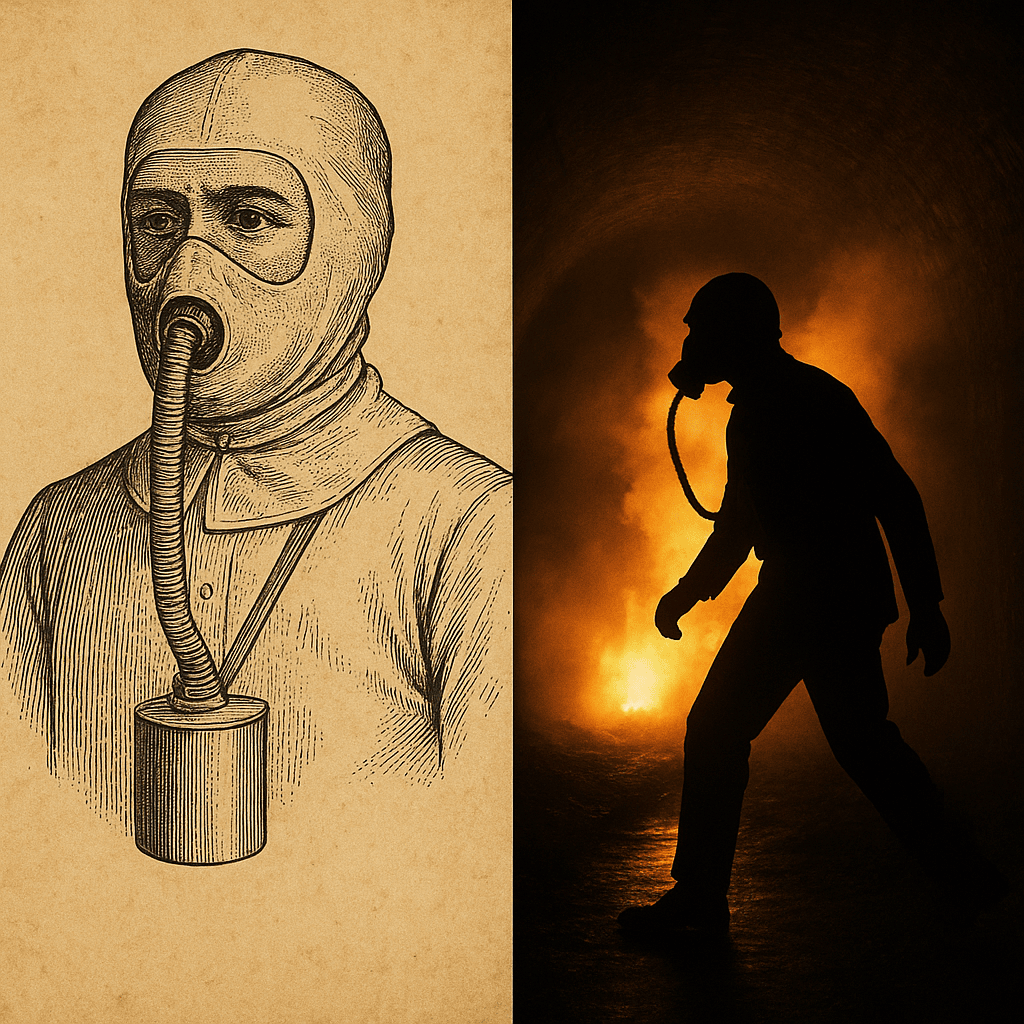
In 1912, Morgan designed a safety hood to protect firefighters and miners from the deadly smoke and toxic fumes they faced on the job. This early version of the gas mask featured breathing tubes and a wet sponge to filter air—simple, yet revolutionary.
But the true test came in 1916, when a natural gas explosion rocked a tunnel under Lake Erie in Cleveland. With little hesitation, Morgan donned his invention and entered the chaos. He saved multiple workers trapped beneath the earth—risking his own life to prove his device could do what others hadn’t even imagined.
Despite his heroism, headlines of the day often left out his name. Why? Because Garrett Morgan was Black. His contributions were buried in the shadows of racial prejudice, even as his inventions were saving lives and modernizing cities.
Today, we’re changing that narrative.
Garrett Morgan didn’t just invent the gas mask—he proved it worked. And his legacy deserves to breathe.
🧠 Now you know.
Related Links:
The Forgotten Genius Behind the Gas Mask – YouTube Short
Who Was Garrett Morgan? – Biography
More “Forgotten Genius Friday” Episodes
📢 Watch the full 60-second episode on our YouTube series, “The Knowledge,” and help us give credit where it’s due.


Forgotten Genius Fridays
Octavia E. Butler: The Black Woman Who Helped Change Science Fiction
Discover how Octavia E. Butler transformed science fiction, explored Black identity, and helped shape Afrofuturism through her groundbreaking novels.
Last Updated on October 16, 2026 by Daily News Staff
Forgotten Genius Friday | The Knowledge | STM Daily News
Octavia E. Butler: The Woman Who Reimagined the Future
When we think about science fiction, we often picture spaceships, robots, alien civilizations, and futuristic technology. But what happens when science fiction becomes a way to explore racism, inequality, human survival, and the consequences of our choices?
That is exactly what Octavia E. Butler brought to the genre.
Long before Afrofuturism became a widely recognized cultural movement, Butler was creating extraordinary stories that placed Black characters—especially Black women—at the center of imagined futures.
Her work challenged conventional ideas about who could be a hero, whose experiences mattered, and what science fiction could accomplish.
A Young Girl With a Powerful Imagination
Octavia Estelle Butler was born on June 22, 1947, in Pasadena, California.
Raised primarily by her mother and grandmother after her father’s death, Butler grew up shy and found comfort in books and storytelling.
Her mother worked as a domestic employee, and Butler sometimes accompanied her to work. Those experiences exposed her to the racial and economic inequalities that would later influence her fiction.
As a child, Butler loved science fiction, but she noticed something missing: people who looked like her.
Rather than accepting that absence, she began creating stories of her own.
She would eventually become one of the most influential writers in speculative fiction.
Breaking Barriers in Science Fiction
During the 1970s, mainstream American science fiction was largely associated with white male writers and protagonists.
Butler entered that literary world with a different perspective.
Her first published novel, Patternmaster, appeared in 1976. It introduced readers to a world shaped by extraordinary mental abilities, social hierarchies, and struggles for power.
Butler continued developing complex stories that explored humanity’s relationship with authority, identity, biology, and survival.
In 1979, she published one of her best-known novels, Kindred.
The book follows Dana, a Black woman living in 1970s California who is repeatedly transported back to a Maryland plantation before the Civil War.
Through Dana’s experiences, Butler forced readers to confront the brutality of American slavery and its continuing influence on the present.
Rather than treating history as something safely confined to the past, Kindred makes that history immediate and deeply personal.
Imagining the Future—and Warning Us About It
In 1993, Butler published Parable of the Sower, a novel set in a collapsing American society struggling with economic inequality, environmental destruction, violence, and weakened institutions.
Its central character, Lauren Olamina, is a young Black woman who develops a philosophy called Earthseed while searching for a way to survive and build a community.
The novel takes place beginning in 2024, making its imagined future particularly striking to modern readers.
Butler followed it with Parable of the Talents in 1998, continuing her examination of social instability, religious extremism, authoritarianism, and the struggle to create a better future.
Her novels were not literal predictions. They were works of speculative fiction that used recognizable social trends to ask difficult questions about where humanity might be headed.
Octavia Butler and Afrofuturism
Afrofuturism brings together African and African diasporic experiences with science fiction, technology, history, mythology, and imaginative visions of the future.
While artists such as Sun Ra and George Clinton explored cosmic identity through music, performance, and futuristic imagery, Butler used literature to investigate power, history, and humanity’s possible futures.
Her novels frequently placed Black women in situations where they had to navigate extraordinary challenges and reshape the societies around them.
Butler’s work is widely discussed within Afrofuturist scholarship, although her literary contributions also extend beyond any single cultural label.
She demonstrated that Black people did not have to remain secondary characters in someone else’s vision of the future.
They could be the architects of entirely new worlds.
Recognition and a Lasting Legacy
Butler received some of science fiction’s most significant honors, including Hugo and Nebula Awards.
In 1995, she became the first science-fiction writer to receive a MacArthur Fellowship, often called a genius grant.
Her work also included the Xenogenesis trilogy, later collected as Lilith’s Brood, which explored humanity’s encounter with an extraterrestrial species and raised questions about consent, adaptation, identity, and survival.
Butler died on February 24, 2006, at age 58.
Yet her influence has continued to grow.
Her novels are studied in classrooms, discussed by scholars, and embraced by new generations of readers and creators interested in science fiction, social justice, and Afrofuturism.
A Genius Who Made Us Think Differently About Tomorrow
Octavia E. Butler was more than a science-fiction author.
She was a visionary storyteller who understood that imagining the future also meant examining the past and questioning the present.
Her stories asked readers to consider how power operates, how communities survive, and how human beings might change.
And perhaps her greatest contribution was demonstrating that the future belongs in the imagination of everyone.
Why Octavia E. Butler Belongs in Forgotten Genius Friday
At STM Daily News, our Forgotten Genius Friday series celebrates extraordinary individuals whose ideas, innovations, and accomplishments helped shape our world, even if their stories aren’t widely known. Octavia E. Butler fits that mission perfectly. Although she received prestigious literary awards and recognition during her lifetime, her influence extends far beyond science fiction. Like the inventors, scientists, and trailblazers we’ve featured in this series, Butler challenged barriers, defied expectations, and opened doors for future generations. Through her imagination, she helped redefine who could tell stories about humanity’s future—and who could be at the center of those stories. Her inclusion in Forgotten Genius Friday reminds us that genius isn’t limited to laboratories and inventions. Sometimes, it begins with a pen, a powerful imagination, and the courage to envision a different world.
Sources and fact-checking
The Huntington Library holds Butler’s literary archive and confirms the chronology of her major novels, awards, and career. The MacArthur Foundation independently documents her 1995 fellowship.
- Official Octavia E. Butler biography
- The Huntington — Octavia E. Butler Papers
- MacArthur Foundation — Octavia Butler
- The Huntington — Telling My Stories exhibition
For more stories about overlooked innovators, writers, scientists, and visionaries who changed our world, explore The Knowledge and Forgotten Genius Friday at STM Daily News.
Forgotten Genius Fridays
Sarah Boone Improved the Ironing Board by Thinking About the Sleeve
Sarah Boone didn’t invent the first ironing board. The New Haven dressmaker patented a clever improvement shaped for pressing sleeves and fitted clothing.
Forgotten Genius | STM Daily News
Try ironing a sleeve on a wide, flat board. The fabric bunches, the seams curve, and pressing one side can leave a crease on the other. For dressmaker Sarah Boone, that everyday frustration presented a problem she could solve.
Working in New Haven, Connecticut, Boone designed an ironing board shaped for sleeves and fitted garments. Her board was narrow enough for a sleeve to slip over it, allowing one side to be pressed without flattening the other. Its curved edges followed the lines of a sleeve’s seams, while its supports helped position the board for different uses.
Boone filed her patent application in 1891. On April 26, 1892, she received U.S. Patent No. 473,653 for her improvement.
Boone did not invent the first ironing board. What she patented was a thoughtful redesign for a particular task. That distinction makes her achievement more interesting: she understood how the tool was used, recognized where it fell short, and changed its shape to make the work easier.
The patent drawing brings her idea to life. Instead of the broad surface most people picture when they hear “ironing board,” Boone’s design looks almost like the part of a garment it was meant to support. It is a practical solution from someone who knew the job firsthand.
That is the heart of Sarah Boone’s story. Invention does not always begin with an entirely new machine. Sometimes it begins when a person doing familiar work asks a better question: What would this tool look like if it truly fit the task?
Boone answered with a design—and secured a place in the history of Black innovation.
References:
Sarah Boone’s Original Ironing Board Patent — U.S. Patent No. 473,653, granted April 26, 1892. Includes her description, construction details, and original drawings.
USPTO: Beyond Baker’s List—Black Innovation Then and Now — Identifies Boone as a New Haven dressmaker who patented an improved ironing board shaped for bodices and sleeves.
USPTO: Found on Baker’s List — Background on Henry Baker’s work documenting Black patent holders, providing historical context for the Forgotten Genius series.
Explore more inventors and innovators in STM Daily News’ Forgotten Genius series.
Sources: U.S. Patent and Trademark Office; Sarah Boone’s original 1892 patent, available through Google Patents.
The Knowledge
Benjamin O. Davis Jr.: From West Point Isolation to Four-Star General
Benjamin O. Davis Jr. endured racial isolation at West Point before becoming a pioneering military aviator, commander of the Tuskegee Airmen and the first Black general officer in the U.S. Air Force. His extraordinary career ultimately earned him four stars.
Forgotten Genius Fridays | STM Daily News
For four years at West Point, fellow cadets tried to isolate Benjamin O. Davis Jr.
They wouldn’t room with him. They excluded him socially. Outside of official duties, other cadets largely refused to speak to him.
The intention was clear: make life so difficult that he would leave.
Benjamin O. Davis Jr. didn’t leave.
He graduated.
And the young officer who endured isolation at West Point would eventually command some of America’s most celebrated fighter pilots, help lead the integration of the U.S. Air Force and finish his remarkable journey wearing four stars.
The Son of a Pioneer
Benjamin Oliver Davis Jr. was born in Washington, D.C., on December 18, 1912.
Military service was already part of the Davis household.
His father, Benjamin O. Davis Sr., was a career Army officer who would make history in 1940 as the first Black general officer in the U.S. Army and U.S. armed forces.
The younger Davis developed another ambition.
He wanted to fly.
But in the segregated American military of the era, becoming a Black military aviator wasn’t simply difficult.
The opportunity effectively didn’t exist.
Davis would first have to prove himself somewhere else.
Four Years of Isolation at West Point
Davis entered the United States Military Academy at West Point in July 1932.
He encountered racial hostility almost immediately.
White cadets subjected Davis to what amounted to a prolonged campaign of social isolation. He roomed alone and generally ate without other cadets speaking to him.
The National Park Service records that Davis nevertheless persevered, graduating in June 1936 in the top 20 percent of his class. He was the fourth African American to graduate from West Point.
Years later, Davis recalled the purpose of the treatment: it was intended to make him buckle.
He refused.
That determination would become one of the defining characteristics of his military career.
An Officer Who Wanted to Fly
Graduation didn’t eliminate the barriers.
Davis was commissioned as a second lieutenant of infantry. After assignments including Fort Benning, Georgia, he became a professor of military science at Tuskegee Institute in Alabama.
Then an opportunity appeared that would change American military aviation.
The Army began establishing a program to train Black military pilots at Tuskegee.
Davis entered advanced flying school in 1941.
On March 7, 1942, the first class of five Black Army Air Forces fighter pilots graduated from Tuskegee.
Benjamin O. Davis Jr. was among them.
He finally had his wings.
Taking the 99th to War
Davis transferred to the Army Air Corps and became commander of the 99th Fighter Squadron.
In April 1943, he traveled with the squadron to North Africa.
Flying P-40 Warhawks, the Black pilots were finally entering combat.
But their abilities would soon be challenged from within their own military.
Reports questioning the combat performance of the 99th threatened the future of Black military aviation.
Davis returned to Washington and defended his pilots before War Department officials.
The squadron continued fighting.
Its combat performance helped answer the critics more convincingly than prejudice ever could.
Commanding the 332nd
Davis subsequently assumed command of the 332nd Fighter Group, which eventually brought together the 99th, 100th, 301st and 302nd Fighter Squadrons.
Operating from Italy, the group flew bomber escort and other combat missions over Europe.
Eventually flying P-51 Mustangs distinguished by their red-painted tails, the pilots became associated with one of the most recognizable names in American aviation history:
The Red Tails.
Davis didn’t simply command from behind a desk.
He flew combat missions himself.
During the war, his leadership and combat service earned decorations including the Silver Star and Distinguished Flying Cross.
The Tuskegee Airmen were demonstrating something segregation had attempted to deny—that Black Americans could perform highly demanding aviation missions and lead combat organizations.
From Tuskegee to an Integrated Air Force
World War II ended, but Davis’s military career continued.
In 1947, the United States Air Force became an independent military service.
Then, in 1948, President Harry S. Truman issued Executive Order 9981, establishing a policy of equality of treatment and opportunity in the armed forces regardless of race, color, religion or national origin.
Davis became involved in the Air Force’s efforts to implement integration.
The officer who had once been deliberately isolated because of his race was now helping a military service move away from institutional segregation.
Another War
Davis continued advancing.
During the Korean War era, he commanded the 51st Fighter-Interceptor Wing in Korea.
His responsibilities continued expanding through assignments in the United States, Europe and Asia.
Then another barrier fell.
On October 27, 1954, Davis received his temporary promotion to brigadier general.
He became the first Black general officer in the United States Air Force.
His father’s historic achievement now had an extraordinary parallel.
Benjamin O. Davis Sr. had become the Army’s first Black general.
Benjamin O. Davis Jr. had become the Air Force’s first.
Three Stars
Davis continued climbing through the senior leadership of the Air Force.
He became a major general and, in 1965, lieutenant general.
His assignments included command of the 13th Air Force in the Philippines and service as deputy commander in chief of U.S. Strike Command.
By the time Davis retired from active military service on February 1, 1970, the cadet who had once eaten alone at West Point was wearing three stars.
But history wasn’t quite finished with Benjamin O. Davis Jr.
The Fourth Star
Twenty-eight years after his retirement, Davis returned to the national spotlight.
On December 9, 1998, President Bill Clinton advanced the retired lieutenant general to the rank of general.
Four stars.
The moment carried enormous symbolism.
The cadet other students had refused to speak to had become one of the highest-ranking officers in American military history.
Yet an important distinction should be remembered: Davis was not the first Black four-star general in the Air Force. That milestone belonged to Daniel “Chappie” James Jr., who reached four-star rank while on active duty in 1975.
Davis’s fourth star nevertheless represented recognition of an extraordinary career spanning some of the most significant transformations in twentieth-century American military history.
The Davis Legacy
Benjamin O. Davis Jr. died on July 4, 2002, at age 89.
His life tells an extraordinary American story.
His father began his Regular Army career with the Buffalo Soldiers and became America’s first Black general officer.
The son endured four years of racial isolation at West Point.
He became one of the first five Black Army pilots trained at Tuskegee.
He commanded the 99th Fighter Squadron.
He led the 332nd Fighter Group.
He helped the Air Force navigate integration.
He commanded forces during the Cold War.
And eventually, he wore four stars.
The Davis family story spans generations of American military history—from the Buffalo Soldiers to the Tuskegee Airmen and from segregation to integration.
Benjamin O. Davis Sr. broke one barrier.
The Tuskegee Airmen shattered assumptions about Black military aviation.
And Benjamin O. Davis Jr. carried that legacy from West Point into the skies—and ultimately to the highest ranks of the United States Air Force.
Two generations. One extraordinary legacy.
Forgotten Genius Fridays is an STM Daily News series highlighting innovators, pioneers and historical figures whose achievements deserve a larger place in our collective memory.
Sources and Related Reading
U.S. Air Force — General Benjamin O. Davis Jr. biography
National Park Service — Benjamin O. Davis Jr.
National Museum of the United States Army — Benjamin O. Davis Jr.
More more stories like this, please visit our Forgotten Genius Friday!





