Gender is not an ideology – but conservative groups know learning about it empowers people to think for themselves
Victoria Pitts-Taylor, Wesleyan University and Elizabeth Anne Wood, Nassau Community College Political attacks on teaching about gender in colleges and universities are about more than just gender: They are part of agrander projectof eroding civil and human rights, limiting personal freedoms and undermining democracy in the name of “traditional” values. On the first day of his second term, President Donald Trump issued an executive order declaring there are two sexes determined solely by the kind of reproductive cells the body makes, and that the federal government would recognize nothing else. The order claims to protect the “freedom to express the binary nature of sex” and bans the use of federal funds to “promote gender ideology.” Legal experts have criticized the directive as unconstitutional and are challenging it in the courts. Yet the order has provided fuel for conservatives, right-wing politicians and activists trying to remove so-called gender ideology from many places in American society, including classrooms. Right-wing activists are pushing for censorship of educational curricula in K-12 schools and in colleges and universities, and they have succeeded in Texas, Florida and other red states. Why are conservative politicians so determined to control how Americans define sex and understand gender? As sociologistswho research and teach about gender, we know that gender across disciplines is understood to be a complex topic of study, not an ideology. The study of gender represents the kind of free inquiry that allows people to decide for themselves how to live, free of coercion or government control.
What is ‘gender ideology’?
“Gender ideology” is a catch-all term conservative Catholics initially promoted in the 1990s in response to the United Nations’ promotion of women’s equality. In 2004, pushing back on the global women’s and gay rights movements, the Vatican declared in a letter to bishops that men and women are different by nature “not only on the physical level, but also on the psychological and spiritual.” The letter stated that the idea of gender “inspired ideologies” that sanction alternatives to the traditional two-parent family headed by men and treated homosexuality on par with heterosexuality. Over the following decades, evangelical groups and far-right parties across the globe – from Hungary and Russia to Peru, Brazil and Ghana – have used the language of combating “gender ideology” to counter a host of social policies, including sex education in schools, the legalization of gay marriage and same-sex adoption, reproductive rights and transgender rights.Anti-gender protestors during a 2018 Equality March in Kraków, Poland.Silar/Wikimedia Commons, CC BY-SA The anti-gender movement is no longer fringe but rather well funded, organized and transnational. For example, 40 countries have signed the Geneva Consensus Declaration, an international pact proposed by the first Trump administration and supported by anti-gender campaigners as a way to deny abortion rights internationally. In the U.S., where the majority of Americans support gay marriageand abortion rights, targeting trans rights has become one of the conservative movement’s galvanizing issues. A flood of state bills not only ban books and discussions of gender, sexuality and race in schools but also criminalize abortion, ban gender-affirming health care and legalize discrimination in housing and employment on religious grounds.
What we talk about when we talk about gender
How gender is researched and taught in universities has becomea key target of anti-gender campaigns across the globe, in part because the study of gender raises questions about the universality of traditional social roles and the inequalities that can result from them. Gender is a focus of inquiry not only in gender studies classes but in literature, sociology, law, government, history, anthropology and cultural geography, among many other fields. Anti-gender campaigners argue there is nothing to understand about it because gender is given by nature or God. For them, gender is equivalent to sex, which is taken to be straightforward and without exception male or female. Scientific evidence suggests, however, that sex is not always binary. In biology, sex refers to genes, reproductive organs, hormone systems and observable physical characteristics; different combinations of these lead to variations in sex. Far from straightforward, then, sex is complicated. And a person’s assigned sex at birth does not always align with their deeply held sense of self – their gender identity. Gender is both a feature of individual people and a mode of organizing social life. At the individual level, people have a subjective sense of and embody their gender by dressing and behaving in ways that encourage other people to see them as they want to be seen. A man might wear a tie at the office to convey masculinity. People will interact differently with a woman when she is wearing high heels and makeup than when she goes barefaced or dons a swimsuit. Someone who is gender fluid may appear more masculine or feminine at different times and experience prejudice and discrimination.Gender roles shape society and culture in both subtle and glaring ways. Gender shapes societies through norms and rules on everything from what you wear to how families operate, whom you are allowed to partner with and what jobs you are likely to hold. Whether in the spheres of culture, family, economic or civic life, gender roles and norms intersect with class, race and other social differences and shift across cultures and historical eras. Indigenous societies across the globe have long recognized more than two gender categories, and historical and contemporary examples of gender diversity abound. A ban on learning about gender would sweep aside all this variation in favor of a homogeneous worldview that deliberately ignores biology, history and lived experience. Denying the diversity of gender makes it easier to impose a conservative worldview and roll back rights.
Education as a political target
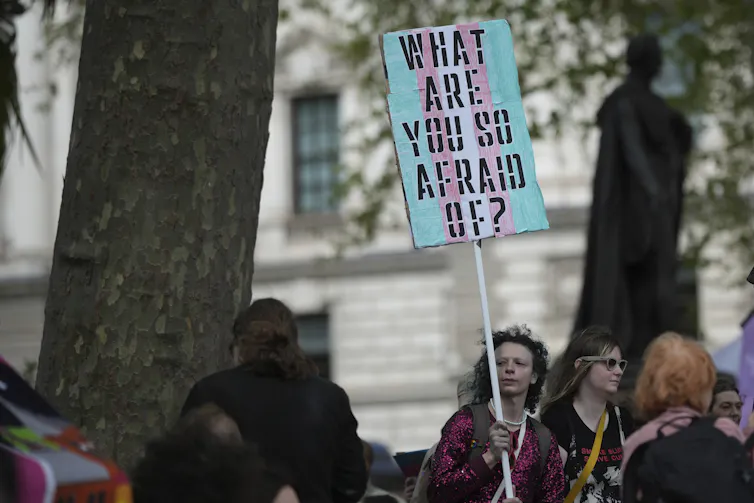
Anti-gender campaigners view education as a major battleground in the fight over societal values. In the U.S., conservative efforts to ban the study of gender and sexuality initially centered on K-12 education, exemplified in bills such as Florida’s 2022 “Don’t Say Gay” law. But the movement has also affected colleges and universities. Texas A&M’s president fired a professor in September 2025 after a student recorded her confrontation with her for discussing gender diversity in a literature course. The student alleged the course was “not legal” because it contradicted “our president’s laws” and her own religious beliefs. The university president also later resigned under pressure. The same month, the chancellor of the Texas Tech University system, citing Trump’s executive order on “gender ideology,” banned all faculty members across its five universities from recognizing “more than two sexes” in any course or classroom.Controlling thought is a means of repressing social movements.AP Photo/Charlie Neibergall As the Texas chapter of the American Association of University Professors reminds its members, faculty have a constitutional right to teach and discuss “all matters related to the subject matter of a class” without interference from administrators, politicians or government officials. Despite this, states led by conservative lawmakers have useda rangeof tacticsto eliminategender studies programs or curriculum from colleges. These attacks on universities are attempts to control thought, subdue social movements advocating for change and promote an orthodoxy that upholds those in power.Books on gender are among those conservatives are purging from libraries and classrooms.AP Photo/Rick Bowmer
Restricting rights, eroding democracy
These attacks on education are not only academic matters. They disempower women and marginalized groups that have achieved some legal protection or rights in recent decades. And they contribute to the erosion of democracy. Authoritarian approaches to governing rely on scapegoating people, policing thought and speech, and punishing dissent. This is true whether it’s Viktor Orban’s Hungary, Vladimir Putin’s Russia or Donald Trump’s United States. By prohibiting questions and challenges, autocrats gain the power to limit how people think and control their bodies.Victoria Pitts-Taylor, Professor of Feminist, Gender, and Sexuality Studies; Sociology; Science and Technology Studies, Wesleyan University and Elizabeth Anne Wood, Professor of Sociology, Nassau Community College This article is republished from The Conversation under a Creative Commons license. Read the original article.
STM Daily News is a multifaceted podcast that explores a wide range of topics, from life and consumer issues to the latest in food and beverage trends. Our discussions dive into the realms of science, covering everything from space and Earth to nature, artificial intelligence, and astronomy. We also celebrate the amateur sports scene, highlighting local athletes and events, including our special segment on senior Pickleball, where we report on the latest happenings in this exciting community. With our diverse content, STM Daily News aims to inform, entertain, and engage listeners, providing a comprehensive look at the issues that matter most in our daily lives. https://stories-this-moment.castos.com/
How Water Towers Work: The Simple System That Keeps Water Flowing in American Cities
Learn how water towers work in the United States, why they are so tall, and how gravity helps cities maintain water pressure and emergency water supplies.
Water towers are one of the most recognizable pieces of infrastructure across the United States. Rising above towns, suburbs, and cities, these elevated tanks quietly perform a vital function every day: maintaining water pressure and storing emergency water for local communities.
Although they may look simple, water towers are an essential part of modern municipal water systems and remain one of the most reliable ways to deliver water to homes and businesses.
The Basic Science Behind Water Towers
Water towers work using a simple principle of physics: gravity.
Water from treatment plants or underground wells is pumped into a storage tank located high above the ground—typically between 100 and 200 feet tall. Because the tank is elevated, gravity naturally pushes the water downward through the city’s pipeline network.
This gravitational force creates the water pressure needed to supply homes, businesses, irrigation systems, and fire hydrants throughout the community.
Most residential plumbing systems in the United States operate best at 40 to 60 PSI (pounds per square inch), which water towers can easily provide through elevation alone.
Ever wondered why cities build giant water towers? 💧 It’s all about gravity. Water is pumped up into the tower and gravity pushes it through city pipes, creating the pressure that delivers water to homes, businesses, and fire hydrants. Simple engineering that keeps entire towns running. Now you know. Hashtags NowYouKnow WaterTower Infrastructure EngineeringExplained HowItWorks DidYouKnow CityInfrastructure UrbanEngineering STMDailyNews EducationalContent ♬ original sound – STMDailyNews – STMDailyNews
Why Water Towers Are Built So Tall
The height of a water tower determines how much pressure it can create. Engineers use a common rule:
For example, a water tower standing 120 feet tall can generate roughly 50 PSI of pressure—perfect for delivering water throughout a residential neighborhood.
Why Cities Still Use Water Towers
While modern pumping systems could theoretically move water through pipes continuously, water towers provide several major advantages that make them a preferred design in many municipal systems.
Stable Water Pressure – Water towers maintain consistent pressure even during peak usage times.
Energy Efficiency – Pumps can refill towers overnight when electricity demand is lower.
Emergency Water Supply – If power fails, gravity can continue delivering water.
Fire Protection – Fire hydrants depend on strong, immediate water pressure.
The Daily Fill-and-Use Cycle
Water towers typically operate on a daily cycle based on community demand.
Night: Pumps refill the tower while water demand is low.
Morning: Water levels drop as residents shower and prepare for the day.
Daytime: Businesses and homes continue drawing water from the tower.
Evening: The system begins refilling the tank for the next day.
How Much Water Can a Tower Store?
Water towers come in many sizes depending on the population they serve.
Small towns: 50,000–300,000 gallons
Suburban communities: 500,000–1 million gallons
Larger urban systems: up to 2 million gallons or more
Even a single tower holding one million gallons can supply thousands of homes for several hours during peak demand or emergencies.
Modern Technology Inside Water Towers
Today’s water towers are equipped with advanced monitoring systems that help utilities maintain safe and reliable water supplies.
Advertisement
Digital water level sensors
Automated pump controls
Water quality monitoring
Protective interior coatings
Regular inspections and maintenance
Landmarks in the American Skyline
Many cities turn their water towers into local landmarks by painting them with city names, mascots, or community slogans. Some towns even design towers shaped like giant objects such as fruit, coffee cups, or sports balls.
Despite their distinctive appearance, water towers remain one of the simplest and most reliable engineering solutions for delivering clean water to millions of Americans every day.
Next time you see a water tower rising above a town skyline, remember: it’s not just a landmark—it’s the gravity-powered system that keeps water flowing.
Related External Coverage
For more information about how water towers and municipal water systems work, explore the following resources:
Dive into “The Knowledge,” where curiosity meets clarity. This playlist, in collaboration with STMDailyNews.com, is designed for viewers who value historical accuracy and insightful learning. Our short videos, ranging from 30 seconds to a minute and a half, make complex subjects easy to grasp in no time. Covering everything from historical events to contemporary processes and entertainment, “The Knowledge” bridges the past with the present. In a world where information is abundant yet often misused, our series aims to guide you through the noise, preserving vital knowledge and truths that shape our lives today. Perfect for curious minds eager to discover the ‘why’ and ‘how’ of everything around us. Subscribe and join in as we explore the facts that matter. https://stmdailynews.com/the-knowledge/
Rod: A creative force, blending words, images, and flavors. Blogger, writer, filmmaker, and photographer. Cooking enthusiast with a sci-fi vision. Passionate about his upcoming series and dedicated to TNC Network. Partnered with Rebecca Washington for a shared journey of love and art.
The Unfavorable Semicircle Mystery: The YouTube Channel That Uploaded Tens of Thousands of Cryptic Videos
In 2015, the YouTube channel Unfavorable Semicircle gained attention for its enigmatic and abundant video uploads, totaling over 70,000 before its deletion in 2016. Theories about its purpose vary, from automated content generation to digital art experimentation, leaving its intent unresolved.
In the vast digital landscape of the internet, strange phenomena occasionally emerge that leave investigators, tech enthusiasts, and everyday viewers scratching their heads. One of the most puzzling cases appeared in 2015, when a mysterious YouTube channel called Unfavorable Semicircle began uploading an astonishing number of cryptic videos.
Within months, the channel had published tens of thousands of bizarre clips, many of which seemed random, incomprehensible, and visually chaotic. But as internet detectives began analyzing the content more closely, they discovered that these videos might not have been random at all.
The Sudden Appearance of an Internet Mystery
The Unfavorable Semicircle channel reportedly appeared in March 2015, with its first uploads arriving in early April.
Almost immediately, the channel began publishing videos at an incredible pace. Observers estimated that the account uploaded thousands of videos per week, sometimes multiple videos per minute. By the time the channel disappeared in early 2016, researchers believed it had uploaded well over 70,000 videos, possibly far more.
The scale alone made the project seem impossible for a human to manage manually.
Most of the videos shared similar characteristics:
Extremely short or very long runtime
Abstract visuals such as flashing colors, static, or distorted imagery
Little or no audio, or heavily distorted sounds
Titles made of random characters, symbols, or numbers
To casual viewers, the videos looked like pure digital noise. However, online investigators suspected something more deliberate was happening.
Hidden Images Discovered
The mystery deepened when researchers began extracting individual frames from some videos.
When thousands of frames from certain clips were stitched together, the results sometimes formed coherent images. One of the most famous examples involved a video titled “LOCK.” While the footage appeared chaotic at first, combining the frames revealed a recognizable composite image.
This discovery suggested the videos were carefully constructed rather than random uploads.
Theories About the Channel’s Purpose
Because the creator never explained the project, several theories emerged across Reddit, YouTube, and internet forums.
Automated Experiment Many believe the channel was created using automated software that generated and uploaded content at scale.
Alternate Reality Game (ARG) Some viewers suspected the channel might be part of a hidden puzzle or digital scavenger hunt.
Advertisement
Encrypted Communication Others compared the channel to Cold War “numbers stations,” suggesting the videos could contain coded messages.
Digital Art Project Another theory suggests the channel was an experimental art project exploring algorithms, data, and visual noise.
Despite years of investigation, no single explanation has been confirmed.
Why the Channel Disappeared
In February 2016, YouTube removed the channel, reportedly due to spam or automated activity violations.
By that time, the channel had already become a minor internet legend. Fortunately, some researchers managed to archive a large portion of the videos before they disappeared.
Even today, archived clips continue to circulate online as investigators attempt to decode them.
Unfavorable Semicircle: The Most Bizarre YouTube Mystery
Other Mysterious YouTube Channels
The Unfavorable Semicircle mystery is not the only strange case on YouTube.
One well-known example is Webdriver Torso, a channel that uploaded hundreds of thousands of videos showing red and blue rectangles with simple beeping sounds. Internet speculation ran wild before Google eventually confirmed it was an internal YouTube testing account.
Another example is AETBX, which posts distorted visuals and unusual audio that some viewers believe contain hidden patterns or encoded information.
These cases highlight how automation, experimentation, and creativity can sometimes blur the line between technology and mystery.
Advertisement
A Digital Mystery That Remains Unsolved
Nearly a decade later, the true purpose behind Unfavorable Semicircle remains unknown.
Was it a sophisticated experiment? A piece of algorithmic art? Or simply an automated test that accidentally captured the internet’s imagination?
Whatever the explanation, the channel stands as a reminder that even in a world filled with billions of videos and endless information, the internet can still produce mysteries that challenge our understanding of technology.
Why Internet Mysteries Still Fascinate Us
Stories like Unfavorable Semicircle capture attention because they combine technology, creativity, and the unknown. They invite people from around the world to collaborate, analyze patterns, and search for meaning hidden in the noise.
And sometimes, the most intriguing part of the mystery is that the answer may never fully be known.
Dive into “The Knowledge,” where curiosity meets clarity. This playlist, in collaboration with STMDailyNews.com, is designed for viewers who value historical accuracy and insightful learning. Our short videos, ranging from 30 seconds to a minute and a half, make complex subjects easy to grasp in no time. Covering everything from historical events to contemporary processes and entertainment, “The Knowledge” bridges the past with the present. In a world where information is abundant yet often misused, our series aims to guide you through the noise, preserving vital knowledge and truths that shape our lives today. Perfect for curious minds eager to discover the ‘why’ and ‘how’ of everything around us. Subscribe and join in as we explore the facts that matter. https://stmdailynews.com/the-knowledge/
International Women’s Day is celebrated globally on March 8th to honor women’s achievements and promote gender equality, originating from a 1908 march in New York for better rights.
International Women’s Day is a global celebration that honors the achievements of women and highlights the progress still to be made in the fight for gender equality. On this day, people around the world come together to recognize the amazing contributions of women everywhere and to rally for greater gender equity in all areas of life.
The origins of International Women’s Day can be traced back to 1908, when 15,000 women marched through the streets of New York City to demand better working conditions and the right to vote. Since then, the celebration has grown to be an international event, with more than 100 countries recognizing the day. The United Nations even declared March 8th as International Women’s Day in 1975, to honor the struggles of women around the world.
This year’s International Women’s Day theme is #ChooseToChallenge, meaning that everyone is encouraged to call out gender bias and inequality when they see it. We’re also encouraged to celebrate women’s achievements, support each other, and take action for equality.
It’s important to recognize the progress we’ve made in terms of gender equality, but we still have a long way to go. International Women’s Day serves as a reminder that we must continue to fight for gender equality in all areas of life. Let’s use this day to honor the contributions of women around the world, and to continue the fight for a more equitable world.
Rebecca Jo is a mother of four and is a creative soul from Phoenix, Arizona, who also enjoys new adventures. Rebecca Jo has a passion for the outdoors and indulges in activities like camping, fishing, hunting and riding roller coasters. She is married to Rod Washington




 Victoria Pitts-Taylor, Professor of Feminist, Gender, and Sexuality Studies; Sociology; Science and Technology Studies, Wesleyan University and Elizabeth Anne Wood, Professor of Sociology, Nassau Community College This article is republished from The Conversation under a Creative Commons license. Read the original article.







