Connect with us

STM Blog

Gender is not an ideology – but conservative groups know learning about it empowers people to think for themselves

Published

on

Gender is not an ideology
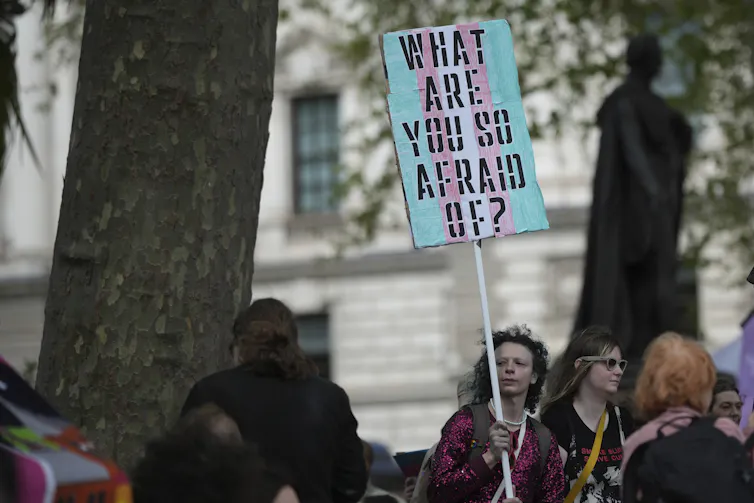
Who is afraid of gender and why?
AP Photo/Alastair Grant

Gender is not an ideology – but conservative groups know learning about it empowers people to think for themselves

Victoria Pitts-Taylor, Wesleyan University and Elizabeth Anne Wood, Nassau Community College

Political attacks on teaching about gender in colleges and universities are about more than just gender: They are part of a grander project of eroding civil and human rights, limiting personal freedoms and undermining democracy in the name of “traditional” values.

On the first day of his second term, President Donald Trump issued an executive order declaring there are two sexes determined solely by the kind of reproductive cells the body makes, and that the federal government would recognize nothing else. The order claims to protect the “freedom to express the binary nature of sex” and bans the use of federal funds to “promote gender ideology.” Legal experts have criticized the directive as unconstitutional and are challenging it in the courts.

Yet the order has provided fuel for conservatives, right-wing politicians and activists trying to remove so-called gender ideology from many places in American society, including classrooms. Right-wing activists are pushing for censorship of educational curricula in K-12 schools and in colleges and universities, and they have succeeded in Texas, Florida and other red states.

Why are conservative politicians so determined to control how Americans define sex and understand gender?

As sociologists who research and teach about gender, we know that gender across disciplines is understood to be a complex topic of study, not an ideology. The study of gender represents the kind of free inquiry that allows people to decide for themselves how to live, free of coercion or government control.

What is ‘gender ideology’?

“Gender ideology” is a catch-all term conservative Catholics initially promoted in the 1990s in response to the United Nations’ promotion of women’s equality.

In 2004, pushing back on the global women’s and gay rights movements, the Vatican declared in a letter to bishops that men and women are different by nature “not only on the physical level, but also on the psychological and spiritual.” The letter stated that the idea of gender “inspired ideologies” that sanction alternatives to the traditional two-parent family headed by men and treated homosexuality on par with heterosexuality.

Over the following decades, evangelical groups and far-right parties across the globe – from Hungary and Russia to Peru, Brazil and Ghana – have used the language of combating “gender ideology” to counter a host of social policies, including sex education in schools, the legalization of gay marriage and same-sex adoption, reproductive rights and transgender rights.

Crowd of people, center of which is a sign depicting silhouette figures of a man and a woman holding an umbrella shielding two children from a rainbow
Anti-gender protestors during a 2018 Equality March in Kraków, Poland.
Silar/Wikimedia Commons, CC BY-SA

The anti-gender movement is no longer fringe but rather well funded, organized and transnational. For example, 40 countries have signed the Geneva Consensus Declaration, an international pact proposed by the first Trump administration and supported by anti-gender campaigners as a way to deny abortion rights internationally.

In the U.S., where the majority of Americans support gay marriage and abortion rights, targeting trans rights has become one of the conservative movement’s galvanizing issues. A flood of state bills not only ban books and discussions of gender, sexuality and race in schools but also criminalize abortion, ban gender-affirming health care and legalize discrimination in housing and employment on religious grounds.

What we talk about when we talk about gender

How gender is researched and taught in universities has become a key target of anti-gender campaigns across the globe, in part because the study of gender raises questions about the universality of traditional social roles and the inequalities that can result from them.

Advertisement
Reveal Your Skin's Youthful Radiance with FOREO's LUNA 2 Facial Massager. Shop Now For $199

Gender is a focus of inquiry not only in gender studies classes but in literature, sociology, law, government, history, anthropology and cultural geography, among many other fields.

Anti-gender campaigners argue there is nothing to understand about it because gender is given by nature or God. For them, gender is equivalent to sex, which is taken to be straightforward and without exception male or female.

Scientific evidence suggests, however, that sex is not always binary. In biology, sex refers to genes, reproductive organs, hormone systems and observable physical characteristics; different combinations of these lead to variations in sex. Far from straightforward, then, sex is complicated.

And a person’s assigned sex at birth does not always align with their deeply held sense of self – their gender identity.

Gender is both a feature of individual people and a mode of organizing social life. At the individual level, people have a subjective sense of and embody their gender by dressing and behaving in ways that encourage other people to see them as they want to be seen. A man might wear a tie at the office to convey masculinity. People will interact differently with a woman when she is wearing high heels and makeup than when she goes barefaced or dons a swimsuit. Someone who is gender fluid may appear more masculine or feminine at different times and experience prejudice and discrimination.

Gender roles shape society and culture in both subtle and glaring ways.

Gender shapes societies through norms and rules on everything from what you wear to how families operate, whom you are allowed to partner with and what jobs you are likely to hold. Whether in the spheres of culture, family, economic or civic life, gender roles and norms intersect with class, race and other social differences and shift across cultures and historical eras. Indigenous societies across the globe have long recognized more than two gender categories, and historical and contemporary examples of gender diversity abound.

A ban on learning about gender would sweep aside all this variation in favor of a homogeneous worldview that deliberately ignores biology, history and lived experience. Denying the diversity of gender makes it easier to impose a conservative worldview and roll back rights.

Education as a political target

Anti-gender campaigners view education as a major battleground in the fight over societal values. In the U.S., conservative efforts to ban the study of gender and sexuality initially centered on K-12 education, exemplified in bills such as Florida’s 2022 “Don’t Say Gay” law. But the movement has also affected colleges and universities.

Texas A&M’s president fired a professor in September 2025 after a student recorded her confrontation with her for discussing gender diversity in a literature course. The student alleged the course was “not legal” because it contradicted “our president’s laws” and her own religious beliefs. The university president also later resigned under pressure.

The same month, the chancellor of the Texas Tech University system, citing Trump’s executive order on “gender ideology,” banned all faculty members across its five universities from recognizing “more than two sexes” in any course or classroom.

Advertisement
Reveal Your Skin's Youthful Radiance with FOREO's LUNA 2 Facial Massager. Shop Now For $199
Crowd of protestors holding signs inside a capitol building
Controlling thought is a means of repressing social movements.
AP Photo/Charlie Neibergall

As the Texas chapter of the American Association of University Professors reminds its members, faculty have a constitutional right to teach and discuss “all matters related to the subject matter of a class” without interference from administrators, politicians or government officials. Despite this, states led by conservative lawmakers have used a range of tactics to eliminate gender studies programs or curriculum from colleges.

These attacks on universities are attempts to control thought, subdue social movements advocating for change and promote an orthodoxy that upholds those in power.

Person reading the book 'Genderqueer' atop a stack of other challenged books
Books on gender are among those conservatives are purging from libraries and classrooms.
AP Photo/Rick Bowmer

Restricting rights, eroding democracy

These attacks on education are not only academic matters. They disempower women and marginalized groups that have achieved some legal protection or rights in recent decades. And they contribute to the erosion of democracy.

Authoritarian approaches to governing rely on scapegoating people, policing thought and speech, and punishing dissent. This is true whether it’s Viktor Orban’s Hungary, Vladimir Putin’s Russia or Donald Trump’s United States. By prohibiting questions and challenges, autocrats gain the power to limit how people think and control their bodies.The Conversation

Victoria Pitts-Taylor, Professor of Feminist, Gender, and Sexuality Studies; Sociology; Science and Technology Studies, Wesleyan University and Elizabeth Anne Wood, Professor of Sociology, Nassau Community College

This article is republished from The Conversation under a Creative Commons license. Read the original article.

STM Daily News is a multifaceted podcast that explores a wide range of topics, from life and consumer issues to the latest in food and beverage trends. Our discussions dive into the realms of science, covering everything from space and Earth to nature, artificial intelligence, and astronomy. We also celebrate the amateur sports scene, highlighting local athletes and events, including our special segment on senior Pickleball, where we report on the latest happenings in this exciting community. With our diverse content, STM Daily News aims to inform, entertain, and engage listeners, providing a comprehensive look at the issues that matter most in our daily lives. https://stories-this-moment.castos.com/

📜 Who Created Blogging? A Look Back at the Birth of the Blog

Link: https://stmdailynews.com/%f0%9f%93%9c-who-created-blogging-a-look-back-at-the-birth-of-the-blog/

Continue Reading
Advertisement Simply Wholesale

Community

Feeding America Highlights Farmers’ Role in Fighting Hunger on National Agriculture Day

Published

on

food love people africa. Feeding America
Photo by RDNE Stock project on Pexels.com

Feeding America is marking National Agriculture Day by recognizing farmers, ranchers, and producers as key partners in the fight against hunger.

In a March 24 press release, the organization said the agricultural community plays a vital role in helping food banks and pantries deliver fresh, nutritious food to families across the country. Feeding America noted that produce, dairy, and protein are among the most requested foods by neighbors facing hunger and make up half of all food distributed through its network.

The organization said that in 2025, its network worked with growers to rescue 971 million pounds of fresh produce, helping redirect surplus food to communities in need. Feeding America also pointed to federal nutrition and farm support programs, saying government purchases from U.S. growers provide more than 20% of the food distributed through its network.

Ami McReynolds, Feeding America’s chief advocacy and community partnerships officer, said supporting farmers is directly connected to helping families access healthy meals. The organization is also urging Congress to support additional farm aid and a Farm Bill that strengthens nutrition programs.

Feeding America said a recent poll found that 95% of voters view hunger as a nonpartisan issue, reinforcing support for collaborative solutions between agriculture, food banks, and policymakers.

Related Links

Source Links

The Bridge is a section of the STM Daily News Blog meant for diversity, offering real news stories about bona fide community efforts to perpetuate a greater good. The purpose of The Bridge is to connect the divides that separate us, fostering understanding and empathy among different groups. By highlighting positive initiatives and inspirational actions, The Bridge aims to create a sense of unity and shared purpose. This section brings to light stories of individuals and organizations working tirelessly to promote inclusivity, equality, and mutual respect. Through these narratives, readers are encouraged to appreciate the richness of diverse perspectives and to participate actively in building stronger, more cohesive communities.

https://stmdailynews.com/the-bridge

Author

  • Rod Washington

    Rod: A creative force, blending words, images, and flavors. Blogger, writer, filmmaker, and photographer. Cooking enthusiast with a sci-fi vision. Passionate about his upcoming series and dedicated to TNC Network. Partnered with Rebecca Washington for a shared journey of love and art.

    View all posts
Continue Reading

Community

McDonald’s First Job Confessional Turns Career Stories Into Free Meal Opportunity

McDonald’s is launching First Job Confessional, a campaign inviting fans to share first job stories for a chance to receive a $15 gift card in select cities.

Published

on

McDonald’s is launching First Job Confessional, a campaign inviting fans to share first job stories for a chance to receive a $15 gift card in select cities.
McDonald’s is Asking Fans to Get Real About Their First Job Skills in Exchange for Free Meals

First Job Confessional

McDonald’s is putting first jobs in the spotlight with a new campaign that asks fans to share the real-world skills they gained early in their working lives. Launched on National Employee Appreciation Day, the brand’s First Job Confessional invites people to reflect on how those first roles helped shape their careers — and, in some cases, earn a free meal in the process.

The campaign is built around a simple idea: first jobs often teach lasting skills that deserve more recognition. Whether someone learned problem-solving while babysitting, communication during a lunch rush, or teamwork behind a counter, McDonald’s is framing those experiences as valuable career foundations. The company says those are the same kinds of skills employers continue to prioritize as workplace demands evolve.

McDonald’s is launching First Job Confessional, a campaign inviting fans to share first job stories for a chance to receive a $15 gift card in select cities.
McDonald’s is Asking Fans to Get Real About Their First Job Skills in Exchange for Free Meals

How the First Job Confessional Works

In select cities, McDonald’s is setting up confessional booths designed to look like ordering kiosks. But instead of placing a meal order, participants can record a story about their first job and the skills they picked up along the way. Those who take part in person will have the opportunity to receive a $15 McDonald’s gift card, while supplies last.

Fans who cannot attend in person can still join online by posting their stories using #FirstJobConfessional. McDonald’s says selected videos may also be featured on its YouTube channel, extending the campaign beyond the live events.

External Related Links

Source Links

The Bridge is a section of the STM Daily News Blog meant for diversity, offering real news stories about bona fide community efforts to perpetuate a greater good. The purpose of The Bridge is to connect the divides that separate us, fostering understanding and empathy among different groups. By highlighting positive initiatives and inspirational actions, The Bridge aims to create a sense of unity and shared purpose. This section brings to light stories of individuals and organizations working tirelessly to promote inclusivity, equality, and mutual respect. Through these narratives, readers are encouraged to appreciate the richness of diverse perspectives and to participate actively in building stronger, more cohesive communities.

https://stmdailynews.com/the-bridge

Continue Reading

The Knowledge

Why Phoenix’s Skyline Has Stayed Low — And How It Compares to Los Angeles

Discover why Phoenix’s skyline lacks supertall skyscrapers, from FAA flight path limits near Phoenix Sky Harbor International Airport to how it compares with Los Angeles’s skyline growth.

Published

on

Last Updated on March 25, 2026 by Daily News Staff

Discover why Phoenix's skyline lacks supertall skyscrapers, from FAA flight path limits near Phoenix Sky Harbor International Airport to how it compares with Los Angeles’s skyline growth.
Tall buildings in downtown Phoenix Arizona

Phoenix is the fifth-largest city in the United States, yet its skyline doesn’t resemble other major metros like Los Angeles, Chicago, or Dallas. Despite rapid population and economic growth, downtown Phoenix has long lacked supertall skyscrapers — and until recently, didn’t even have a building tall enough to qualify as a true “skyscraper” under standard definitions.  

The Basics: Phoenix’s Height Reality

The tallest structure in Phoenix for decades has been Chase Tower, rising to about 483 feet. Under the Council on Tall Buildings and Urban Habitat definition, a skyscraper reaches at least 492 feet — which means Phoenix has technically lacked one — despite its size and population.  

@stmblog

Why doesn’t Phoenix have super tall skyscrapers? 🤔🌵 It’s not what you think… ✈️ From FAA flight paths over Phoenix Sky Harbor International Airport to the city’s sprawling growth, there’s a hidden reason the skyline stayed low for decades. But that might be changing… 👀🏙️ Phoenix Arizona CityFacts UrbanPlanning Skyline DidYouKnow Infrastructure RealEstate USCities #STMdailynews ♬ original sound – STMDailyNews – STMDailyNews

A new project, the Astra Tower, is planned to rise around 540+ feet when it breaks ground, potentially giving Phoenix its first true skyscraper.  

Airport Proximity: The FAA’s Height Grid

FAA Obstacle Evaluation & Downtown Limits

Phoenix’s skyline constraints are rooted in aviation safety.

📍 Phoenix Sky Harbor International Airport sits just a few miles from downtown.

  • The Federal Aviation Administration (FAA) regulates building heights near airports so they don’t obstruct flight paths, require planes to alter approaches, or interfere with climb-out safety.
  • In Phoenix, this results in a layered set of height limits that vary by location and elevation above sea level — often measured in feet above mean sea level (MSL) rather than simply building height from ground.  

The city’s zoning code divides downtown into multiple contour zones with distinct maximum elevation values (e.g., 1,275 ft, 1,525 ft, 1,700 ft MSL), each tied to how close it sits under airport flight paths.  

That means in some blocks you can’t build above a specific elevation even if ground levels are lower — a regulatory “roof” that varies across downtown.

City zoning also explicitly states that no building can exceed the FAA’s airport height limits, even if other bonuses or zoning allowances exist.  


Phoenix vs. Los Angeles: A Quick Comparison

Los Angeles: Higher Limits, Different Constraints

Cities like Los Angeles also have nearby airports (e.g., Los Angeles International Airport), but their key business districts aren’t directly under major flight corridors.

LA’s downtown has:

  • Taller office and residential towers
  • A financial core with dense development
  • Fewer FAA-driven overlays because the flight paths stretch past the downtown edge

Los Angeles’s tallest buildings — including Wilshire Grand Center (~1,100 ft) and U.S. Bank Tower (~1,018 ft) — were built where FAA restrictions don’t force low ceilings. FAA evaluations were conducted but didn’t cut as deeply into downtown zoning compared to Phoenix.

Phoenix, by contrast, sits right under approach and departure corridors — leading to consistent FAA involvement in almost every proposed mid- or high-rise downtown.

Advertisement
Reveal Your Skin's Youthful Radiance with FOREO's LUNA 2 Facial Massager. Shop Now For $199

Economic and Planning Philosophies

Beyond FAA rules:

  • Phoenix developed in the automobile era, with vast inexpensive land encouraging horizontal growth.  
  • Los Angeles grew earlier with heavier investment in centralized neighborhoods and higher density.
  • Phoenix’s village plan long encouraged multiple smaller hubs instead of concentrating all growth in one downtown core.  

These historical differences mean Phoenix didn’t have the same economic “pressure” to build up — even with zoning that allows significant height if FAA permits are met.


What This Means for Phoenix’s Future

Phoenix still has room to grow vertically — but:

  • FAA height contours will remain the ceiling unless flight paths change
  • Developers must secure determinations of no hazard from the FAA before going taller
  • New projects like Astra show demand for taller buildings is rising

As Phoenix’s urban core densifies and land becomes scarcer, its skyline may yet reach higher — but always within the invisible grid drawn by aviation safety.

Related External Links

Dive into “The Knowledge,” where curiosity meets clarity. This playlist, in collaboration with STMDailyNews.com, is designed for viewers who value historical accuracy and insightful learning. Our short videos, ranging from 30 seconds to a minute and a half, make complex subjects easy to grasp in no time. Covering everything from historical events to contemporary processes and entertainment, “The Knowledge” bridges the past with the present. In a world where information is abundant yet often misused, our series aims to guide you through the noise, preserving vital knowledge and truths that shape our lives today. Perfect for curious minds eager to discover the ‘why’ and ‘how’ of everything around us. Subscribe and join in as we explore the facts that matter.  https://stmdailynews.com/the-knowledge/

Continue Reading

Trending

