




Connect with us

art, culture and humanities

Harlem Fine Arts Show Announces 15th Anniversary

Published

on

The Largest Travelling Black Artist Focused Art Show Presents Three-Days of Culture, Community and Commerce in New York City

NEW YORK /PRNewswire/ — Harlem Fine Arts Show (HFAS) will celebrate their 15th year of being the largest traveling arts show featuring Artists from the African Diaspora. This show will feature up to 100 artists of African, Caribbean, and Black descent over a monumental three-day cultural experience and festival at the end of Black History Month, 2023, in New York City.

African Diaspora
Andrew Nichols, “Feeling Good”

The 15th Anniversary Celebration: Celebrating Art and Culture in America is inspired by the Harlem Renaissance; the 2023 curator for the three-day experience will be Debra Vanderburg Spencer, the award-winning and museum-trained Curator and Art Historian who has worked with: U.S. Congress, Architect of the Capitol, National Endowment for the Arts, William J. Clinton Foundation and The Romanian Cultural Institute in Bucharest, Romania. Ms. Spencer has guided numerous art initiatives for institutions such as Harlem’s 125th Street Improvement District, New York Foundation for the Arts and the Harlem Arts Alliance. She holds a graduate degree from Harvard University.

HFAS provides a platform for African Diasporic Artists and American Visual Artists to exhibit and sell their works. The weekend will salute esteemed illustrator Brenda Joysmith all weekend. This three-day event serves as an economic platform for the multi-cultural, general market, and arts communities to empower and increase market share in numerous regions throughout the United States and around the world. For the first time, the Harlem Fine Arts Show will take place in Midtown Manhattan at The Glass House, 660 12th Avenue (between 49th & 50th), New York City.

The 15th Anniversary Celebration will take place in an expansive new venue, opening up endless possibilities for HFAS as we look to intensify our efforts toward amplifying the voices of Artists from the African Diaspora to a global audience. Remaining true to our community, we will be sourcing as many vendors, caterers, and activations as possible from Harlem-based businesses, restaurants, and cultural centers.

“HFAS prides itself on a sole tenet: creating economic empowerment, educational opportunities, and professional recognition for the artists in our shows. These artists have been forced to make hard pivots in how they showcase and sell their work in the new-normal of a Post-COVID-19 economy. However, the poignancy of their individual works is more important now than ever. This work, created by African Diaspora, will tell the story of this unprecedented moment in history: the choices we made in this moment of historical change, and most importantly: how we felt,” says Dion Clarke, Founder, Harlem Fine Arts Show.

Harlem Fine Arts Show 15th Anniversary highlights include:

Friday, February 24 | 10am – 1pm
Community Day – HFAS will invite community members including: NYC students, seniors and other community based organizations to preview the art show for FREE. The early program will include select panel discussions and other special engagements. The community members will be the first to see 2022 cavalcade of participating contemporary, fine and visual arts including from:

Artists: Frank Frazier, Dr. Myrah Brown Green, Anthony Lucas, Woodrow Nash, Andrew Nichols, Dane Tilghman and more to announce.

Galleries: Band of Vices, LLCE&S Gallery, Inc.Soweto Fine Art GalleryWaterkolours Fine Art Gallery and more to announce.

Friday, February 24 | 6 – 10pm
Red Dot VIP Opening Night – HFAS will host a VIP reception for art collectors, media, corporate sponsors, and NYC notables – elected officials, celebrities and more for a red-carpet evening including a cocktail reception with live music performances hosted by NYC television personality to preview and purchase art during the evening.

Advertisement
Reveal Your Skin's Youthful Radiance with FOREO's LUNA 2 Facial Massager. Shop Now For $199

The VIP evening will be a ticketed event that will benefit four special organizations – Harlem Arts Alliance, Touch: The Black Breast Cancer Alliance, The Links, and Tau Omega – NYC Chapter of Alpha Kappa Alpha Sorority, Inc.

Saturday, February 25 | 10am – 5pm
General admission

Sunday, February 26 | 10am – 6pm
General admission

Harlem Fine Arts Show 2023: The 15th Anniversary Celebration: Celebrating Art and Culture in America

General admission tickets (single day pass) $35
General admission tickets (two-day pass) $50
Red Dot Opening Night VIP Ticket, $100

Tickets on sale at now: www.harlemfineartsshow.org

#buyblackart

SOURCE Harlem Fine Arts Show

Author

Continue Reading
Advertisement Simply Wholesale

Entertainment

‘Project Hail Mary’ demonstrates how intellectual humility can be a guiding force for scientists and astronauts

Published

on

Man in futuristic control room. Project Hail Mary
Ryland Grace, the ‘Project Hail Mary’ protagonist, exhibits intellectual humility while problem-solving to save the Earth. Amazon MGM Studios

‘Project Hail Mary’ demonstrates how intellectual humility can be a guiding force for scientists and astronauts

Deana L. Weibel, Grand Valley State University

Early in Phil Lord and Christopher Miller’s science fiction blockbuster “Project Hail Mary,” middle school teacher Ryland Grace, played by Ryan Gosling, is tasked by an international coalition to uncover the biology of a strange microbe known as an “astrophage” that has been absorbing energy from an ever-dimming Sun.

Grace is a molecular biologist by training, but his controversial ideas and overconfident attitude have kept him out of academia. The viewer will see through flashbacks that as he’s matured, he’s developed a vital skill for solving the astrophage crisis: intellectual humility.

I’m an anthropologist who studies astronauts and space professionals to understand what space symbolizes to the people who experience it firsthand. Grace’s character in “Project Hail Mary” developed several of the traits that I’ve observed in the astronauts I’ve interviewed. These characteristics prove essential to success in high-stakes, uncertain situations. Warning: some plot points will be revealed ahead.

‘Project Hail Mary’ follows a middle school science teacher tasked with saving Earth from star-eating microbes.

Grace has been chosen as one of the first to study astrophage because of his Ph.D. dissertation on whether life can exist without water, a hot take in the world of science that, along with his rude response to peer reviewers, has gotten him banned from polite science conferences. The solar microbes eating the Sun seem to live without water, so Grace is the acknowledged expert.

Unfortunately, Grace can’t see into the mysterious, opaque little organisms until a dead one becomes translucent. Finally, Grace can see inside the microbe to study it, and he believes his hypothesis about life not needing water will be proven. However, chemical analysis reveals astrophage is made up of mostly water.

In a moment that undercuts both his expertise and his expectations, Grace is wrong. Crushed, he throws a tantrum, observed by a bemused assembly of international leaders.

What actually matters isn’t that Grace is wrong but what he does next. Only after Grace overcomes his frustration and need to be right is he able to move forward, returning to the problem with curiosity rather than defensiveness and the resolve to learn enough about astrophage to make saving the world a possibility.

Admitting what you don’t know

Perhaps the real hero of the story is not Ryland Grace himself but his intellectual humility. Intellectual humility, the admission of your own limited knowledge and a willingness to learn from others, sometimes seems to be undervalued, particularly by those in leadership positions.

People who are intellectually humble will say things like, “Tell me more,” or “I wish I had thought of that.” They don’t feel threatened when admitting vulnerability.

Advertisement
Reveal Your Skin's Youthful Radiance with FOREO's LUNA 2 Facial Massager. Shop Now For $199

Some people, however, do feel threatened by the thought of admitting incomplete knowledge or appearing to have limitations. Instead of confessing what they don’t know, they may claim a kind of certainty that goes beyond their true expertise, shutting down further questioning. Intellectual humility, in contrast, encourages someone to remain engaged by highlighting how much they still have to learn.

Being contradicted by the facts can produce diverse reactions. For someone without intellectual humility, not knowing can feel like failure. It can lead to defensiveness, denial or a refusal to engage. With humility, however, not knowing is more interesting than scary. The defensiveness is gone, replaced by curiosity.

When Grace realizes his expectations about astrophage aren’t supported by scientific evidence, he goes from feeling sure to feeling unsure. Reality itself hasn’t changed, but Grace’s sense of reality shifts in an important way. He realizes that there is a great deal he still needs to learn about these microbes, without assumptions blocking new knowledge. His intellectual humility gives him a path forward, a way to reset and take in new information without shutting down.

Intellectual humility as a method

Ryland Grace is willing to learn, and this serves him well throughout the movie. His intellectual humility operates as a method, guiding how he approaches problems step by step.

For instance, once he realizes, to his dismay, that astrophage is made of water, Grace acknowledges this new truth. He doesn’t like it, but he accepts it. Moving forward, he avoids making assumptions about astrophage. Instead, he tests hypotheses using simple tools that have been cobbled together from items available in a big-box store.

His partner in this experiment is Carl, played by Lionel Boyce, who is there as a sort of half-“babysitter,” half-security guard, keeping an eye on Grace but also being irresistibly pulled into his scientific orbit.

Ryland Grace, wearing a beanie and rain jacket, walks with Carl, wearing a suit jacket and tie.
While Carl doesn’t have any scientific training, Grace listens to his ideas and enlists his help with his experiments. Amazon MGM Studios

Grace’s intellectual humility transforms Carl from a minder into a partner. Even though Carl isn’t a scientist himself, when Grace has to figure out how to make the lab’s astrophage experiment replicate the conditions causing the crisis in our solar system, it is Carl who suggests a solution.

Instead of being bothered that a nonscientist knew better than he did, Grace acknowledges the solution’s value, thanks Carl and uses Carl’s idea to reach a crucial discovery, proving himself to be open to ideas and feedback from others.

When Grace’s experiments struggle, he moves forward without defensiveness and instead displays increasing curiosity. His method of intellectual humility is to admit ignorance, test variables and revise working hypotheses based on new data, staying open to suggestions from others the whole time. To borrow a phrase from a different space story, “this is the way.”

Science fiction to real space exploration

Although “Project Hail Mary” is fictional, the attitude displayed by Ryland Grace is something I have seen in ethnographic interviews with astronauts and other space professionals, including engineers, astronomers and flight surgeons. Ethnography is a method of research, usually done in the long term, that combines interviews and participant observation.

When confronted with the reality of the universe – an enormous starry void we humans are only beginning to understand – scientists and space explorers are often stunned and humbled by the extent of their own ignorance. Although there are, without a doubt, less-than-humble people building rockets or going into space, intellectual humility is often a guiding force among many successful space researchers.

Advertisement
Reveal Your Skin's Youthful Radiance with FOREO's LUNA 2 Facial Massager. Shop Now For $199
A photo showing thousands of galaxies in a night sky.
The universe is full of stars, planets and galaxies – astronauts report feeling humility when confronted with the vastness of space. NASA/STScI

In my book, “The Ultraview Effect,” I trace the way a sense of cosmic awe can provoke feelings of humility and openness, which serve as catalysts for curiosity. This pattern, which I began to notice after an astronaut told me how seeing billions of stars with his own eyes made him realize how little he actually knew, is very similar to what Grace experiences in the movie.

Being open to awe and willing to be humbled by it isn’t weakness but strength. And in his embrace of intellectual humility, Grace lives up to his name.

Deana L. Weibel, Professor of Anthropology, Grand Valley State University

This article is republished from The Conversation under a Creative Commons license. Read the original article.

Looking for an entertainment experience that transcends the ordinary? Look no further than STM Daily News Blog’s vibrant Entertainment section. Immerse yourself in the captivating world of indie films, streaming and podcasts, movie reviews, music, expos, venues, and theme and amusement parks. Discover hidden cinematic gems, binge-worthy series and addictive podcasts, gain insights into the latest releases with our movie reviews, explore the latest trends in music, dive into the vibrant atmosphere of expos, and embark on thrilling adventures in breathtaking venues and theme parks. Join us at STM Entertainment and let your entertainment journey begin! https://stmdailynews.com/category/entertainment/

and let your entertainment journey begin!

Author

Want more stories 👋
“Your morning jolt of Inspiring & Interesting Stories!”

Sign up to receive awesome articles directly to your inbox.

STM Coffee Newsletter 1

We don’t spam! Read our privacy policy for more info.

Continue Reading

Entertainment

Philly theaters unite to stage 3 plays by Pulitzer-winning playwright James Ijames

James Ijames, 2022 Pulitzer Prize winner for “Fat Ham,” is celebrated with a Citywide Pass in Philadelphia, offering access to three of his plays across different theaters. This initiative fosters collaboration among local theaters and showcases Ijames’ unique ability to create nuanced, character-driven narratives that explore complex queer and Black identities.

Published

on

James Ijames in front of floral backdrop.
James Ijames won the 2022 Pulitzer Prize for drama for his play ‘Fat Ham.’ Here he’s shown at the Obie Awards in New York City in February 2023. Jenny Anderson/Getty Images for American Theatre Wing

Bess Rowen, Villanova University

Most theater subscriptions offer a patron access to a single theater’s season. But Philadelphia’s new Citywide James Ijames Pass provides tickets to three James Ijames – pronounced EYE-ms, rhymes with “chimes” – plays at three theaters in Philadelphia. Subscribers will also get one mustard-colored beanie, one of Ijames’ signature accessories.

The full pass, which costs US$130, includes tickets for the Arden Theatre’s “Good Bones,” which premiered Jan. 22 and runs through March 22, the Wilma Theater’s “The Most Spectacularly Lamentable Trial of Miz Martha Washington,” which runs March 17 to April 5, and the Philadelphia Theatre Company’s “Wilderness Generation,” a world premiere that runs April 10 to May 3. There is also a two-show pass for $90 without “Good Bones.”

I’m a theater theorist, historian and practitioner who has written about Ijames’ work before and after his 2022 Pulitzer Prize. I believe this landmark collaboration between three important Philadelphia theaters is a fitting celebration of a multi-hyphenate theater artist who continues to champion his longtime artistic home.

Actor, playwright, director

Ijames, 46, was born in North Carolina and attended Morehouse College in Atlanta, Georgia. He earned his Master of Fine Arts degree at Temple University and stayed in Philadelphia after graduating.

Notably, this playwright’s MFA is in the study of acting. Ijames is also a talented director, and he performed and directed at multiple theaters around Philadelphia before starting to work as a playwright. He was also a tenured professor of theater at Villanova University, where I had the privilege to work with him and watch his creative process before he moved to New York City in 2025 to run the playwriting concentration at Columbia University.

Ijames was already a local celebrity in Philly before winning the Pulitzer Prize for drama for “Fat Ham,” his Hamlet adaptation centered on a queer Black Hamlet named Juicy and the legacy of his father’s barbecue joint. The New York theater scene took notice of him when the National Black Theatre staged “Kill Move Paradise” in 2017. This haunting piece is set in limbo, where unarmed Black men who have been killed by police examine how they have come to this place and how society continues to enable this pattern.

Other Ijames plays include “White,” a satire of the art world that tells the story of a gay white male artist who hires a Black woman actor to pretend to have done his work to see if that makes a difference in how his art is viewed. “TJ Loves Sally 4Ever” sets Thomas Jefferson and Sally Hemings’ relationship on a college campus where “TJ” is a dean and Sally is a student. And “Reverie” is a chamber play, which is an intimate meditation with an earnest and somber tone. In it, the father of a recently deceased Black gay man comes to meet the man he believed was his son’s partner.

Most recently, in 2025, Ijames partnered with the Australian pop singer Sia on a musical called “Saturday Church.” It is a story about reconciling queer community and Christian faith, and relying on the support of family, both biological and chosen.

A large crowd of people onstage with a sign behind them that reads 'See What I See'
The cast and crew of ‘Fat Ham’ during the opening night curtain call at the Roundabout American Airlines Theatre on Broadway on April 12, 2023. Bruce Glikas/WireImage via Getty Images

Charting new dramatic territory

Although his theatrical styles and genres vary, at his core, Ijames writes nuanced, character-driven works that revolve around interpersonal relationships. His plays are playgrounds for performers, particularly due to his ability to write complex queer Black characters.

Influential American playwright Suzan-Lori Parks notes in her 1994 essay “Elements of Style” that the conflict between Black people and white people is the default trope of how Black people have been represented onstage – by almost exclusively white playwrights – for most of U.S. theater history. Parks posits that a way to avoid this centering of white conflict in Black lives comes from new dramatic territory that depicts conflicts between Black people and anything else.

Ijames never sets his Black characters in opposition to white society alone. He also refuses to take up the tropes of LGBTQ identity as incompatible with religion, or the idea that characters can be only gay or straight. Instead, Ijames creates narratives with queer religious people and pansexual men whose identities are not sources of conflict.

Advertisement
Reveal Your Skin's Youthful Radiance with FOREO's LUNA 2 Facial Massager. Shop Now For $199

The citywide pass

The plays in the citywide pass offer an exciting cross section of what makes Ijames’s work so vibrant.

“Good Bones” is the story of a now-affluent Black woman, Aisha, who moves back to her blue-collar hometown. Aisha might be from this working-class neighborhood, but her elaborate renovations and white-collar sensibilities make her return seem more like gentrification than homecoming, at least as far as her local contractor can see.

“Miz Martha” follows the titular Martha Washington through a fever-dream-inspired trial in her final moments, as enslaved people care for her while knowing her death means their freedom.

And “Wilderness Generation” follows five cousins reunited in the U.S. South after many years apart, ready to talk about the secrets from their pasts.

With theater’s ever-changing and unstable financial landscape, I believe the Citywide James Ijames Pass is an exciting new subscriber model. The collaboration highlights Philadelphia’s theatrical talent and banks on local theaters working together to build audiences instead of treating each other as competition – a new development that could change how regional theater scenes operate.

Bess Rowen, Assistant Professor of Theatre, Villanova University

This article is republished from The Conversation under a Creative Commons license. Read the original article.

Looking for an entertainment experience that transcends the ordinary? Look no further than STM Daily News Blog’s vibrant Entertainment section. Immerse yourself in the captivating world of indie films, streaming and podcasts, movie reviews, music, expos, venues, and theme and amusement parks. Discover hidden cinematic gems, binge-worthy series and addictive podcasts, gain insights into the latest releases with our movie reviews, explore the latest trends in music, dive into the vibrant atmosphere of expos, and embark on thrilling adventures in breathtaking venues and theme parks. Join us at STM Entertainment and let your entertainment journey begin! https://stmdailynews.com/category/entertainment/

and let your entertainment journey begin!

Advertisement
Reveal Your Skin's Youthful Radiance with FOREO's LUNA 2 Facial Massager. Shop Now For $199

Author

Continue Reading

STM Blog

‘I were but little happy, if I could say how much’: Shakespeare’s insights on happiness have held up for more than 400 years

The World Happiness Report indicates the U.S. ranks 24th in global happiness, emphasizing that joy arises from societal relationships and care. Shakespeare’s works explore happiness’ duality—both fortune and contentment—highlighting cultural influences that affect individuals’ experiences. Understanding happiness requires recognizing social inequalities, community support, and shared cultural beliefs.

Published

on

Last Updated on May 31, 2025 by Daily News Staff

Shakespeare
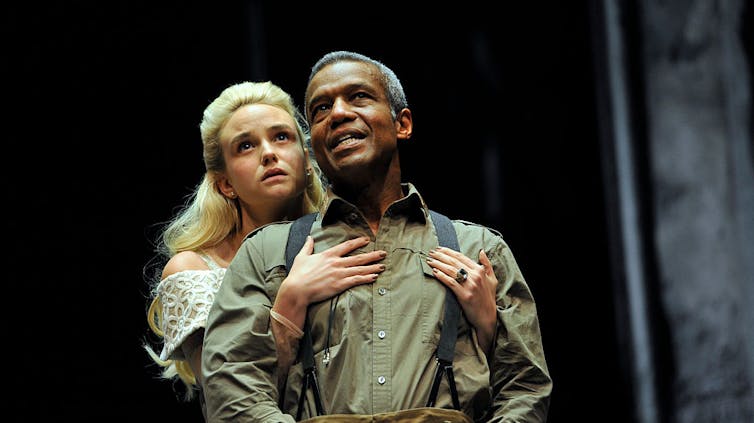
Joanna Vanderham as Desdemona and Hugh Quarshie as the title character in a Royal Shakespeare Company production of ‘Othello.’
Robbie Jack/Corbis via Getty Images

Cora Fox, Arizona State University

What is “happiness” – and who gets to be happy?

Since 2012, the World Happiness Report has measured and compared data from 167 countries. The United States currently ranks 24th, between the U.K. and Belize – its lowest position since the report was first issued. But the 2025 edition – released on March 20, the United Nations’ annual “International Day of Happiness” – starts off not with numbers, but with Shakespeare.

“In this year’s issue, we focus on the impact of caring and sharing on people’s happiness,” the authors explain. “Like ‘mercy’ in Shakespeare’s ‘Merchant of Venice,’ caring is ‘twice-blessed’ – it blesses those who give and those who receive.”

Shakespeare’s plays offer many reflections on happiness itself. They are a record of how people in early modern England experienced and thought about joy and satisfaction, and they offer a complex look at just how happiness, like mercy, lives in relationships and the caring exchanges between people.

Contrary to how we might think about happiness in our everyday lives, it is more than the surge of positive feelings after a great meal, or a workout, or even a great date. The experience of emotions is grounded in both the body and the mind, influenced by human physiology and culture in ways that change depending on time and place. What makes a person happy, therefore, depends on who that person is, as well as where and when they belong – or don’t belong.

Happiness has a history. I study emotions and early modern literature, so I spend a lot of my time thinking about what Shakespeare has to say about what makes people happy, in his own time and in our own. And also, of course, what makes people unhappy.

From fortune to joy

A timber home with lush gardens.
Shakespeare’s birthplace in Stratford-upon-Avon, England.
Tony Hisgett/Flickr via Wikimedia Commons, CC BY-SA

“Happiness” derives from the Old Norse word “hap,” which meant “fortune” or “luck,” as historians Phil Withington and Darrin McMahon explain. This earlier sense is found throughout Shakespeare’s works. Today, it survives in the modern word “happenstance” and the expression that something is a “happy accident.”

But in modern English usage, “happy” as “fortunate” has been almost entirely replaced by a notion of happiness as “joy,” or the more long-term sense of life satisfaction called “well-being.” The term “well-being,” in fact, was introduced into English from the Italian “benessere” around the time of Shakespeare’s birth.

The word and the concept of happiness were transforming during Shakespeare’s lifetime, and his use of the word in his plays mingles both senses: “fortunate” and “joyful.” That transitional ambiguity emphasizes happiness’ origins in ideas about luck and fate, and it reminds readers and playgoers that happiness is a contingent, fragile thing – something not just individuals, but societies need to carefully cultivate and support.

For instance, early in “Othello,” the Venetian senator Brabantio describes his daughter Desdemona as “tender, fair, and happy / So opposite to marriage that she shunned / The wealthy, curled darlings of our nation.” Before she elopes with Othello she is “happy” in the sense of “fortunate,” due to her privileged position on the marriage market.

Advertisement
Reveal Your Skin's Youthful Radiance with FOREO's LUNA 2 Facial Massager. Shop Now For $199

Later in the same play, though, Othello reunites with his new wife in Cyprus and describes his feelings of joy using this same term:

…If it were now to die,
‘Twere now to be most happy, for I fear
My soul hath her content so absolute
That not another comfort like to this
Succeeds in unknown fate.

Desdemona responds,

The heavens forbid
But that our loves and comforts should increase
Even as our days do grow!

They both understand “happy” to mean not just lucky, but “content” and “comfortable,” a more modern understanding. But they also recognize that their comforts depend on “the heavens,” and that happiness is enabled by being fortunate.

“Othello” is a tragedy, so in the end, the couple will not prove “happy” in either sense. The foreign general is tricked into believing his young wife has been unfaithful. He murders her, then takes his own life.

The seeds of jealousy are planted and expertly exploited by Othello’s subordinate, Iago, who catalyzes the racial prejudice and misogyny underlying Venetian values to enact his sinister and cruel revenge.

A man and woman hold hands, looking upset, as they sit on a cushion on stage.
James Earl Jones playing the title role and Jill Clayburgh as Desdemona in a 1971 production of ‘Othello.’
Kathleen Ballard/Los Angeles Times/UCLA Library via Wikimedia Commons, CC BY-SA

Happy insiders and outsiders

“Othello” sheds light on happiness’s history – but also on its politics.

While happiness is often upheld as a common good, it is also dependent on cultural forces that make it harder for some individuals to experience. Shared cultural fantasies about happiness tend to create what theorist Sara Ahmed calls “affect aliens”: individuals who, by nature of who they are and how they are treated, experience a disconnect between what their culture conditions them to think should make them happy and their disappointment or exclusion from those positive feelings. Othello, for example, rightly worries that he is somehow foreign to the domestic happiness Desdemona describes, excluded from the joy of Venetian marriage. It turns out he is right.

Because Othello is foreign and Black and Desdemona is Venetian and white, their marriage does not conform to their society’s expectations for happiness, and that makes them vulnerable to Iago’s deceit.

Similarly, “The Merchant of Venice” examines the potential for happiness to include or exclude, to build or break communities. Take the quote about mercy that opens the World Happiness Report.

The phrase appears in a famous courtroom scene, as Portia attempts to persuade a Jewish lender, Shylock, to take pity on Antonio, a Christian man who cannot pay his debts. In their contract, Shylock has stipulated that if Antonio defaults on the loan, the fee will be a “pound of flesh.”

“The quality of mercy is not strained,” Portia lectures him; it is “twice-blessed,” benefiting both giver and receiver.

Advertisement
Reveal Your Skin's Youthful Radiance with FOREO's LUNA 2 Facial Massager. Shop Now For $199

It’s a powerful attempt to save Antonio’s life. But it is also hypocritical: Those cultural norms of caring and mercy seem to apply only to other Christians in the play, and not the Jewish people living alongside them in Venice. In that same scene, Shylock reminds his audience that Antonio and the other Venetians in the room have spit on him and called him a dog. He famously asks why Jewish Venetians are not treated as equal human beings: “If you prick us, do we not bleed?”

A sepia-toned photograph of a man with a beard, curly hair and cap staring intently at the camera.
Actor Henry Irving as Shylock in a late 19th-century performance of ‘The Merchant of Venice.’
Lock & Whitfield/Folger Shakespeare Library via Wikimedia Commons, CC BY-SA

Shakespeare’s plays repeatedly make the point that the unjust distribution of rights and care among various social groups – Christians and Jews, men and women, citizens and foreigners – challenges the happy effects of benevolence.

Those social factors are sometimes overlooked in cultures like the U.S., where contemporary notions of happiness are marketed by wellness gurus, influencers and cosmetic companies. Shakespeare’s plays reveal both how happiness is built through communities of care and how it can be weaponized to destroy individuals and the fabric of the community.

There are obvious victims of prejudice and abuse in Shakespeare’s plays, but he does not just emphasize their individual tragedies. Instead, the plays record how certain values that promote inequality poison relationships that could otherwise support happy networks of family and friends.

Systems of support

Pretty much all objective research points to the fact that long-term happiness depends on community, connections and social support: having systems in place to weather what life throws at us.

And according to both the World Happiness Report and Shakespeare, contentment isn’t just about the actual support you receive but your expectations about people’s willingness to help you. Societies with high levels of trust, like Finland and the Netherlands, tend to be happier – and to have more evenly distributed levels of happiness in their populations.

Shakespeare’s plays offer blueprints for trust in happy communities. They also offer warnings about the costs of cultural fantasies about happiness that make it more possible for some, but not for all.The Conversation

Cora Fox, Associate Professor of English and Health Humanities, Arizona State University

This article is republished from The Conversation under a Creative Commons license. Read the original article.

The Bridge is a section of the STM Daily News Blog meant for diversity, offering real news stories about bona fide community efforts to perpetuate a greater good. The purpose of The Bridge is to connect the divides that separate us, fostering understanding and empathy among different groups. By highlighting positive initiatives and inspirational actions, The Bridge aims to create a sense of unity and shared purpose. This section brings to light stories of individuals and organizations working tirelessly to promote inclusivity, equality, and mutual respect. Through these narratives, readers are encouraged to appreciate the richness of diverse perspectives and to participate actively in building stronger, more cohesive communities.

https://stmdailynews.com/the-bridge

Advertisement
Reveal Your Skin's Youthful Radiance with FOREO's LUNA 2 Facial Massager. Shop Now For $199

Author

Continue Reading

Trending

