
Connect with us

News

How do children learn to read? This literacy expert says ‘there are as many ways as there are students’

Published

on

children
Not all children learn to read in the same way, but schools tend to adopt a single approach to literacy. luckyvector/iStock via Getty Images Plus
K. Dara Hill, University of Michigan-Dearborn Five years after the pandemic forced children into remote instruction, two-thirds of U.S. fourth graders still cannot read at grade level. Reading scores lag 2 percentage points below 2022 levels and 4 percentage points below 2019 levels. This data from the 2024 report of National Assessment of Educational Progress, a state-based ranking sometimes called “America’s report card,” has concerned educators scrambling to boost reading skills. Many school districts have adopted an evidence-based literacy curriculum called the “science of reading” that features phonics as a critical component. Phonics strategies begin by teaching children to recognize letters and make their corresponding sounds. Then they advance to manipulating and blending first-letter sounds to read and write simple, consonant-vowel-consonant words – such as combining “b” or “c” with “-at” to make “bat” and “cat.” Eventually, students learn to merge more complex word families and to read them in short stories to improve fluency and comprehension. Proponents of the curriculum celebrate its grounding in brain science, and the science of reading has been credited with helping Louisiana students outperform their pre-pandemic reading scores last year. In practice, Louisiana used a variety of science of reading approaches beyond phonics. That’s because different students have different learning needs, for a variety of reasons. Yet as a scholar of reading and language who has studied literacy in diverse student populations, I see many schools across the U.S. placing a heavy emphasis on the phonics components of the science of reading. If schools want across-the-board gains in reading achievement, using one reading curriculum to teach every child isn’t the best way. Teachers need the flexibility and autonomy to use various, developmentally appropriate literacy strategies as needed.

Phonics fails some students

Phonics programs often require memorizing word families in word lists. This works well for some children: Research shows that “decoding” strategies such as phonics can support low-achieving readers and learners with dyslexia. However, some students may struggle with explicit phonics instruction, particularly the growing population of neurodivergent learners with autism spectrum disorder or attention deficit hyperactivity disorder. These students learn and interact differently than their mainstream peers in school and in society. And they tend to have different strengths and challenges when it comes to word recognition, reading fluency and comprehension. This was the case with my own child. He had been a proficient reader from an early age, but struggles emerged when his school adopted a phonics program to balance out its regular curriculum, a flexible literature-based curriculum called Daily 5 that prioritizes reading fluency and comprehension. I worked with his first grade teacher to mitigate these challenges. But I realized that his real reading proficiency would likely not have been detected if the school had taught almost exclusively phonics-based reading lessons. Another weakness of phonics, in my experience, is that it teaches reading in a way that is disconnected from authentic reading experiences. Phonics often directs children to identify short vowel sounds in word lists, rather than encounter them in colorful stories. Evidence shows that exposing children to fun, interesting literature promotes deep comprehension.

Balanced literacy

To support different learning styles, educators can teach reading in multiple ways. This is called balanced literacy, and for decades it was a mainstay in teacher preparation and in classrooms. Balanced literacy prompts children to learn words encountered in authentic literature during guided, teacher-led read-alouds – versus learning how to decode words in word lists. Teachers use multiple strategies to promote reading acquisition, such as blending the letter sounds in words to support “decoding” while reading. Another balanced literacy strategy that teachers can apply in phonics-based strategies while reading aloud is called “rhyming word recognition.” The rhyming word strategy is especially effective with stories whose rhymes contribute to the deeper meaning of the story, such as Marc Brown’s “Arthur in a Pickle.”
The rhyming structure of ‘Arthur in a Pickle’ helps children learn to read entire words, versus word parts.
After reading, teachers may have learners arrange letter cards to form words, then tap the letter cards while saying and blending each sound to form the word. Similar phonics strategies include tracing and writing letters to form words that were encountered during reading. There is no one right way to teach literacy in a developmentally appropriate, balanced literacy framework. There are as many ways as there are students.

What a truly balanced curriculum looks like

The push for the phonics-based component of the science of reading is a response to the discrediting of the Lucy Calkins Reading Project, a balanced literacy approach that uses what’s called “cueing” to teach young readers. Teachers “cue” students to recognize words with corresponding pictures and promote guessing unfamiliar words while reading based on context clues. A 2024 class action lawsuit filed by Massachusetts families claimed that this faulty curriculum and another cueing-based approach called Fountas & Pinnell had failed readers for four decades, in part because they neglect scientifically backed phonics instruction. But this allegation overlooks evidence that the Calkins curriculum worked for children who were taught basic reading skills at home. And a 2021 study in Georgia found modest student achievement gains of 2% in English Language Arts test scores among fourth graders taught with the Lucy Calkins method. Nor is the method unscientific. Using picture cues with corresponding words is supported by the predictable language theory of literacy. This approach is evident in Eric Carle’s popular children’s books. Stories such as the “Very Hungry Caterpillar” and “Brown Bear, Brown Bear What do you See?” have vibrant illustrations of animals and colors that correspond with the text. The pictures support children in learning whole words and repetitive phrases, suchg as, “But he was still hungry.”
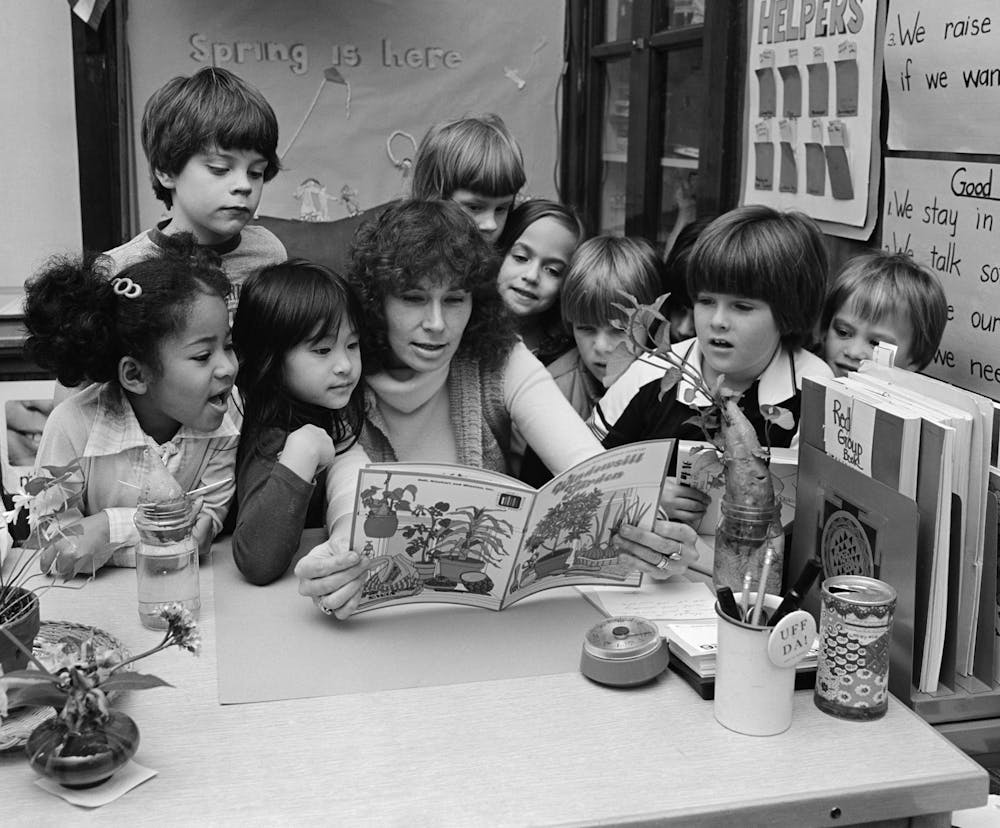
Students gather around a teacher who reads a picture book.
Teacher-led read-alouds have been a mainstay learn-to-read activity in U.S. classrooms for decades. H. Armstrong Roberts/ClassicStock/Getty Images
The intention here is for learners to acquire words in the context of engaging literature. But critics of Calkins contend that “cueing” during reading is a guessing game. They say readers are not learning the fundamentals necessary to identify sounds and word families on their way to decoding entire words and sentences. As a result, schools across the country are replacing traditional learn-to-read activities tied to balanced literacy approaches with the science of reading. Since its inception in 2013, the phonics-based curriculum has been adopted by 40 states and the Disctrict of Columbia.

Recommendations for parents, educators and policymakers

The most scientific way to teach reading, in my opinion, is by not applying the same rigid rules to every child. The best instruction meets students where they are, not where they should be. Here are five evidence-based tips to promote reading for all readers that combine phonics, balanced literacy and other methods. 1. Maintain the home-school connection. When schools send kids home with developmentally appropriate books and strategies, it encourages parents to practice reading at home with their kids and develop their oral reading fluency. Ideally, reading materials include features that support a diversity of learning strategies, including text, pictures with corresponding words and predictable language. 2. Embrace all reading. Academic texts aren’t the only kind of reading parents and teachers should encourage. Children who see menus, magazines and other print materials at home also acquire new literacy skills. 3. Make phonics fun. Phonics instruction can teach kids to decode words, but the content is not particularly memorable. I encourage teachers to teach phonics on words that are embedded in stories and texts that children absolutely love. 4. Pick a series. High-quality children’s literature promotes early literacy achievement. Texts that become increasingly more complex as readers advance, such as the “Arthur” step-into-reading series, are especially helpful in developing reading comprehension. As readers progress through more complex picture books, caregivers and teachers should read aloud the “Arthur” novels until children can read them independently. Additional popular series that grow with readers include “Otis,” “Olivia,” “Fancy Nancy” and “Berenstain Bears.” 5. Tutoring works. Some readers will struggle despite teachers’ and parents’ best efforts. In these cases, intensive, high-impact tutoring can help. Sending students to one session a week of at least 30 minutes is well documented to help readers who’ve fallen behind catch up to their peers. Many nonprofit organizations, community centers and colleges offer high-impact tutoring.The Conversation K. Dara Hill, Professor of Reading and Language Arts, University of Michigan-Dearborn This article is republished from The Conversation under a Creative Commons license. Read the original article.
STM Daily News is a vibrant news blog dedicated to sharing the brighter side of human experiences. Emphasizing positive, uplifting stories, the site focuses on delivering inspiring, informative, and well-researched content. With a commitment to accurate, fair, and responsible journalism, STM Daily News aims to foster a community of readers passionate about positive change and engaged in meaningful conversations. Join the movement and explore stories that celebrate the positive impacts shaping our world. https://stmdailynews.com/  

Discover more from Daily News

Subscribe to get the latest posts sent to your email.

Entertainment

Funny, Tender, Goofy: Why Catherine O’Hara Stole Every Scene From SCTV to Schitt’s Creek

Catherine O’Hara, a beloved actor and comedian, passed away at 71. Her career spanned over 50 years, showcasing her unique comedic timing in various roles, including Delia Deetz in Beetlejuice and Moira Rose in Schitt’s Creek. O’Hara’s influence and creativity left a lasting legacy in comedy, inspiring many.

Published

on

Ben McCann, Adelaide University

Funny, tender, goofy – Catherine O’Hara lit up the screen every time she showed up

Catherine O’Hara, the beloved actor and comedian who has died aged 71, occupied that rare position in contemporary screen culture: a comic actor, a cult figure and a mainstream star.

Her work spanned more than 50 years, from improv sketch comedy to Hollywood features and off-beat TV classics.

She was celebrated for her unmatched comic timing and chameleon-like character work. Her roles were often absurdist and quirky, but they hid a razor-sharp humour.

Born and raised in Toronto in a close-knit Irish Catholic family, O’Hara was one of seven siblings. She once remarked humour was part of her everyday life; storytelling, impressions and lively conversation helped hone her comedic instincts.

After high school, she worked at Toronto’s Second City Theatre, a famed breeding ground for comedy talent, and sharpened her deadpan improvisational skills.

Big break

O’Hara’s break came with Second City Television (SCTV), a sketch comedy series that rivalled Saturday Night Live in creativity and influence. Alongside contemporaries Eugene Levy, John Candy, Rick Moranis and Martin Short, she defined her distinctly smart, absurdist comedic voice.

O’Hara was not merely a performer on SCTV; she was also a writer, winning an Emmy Award for her contributions. This dual role shaped her career-long sensitivity to rhythm, language and character construction.


Unlike sketch performers who rely on repetition or catchphrases, O’Hara’s humour emerged with a different comedic logic. Audiences laughed not because the character was “funny”, but because the character took herself so seriously.

Advertisement
Get More From A Face Cleanser And Spa-like Massage

Though briefly cast on Saturday Night Live in the early 1980s, O’Hara chose to stay with SCTV when it was renewed, a decision she later described as key in letting her creative career flourish where it belonged.

The transition to film

By the mid-1980s, O’Hara was establishing herself as a screen presence. She appeared in Martin Scorsese’s offbeat black comedy After Hours (1985), and showcased her comic range in Heartburn (1986).

In 1988, she landed what would become one of her most beloved film roles: Delia Deetz in Tim Burton’s left-field Beetlejuice (1988).

Delia – a pretentious, New York art-scene social climber – allowed O’Hara to combine physical comedy and imbecilic dialogue (“A little gasoline … blowtorch … no problem”).

Burton once noted

Catherine’s so good, maybe too good. She works on levels that people don’t even know. I think she scares people because she operates at such high levels.

She went on to play Kate McCallister, the beleaguered mother in the holiday blockbusters Home Alone (1990) and Home Alone 2: Lost in New York (1992). Audiences loved the fact that this rather thinly written role became the films’ beating heart.

Working with Christopher Guest

Another distinctive phase of O’Hara’s career was her work with writer-director Christopher Guest on a series of largely improvised mockumentaries that have become cult classics.

Three standouts were Waiting for Guffman (1996), where she plays a desperate local performer in a small-town theatre troupe, and A Mighty Wind (2003), where she teamed up with old pal Levy as an ageing folk duo.

Her best turn came in Best in Show (2000), in which she and Levy played a couple competing in a national dog show. Her character Cookie Fleck remains one of the finest examples of improvised comedy on film. https://www.youtube.com/embed/Ay1cJ1QMOms?wmode=transparent&start=0

Her relentless monologues about former lovers are objectively inappropriate, yet O’Hara delivers them with such earnest enthusiasm that they become strangely compelling.

Advertisement
Get More From A Face Cleanser And Spa-like Massage

Her gift for improvisation glittered in these films: these eccentric characters were often laugh-out-loud funny – but O’Hara never mocked them.

Late success

She returned to TV in Six Feet Under (2001–05) and guest appearances on The Larry Sanders Show (1992–98) and Curb Your Enthusiasm (1999–2024). More recently, she appeared in prestige shows such as The Last of Us (2023–) and The Studio (2025–).

But it was the role of Moira Rose, the eccentric, ex-soap opera star in the Canadian sitcom Schitt’s Creek (2015–20), created by Eugene Levy and his son Dan, that would become O’Hara’s most significant late career move. And what a role it was!

Written for O’Hara’s unique talents, Moira was a larger-than-life character with a bizarre, unforgettable vocabulary, dramatic mood swings and a wardrobe that became nearly as famous as the character herself.

Feminist media scholars have noted the rarity of such complex roles for older women, particularly in comedy, making O’Hara’s performance culturally significant.

The show became a global streaming blockbuster during COVID lockdowns and O’Hara’s multi-award-winning performance became a social media phenomenon, spawning memes and viral clips.

There are so many standout moments – her drunken meltdown after losing her wigs, her audition for The Crows Have Eyes 3 and the show’s moving finale where she performs Danny Boy at Alexis’s graduation.

An enduring legacy

O’Hara had a remarkable ability to play flamboyant, self-absorbed characters who were often uproariously funny.

Many comedians and actors have cited O’Hara as an influence for her fearlessness, her ability to blend absurdity with emotional truth, and her steadfast commitment to character integrity. She influenced performers like Tina Fey, Maya Rudolph, Kate McKinnon and Phoebe Waller-Bridge.

O’Hara also refused to chase conventional stardom. Rather than choosing projects designed to flatten her eccentricities, O’Hara favoured collaborative environments that valued creativity over control.

Advertisement
Get More From A Face Cleanser And Spa-like Massage

For her, comedy was always an art of intelligence, empathy and generosity.

Ben McCann, Associate Professor of French Studies, Adelaide University

This article is republished from The Conversation under a Creative Commons license. Read the original article.

Looking for an entertainment experience that transcends the ordinary? Look no further than STM Daily News Blog’s vibrant Entertainment section. Immerse yourself in the captivating world of indie films, streaming and podcasts, movie reviews, music, expos, venues, and theme and amusement parks. Discover hidden cinematic gems, binge-worthy series and addictive podcasts, gain insights into the latest releases with our movie reviews, explore the latest trends in music, dive into the vibrant atmosphere of expos, and embark on thrilling adventures in breathtaking venues and theme parks. Join us at STM Entertainment and let your entertainment journey begin! https://stmdailynews.com/category/entertainment/

and let your entertainment journey begin!


Discover more from Daily News

Subscribe to get the latest posts sent to your email.

Continue Reading

Local Business

Original Tommy’s: How a Chili Burger Became a Southern California Icon

Original Tommy’s, established in 1946 in Los Angeles, is famous for its thick chili burgers and late-night appeal. It remains family-owned, embodying authentic Los Angeles culture and serving as a cultural landmark despite the fast-food industry’s evolution.

Published

on

In a city famous for reinvention, reinvention was never the point at Original Tommy’s. Since 1946, the no-frills hamburger stand at Beverly and Rampart has served generations of Angelenos the same way: chili dripping, paper wrapped, eaten standing up, usually late at night. Original Tommy’s isn’t just a restaurant — it’s a piece of Los Angeles history.

Fast food restaurant with palm trees. Original Tommy's!
Location of the first restaurant at the intersection of Beverly Blvd & Rampart Blvd in Los Angeles. The restaurant comprises both the shack in the foreground as well as the building that surrounds it. Patrons can eat at their cars or standing at the counter along the back walls. Image Credit: Bobak Ha’Eri 

From a Small Stand to a City Landmark

Original Tommy’s was founded on May 15, 1946, by Thomas James “Tommy” Koulax, the son of Greek immigrants. What began as a modest walk-up stand selling hamburgers and hot dogs quickly gained attention for one reason: chili. Not the thin, soupy kind — but a thick, meaty chili ladled generously over burgers, fries, hot dogs, and eventually tamales.

The location mattered. Sitting just west of downtown Los Angeles, the stand became a crossroads for working-class Angelenos, night-shift workers, musicians, cops, cab drivers, and anyone else looking for something filling at all hours. Long before the phrase “LA street food” existed, Tommy’s was already living it.

The Chili Burger Becomes an LA Staple

By the 1950s and 1960s, Original Tommy’s chili burger had become legendary. The menu stayed intentionally simple: burgers, hot dogs, fries, tamales, and breakfast items — all enhanced by the same signature chili. The stand-up counters, fast service, and absence of indoor seating created a rhythm that felt uniquely Los Angeles.

This wasn’t fast food chasing national trends. It was local food defining a city.

Growth Without Franchising

Unlike many post-war burger chains, Original Tommy’s expanded cautiously. Beginning in the 1970s, additional locations opened throughout Southern California and later into Nevada. At its height, the chain operated more than 30 restaurants.

What made Tommy’s different was its refusal to franchise widely. Remaining family-owned helped preserve consistency — the chili tasted the same, the portions stayed generous, and the experience remained unmistakably “Tommy’s.”

A Cultural Shortcut for “Real Los Angeles”

Original Tommy’s became more than a place to eat — it became a visual and cultural shorthand for authenticity. Filmmakers and TV producers regularly used the location to signal a grounded, working-class Los Angeles. If a character eats at Tommy’s, you immediately know who they are.

  • Films: Heat, L.A. Confidential, They Live
  • Television: Bosch, Californication, numerous food and travel shows

Musicians, athletes, and actors have long cited Tommy’s as a post-show, post-game, or late-night ritual — a place that didn’t care who you were, only whether you were hungry.

Why Original Tommy’s Still Matters

Nearly 80 years later, Original Tommy’s endures because it never tried to be trendy. It represents a post-war immigrant success story, a city built on late nights, and a version of fast food rooted in place rather than branding.

In a region overflowing with burger options, Original Tommy’s remains singular — messy, unapologetic, and inseparable from Los Angeles itself.

Original Tommy’s: Then & Now

Original Location (1946–Present):
2575 Beverly Blvd, Los Angeles, CA — the iconic stand-up counter location that started it all.

Advertisement
Get More From A Face Cleanser And Spa-like Massage

Expansion Era:
1970s–1990s locations spread across Los Angeles County, Orange County, the Inland Empire, and Nevada.

Today:
A smaller but focused footprint, still family-owned and operated from headquarters in Monrovia, California.

Also Good to Know

At our core, we at STM Daily News, strive to keep you informed and inspired with the freshest content on all things food and beverage. From mouthwatering recipes to intriguing articles, we’re here to satisfy your appetite for culinary knowledge.

Visit our Food & Drink section to get the latest on Foodie News and recipes, offering a delightful blend of culinary inspiration and gastronomic trends to elevate your dining experience. https://stmdailynews.com/food-and-drink/


Discover more from Daily News

Subscribe to get the latest posts sent to your email.

Continue Reading

The Knowledge

How to avoid seeing disturbing video on social media and protect your peace of mind

How to avoid seeing disturbing video on social media and protect your peace of mind

Published

on

Last Updated on January 29, 2026 by Daily News Staff

How to avoid seeing disturbing video on social media and protect your peace of mind
Social media often serves up disturbing images but you can minimize your exposure. Jacob Wackerhausen/iStock via Getty Images

Annie Margaret, University of Colorado Boulder

How to avoid seeing disturbing video on social media and protect your peace of mind

When graphic videos like those of the recent shooting of a protester by federal agents in Minneapolis go viral, it can feel impossible to protect yourself from seeing things you did not consent to see. But there are steps you can take.

Social media platforms are designed to maximize engagement, not protect your peace of mind. The major platforms have also reduced their content moderation efforts over the past year or so. That means upsetting content can reach you even when you never chose to watch it.

You do not have to watch every piece of content that crosses your screen, however. Protecting your own mental state is not avoidance or denial. As a researcher who studies ways to counteract the negative effects of social media on mental health and well-being, I believe it’s a way of safeguarding the bandwidth you need to stay engaged, compassionate and effective.

Why this matters

Research shows that repeated exposure to violent or disturbing media can increase stress, heighten anxiety and contribute to feelings of helplessness. These effects are not just short-term. Over time, they erode the emotional resources you rely on to care for yourself and others.

Protecting your attention is a form of care. Liberating your attention from harmful content is not withdrawal. It is reclaiming your most powerful creative force: your consciousness.

Just as with food, not everything on the table is meant to be eaten. You wouldn’t eat something spoiled or toxic simply because it was served to you. In the same way, not every piece of media laid out in your feed deserves your attention. Choosing what to consume is a matter of health.

And while you can choose what you keep in your own kitchen cabinets, you often have less control over what shows up in your feeds. That is why it helps to take intentional steps to filter, block and set boundaries.

Practical steps you can take

Fortunately, there are straightforward ways to reduce your chances of being confronted with violent or disturbing videos. Here are four that I recommend:

Advertisement
Get More From A Face Cleanser And Spa-like Massage
  • Turn off autoplay or limit sensitive content. Note that these settings can vary depending on device, operating system and app version, and can change.

https://datawrapper.dwcdn.net/d1deR/2

  • Use keyword filters. Most platforms allow you to mute or block specific words, phrases or hashtags. This reduces the chance that graphic or violent content slips into your feed.
  • Curate your feed. Unfollow accounts that regularly share disturbing images. Follow accounts that bring you knowledge, connection or joy instead.
  • Set boundaries. Reserve phone-free time during meals or before bed. Research shows that intentional breaks reduce stress and improve well-being.
a settings screen with a red rectangle around one option
Where to turn off autoplay in your account on Facebook’s website. Screen capture by The Conversation, CC BY-ND

Reclaim your agency

Social media is not neutral. Its algorithms are engineered to hold your attention, even when that means amplifying harmful or sensational material. Watching passively only serves the interests of the social media companies. Choosing to protect your attention is a way to reclaim your agency.

The urge to follow along in real time can be strong, especially during crises. But choosing not to watch every disturbing image is not neglect; it is self-preservation. Looking away protects your ability to act with purpose. When your attention is hijacked, your energy goes into shock and outrage. When your attention is steady, you can choose where to invest it.

You are not powerless. Every boundary you set – whether it is turning off autoplay, filtering content or curating your feed – is a way of taking control over what enters your mind. These actions are the foundation for being able to connect with others, help people and work for meaningful change.

More resources

I’m the executive director of the Post-Internet Project, a nonprofit dedicated to helping people navigate the psychological and social challenges of life online. With my team, I designed the evidence-backed PRISM intervention to help people manage their social media use.

Our research-based program emphasizes agency, intention and values alignment as the keys to developing healthier patterns of media consumption. You can try the PRISM process for yourself with an online class I launched through Coursera in October 2025. You can find the course, Values Aligned Media Consumption, on Coursera. The course is aimed at anyone 18 and over, and the videos are free to watch.

This story was updated on Jan. 25, 2026 to include reference to the recent shooting in Minneapolis.

Annie Margaret, Teaching Assistant Professor of Creative Technology & Design, ATLAS Institute, University of Colorado Boulder

This article is republished from The Conversation under a Creative Commons license. Read the original article.


Discover more from Daily News

Subscribe to get the latest posts sent to your email.

Continue Reading

Trending