Connect with us

Science

Lawsuits seeking to address climate change have promise but face uncertain future

Published

on

Last Updated on May 10, 2025 by Daily News Staff

climate change
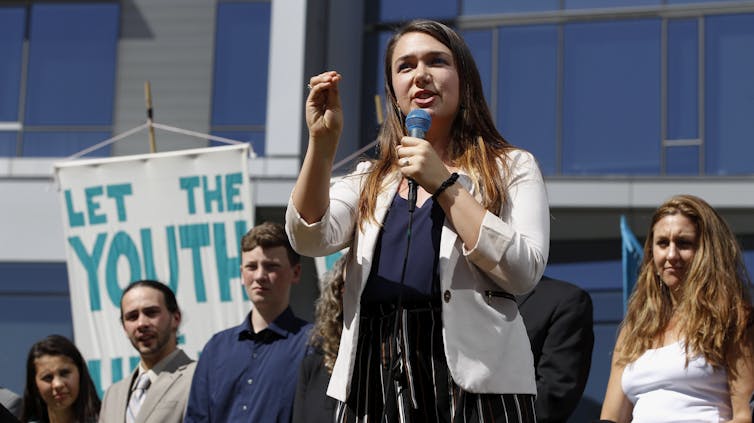
Kelsey Juliana, a lead plaintiff in a federal lawsuit over responsibility for climate change, speaks at a 2019 rally in Oregon. AP Photo/Steve Dipaola
Hannah Wiseman, Penn State The U.S. Supreme Court in March 2025 ended a decade-old lawsuit filed by a group of children who sought to hold the federal government responsible for some of the consequences of climate change. But just two months earlier, the justices allowed a similar suit from the city and county of Honolulu, Hawaii, to continue against oil and gas companies. Evidence shows that fossil fuel companies, electric utilities and the federal government have known about climate change, its dangers and its human causes for at least 50 years. But the steps taken by fossil fuel companies, utilities and governments, including the U.S. government, have not been enough to meet international climate targets. So local and state governments and citizens have asked the courts to force companies and public agencies to act. Their results have varied, with limited victories to date. But the cases keep coming.

Attacking the emissions themselves

In general, legal claims in the U.S. can be based on the U.S. and state constitutions, federal and state laws, or what is called “common law” – legal principles created by courts over time. Lawsuits have used state and federal laws to try to limit greenhouse gas pollution itself and to seek financial compensation for alleged industry cover-ups of the dangers of fossil fuels, among many other types of claims. In 2007 the U.S. Supreme Court determined that greenhouse gases such as carbon dioxide emitted from motor vehicles were a “pollutant” under the federal Clean Air Act. As a result, the court ordered the Environmental Protection Agency to either determine whether greenhouse gases from new vehicles contribute to climate change, and therefore endanger human health, or justify its refusal to study the issue. In 2009 the EPA found that carbon dioxide emissions did in fact endanger human health – a decision called the “endangerment finding.” In 2010 it imposed limits on carbon dioxide emissions from new vehicles and, later, from newly constructed power plants. But related EPA efforts to regulate emissions from older power plants – the ones that emit the most pollution – failed when challenged in court on the grounds that they went too far in limiting emissions beyond the power plants’ own properties. The Biden administration had finalized a new rule to clean up these older plants, but the Trump administration is now seeking to withdraw it. The Trump administration is also now beginning the complicated process of reviewing the 2009 endangerment finding. It could try to remove the legal basis for EPA greenhouse gas regulations.

A common-law approach

In response to this federal executive seesaw of climate action, some legal claims use a court-based, or common law, approach to address climate concerns. For instance, in Connecticut v. American Electric Power, filed in 2004, nine states asked a federal judge to order power plants to reduce their emissions. The states said those emissions contributed to global warming, which they argued met the federal common law definition of a “public nuisance.” That case ended when the U.S. Supreme Court ruled in 2011 that the existence of a statute – the federal Clean Air Actmeant common law did not apply. Other plaintiffs have tried to use the “public nuisance” claim or a related common-law claim of “trespass” to force large power plants or oil and gas producers to pay climate-related damages. But in those cases, too, courts found that the Clean Air Act overrode the common-law grounds for those claims. With those case outcomes, many plaintiffs have shifted their strategies, focusing more on state courts and seeking to hold the fossil fuel industry responsible for allegedly deceiving the public about the causes and effects of climate change.
file 20250414 56 7ic0s.png?ixlib=rb 4.1
Three examples of petroleum industry advertisements a lawsuit alleges are misleading about the causes of climate change. State of Maine v. BP, Chevron, ExxonMobil, Shell, Sunoco and American Petroleum Insititute

Examining deception

In many cases, state and local governments are arguing that the fossil fuel industry knew about the dangers of climate change and deceived the public about them, and that the industry exaggerated the extent of its investments in energy that doesn’t emit carbon. Rather than directly asking courts to order reduced carbon emissions, these cases tend to seek damages that will help governments cover the costs associated with climate change, such as construction of cooling centers and repair of roads damaged by increased precipitation. In legal terms, the lawsuits are saying oil and gas companies violated consumer-protection laws and committed common-law civil violations such as negligence. For instance, the city of Chicago alleges that major petroleum giants – along with the industry trade association the American Petroleum Institute – had “abundant knowledge” of the public harms of fossil fuels yet “actively campaigned” to hide that information and deceive consumers. Many other complaints by states and local governments make similar allegations. Another lawsuit, from the state of Maine, lists and provides photographs of a litany of internal industry documents showing industry knowledge of the threat of climate change. That lawsuit also cites a 1977 memo from an Exxon employee to Exxon executives, which stated that “current scientific opinion overwhelmingly favors attributing atmospheric carbon dioxide increase to fossil fuel consumption,” and a 1979 internal Exxon memo about the buildup of carbon dioxide emissions, which warned that “(t)he potential problem is great and urgent.” These complaints also show organizations supported by fossil fuel companies published ads as far back as the 1990s, with titles such as “Apocalypse No” and “Who told you the earth was warming … Chicken Little?” Some of these ads – part of a broader campaign – were funded by a group called the Information Council for the Environment, supported by coal producers and electric utilities. Courts have dismissed some of these complaints, finding that federal laws overrule the principles those suits are based on. But many are still winding their way through the courts. In 2023 the Supreme Court of Hawaii found that federal laws do not prevent climate claims based on state common law. In January 2025 the U.S. Supreme Court allowed the case to continue.
Several people sit in a group in a formal setting and speak to each other.
Lead claimant Rikki Held, then 22, confers with lawyers before the beginning of a 2023 Montana trial about young people’s rights in a time of climate change. William Campbell/Getty Images

Other approaches

Still other litigation approaches argue that governments inadequately reviewed the effects of greenhouse gas emissions, or even supported or subsidized those emissions caused by private industry. Those lawsuits – some of which were filed by children, with help from their parents or legal guardians – claim the governments’ actions violated people’s constitutional rights. For instance, children in the Juliana v. United States case, first filed in 2015, said 50 years of petroleum-supporting actions by presidents and various federal agencies had violated their fundamental “right to a climate system capable of sustaining human life.” The 9th U.S. Circuit Court of Appeals ruled that their claim was a “political question” – meant for Congress, not the courts. The U.S. Supreme Court declined to reconsider that ruling in March 2025. But children in Montana found more success. The Montana Constitution requires state officials and all residents to “maintain and improve a clean and healthful environment … for present and future generations.” In 2024 the Montana Supreme Court determined that this provision “includes a stable climate system that sustains human lives and liberties.” The Montana Supreme Court also reviewed a state law banning officials from considering greenhouse gas emissions of projects approved by the state. The court found that the ban violated the state constitution, too. Since then, the Montana Supreme Court has specifically required state officials to review the climate effects of a project for which permits were challenged. Concerned people and groups continue to file climate-related lawsuits across the country and around the world. They are seeing mixed results, but as the cases continue and more are filed, they are drawing attention to potential corporate and government wrongdoing, as well as the human costs of climate change. And they are inspiring shareholders and citizens to demand more accurate information and action from fossil fuel companies and electric utilities.The Conversation Hannah Wiseman, Professor of Law, Penn State This article is republished from The Conversation under a Creative Commons license. Read the original article.

Discover more from Daily News

Subscribe to get the latest posts sent to your email.

astronomy

Habitable Zone Planets: How Scientists Search for Liquid Water Beyond Earth

Habitable zone planets: Scientists use the habitable zone to find planets that could host liquid water and life. Learn how planetary atmospheres and geology determine true habitability beyond Earth.

Published

on

 Habitable Zone Planets: How Scientists Search for Liquid Water Beyond Earth
Some exoplanets, like the one shown in this illustration, may have atmospheres that could make them potentially suitable for life. NASA/JPL-Caltech via AP

Habitable Zone Planets: How Scientists Search for Liquid Water Beyond Earth

Morgan Underwood, Rice University When astronomers search for planets that could host liquid water on their surface, they start by looking at a star’s habitable zone. Water is a key ingredient for life, and on a planet too close to its star, water on its surface may “boil”; too far, and it could freeze. This zone marks the region in between. But being in this sweet spot doesn’t automatically mean a planet is hospitable to life. Other factors, like whether a planet is geologically active or has processes that regulate gases in its atmosphere, play a role. The habitable zone provides a useful guide to search for signs of life on exoplanets – planets outside our solar system orbiting other stars. But what’s in these planets’ atmospheres holds the next clue about whether liquid water — and possibly life — exists beyond Earth. On Earth, the greenhouse effect, caused by gases like carbon dioxide and water vapor, keeps the planet warm enough for liquid water and life as we know it. Without an atmosphere, Earth’s surface temperature would average around zero degrees Fahrenheit (minus 18 degrees Celsius), far below the freezing point of water. The boundaries of the habitable zone are defined by how much of a “greenhouse effect” is necessary to maintain the surface temperatures that allow for liquid water to persist. It’s a balance between sunlight and atmospheric warming. Many planetary scientists, including me, are seeking to understand if the processes responsible for regulating Earth’s climate are operating on other habitable zone worlds. We use what we know about Earth’s geology and climate to predict how these processes might appear elsewhere, which is where my geoscience expertise comes in.
A diagram showing three planets orbiting a star: The one closes to the star is labeled 'too hot,' the next is labeled 'just right,' and the farthest is labeled 'too cold.'
Picturing the habitable zone of a solar system analog, with Venus- and Mars-like planets outside of the ‘just right’ temperature zone. NASA

Why the habitable zone?

The habitable zone is a simple and powerful idea, and for good reason. It provides a starting point, directing astronomers to where they might expect to find planets with liquid water, without needing to know every detail about the planet’s atmosphere or history. Its definition is partially informed by what scientists know about Earth’s rocky neighbors. Mars, which lies just outside the outer edge of the habitable zone, shows clear evidence of ancient rivers and lakes where liquid water once flowed. Similarly, Venus is currently too close to the Sun to be within the habitable zone. Yet, some geochemical evidence and modeling studies suggest Venus may have had water in its past, though how much and for how long remains uncertain. These examples show that while the habitable zone is not a perfect predictor of habitability, it provides a useful starting point.

Planetary processes can inform habitability

What the habitable zone doesn’t do is determine whether a planet can sustain habitable conditions over long periods of time. On Earth, a stable climate allowed life to emerge and persist. Liquid water could remain on the surface, giving slow chemical reactions enough time to build the molecules of life and let early ecosystems develop resilience to change, which reinforced habitability. Life emerged on Earth, but continued to reshape the environments it evolved in, making them more conducive to life. This stability likely unfolded over hundreds of millions of years, as the planet’s surface, oceans and atmosphere worked together as part of a slow but powerful system to regulate Earth’s temperature. A key part of this system is how Earth recycles inorganic carbon between the atmosphere, surface and oceans over the course of millions of years. Inorganic carbon refers to carbon bound in atmospheric gases, dissolved in seawater or locked in minerals, rather than biological material. This part of the carbon cycle acts like a natural thermostat. When volcanoes release carbon dioxide into the atmosphere, the carbon dioxide molecules trap heat and warm the planet. As temperatures rise, rain and weathering draw carbon out of the air and store it in rocks and oceans. If the planet cools, this process slows down, allowing carbon dioxide, a warming greenhouse gas, to build up in the atmosphere again. This part of the carbon cycle has helped Earth recover from past ice ages and avoid runaway warming. Even as the Sun has gradually brightened, this cycle has contributed to keeping temperatures on Earth within a range where liquid water and life can persist for long spans of time. Now, scientists are asking whether similar geological processes might operate on other planets, and if so, how they might detect them. For example, if researchers could observe enough rocky planets in their stars’ habitable zones, they could look for a pattern connecting the amount of sunlight a planet receives and how much carbon dioxide is in its atmosphere. Finding such a pattern may hint that the same kind of carbon-cycling process could be operating elsewhere. The mix of gases in a planet’s atmosphere is shaped by what’s happening on or below its surface. One study shows that measuring atmospheric carbon dioxide in a number of rocky planets could reveal whether their surfaces are broken into a number of moving plates, like Earth’s, or if their crusts are more rigid. On Earth, these shifting plates drive volcanism and rock weathering, which are key to carbon cycling.
A diagram showing a few small planets orbiting a star.
Simulation of what space telescopes, like the Habitable Worlds Observatory, will capture when looking at distant solar systems. STScI, NASA GSFC

Keeping an eye on distant atmospheres

The next step will be toward gaining a population-level perspective of planets in their stars’ habitable zones. By analyzing atmospheric data from many rocky planets, researchers can look for trends that reveal the influence of underlying planetary processes, such as the carbon cycle. Scientists could then compare these patterns with a planet’s position in the habitable zone. Doing so would allow them to test whether the zone accurately predicts where habitable conditions are possible, or whether some planets maintain conditions suitable for liquid water beyond the zone’s edges. This kind of approach is especially important given the diversity of exoplanets. Many exoplanets fall into categories that don’t exist in our solar system — such as super Earths and mini Neptunes. Others orbit stars smaller and cooler than the Sun. The datasets needed to explore and understand this diversity are just on the horizon. NASA’s upcoming Habitable Worlds Observatory will be the first space telescope designed specifically to search for signs of habitability and life on planets orbiting other stars. It will directly image Earth-sized planets around Sun-like stars to study their atmospheres in detail.
NASA’s planned Habitable Worlds Observatory will look for exoplanets that could potentially host life.
Instruments on the observatory will analyze starlight passing through these atmospheres to detect gases like carbon dioxide, methane, water vapor and oxygen. As starlight filters through a planet’s atmosphere, different molecules absorb specific wavelengths of light, leaving behind a chemical fingerprint that reveals which gases are present. These compounds offer insight into the processes shaping these worlds. The Habitable Worlds Observatory is under active scientific and engineering development, with a potential launch targeted for the 2040s. Combined with today’s telescopes, which are increasingly capable of observing atmospheres of Earth-sized worlds, scientists may soon be able to determine whether the same planetary processes that regulate Earth’s climate are common throughout the galaxy, or uniquely our own. Morgan Underwood, Ph.D. Candidate in Earth, Environmental and Planetary Sciences, Rice University This article is republished from The Conversation under a Creative Commons license. Read the original article.

Dive into “The Knowledge,” where curiosity meets clarity. This playlist, in collaboration with STMDailyNews.com, is designed for viewers who value historical accuracy and insightful learning. Our short videos, ranging from 30 seconds to a minute and a half, make complex subjects easy to grasp in no time. Covering everything from historical events to contemporary processes and entertainment, “The Knowledge” bridges the past with the present. In a world where information is abundant yet often misused, our series aims to guide you through the noise, preserving vital knowledge and truths that shape our lives today. Perfect for curious minds eager to discover the ‘why’ and ‘how’ of everything around us. Subscribe and join in as we explore the facts that matter.  https://stmdailynews.com/the-knowledge/

Author


Discover more from Daily News

Subscribe to get the latest posts sent to your email.

Continue Reading

Artificial Intelligence

Learning with AI falls short compared to old-fashioned web search

Learning with AI falls short: New research with 10,000+ participants reveals people who learn using ChatGPT develop shallower knowledge than those using Google search. Discover why AI-generated summaries reduce learning effectiveness and how to use AI tools strategically for education.

Published

on

Learning with AI falls short compared to old-fashioned web search
The work of seeking and synthesizing information can improve understanding of it compared to reading a summary. Tom Werner/DigitalVision via Getty Images

Learning with AI falls short compared to old-fashioned web search

Shiri Melumad, University of Pennsylvania Since the release of ChatGPT in late 2022, millions of people have started using large language models to access knowledge. And it’s easy to understand their appeal: Ask a question, get a polished synthesis and move on – it feels like effortless learning. However, a new paper I co-authored offers experimental evidence that this ease may come at a cost: When people rely on large language models to summarize information on a topic for them, they tend to develop shallower knowledge about it compared to learning through a standard Google search. Co-author Jin Ho Yun and I, both professors of marketing, reported this finding in a paper based on seven studies with more than 10,000 participants. Most of the studies used the same basic paradigm: Participants were asked to learn about a topic – such as how to grow a vegetable garden – and were randomly assigned to do so by using either an LLM like ChatGPT or the “old-fashioned way,” by navigating links using a standard Google search. No restrictions were put on how they used the tools; they could search on Google as long as they wanted and could continue to prompt ChatGPT if they felt they wanted more information. Once they completed their research, they were then asked to write advice to a friend on the topic based on what they learned. The data revealed a consistent pattern: People who learned about a topic through an LLM versus web search felt that they learned less, invested less effort in subsequently writing their advice, and ultimately wrote advice that was shorter, less factual and more generic. In turn, when this advice was presented to an independent sample of readers, who were unaware of which tool had been used to learn about the topic, they found the advice to be less informative, less helpful, and they were less likely to adopt it. We found these differences to be robust across a variety of contexts. For example, one possible reason LLM users wrote briefer and more generic advice is simply that the LLM results exposed users to less eclectic information than the Google results. To control for this possibility, we conducted an experiment where participants were exposed to an identical set of facts in the results of their Google and ChatGPT searches. Likewise, in another experiment we held constant the search platform – Google – and varied whether participants learned from standard Google results or Google’s AI Overview feature. The findings confirmed that, even when holding the facts and platform constant, learning from synthesized LLM responses led to shallower knowledge compared to gathering, interpreting and synthesizing information for oneself via standard web links.

Why it matters

Why did the use of LLMs appear to diminish learning? One of the most fundamental principles of skill development is that people learn best when they are actively engaged with the material they are trying to learn. When we learn about a topic through Google search, we face much more “friction”: We must navigate different web links, read informational sources, and interpret and synthesize them ourselves. While more challenging, this friction leads to the development of a deeper, more original mental representation of the topic at hand. But with LLMs, this entire process is done on the user’s behalf, transforming learning from a more active to passive process.

What’s next?

To be clear, we do not believe the solution to these issues is to avoid using LLMs, especially given the undeniable benefits they offer in many contexts. Rather, our message is that people simply need to become smarter or more strategic users of LLMs – which starts by understanding the domains wherein LLMs are beneficial versus harmful to their goals. Need a quick, factual answer to a question? Feel free to use your favorite AI co-pilot. But if your aim is to develop deep and generalizable knowledge in an area, relying on LLM syntheses alone will be less helpful. As part of my research on the psychology of new technology and new media, I am also interested in whether it’s possible to make LLM learning a more active process. In another experiment we tested this by having participants engage with a specialized GPT model that offered real-time web links alongside its synthesized responses. There, however, we found that once participants received an LLM summary, they weren’t motivated to dig deeper into the original sources. The result was that the participants still developed shallower knowledge compared to those who used standard Google. Building on this, in my future research I plan to study generative AI tools that impose healthy frictions for learning tasks – specifically, examining which types of guardrails or speed bumps most successfully motivate users to actively learn more beyond easy, synthesized answers. Such tools would seem particularly critical in secondary education, where a major challenge for educators is how best to equip students to develop foundational reading, writing and math skills while also preparing for a real world where LLMs are likely to be an integral part of their daily lives. The Research Brief is a short take on interesting academic work. Shiri Melumad, Associate Professor of Marketing, University of Pennsylvania This article is republished from The Conversation under a Creative Commons license. Read the original article.

Dive into “The Knowledge,” where curiosity meets clarity. This playlist, in collaboration with STMDailyNews.com, is designed for viewers who value historical accuracy and insightful learning. Our short videos, ranging from 30 seconds to a minute and a half, make complex subjects easy to grasp in no time. Covering everything from historical events to contemporary processes and entertainment, “The Knowledge” bridges the past with the present. In a world where information is abundant yet often misused, our series aims to guide you through the noise, preserving vital knowledge and truths that shape our lives today. Perfect for curious minds eager to discover the ‘why’ and ‘how’ of everything around us. Subscribe and join in as we explore the facts that matter.  https://stmdailynews.com/the-knowledge/

View recent photos

Unlock fun facts & lost history—get The Knowledge in your inbox!

We don’t spam! Read our privacy policy for more info.


Discover more from Daily News

Subscribe to get the latest posts sent to your email.

Continue Reading

Blog

Why the chemtrail conspiracy theory lingers and grows – and why Tucker Carlson is talking about it

The chemtrail conspiracy theory has surged despite being thoroughly debunked. Learn why people believe contrails are chemical weapons, how Tucker Carlson amplified the theory, and what psychology reveals about conspiracy thinking and our need for control.

Published

on

Why the chemtrail conspiracy theory lingers and grows – and why Tucker Carlson is talking about it
Contrails have a simple explanation, but not everyone wants to believe it. AP Photo/Carolyn Kaster

Why the chemtrail conspiracy theory lingers and grows – and why Tucker Carlson is talking about it

Calum Lister Matheson, University of Pittsburgh Everyone has looked up at the clouds and seen faces, animals, objects. Human brains are hardwired for this kind of whimsy. But some people – perhaps a surprising number – look to the sky and see government plots and wicked deeds written there. Conspiracy theorists say that contrails – long streaks of condensation left by aircraft – are actually chemtrails, clouds of chemical or biological agents dumped on the unsuspecting public for nefarious purposes. Different motives are ascribed, from weather control to mass poisoning. The chemtrails theory has circulated since 1996, when conspiracy theorists misinterpreted a U.S. Air Force research paper about weather modification, a valid topic of research. Social media and conservative news outlets have since magnified the conspiracy theory. One recent study notes that X, formerly Twitter, is a particularly active node of this “broad online community of conspiracy.” I’m a communications researcher who studies conspiracy theories. The thoroughly debunked chemtrails theory provides a textbook example of how conspiracy theories work.

Boosted into the stratosphere

Conservative pundit Tucker Carlson, whose podcast averages over a million viewers per episode, recently interviewed Dane Wigington, a longtime opponent of what he calls “geoengineering.” While the interview has been extensively discredited and mocked in other media coverage, it is only one example of the spike in chemtrail belief. Although chemtrail belief spans the political spectrum, it is particularly evident in Republican circles. U.S. Secretary of Health and Human Services Robert F. Kennedy Jr. has professed his support for the theory. U.S. Rep. Marjorie Taylor Greene of Georgia has written legislation to ban chemical weather control, and many state legislatures have done the same. Online influencers with millions of followers have promoted what was once a fringe theory to a large audience. It finds a ready audience among climate change deniers and anti-deep state agitators who fear government mind control.

Heads I win, tails you lose

Although research on weather modification is real, the overwhelming majority of qualified experts deny that the chemtrail theory has any solid basis in fact. For example, geoengineering researcher David Keith’s lab posted a blunt statement on its website. A wealth of other resources exist online, and many of their conclusions are posted at contrailscience.com. But even without a deep dive into the science, the chemtrail theory has glaring logical problems. Two of them are falsifiability and parsimony.
The philosopher Karl Popper explains that unless your conjecture can be proved false, it lies outside the realm of science.
According to psychologist Rob Brotherton, conspiracy theories have a classic “heads I win, tails you lose” structure. Conspiracy theorists say that chemtrails are part of a nefarious government plot, but its existence has been covered up by the same villains. If there was any evidence that weather modification was actually happening, that would support the theory, but any evidence denying chemtrails also supports the theory – specifically, the part that alleges a cover-up. People who subscribe to the conspiracy theory consider anyone who confirms it to be a brave whistleblower and anyone who denies it to be foolish, evil or paid off. Therefore, no amount of information could even hypothetically disprove it for true believers. This denial makes the theory nonfalsifiable, meaning it’s impossible to disprove. By contrast, good theories are not false, but they must also be constructed in such a way that if they were false, evidence could show that. Nonfalsifiable theories are inherently suspect because they exist in a closed loop of self-confirmation. In practice, theories are not usually declared “false” based on a single test but are taken more or less seriously based on the preponderance of good evidence and scientific consensus. This approach is important because conspiracy theories and disinformation often claim to falsify mainstream theories, or at least exploit a poor understanding of what certainty means in scientific methods. Like most conspiracy theories, the chemtrail story tends not to meet the criteria of parsimony, also known as Occam’s razor, which suggests that the more suppositions a theory requires to be true, the less likely it actually is. While not perfect, this concept can be an important way to think about probability when it comes to conspiracy theories. Is it more likely that the government is covering up a massive weather program, mind-control program or both that involve thousands or millions of silent, complicit agents, from the local weather reporter to the Joint Chiefs of Staff, or that we’re seeing ice crystals from plane engines? Of course, calling something a “conspiracy theory” does not automatically invalidate it. After all, real conspiracies do exist. But it’s important to remember scientist and science communicator Carl Sagan’s adage that “extraordinary claims require extraordinary evidence.” In the case of chemtrails, the evidence just isn’t there.
Scientists explain how humans are susceptible to believing conspiracy theories.

Psychology of conspiracy theory belief

If the evidence against it is so powerful and the logic is so weak, why do people believe the chemtrail conspiracy theory? As I have argued in my new book, “Post-Weird: Fragmentation, Community, and the Decline of the Mainstream,” conspiracy theorists create bonds with each other through shared practices of interpreting the world, seeing every detail and scrap of evidence as unshakable signs of a larger, hidden meaning. Uncertainty, ambiguity and chaos can be overwhelming. Conspiracy theories are symptoms, ad hoc attempts to deal with the anxiety caused by feelings of powerlessness in a chaotic and complicated world where awful things like tornadoes, hurricanes and wildfires can happen seemingly at random for reasons that even well-informed people struggle to understand. When people feel overwhelmed and helpless, they create fantasies that give an illusion of mastery and control. Although there are liberal chemtrail believers, aversion to uncertainty might explain why the theory has become so popular with Carlson’s audience: Researchers have long argued that authoritarian, right-wing beliefs have a similar underlying structure. On some level, chemtrail theorists would rather be targets of an evil conspiracy than face the limits of their knowledge and power, even though conspiracy beliefs are not completely satisfying. Sigmund Freud described a fort-da (“gone-here”) game played by his grandson where he threw away a toy and dragged it back on a string, something Freud interpreted as a simulation of control when the child had none. Conspiracy theories may serve a similar purpose, allowing their believers to feel that the world isn’t really random and that they, the ones who see through the charade, really have some control over it. The grander the conspiracy, the more brilliant and heroic the conspiracy theorists must be. Conspiracies are dramatic and exciting, with clear lines of good and evil, whereas real life is boring and sometimes scary. The chemtrail theory is ultimately prideful. It’s a way for theorists to feel powerful and smart when they face things beyond their comprehension and control. Conspiracy theories come and go, but responding to them in the long term means finding better ways to embrace uncertainty, ambiguity and our own limits alongside a new embrace of the tools we do have: logic, evidence and even humility. Calum Lister Matheson, Associate Professor of Communication, University of Pittsburgh This article is republished from The Conversation under a Creative Commons license. Read the original article.

Dive into “The Knowledge,” where curiosity meets clarity. This playlist, in collaboration with STMDailyNews.com, is designed for viewers who value historical accuracy and insightful learning. Our short videos, ranging from 30 seconds to a minute and a half, make complex subjects easy to grasp in no time. Covering everything from historical events to contemporary processes and entertainment, “The Knowledge” bridges the past with the present. In a world where information is abundant yet often misused, our series aims to guide you through the noise, preserving vital knowledge and truths that shape our lives today. Perfect for curious minds eager to discover the ‘why’ and ‘how’ of everything around us. Subscribe and join in as we explore the facts that matter.  https://stmdailynews.com/the-knowledge/


Discover more from Daily News

Subscribe to get the latest posts sent to your email.

Continue Reading

Trending