

Space and Tech
NASA’s Exciting Upcoming Spacewalks: Station Repairs and Upgrades!
Exciting news from NASA! Upcoming spacewalks for station repairs and upgrades. Get ready for an out-of-this-world experience! #NASA #Spacewalks


NASA never ceases to amaze us with its incredible accomplishments in space exploration. And this time, they’re making headlines again with a series of upcoming spacewalks aboard the International Space Station (ISS). These spacewalks, scheduled for June, aim to conduct vital repairs and upgrades to enhance the station’s performance and scientific capabilities. So, mark your calendars and get ready to witness history in the making!
Press Conference and Live Coverage:
To ensure everyone gets a front-row seat, NASA will be hosting a news conference on Tuesday, June 11, at 4 p.m. EDT, where they will discuss the exciting details of the spacewalks. You can catch the action live on NASA+, NASA Television, the NASA app, YouTube, and the agency’s official website. NASA has even made it easier to stream NASA TV through various social media platforms. So no excuses for missing out on this thrilling event!
Participants and Experts:
The news conference will feature some brilliant minds who play significant roles in organizing and guiding the spacewalks. Dina Contella, the deputy program manager of the International Space Station, will provide insights into the broader aspects of the missions. Additionally, Rebecca Wingfield and Nicole McElroy, esteemed flight directors, will shed light on the specific spacewalks, while Sandy Fletcher and Faruq Sabur, the spacewalk officers, will share their expertise and experiences.
Spacewalk 1: Repairing and Analyzing
The first spacewalk will see NASA astronauts Tracy C. Dyson and Matt Dominick exiting the Quest airlock to complete the removal of a faulty electronics box located on the starboard truss of the ISS. However, that’s not all! Dyson and Dominick will also collect samples to study the survival and reproduction abilities of microorganisms on the exterior of the space station. This exciting research will expand our knowledge of living organisms in space.
Spacewalk 2: Camera Replacement and Experiments
During the second spacewalk, astronauts will replace an external high-definition camera responsible for capturing breathtaking views of the ISS. They will also perform a cable connection fit check for the alpha magnetic spectrometer, an essential particle physics experiment on the exterior of the station. If time permits, the astronauts will carry out further experiments involving microorganism samples.
Spacewalk 3: Upgrading and Preparing for New Solar Arrays
In the third and final spacewalk, crew members will replace a rate gyro assembly, an instrument crucial for maintaining the station’s orientation. Following this, they will attach a support bracket, known as a modification kit, in preparation for the future installation of the ISS’s next Roll-Out Solar Array on the port truss. These solar arrays will enhance the station’s power supply and sustainability.
NASA’s spacewalks are moments of excitement, curiosity, and scientific marvel. Witnessing astronauts venture into the vastness of space, making essential repairs and conducting experiments, is an awe-inspiring experience. Take the time to tune in to the upcoming news conference, and enjoy the live coverage of these unforgettable spacewalks. Don’t forget to join the conversation on social media using the hashtag #AskNASA, as you might have the opportunity to submit your own questions. Stay tuned for updates on the participating crew members for U.S. spacewalks 91 and 92. Let’s celebrate the ingenuity and courage of these astronauts as they continue to push the boundaries of exploration!
Learn more about the space station, its research, and crew, at:
For more science news and stories, visit our science section for more science news and stories, visit our science section.
https://stmdailynews.com/category/science
About NASA and the ISS?
For more than 50 years, NASA has been breaking barriers to achieve the seemingly impossible.
At its 20 centers and facilities across the country – and the only National Laboratory in space – NASA studies Earth, including its climate, our Sun, and our solar system and beyond. We conduct research, testing, and development to advance aeronautics, including electric propulsion and supersonic flight. We develop and fund space technologies that will enable future exploration and benefit life on Earth.
Author


Space and Tech
Astronaut Victor Glover is the latest in a long line of Black American explorers − including York, the enslaved man who played a key role in the Lewis and Clark expedition

Craig Fehrman, Indiana University
Astronaut Victor Glover
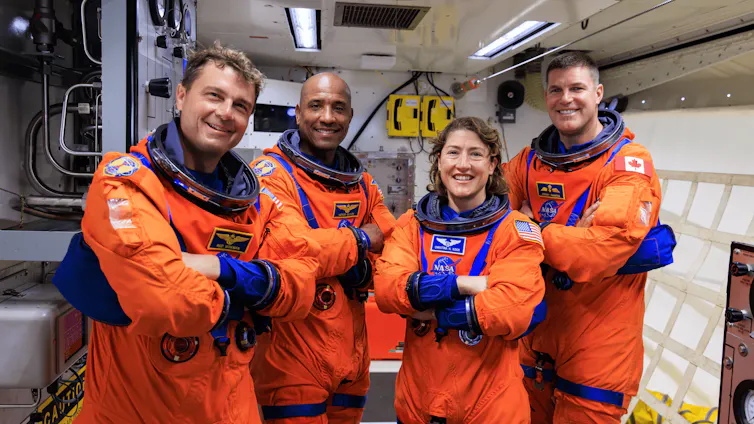
In April 2026, four astronauts are scheduled to fly around the Moon. As part of NASA’s Artemis II mission, they will become the first humans to do so in half a century. One crew member, pilot Victor Glover, will become the first Black astronaut to ever orbit the Moon.
Glover’s achievement is worth celebrating. But it’s also worth remembering that he belongs to a long and underappreciated history. America’s first Black explorer didn’t fly an Apollo rocket or sail with the U.S. Exploring Expedition. He traveled with Lewis and Clark, and he was known by a single name: York.
I’m a historian who spent five years writing a book about Lewis and Clark, and I found new documents that show York was one of the most important people on their expedition. Even in a party that could number as many as 45 men, York stood out – for his courage, his skill and his sacrifices that helped the famous captains reach the Pacific Ocean.
York’s life as a slave

York was born in Virginia around 1770. Growing up, he was a creative and sociable child, unusually tall with dark hair and a dark complexion – “black as a bear,” a contemporary noted.
He was also enslaved by the Clarks. William Clark, who was around the same age, was also unusually tall, though his hair was a rusty red, and sometimes the boys played together. But the playing stopped once York turned 9 or 10. That’s when he joined the adult slaves in working full time. That’s also when he began to note the differences between his life and William’s – differences that became only clearer once William started ordering him around.
In the 1780s, the Clark household headed to Kentucky. York met a Black woman there and married her. He also became William’s “body servant.”
A body servant was a slave who stayed close to his owner and prioritized his comfort, laying out his clothes and serving his meals. When Meriwether Lewis asked Clark to join his expedition, in 1803, Clark ordered York to accompany him.
Perhaps York was excited for this adventure. Perhaps he was not – it would be punishing, and he would be separated from his wife.
Either way, York didn’t have a choice.
The Corps of Discovery
York proved his worth from the start. Once they reached St. Louis, the soldiers, later known as the Corps of Discovery, rushed to raise winter quarters. Working in hail and snow, York and the others built log huts. They needed rough planks for their tables and bunks, but the carpenters had only a single whipsaw to make them. They chose two men to operate this crucial tool. One of them was York.
On May 14, 1804, the corps began ascending the Missouri River. York helped row and tow the party’s barge, which was the size of a semi-truck trailer. He carried a rifle and hunted – according to the expedition’s journals, he was only the fifth named member to bring down a buffalo. York cooked for the captains. He collected scientific specimens. He nursed the sick, including several soldiers and, later on, Sacagawea, a Shoshone woman who would also prove essential to the expedition’s success.

The soldiers were not always kind in return. During this period, officers rarely brought along enslaved body servants. York’s race probably made some of the men angry or uncomfortable. One day, someone threw so much sand in his face that it nearly blinded him. Clark claimed it was “in fun,” but he also wrote that York was “very near losing his eyes,” and no one else got cruelly sprayed with sand.
That fall, during councils with Native leaders, York played a surprising and vital role. The Arikara, Mandan and Hidatsa all crowded in to see him and to touch his skin. They had never met a Black person before, and York showed off his strength and played with the Native children. Later, the Arikara said York was “the most marvelous” thing about the corps.
The next year, the expedition crossed the Rockies and the Continental Divide. York’s most important – and most overlooked – contributions came soon after. On the Columbia River and its tributaries, the party had to dig out five new canoes and then paddle them through treacherous rapids.
Lewis and Clark allowed only their best rivermen on these foaming, rock-riven waters. One of them was almost certainly York. During my research, I found an unpublished letter in which Clark praised York’s ability to “manage the boats.”
Just as important, York was a strong swimmer, a rare thing in an era when many people never learned to swim.
York’s life as an explorer
On the Columbia River, the corps survived a series of terrifying choke points – soggy hazards they referred to as the “Long Narrows” and the “Great Chute.” After that came the ocean. They had traveled together for more than 4,000 miles (6,400 kilometers), and when the captains asked the men to vote on where to put their final winter quarters, they made sure to ask York, too.
It was the latest sign that his role had changed during this epic journey. But those changes began with York. In the West, he found ways to make choices and assert himself. He sent a buffalo robe to his wife in Kentucky. When Clark told him to scale back his performances for Native people, York ignored him – because he wanted to, and because he could.
York’s vote was also evidence that, like Victor Glover today, he was an official American explorer, a key member of a sprawling, federally funded mission. From 1804 to 1806, the government devoted a larger percentage of its budget to the corps than it devotes to NASA today.
Part of that money was earmarked for York. The Army gave officers who brought along their slaves a monthly ration or its cash equivalent. When the corps made it home, the government paid US$274.57 for York’s labor, a sum similar to what the privates received. But that money didn’t go to York. It went to Clark.
The hidden history of Black explorers
There have been many Black explorers in American history. Thomas Jefferson launched other expeditions besides Lewis and Clark’s, and those expeditions also included enslaved people, though their names have not survived. Isaiah Brown served on the Wheeler Survey, which mapped the West in greater detail after the Civil War. Matthew Henson accompanied Robert Peary on his Arctic expeditions, which received some federal support. More recently, NASA has depended on Black astronauts such as Guy Bluford, Mae Jemison and Jeanette Epps, among others.
York and Victor Glover are, for now, the first and most recent examples of this inspiring tradition. But their contributions go beyond that. When the captains asked York to vote on the winter quarters, they were acknowledging in some small way that he’d proven he was more than a body servant.
Of course, York had always been more than that. It just took 4,000 miles for Lewis and Clark to see it.
Craig Fehrman, Adjunct instructor at the Media School, Indiana University
This article is republished from The Conversation under a Creative Commons license. Read the original article.
🧠 Forgotten Genius Fridays
A Short-Form Series from The Knowledge by STM Daily News
Every Friday, STM Daily News shines a light on brilliant minds history overlooked.
Forgotten Genius Fridays is a weekly collection of short videos and articles dedicated to inventors, innovators, scientists, and creators whose impact changed the world—but whose names were often left out of the textbooks.
From life-saving inventions and cultural breakthroughs to game-changing ideas buried by bias, our series digs up the truth behind the minds that mattered.
Each episode of The Knowledge runs 30–90 seconds, designed for curious minds on the go—perfect for YouTube Shorts, TikTok, Reels, and quick reads.
Because remembering these stories isn’t just about the past—it’s about restoring credit where it’s long overdue.
🔔 New episodes every Friday
📺 Watch now at: stmdailynews.com/the-knowledge
🧠 Now you know.
Last Updated on April 7, 2026 by Daily News Staff
🕒 [UPDATE] Artemis II Reaches the Moon
Orion has reached lunar proximity, giving astronauts a historic view of the Moon as the spacecraft performs its flyby maneuver.

Artemis II Successfully Launches
CAPE CANAVERAL, Fla. — NASA has successfully launched its Artemis II mission, marking the first crewed journey toward the Moon in more than 50 years.
The powerful Space Launch System (SLS) rocket lifted off from Kennedy Space Center on April 1, carrying four astronauts on a 10-day mission around the Moon and back.
On board are Commander Reid Wiseman, Pilot Victor Glover, Mission Specialist Christina Koch, and Canadian astronaut Jeremy Hansen. The mission is already being hailed as a major milestone in NASA’s effort to return humans to deep space.
Shortly after liftoff, the Orion spacecraft successfully reached orbit and deployed its solar arrays, beginning its journey that will eventually send the crew on a translunar trajectory toward the Moon. 
Artemis II is a lunar flyby mission, meaning astronauts will not land but will travel farther from Earth than any human mission in decades while testing critical systems needed for future landings.
The mission also marks several historic firsts, including the first woman and the first person of color—Victor Glover—to travel into lunar space.
NASA says the mission is a key step toward future lunar landings and long-term plans to establish a human presence on the Moon later this decade.
🛰️ Artemis II Mission Timeline
The 10-day Artemis II mission follows a carefully planned trajectory from Earth to the Moon and back:
- Day 1: Launch and Earth orbit
- Day 1–2: Translunar injection burn
- Days 2–4: Deep space travel
- Days 4–5: Lunar flyby
- Days 5–8: Return to Earth
- Days 9–10: Reentry and splashdown
For official updates and in-depth mission details, visit the following trusted sources:
- NASA: Artemis II Mission Overview
- NASA Artemis Program (Return to the Moon)
- Orion Spacecraft – Mission Details
- Space Launch System (SLS) Rocket Overview
- Kennedy Space Center – Launch Operations
- Watch NASA Live Coverage and Replays
🧾 Sources
- NASA official launch coverage and mission updates
- NASA Artemis II press materials and briefings
- NASA Kennedy Space Center launch operations updates
Stay with STM Daily News for live updates on Artemis II.
Last Updated on February 10, 2026 by Daily News Staff
Valerie Thomas is a true pioneer in the world of science and technology. A NASA engineer and physicist, she is best known for inventing the illusion transmitter, a groundbreaking device that creates 3D images using concave mirrors. This invention laid the foundation for modern 3D imaging and virtual reality technologies.
Beyond her inventions, Thomas broke barriers as an African American woman in STEM, mentoring countless young scientists and advocating for diversity in science and engineering. Her work at NASA’s Goddard Space Flight Center helped advance satellite technology and data visualization, making her contributions both innovative and enduring.
In our latest short video, we highlight Valerie Thomas’ remarkable journey—from her early passion for science to her groundbreaking work at NASA. Watch and be inspired by a true STEM pioneer whose legacy continues to shape the future of space and technology.
🎥 Watch the video here: https://youtu.be/P5XTgpcAoHw
Dive into “The Knowledge,” where curiosity meets clarity. This playlist, in collaboration with STMDailyNews.com, is designed for viewers who value historical accuracy and insightful learning. Our short videos, ranging from 30 seconds to a minute and a half, make complex subjects easy to grasp in no time. Covering everything from historical events to contemporary processes and entertainment, “The Knowledge” bridges the past with the present. In a world where information is abundant yet often misused, our series aims to guide you through the noise, preserving vital knowledge and truths that shape our lives today. Perfect for curious minds eager to discover the ‘why’ and ‘how’ of everything around us. Subscribe and join in as we explore the facts that matter. https://stmdailynews.com/the-knowledge/
Forgotten Genius Fridays
https://stmdailynews.com/the-knowledge-2/forgotten-genius-fridays/
🧠 Forgotten Genius Fridays
A Short-Form Series from The Knowledge by STM Daily News
Every Friday, STM Daily News shines a light on brilliant minds history overlooked.
Forgotten Genius Fridays is a weekly collection of short videos and articles dedicated to inventors, innovators, scientists, and creators whose impact changed the world—but whose names were often left out of the textbooks.
From life-saving inventions and cultural breakthroughs to game-changing ideas buried by bias, our series digs up the truth behind the minds that mattered.
Each episode of The Knowledge runs 30–90 seconds, designed for curious minds on the go—perfect for YouTube Shorts, TikTok, Reels, and quick reads.
Because remembering these stories isn’t just about the past—it’s about restoring credit where it’s long overdue.
🔔 New episodes every Friday
📺 Watch now at: stmdailynews.com/the-knowledge
🧠 Now you know.
Author





