

STM Blog
Pharaohs in Dixieland – how 19th-century America reimagined Egypt to justify racism and slavery

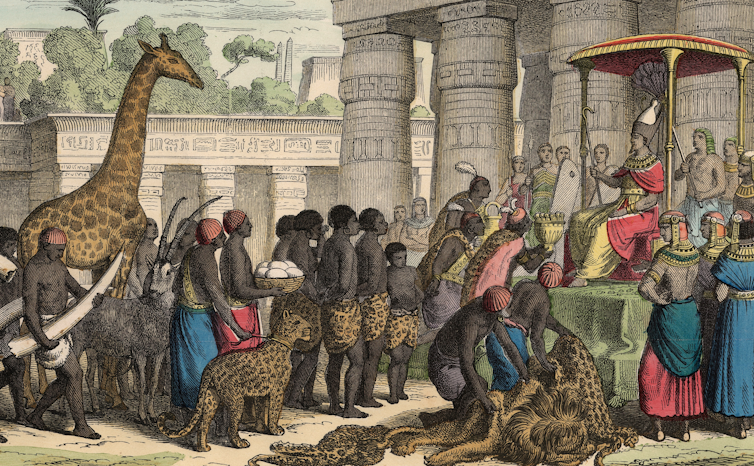
Pharaohs in Dixieland – how 19th-century America reimagined Egypt to justify racism and slavery
Charles Vanthournout, Université de Lorraine
When Napoleon embarked upon a military expedition into Egypt in 1798, he brought with him a team of scholars, scientists and artists. Together, they produced the monumental “Description de l’Égypte,” a massive, multivolume work about Egyptian geography, history and culture.
At the time, the United States was a young nation with big aspirations, and Americans often viewed their country as an heir to the great civilizations of the past. The tales of ancient Egypt that emerged from Napoleon’s travels became a source of fascination to Americans, though in different ways.
In the slaveholding South, ancient Egypt and its pharaohs became a way to justify slavery. For abolitionists and African Americans, biblical Egypt served as a symbol of bondage and liberation.
As a historian, I study how 19th-century Americans – from Southern intellectuals to Black abolitionists – used ancient Egypt to debate questions of race, civilization and national identity. My research traces how a distorted image of ancient Egypt shaped competing visions of freedom and hierarchy in a deeply divided nation.
Egypt inspires the pro-slavery South
In 1819, when lawyer John Overton, military officer James Winchester and future president Andrew Jackson founded a city in Tennessee along the Mississippi River, they christened it Memphis, after the ancient Egyptian capital.
While promoting the new city, Overton declared of the Mississippi River that ran alongside it: “This noble river may, with propriety, be denominated the American Nile.”
“Who can tell that she may not, in time, rival … her ancient namesake, of Egypt in classic elegance and art?” The Arkansas Banner excitedly reported.
In the region’s fertile soil, Chancellor William Harper, a jurist and pro-slavery theorist from South Carolina, saw the promise of an agricultural empire built on slavery, one “capable of being made a far greater Egypt.”
There was a reason pro-slavery businessmen and thinkers were energized by the prospect of an American Egypt: Many Southern planters imagined themselves as guardians of a hierarchical and aristocratic system, one grounded in landownership, tradition and honor. As Alabama newspaper editor William Falconer put it, he and his fellow white Southerners belonged to a “race that had established law, order, and government on earth.”
To them, Egypt represented the archetype of a great hierarchical civilization. Older than Athens or Rome, Egypt conferred a special legitimacy. And just like the pharaohs, the white elites of the South saw themselves as the stewards of a prosperous society sustained by enslaved labor.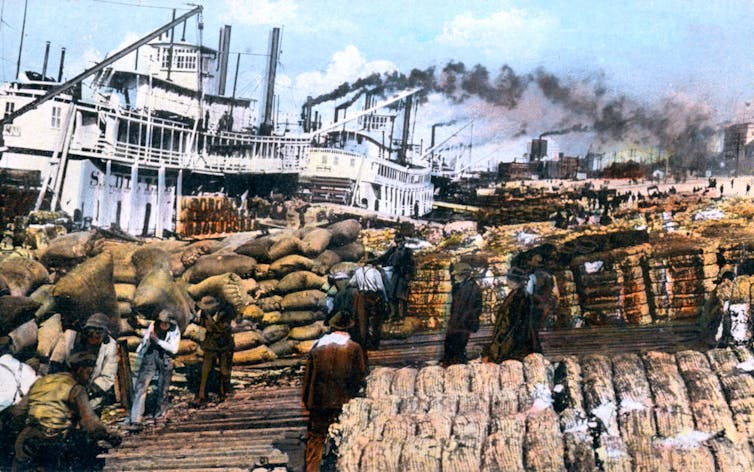
The founders of Memphis named it after the ancient Egyptian capital, and they hoped the Mississippi River that ran alongside it would become an ‘American Nile.’ The Print Collector/Getty Images
Leading pro-slavery thinkers like Virginia social theorist George Fitzhugh, South Carolina lawyer and U.S. Senator Robert Barnwell Rhett and Georgia lawyer and politician Thomas R.R. Cobb all invoked Egypt as an example to follow.
“These [Egyptian] monuments show negro slaves in Egypt at least 1,600 years before Christ,” Cobb wrote in 1858. “That they were the same happy negroes of this day is proven by their being represented in a dance 1,300 years before Christ.”
A distorted view of history
But their view of history didn’t exactly square with reality. Slavery did exist in ancient Egypt, but most slaves had been originally captured as prisoners of war.
The country never developed a system of slavery comparable to that of Greece or Rome, and servitude was neither race-based nor tied to a plantation economy. The mistaken notion that Egypt’s great monuments were built by slaves largely stems from ancient authors and the biblical account of the Hebrews. Later, popular culture – especially Hollywood epics – would continue to advance this misconception.
Nonetheless, 19th-century Southern intellectuals drew on this imagined Egypt to legitimize slavery as an ancient and divinely sanctioned institution.
Even after the Civil War, which ended in 1865, nostalgia for these myths of ancient Egypt endured. In 1877, former Confederate officer Edward Fontaine noted how “Veritable specimens of black, woolyheaded negroes are represented by the old Egyptian artists in chains, as slaves, and even singing and dancing, as we have seen them on Southern plantations in the present century.”
Turning Egypt white
But to claim their place among the world’s great civilizations, Southerners had to reconcile a troubling fact: Egypt was located in Africa, the ancestral land of those enslaved in the U.S.
In response, an intellectual movement called the American School of Ethnology – which promoted the idea that races had separate, unequal origins to justify Black inferiority and slavery – set out to “whiten” Egypt.
In a series of texts and lectures, they portrayed Egypt as a slaveholding civilization dominated by whites. They pointed to Egyptian monuments as proof of the greatness that a slave society could achieve. And they also promoted a scientifically discredited theory called “polygenesis,” which argued that Black people did not descend from the Bible’s Adam, but from some other source.
Richard Colfax, the author of the 1833 pamphlet “Evidence Against the Views of the Abolitionists,” insisted that “the Egyptians were decidedly of the Caucasian variety of men.” Most mummies, he added, “bear not the most distant resemblance to the negro race.”
Physician Samuel George Morton cited “Crania Aegyptiaca,” an 1822 German study of Egyptian skulls, to reinforce this view. Writing in the Charleston Medical Journal in 1851, he explained how the German study had concluded that the skulls mirrored those of Europeans in size and shape. In doing so, it established “the negro his true position as an inferior race.”
Physician Josiah C. Nott, Egyptologist George Gliddon and physician and propagandist John H. Van Evrie formed an effective triumvirate: Through press releases and public lectures featuring the skulls of mummies, they turned Egyptology into a tool of pro-slavery propaganda.
“The Negro question was the one I wished to bring out,” Nott wrote, adding that he “embalmed it in Egyptian ethnography.”
Nott and Gliddon’s 1854 bestseller “Types of Mankind” fused pseudoscience with Egyptology to both “prove” Black inferiority and advance the idea that their beloved African civilization was populated by a white Egyptian elite.
“Negroes were numerous in Egypt,” they write, “but their social position in ancient times was the same that it now is, that of servants and slaves.”
Denouncing America’s pharaohs
This distorted vision of Egypt, however, wasn’t the only one to take hold in the U.S., and abolitionists saw this history through a decidedly different lens.
In the Bible, Egypt occupies a central place, mentioned repeatedly as a land of refuge – notably for Joseph – but also as a nation of idolatry and as the cradle of slavery.
The episode of the Exodus is perhaps the most famous reference. The Hebrews, enslaved under an oppressive pharaoh, are freed by Moses, who leads them to the Promised Land, Canaan. This biblical image of Egypt as a land of bondage deeply shaped 19th-century moral and political debates: For many abolitionists, it represented the ultimate symbol of tyranny and human oppression.
When the Emancipation Proclamation went into effect on Jan. 1, 1863, Black people could be heard singing in front of the White House, “Go down Moses, way down in Egypt Land … Tell Jeff Davis to let my people go.”
Black Americans seized upon this biblical parallel. Confederate President Jefferson Davis was a contemporary pharaoh, with Moses still the prophet of liberation.
African American writers and activists like Phillis Wheatley and Sojourner Truth also invoked Egypt as a tool of emancipation.
“God has implanted in every human heart a principle which we call the love of liberty,” Wheatley wrote in a 1774 letter. “It is impatient with oppression and longs for deliverance; and with the permission of our modern Egyptians, I will assert that this same principle lives in us.”
Yet the South’s infatuation with Egypt shows how antiquity can always be recast to serve the powerful. And it’s a reminder that the past is far from neutral terrain – that there is rarely, if ever, a ceasefire in wars over history and memory.
Charles Vanthournout, Ph.D. Student in Ancient History, Université de Lorraine
This article is republished from The Conversation under a Creative Commons license. Read the original article.
STM Daily News is a multifaceted podcast that explores a wide range of topics, from life and consumer issues to the latest in food and beverage trends. Our discussions dive into the realms of science, covering everything from space and Earth to nature, artificial intelligence, and astronomy. We also celebrate the amateur sports scene, highlighting local athletes and events, including our special segment on senior Pickleball, where we report on the latest happenings in this exciting community. With our diverse content, STM Daily News aims to inform, entertain, and engage listeners, providing a comprehensive look at the issues that matter most in our daily lives. https://stories-this-moment.castos.com/
https://stmdailynews.com/%f0%9f%93%9c-who-created-blogging-a-look-back-at-the-birth-of-the-blog/


Feeding America is marking National Agriculture Day by recognizing farmers, ranchers, and producers as key partners in the fight against hunger.
In a March 24 press release, the organization said the agricultural community plays a vital role in helping food banks and pantries deliver fresh, nutritious food to families across the country. Feeding America noted that produce, dairy, and protein are among the most requested foods by neighbors facing hunger and make up half of all food distributed through its network.
The organization said that in 2025, its network worked with growers to rescue 971 million pounds of fresh produce, helping redirect surplus food to communities in need. Feeding America also pointed to federal nutrition and farm support programs, saying government purchases from U.S. growers provide more than 20% of the food distributed through its network.
Ami McReynolds, Feeding America’s chief advocacy and community partnerships officer, said supporting farmers is directly connected to helping families access healthy meals. The organization is also urging Congress to support additional farm aid and a Farm Bill that strengthens nutrition programs.
Feeding America said a recent poll found that 95% of voters view hunger as a nonpartisan issue, reinforcing support for collaborative solutions between agriculture, food banks, and policymakers.
Related Links
Source Links
The Bridge is a section of the STM Daily News Blog meant for diversity, offering real news stories about bona fide community efforts to perpetuate a greater good. The purpose of The Bridge is to connect the divides that separate us, fostering understanding and empathy among different groups. By highlighting positive initiatives and inspirational actions, The Bridge aims to create a sense of unity and shared purpose. This section brings to light stories of individuals and organizations working tirelessly to promote inclusivity, equality, and mutual respect. Through these narratives, readers are encouraged to appreciate the richness of diverse perspectives and to participate actively in building stronger, more cohesive communities.
https://stmdailynews.com/the-bridge
Author

Community
McDonald’s First Job Confessional Turns Career Stories Into Free Meal Opportunity
McDonald’s is launching First Job Confessional, a campaign inviting fans to share first job stories for a chance to receive a $15 gift card in select cities.


First Job Confessional
McDonald’s is putting first jobs in the spotlight with a new campaign that asks fans to share the real-world skills they gained early in their working lives. Launched on National Employee Appreciation Day, the brand’s First Job Confessional invites people to reflect on how those first roles helped shape their careers — and, in some cases, earn a free meal in the process.
The campaign is built around a simple idea: first jobs often teach lasting skills that deserve more recognition. Whether someone learned problem-solving while babysitting, communication during a lunch rush, or teamwork behind a counter, McDonald’s is framing those experiences as valuable career foundations. The company says those are the same kinds of skills employers continue to prioritize as workplace demands evolve.

How the First Job Confessional Works
In select cities, McDonald’s is setting up confessional booths designed to look like ordering kiosks. But instead of placing a meal order, participants can record a story about their first job and the skills they picked up along the way. Those who take part in person will have the opportunity to receive a $15 McDonald’s gift card, while supplies last.
Fans who cannot attend in person can still join online by posting their stories using #FirstJobConfessional. McDonald’s says selected videos may also be featured on its YouTube channel, extending the campaign beyond the live events.
External Related Links
- McDonald’s corporate article: McDonald’s is Asking Fans to Get Real About Their First Job Skills in Exchange for Free Meals
- McDonald’s 1 in 8: First Job Confessional
- McDonald’s 1 in 8 home page
- Marketing Dive coverage of the campaign
- Parade coverage of the First Job Confessional tour
Source Links
- Original PRNewswire press release from McDonald’s USA, LLC
- McDonald’s official corporate story
- McDonald’s 1 in 8 First Job Confessional page
- McDonald’s 1 in 8 official website
The Bridge is a section of the STM Daily News Blog meant for diversity, offering real news stories about bona fide community efforts to perpetuate a greater good. The purpose of The Bridge is to connect the divides that separate us, fostering understanding and empathy among different groups. By highlighting positive initiatives and inspirational actions, The Bridge aims to create a sense of unity and shared purpose. This section brings to light stories of individuals and organizations working tirelessly to promote inclusivity, equality, and mutual respect. Through these narratives, readers are encouraged to appreciate the richness of diverse perspectives and to participate actively in building stronger, more cohesive communities.
https://stmdailynews.com/the-bridge
The Knowledge
Why Phoenix’s Skyline Has Stayed Low — And How It Compares to Los Angeles
Discover why Phoenix’s skyline lacks supertall skyscrapers, from FAA flight path limits near Phoenix Sky Harbor International Airport to how it compares with Los Angeles’s skyline growth.
Last Updated on March 25, 2026 by Daily News Staff
Phoenix is the fifth-largest city in the United States, yet its skyline doesn’t resemble other major metros like Los Angeles, Chicago, or Dallas. Despite rapid population and economic growth, downtown Phoenix has long lacked supertall skyscrapers — and until recently, didn’t even have a building tall enough to qualify as a true “skyscraper” under standard definitions.
The Basics: Phoenix’s Height Reality
The tallest structure in Phoenix for decades has been Chase Tower, rising to about 483 feet. Under the Council on Tall Buildings and Urban Habitat definition, a skyscraper reaches at least 492 feet — which means Phoenix has technically lacked one — despite its size and population.
A new project, the Astra Tower, is planned to rise around 540+ feet when it breaks ground, potentially giving Phoenix its first true skyscraper.
Airport Proximity: The FAA’s Height Grid
FAA Obstacle Evaluation & Downtown Limits
Phoenix’s skyline constraints are rooted in aviation safety.
📍 Phoenix Sky Harbor International Airport sits just a few miles from downtown.
- The Federal Aviation Administration (FAA) regulates building heights near airports so they don’t obstruct flight paths, require planes to alter approaches, or interfere with climb-out safety.
- In Phoenix, this results in a layered set of height limits that vary by location and elevation above sea level — often measured in feet above mean sea level (MSL) rather than simply building height from ground.
The city’s zoning code divides downtown into multiple contour zones with distinct maximum elevation values (e.g., 1,275 ft, 1,525 ft, 1,700 ft MSL), each tied to how close it sits under airport flight paths.
That means in some blocks you can’t build above a specific elevation even if ground levels are lower — a regulatory “roof” that varies across downtown.
City zoning also explicitly states that no building can exceed the FAA’s airport height limits, even if other bonuses or zoning allowances exist.
Phoenix vs. Los Angeles: A Quick Comparison
Los Angeles: Higher Limits, Different Constraints
Cities like Los Angeles also have nearby airports (e.g., Los Angeles International Airport), but their key business districts aren’t directly under major flight corridors.
LA’s downtown has:
- Taller office and residential towers
- A financial core with dense development
- Fewer FAA-driven overlays because the flight paths stretch past the downtown edge
Los Angeles’s tallest buildings — including Wilshire Grand Center (~1,100 ft) and U.S. Bank Tower (~1,018 ft) — were built where FAA restrictions don’t force low ceilings. FAA evaluations were conducted but didn’t cut as deeply into downtown zoning compared to Phoenix.
Phoenix, by contrast, sits right under approach and departure corridors — leading to consistent FAA involvement in almost every proposed mid- or high-rise downtown.
Economic and Planning Philosophies
Beyond FAA rules:
- Phoenix developed in the automobile era, with vast inexpensive land encouraging horizontal growth.
- Los Angeles grew earlier with heavier investment in centralized neighborhoods and higher density.
- Phoenix’s village plan long encouraged multiple smaller hubs instead of concentrating all growth in one downtown core.
These historical differences mean Phoenix didn’t have the same economic “pressure” to build up — even with zoning that allows significant height if FAA permits are met.
What This Means for Phoenix’s Future
Phoenix still has room to grow vertically — but:
- FAA height contours will remain the ceiling unless flight paths change
- Developers must secure determinations of no hazard from the FAA before going taller
- New projects like Astra show demand for taller buildings is rising
As Phoenix’s urban core densifies and land becomes scarcer, its skyline may yet reach higher — but always within the invisible grid drawn by aviation safety.
Related External Links
- Phoenix Sky Harbor International Airport Official Website
- FAA Obstruction Evaluation / Airport Airspace Analysis (OE/AAA)
- City of Phoenix Planning & Development Department
- Council on Tall Buildings and Urban Habitat (CTBUH)
- Los Angeles World Airports (LAX Authority)
- Phoenix Skyscraper Database & Diagrams
- Los Angeles Skyscraper Database & Diagrams
Dive into “The Knowledge,” where curiosity meets clarity. This playlist, in collaboration with STMDailyNews.com, is designed for viewers who value historical accuracy and insightful learning. Our short videos, ranging from 30 seconds to a minute and a half, make complex subjects easy to grasp in no time. Covering everything from historical events to contemporary processes and entertainment, “The Knowledge” bridges the past with the present. In a world where information is abundant yet often misused, our series aims to guide you through the noise, preserving vital knowledge and truths that shape our lives today. Perfect for curious minds eager to discover the ‘why’ and ‘how’ of everything around us. Subscribe and join in as we explore the facts that matter. https://stmdailynews.com/the-knowledge/





